
InspectAPedia® FREE Encyclopedia of Building & Environmental Construction, Diagnosis, Maintenance & Repair |
Question? Just ask us! InspectAPedia
|
 Dangers of Excessive Water Pressure in Buildings
- POST a QUESTION or COMMENT about the problems caused by building water pressure that is too high; diagnosis & cure of excessive water pressure; safety hazards of high water pressure;
Water pressure too high:
This article describes the dangers of excessive water pressure in buildings: safety hazards include burst water tanks or boilers, clogged relief valves, and even building flooding and mold contamination.
InspectAPedia tolerates no conflicts of interest. We have no relationship with advertisers, products, or services discussed at this website.
List of Problems Caused by Excessive Water Pressure in a Building
 As we explain in more detail at WATER PRESSURE REDUCER / REGULATOR, often municipal water supply pressure can run quite high, say over 80 psi and in some communities, more than 150 psi.
Some national and regional plumbing codes require that the maximum static water pressure should be not more than 80 psi (5.5 bar).
Watts Corporation and other plumbing manufacturers recommend that a water pressure regulator should be installed in buildings where water pressure exceeds 60 psi. T
here are good reasons for this upper limit on building water pressure, as we list here.
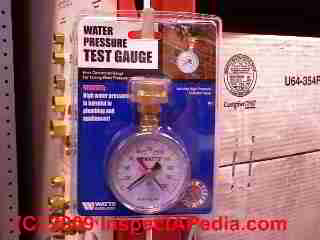
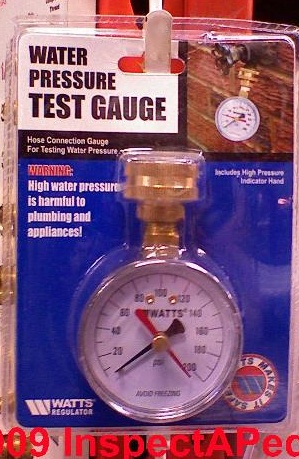
To accurately determine the water pressure in a building using a simple water pressure test gauge,
see WATER FLOW RATE MEASUREMENT.
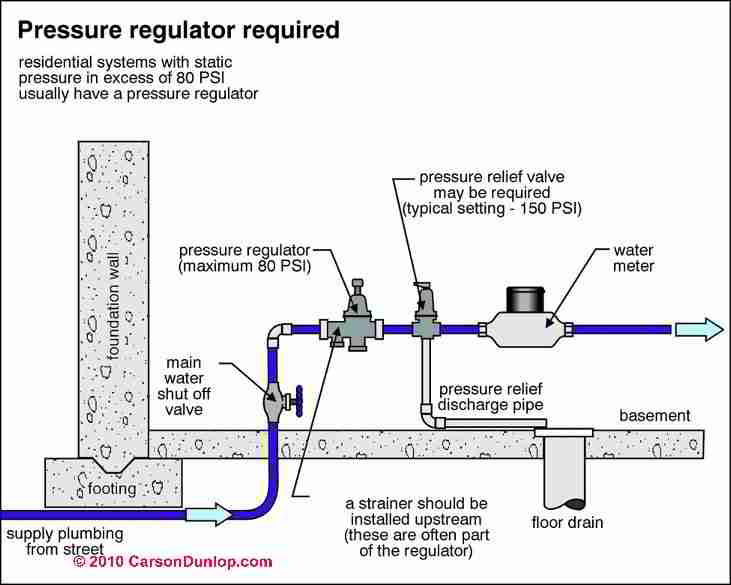
Our sketch above, courtesy of Carson Dunlop Associates, shows the key components found where a municipal water supply enters a building.
If the building water pressure is too high, here are some problems that you may encounter
- Banging or noisy water pipes when turning on or off water at a faucet
- Spitting from the water faucet aerator when water is turned on
- Short water heater life
- Leaking faucets
- Running toilets
- Reduced washing machine or dishwasher life due to leaks
- Septic drainfield flooding and failure if your building is connected to a private septic system
- Increased sewer bill costs in communities who base their sewer charges on water usage metering.
- Increased hot water heating costs: if water pressure is unnecessarily high, the increased volume and rate of cold water flowing through a home water heater increases the operating cost of that appliance.
- Wasted water - running water at higher-than-needed pressure and flow wastes water in daily fixture use. Watts estimates that twice as much water flows through a plumbing system at 150 psi as flows at 50 psi and that "... much of this additional water is wasted."
- Water heater tank explosions - see our warning notes below.
- Wire Draw Leaks at Pressure Reducers are caused by excessive municipal water pressure, leading to relief valve spillage, relief valve clogging,
possible BLEVE EXPLOSIONS or boiling liquid vapor explosion.
Or less dramatic, building leaks that cause flooding can also lead to costly mold contamination.
Watch out: although normal municipal water pressure is under 70 psi, when the building's pressure reducing valve is set too high even if a water heater is protected by a thermal expansion bypass valve, that safety device may become ineffective due to the high inlet water pressure.
This combination of circumstances can produce high inlet water pressure at a water heater tank that combines with thermal expansion pressure to create unsafe water pressures in the system.
If we add to this list of water heater overpressure risks the chance that an upper-limit temperature control is damaged or tampered-with, severe overheating at a water heater tank and even a BLEVE explosion can can occur.
Watch out: BLEVE EXPLOSIONS or boiling liquid vapor explosions can occur at both domestic water heaters (calorifiers or geysers) and at hot water heating boilers (hydronic heating systems).
We discuss the role of pressure/temperature relief valves in protecting against these hazards
at RELIEF VALVE, TP VALVE, BOILER
As we further explain
at RELIEF VALVE, WATER HEATER, in some locations where hard water is found, an expansion control valve is also used to drain excess hot water tank pressure.
If the building water pressure gauge reading is ever found at 80 psi or higher, you will want to install a water pressure regulator at the point where water supply enters the building. Watts produces a Watts Governor 80™ used for this purpose, but other manufacturers also produce a wide variety of water pressure regulators.
If your building already has a water pressure gauge installed, it may be defective or it may be set too high.
At HOT WATER PRESSURE EXPANSION RATE we discuss how we measure water pressure and how temperature changes affect water pressure in a closed water heater tank or heating boiler.
And as we discuss
at WATER PRESSURE REDUCER / REGULATOR, too-high incoming water pressure at a building can cause both dangerous conditions (bursting water tanks, heaters, boilers, piping, lime-clogged relief valves), and costly building flooding and mold contamination.
That article also describes solutions to high incoming water pressure.
Watch out: If the building water pressure gauge reading is ever found at 80 psi or higher, you will want to install a water pressure regulator at the point where water supply enters the building.
Watts produces a Watts Governor 80™ used for this purpose, but other manufacturers also produce a wide variety of water pressure regulators. If your building already has a water pressure gauge installed, it may be defective or it may be set too high
If your static water pressure is too high on a municipal supply, you should adjust the water pressure regulator.
A link to that procedure is given below at MORE READING
The articles listed just below discuss how water pressure reducers / pressure regulators work and how to adjust a water pressure regulator:
Watch out: If your well water pressure is too high, the system may be unsafe.
What is Pressure Reducing Valve Wire Draw and Why is it a Problem?
"Wire draw" problems occur in a diaphragm-type (residential) pressure reducing valve at low or intermittent water flow rates that happen to be close to the shut-off or "close" point of the pressure reducer, the valve mechanism becomes unstable and begins to "hunt" for the proper valve seat position.
You'll notice wire draw on a pressure reducer valve if you hear chattering or noise caused by this rapid cycling, almost vibration, at the valve seat at low water flow conditions.
The underlying cause of wire draw problems on pressure reducing or pressure regulating valves occurs because the valve, probably the wrong model for where it is being used, is forced to operate for long periods at low flow rates very close to the "close" position of the pressure regulating valve.
Water flowing over the valve seat through this nearly-closed very small opening can wear a groove or depression in the seat.
As a result, water may flow through that little opening even when the valve has closed. The continued flow of water through this worn groove or depression continues to form and enlarge this "wire-shaped" slot in the pressure reducing valve seat.
Mysterious Temporary Over-Pressure Water Pressure in Buildings: BLEVE explosions, Building Floods
What happens when a pressure reducing valve is suffering from wire draw? When no plumbing fixtures are being operated in the building for a period of time, water pressure will slowly increase above the intended or regulated pressure. The result, if we're lucky, is a mysterious leakage from pressure relief valves such as found on water heaters or boilers in the building. In the worst case, an overpressure condition at a water heater or boiler might damage the equipment or even render it unsafe.
Watch out: For example, chronic leaks out of a pressure/temperature relief valve, combined with a water supply high in mineral content, can lead to eventual pressure-temperature valve clogging and failure to operate in an emergency overpressure or overheating condition, resulting in
a BLEVE EXPLOSION or boiling liquid vapor explosion - as we've warned previously.
Or less dramatic, building leaks that cause flooding can also lead to costly mold contamination.
Watts Regulator CO. discusses the wire draw problem in their literature on water pressure reducing valves.
Watts points out that selecting a pressure reducer control that is properly-sized for the building and the incoming water pressure will avoid wire-draw and the potentially catastrophic failures to which wire draw can lead.
A smaller pressure reducer valve or a pressure reducer with a stainless steel valve seat to resist corrosion is likely to be better in this case.
Watts informs us that:
In general, the minimum flow through a water pressure reducing valve should be 10% to 15% of the maximum flow rate desired in the system.
Also, water pressure reducing valves should be selected based on the flow and pressure ranges listed in the literature, not the size of the pipe to which they will be attached.
You should select a regulator whose operating pressures fall within the middle of its rated range.
WATER PRESSURE REGULATOR ADJUSTMENT explains how to adjust this device.
...
Reader Comments, Questions & Answers About The Article Above
Below you will find questions and answers previously posted on this page at its page bottom reader comment box.
Reader Q&A - also see RECOMMENDED ARTICLES & FAQs
On 2019-08-10 by Phil - loud rumbling sound when I turned cold water on
Hi, you helped me a couple of years ago, diagnosing my wonderful 90 year old National Furnace. (I miss it.)
Tonight I took a shower and was surprised that the water was pretty hot when I turned on the faucet, When I turned it to cold, there was a LOUD rumbling sound. (It sounded like an airplane.)
This is the very first time I heard that. My daughter had been visiting and took a shower and she always puts the water flow at heavy force. Any thoughts?
Thank you!
On 2019-08-20 - by (mod) -
Phil
Perhaps the change in water velocity through pipes was causing a water hammer noise.
See WATER HAMMER NOISE DIAGNOSE & CURE https://inspectapedia.com/plumbing/Water_Hammer_Noise.php
Reader Question:
(June 24, 2011) Anonymous said:
Is there a maximum pressure that cities can deliver water to a home?
Reply:
(July 8, 2011) (mod) said:
There are recommended water pressure upper limits for within buildings, lest we have leaky faucets or worse. But municipal water pressure is permitted to be and in fact actually may be much higher in some areas. That's why we install a water pressure regulator at the point of water service entry into the building. The pressure regulator can protect the building from excessive municipal water main water pressures.Pressures over about 70 psi invite leaks.
Question: high pressure and "leaky hot water tank" - leaky hot water cylinder
(Sept 2, 2012) Carla said:
My hot water heater is leaking and the pressure valve is acting erratic, the needle is moving really fast sometimes and right now the needle is at 160. What should I do?
Reply:
Carla
Watch out: you are describing a dangerous condition risking a very serious, even fatal explosion of your water heater tank.
Shut the system off and ask for help from a licensed plumber.
...
Continue reading at WATER PRESSURE MEASUREMENT or select a topic from the closely-related articles below, or see the complete ARTICLE INDEX.
Or see WATER PRESSURE TOO HIGH, FAQs - questions & answers about very high water pressure, posted originally at this page.
Or see these
Water Pressure Diagnosis & Improvement Articles
- WATER PRESSURE BOOSTER PUMP
- WATER PRESSURE GAUGE
- WATER PRESSURE MEASUREMENT
- WATER PRESSURE REDUCER / REGULATOR - home
- WATER PRESSURE REGULATOR ADJUSTMENT
- WATER PRESSURE REGULATOR BAD
- WATER PRESSURE TOO HIGH: DANGERS
- WATER PRESSURE TOO LOW
- WATER PRESSURE VARIATION CAUSES
- WATER PUMP CONTROLS & SWITCHES
- WATER PRESSURE CONTROL SWITCH ADJUSTMENTS
- WATER TANK SAFETY
Suggested citation for this web page
WATER PRESSURE TOO HIGH: DANGERS at InspectApedia.com - online encyclopedia of building & environmental inspection, testing, diagnosis, repair, & problem prevention advice.
Or see this
INDEX to RELATED ARTICLES: ARTICLE INDEX to WATER SUPPLY, PUMPS TANKS WELLS
Or use the SEARCH BOX found below to Ask a Question or Search InspectApedia
...
Ask a Question or Search InspectApedia
Try the search box just below, or if you prefer, post a question or comment in the Comments box below and we will respond promptly.
Search the InspectApedia website
Note: appearance of your Comment below may be delayed: if your comment contains an image, photograph, web link, or text that looks to the software as if it might be a web link, your posting will appear after it has been approved by a moderator. Apologies for the delay.
Only one image can be added per comment but you can post as many comments, and therefore images, as you like.
You will not receive a notification when a response to your question has been posted.
Please bookmark this page to make it easy for you to check back for our response.
Our Comment Box is provided by Countable Web Productions countable.ca
Citations & References
In addition to any citations in the article above, a full list is available on request.
- Watts, 815 Chestnut Street, North Andover, MA, USA 01845-6098, web search 09/18/2010 Watts Regulator Corporation, 815 Chestnut Street, North Andover, MA, USA 01845-6098, provides pressure and temperature relief valves, water pressure test gauges, water pressure regulators, backflow preventers, check valves, and other plumbing and heating controls and supplies. Website: http://www.watts.com/
- Watts Backflow preventers - 978-688-1811
- Watts Control valves - 713-943-0688 for example Watts pressure reducing valves, original source: http://www.watts.com/pages/learnAbout/reducingValves.asp?catId=64
- Watts Drainage products - 828-288-2179
- Watts Potable water PEX plumbing - 978-688-1811
- Watts Water safety controls - 978-688-1811
- Watts Water quality & conditioning products - 352-465-2000
- Engineering toolbox properties of water - http://www.engineeringtoolbox.com/water-thermal-properties-d_162.html editor.engineeringtoolbox@gmail.com web search 09/16/2010
- SI Metric.co.uk provides tables and constants for the properties of water - web search 09/16/2010 original source: http://www.simetric.co.uk/si_water.htm
- Wikipedia on the Density of water at 1 atmosphere, web search 09/16/2010, original source: http://en.wikipedia.org/wiki/Density
-
Flexcon, SMART TANK INSTALLATION INSTRUCTIONS [PDF], Flexcon Industries, 300 Pond St., Randolph MA 02368, www.flexconind.com, Tel: 800-527-0030 - web search 07/24/2010, original source: http://www.flexconind.com/pdf/st_install.pdf
- Grove Electric, Typical Shallow Well One Line Jet Pump Installation [PDF], Grove Electric, G&G Electric & Plumbing, 1900 NE 78th St., Suite 101, Vancouver WA 98665 www.grovelectric.com - web search -7/15/2010 original source: http://www.groverelectric.com/howto/38_Typical%20Jet%20Pump%20Installation.pdf
- Grove Electric, Typical Deep Well Two Line Jet Pump Installation [PDF], Grove Electric, G&G Electric & Plumbing, 1900 NE 78th St., Suite 101, Vancouver WA 98665 www.grovelectric.com - web search -7/15/2010 original source: http://www.groverelectric.com/howto/38_Typical%20Jet%20Pump%20Installation.pdf
- In addition to citations & references found in this article, see the research citations given at the end of the related articles found at our suggested
CONTINUE READING or RECOMMENDED ARTICLES.
- Carson, Dunlop & Associates Ltd., 120 Carlton Street Suite 407, Toronto ON M5A 4K2. Tel: (416) 964-9415 1-800-268-7070 Email: info@carsondunlop.com. Alan Carson is a past president of ASHI, the American Society of Home Inspectors.
Thanks to Alan Carson and Bob Dunlop, for permission for InspectAPedia to use text excerpts from The HOME REFERENCE BOOK - the Encyclopedia of Homes and to use illustrations from The ILLUSTRATED HOME .
Carson Dunlop Associates provides extensive home inspection education and report writing material. In gratitude we provide links to tsome Carson Dunlop Associates products and services.
 | HOME | ABOUT | ASK a QUESTION | CONTACT | CONTENT USE POLICY | DESCRIPTION | POLICIES | PRIVACY | |
| © 2024 - 1985 Publisher InspectApedia.com - Daniel Friedman | |||||||||