
InspectAPedia® FREE Encyclopedia of Building & Environmental Construction, Diagnosis, Maintenance & Repair |
Question? Just ask us! InspectAPedia
|
 Diagnose & Repair Water Pump Pressure Control Switch
Pumptrol® & similar pressure control switch repair procedures & kits
- POST a QUESTION or COMMENT about diagnosing, repairing, or replacing a well pump pressure control switch
Pumptrol and similar water pressure control switch repair procedures.
Water pressure control switch repair: Pumptrol switch repair & repair kits.
This article describes how a water pump pressure control switch works and how to diagnose problems with the building water supply that seem to be traced to the pump control, switch, or to other underlying issues with a water pump, well, piping or other controls. We describe the diagnostic steps to take if a water pump won't turn on, won't turn off, or a switch that is burned, corroded or damaged.
We discuss: How to Repair a Water Pressure Control Switch that Sticks "ON" or "OFF" or is irregular.
How to Find & Adjust the Water Pump Pressure Control Switch, what the pump pressure switch looks like, where is it located on the water system?
Pumptrol 20-40, 30-50, or 40-60 pressure switch operation. What are the controls, switches, valves found on water tanks and water pumps, what do they do, how are they repaired?
Well pump & water tank diagnosis & repair procedures.
This article series describes how to repair a water pressure control switch that sticks on, off, or chatters or is otherwise not working properly, causing loss of water pressure or irregular in cycling on and off. We discuss how to diagnose problems with the water pump control and how to fix them by correcting an underlying problem, by replacing a bad pressure control switch, or by replacing switch parts such as bad contacts or diaphragm.
InspectAPedia tolerates no conflicts of interest. We have no relationship with advertisers, products, or services discussed at this website.
Water Pump Pressure Control Switch Repair Procedures
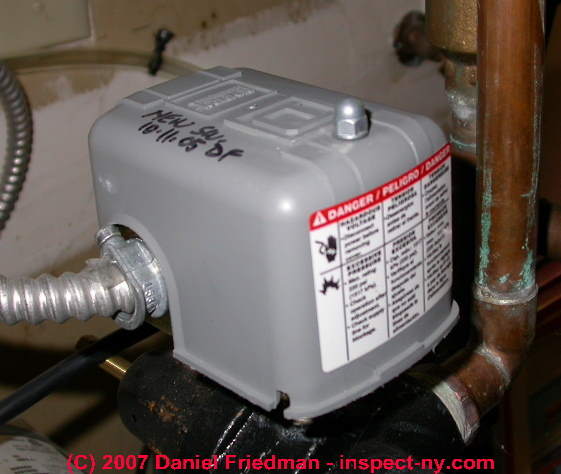
This article explains inspecting, cleaning, and possibly repairing a typical Water Pump Pressure Control Switch, normally found mounted on piping at the water pressure tank such as in this example [image] where you see a small gray-covered box with electrical wires coming in (power) and out (to pump) of it.
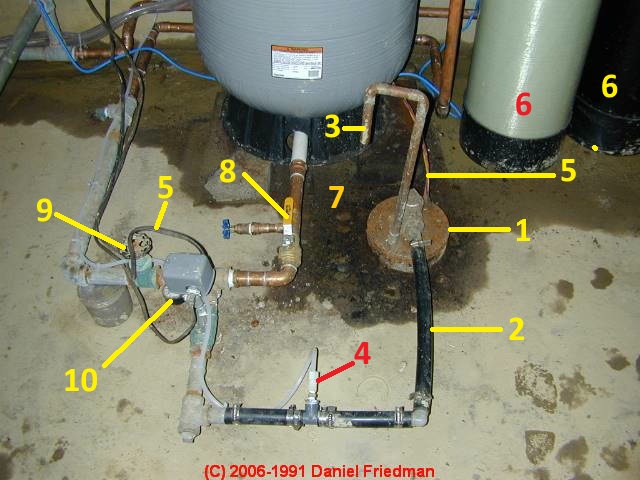
We describe troubleshooting several problems that can cause the control switch to fail to turn the pump ON when it should or that can cause the control to fail to turn the pump OFF when it should.
[Click to enlarge any image]
Following the procedure to test the operation of a pump control switch just below we provide links to individual diagnostic & repair articles that address particular pump operating problems such as a pump that won't turn on or won't turn off or that runs continuously.
How to Check a Well Pump Pressure Control Switch for Normal Operation
If the water supply is high in sediment often sediment will clog the pressure sensing opening at the bottom of the pressure control. We've tried cleaning out this orifice but it's never proven to be a lasting repair. If your pump pressure switch stops responding to changes in water pressure it probably needs to be replaced.
How to Diagnose and Repair a Water Pump Pressure Control Switch that Sticks "on" or "off" or is misbehaving
If we’ve traced a pump control problem to the water tank or water pump pressure switch itself with some certainty, we will often just replace the switch. But beware, we once replaced a pump control switch when the problem was a clogged filter which was causing the pump to cycle on and off erratically. We felt pretty stupid.
How to Diagnose a Malfunctioning Water Pump Control Switch
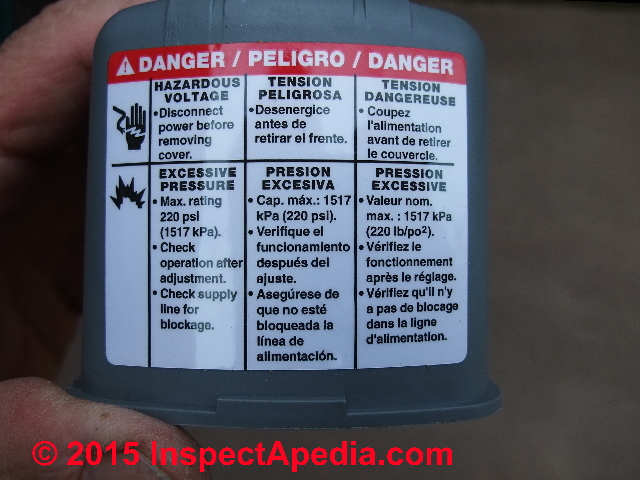 We’ll need to do some water pump switch diagnosis – here are a few ideas that may help getting a recalcitrant pump control switch working again.
Watch Out: Safety warning - Shock Hazards: To remove a pump control/pressure switch remember to turn off electrical power, and using a neon tester or VOM double check to make SURE that electrical power is off, and taped-off so that on one turns it on and causes you to get shocked.
Working around electricity and plumbing is particularly dangerous because of the increased chance of touching a live electrical wire while touching grounded plumbing piping. Turn off power.
See WATER PUMP ELECTRICAL SWITCHES.
A pump or water tank pressure control switch is designed and adjusted to turn the pump on at a "cut in" pressure, usually 20 psi or 30 psi, and to turn the water pump off at a "cut out" pressure, usually 40 psi or 50 psi.
When you buy this control it is usually set at the proper cut-in and cut-out pressures - check the box.
If your pump control is properly adjusted then it should be turning the pump on and off nicely at the pre-set pressures.
If the switch is behaving erratically or not coming on or not shutting off at all, there could be various explanations, some of which have nothing to do with the switch itself.
See WATER PRESSURE CONTROL SWITCH ADJUSTMENTS
These other problems are discussed
at WATER PRESSURE LOSS DIAGNOSIS & REPAIR
and WATER TANK REPAIRS.
Alternatively you may want to see one of these water pressure or pump diagnostic procedures:
1. The water PUMP WON'T TURN OFF when it should - the pump just keeps running.
If water pressure is at or above the pressure switch CUT-OUT pressure and the pump won't turn OFF there could be several causes and fixes that we will describe.
Watch out: this is a dangerous condition. If the pump brings water pressure well above normal building water pressure levels, say over 70 psi, there is risk of a burst pipe or burst water tank that can cause a flood or injure someone. Turn off the pump.
See WATER PUMP WONT STOP RUNNING - there we list all of the things that can cause a pump to run continuously.
2. The water PUMP WON'T TURN ON when it should.
If water pressure falls below the pressure switch CUT-IN pressure and the pump won't turn ON there could be several causes and fixes that we will describe.
See WATER PUMP WON'T START - where we list all of the things that prevent a pump from turning on.
Some water pump control problems can cause both pump-start and pump-stop problems, as you'll see in the following
3. The water pump runs but there is WEAK WATER PRESSURE
See PUMP RUNS, WEAK or NO WATER PRESSURE for a diagnostic table
4. The water pump runs but there is NO WATER PRESSURE
See NO WATER PRESSURE for a diagnostic table
5. The water pump runs but the PUMP CYCLES ON & OFF RAPIDLY or INTERMITTENTLY
See WATER PUMP SHORT CYCLING for diagnosing a pump that turns on and off too rapidly
See WATER PUMP INTERMITTENT CYCLING for diagnosing a pump that runs at odd times and for no apparent reason
The pump pressure control switch, by being connected
to the actual water piping in the building, senses the water pressure and when necessary, turns the water pump on.
The water pump pressure control switch either turns on the water pump directly, or (particularly when a submersible water pump is in use), this switch may operate a physically separate (usually wall-mounted) heavier-duty pump relay which turns on the water pump itself.
See WATER PUMP RELAY SWITCH for more details of that control.
If the Water Pump Is Not Turning OFF
Watch out: If your well pump won't stop running, you should probably turn power to the pump off to avoid burning up the pump motor.
If the water pump will not turn OFF,
see WATER PUMP WONT STOP RUNNING for detailed diagnostic and repair procedures.
Water Pump Won't Start - If the Water Pump is Not Turning ON Try These Steps:
If your well pump won't start, see the diagnostic and repair advice
Try the Pressure Control Switch Re-Set or Manual or Bypass Lever - if your pressure switch has one
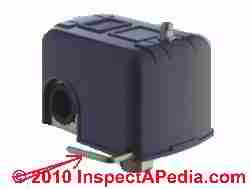
See details at CHECK RESET SWITCH / BYPASS LEVER (not present on all controls)
Check the pump pressure control switch for pressure sensor clogging or failed diaphragm
See these two procedures
Check & Clean the Well Pump Switch Contacts
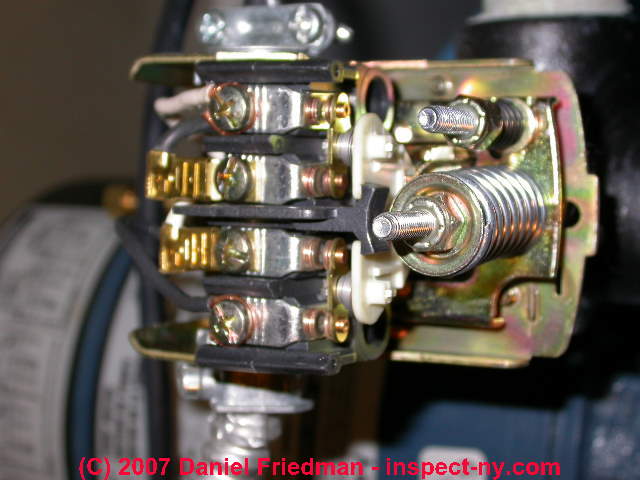
If the pump pressure control switch contacts are burned we can sometimes get it working again for a while by first, turning off electrical power as we described above, and then using a file, carefully cleaning all touching-surfaces the switch contacts.
Details are at CHECK PRESSURE SWITCH RELAY CONTACTS
If after inspecting the pump pressure control switch or its mounting fittings you decide that you've repaired it or that you need to replace it, follow the instructions
at PUMP PRESSURE CONTROL REPLACE for reinstalling the control.
Watch out: do NOT try working on a pump control switch without first removing electrical power - you could be killed by electrical shock.
Replacement Parts & Repair Kits for Pumptrol® and Similar Water Pump Control Switches
This topic has moved to PRESSURE SWITCH REPAIR KIT - separate article
Guides & Manuals for Adjusting or Repairing the Water Pump Pressure Control Switch
This section has moved to WATER PUMP PRESSURE SWITCH MANUALS
Reader Comments, Questions & Answers About The Article Above
Below you will find questions and answers previously posted on this page at its page bottom reader comment box.
Reader Q&A - also see RECOMMENDED ARTICLES & FAQs
Below are some additional pump control repair questions and answers that you may find helpful.
Water Pressure Control Switch Burn-Ups
Question: water to air heat pump switch burned up
Sept 17, 2014) DPaul1701 said:
Have a water to air heat pump supplied by a 1hp jet pump. After inspection, the contacts on the pressure switch appeared burned.
Replaced the switch, however, upon replacement, the pump began cycling every few seconds while the AC unit was running.
Usually the pump runs continuously providing water to the system until the AC unit turns off. Afraid of burning up my pump if this continues. Possibly a bad bladder tank (it's a small one like that used in an irrigation system)?
Reply:
Indeed D Paul, if a water pump is short cycling that can burn up the switch contacts as well as damage the pump itself.
At the ARTICLE INDEX at the end of this article please see the article series WATER PUMP SHORT CYCLING where we explain how to diagnose and fix the trouble.
Your case might be a ruptured tank bladder or something else - as you'll read there.
On 2022-12-06 by InspectApedia (Editor) - lost contact part needs repair or replacement
@Musketears3Bdm,
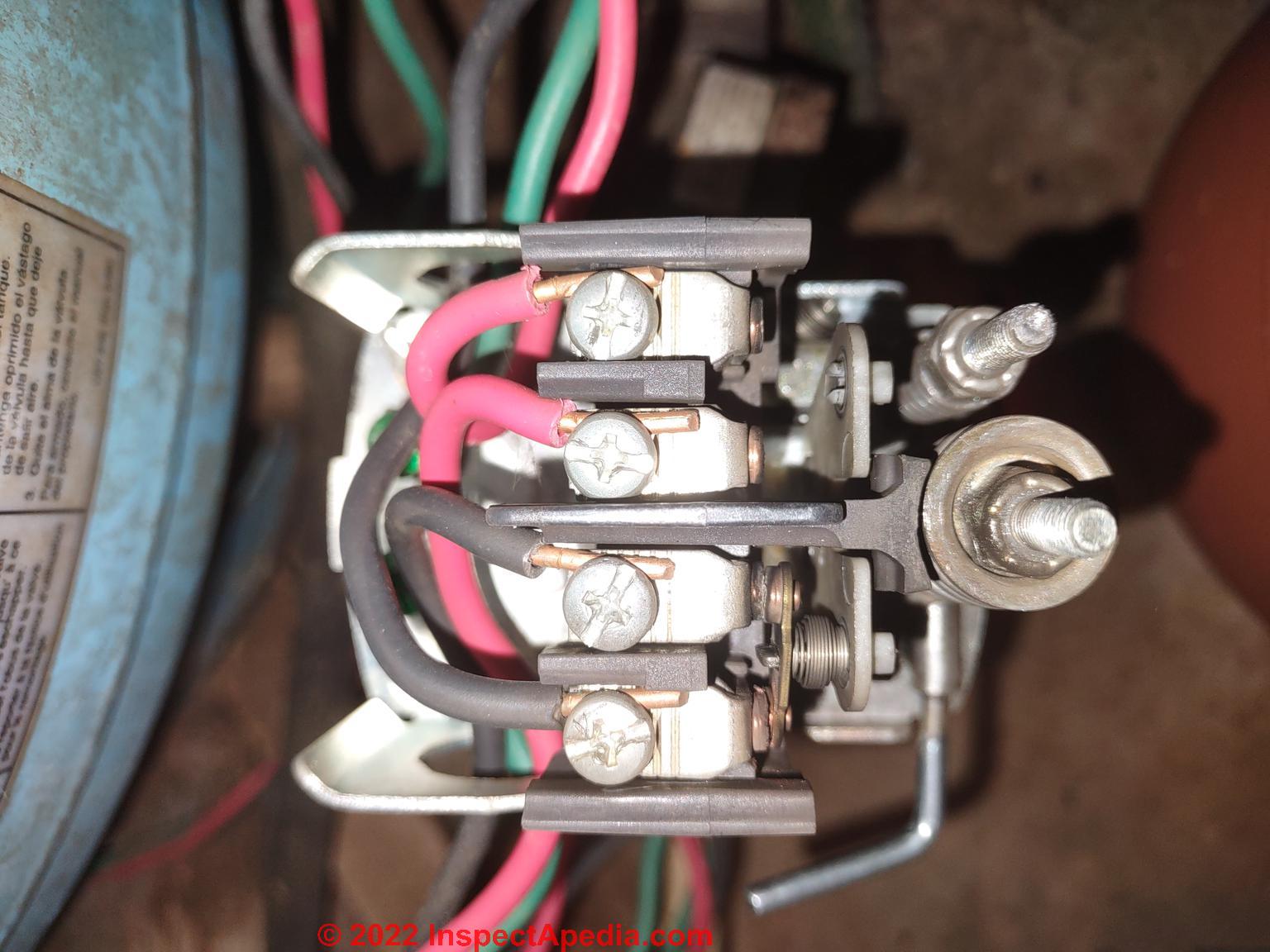
Looks like a contact part has been lost from the upper contact in your photo
I would not try to repair this switch, though there are re-build kits for water pump pressure controls. It's simpler and similar in cost to replace the switch.
See
WATER PUMP PRESSURE SWITCH INSTALL / REPLACE
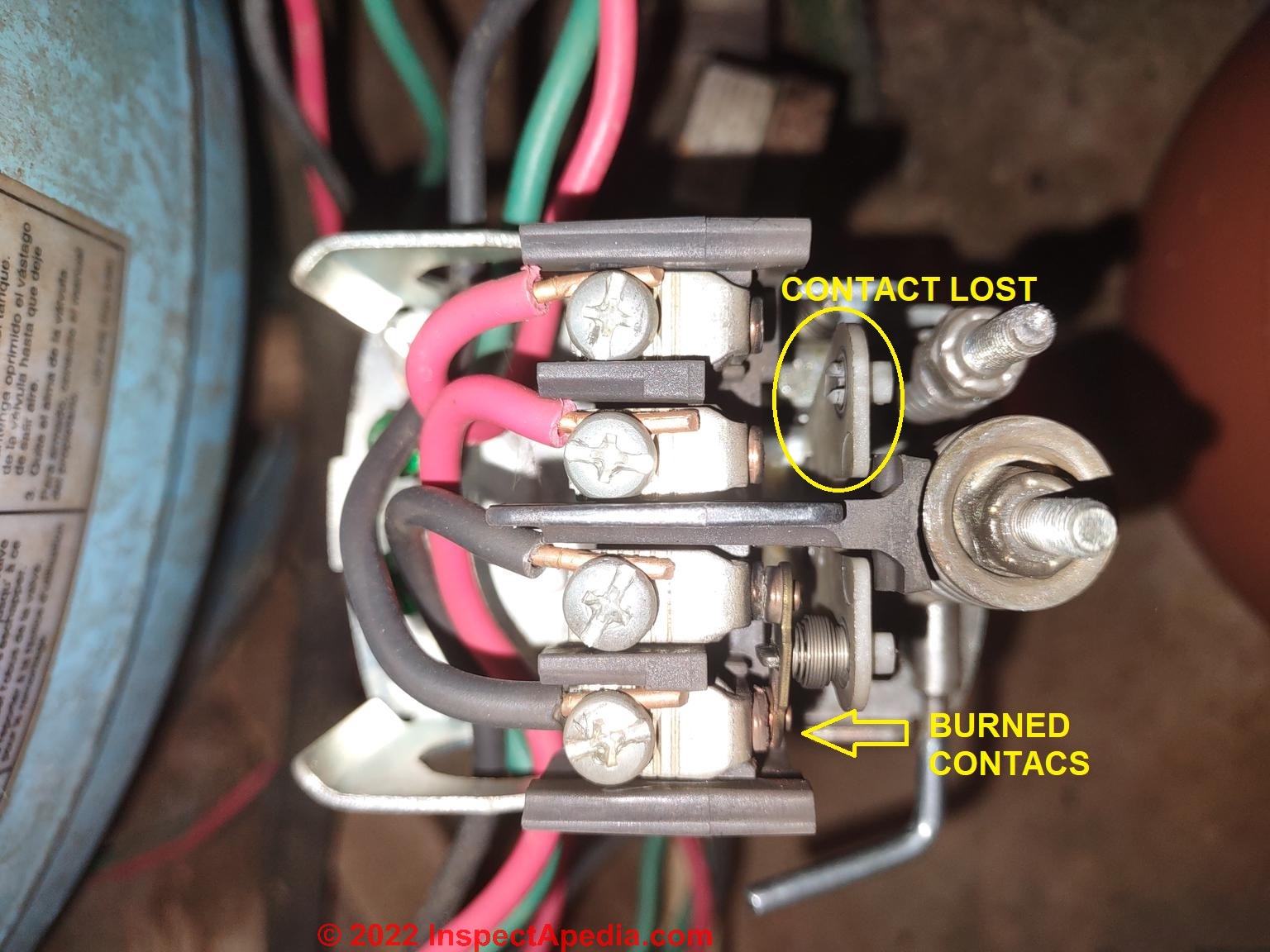
On 2022-12-06 by Musketears3Bdm
@InspectApedia (Editor), I'm trying to send a pic to you
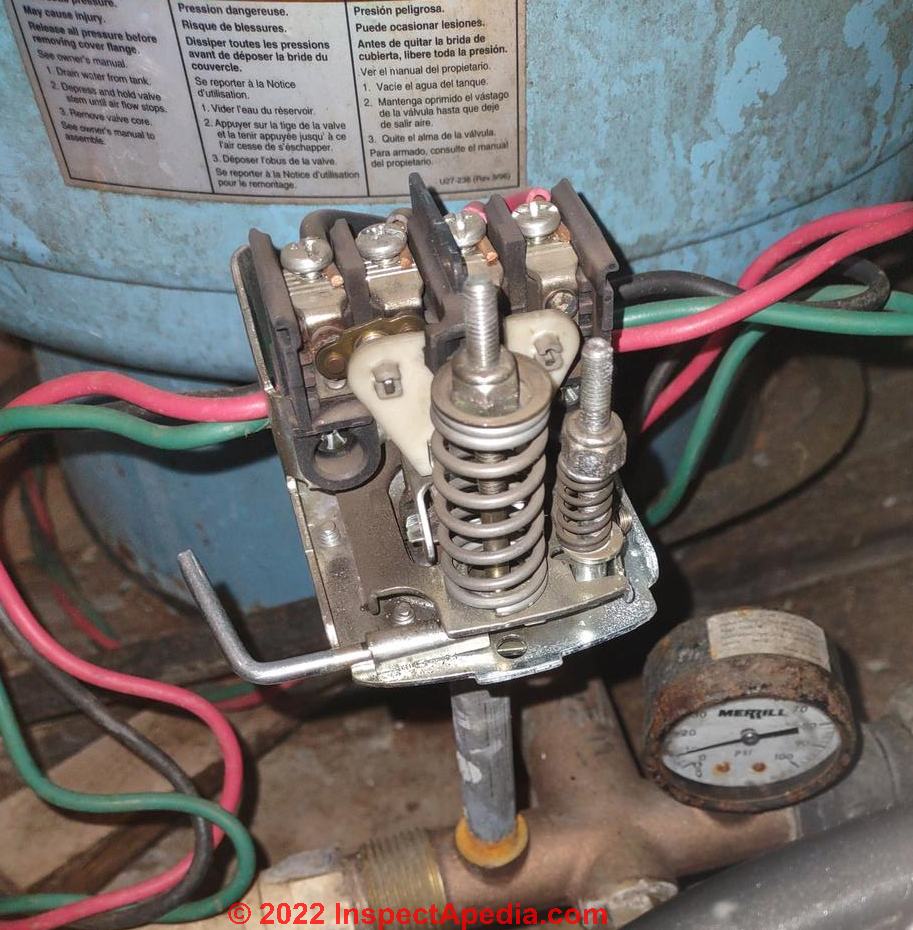 ...
... 
On 2022-12-06 by InspectApedia (Editor)
@Rachel,
I can but GUESS as I can't see your pump control switch: it sounds as if a contact relay tip has broken off - the switch then can't turn on the pump. You will need help from an electrician or experienced plumber who can replace the pump pressure control switch.
On 2022-12-06 by Rachel
Hi. My pump will not come on when I pull the metal lever up as it normally does. It has been cycling over and over again and then shutting off by itself every few days.
I've taken the box cover off and can see a spring and small piece of metal has broken off. I'm not sure how to fix it myself or who to call for help. Can you help me? Thank you.
On 2022-03-03 by Inspectapedia Com Moderator (mod) - photos of water pump pressure switches
@dennis jackson,
yes indeed.
Throughout this article series about pump pressure control switches, you will see photographs of switches and their various parts as well as their instructions.
On 2022-03-03 by dennis jackson
is thereany pictures of the water pump pressure switches
On 2021-11-12 by Inspectapedia Com Moderator (mod) - Why the sudden drop in pressure
@Bill,
If the pump is OFF when you're seeing that pressure drop I suspect the pressure switch isn't receiving the water pressure properly through its sensor tube. With a new tank and pressure switch that's odd but not impossible - e.g. if pipe dope or teflon tape blocked the switch sensor port.
If the pressure drops from 30 to 10 while the pump is running continuously AND if no water is being run in the building, that sounds like a failing pump motor or bad wiring.
On 2021-11-12 by Bill
i replaced my storeage tank and pressure switch. Set pressure at 30-50psi. Pump kicks in at 30 lbs but switch drop rapidly to about 10 lbs then immediately jumps back up to 30 and shuts off at 50 psi. Why the sudden drop in pressure before resumeing the normal pressure build up and shut off at 50 psi.
On 2021-05-04 by danjoefriedman (mod)
@Douglas Grooms,
Let's step through the NO WATER PRESSURE diagnosis found in the ARTICLE INDEX
On 2021-05-04 by Douglas Grooms
I have no water at all . 0 pressure at tank and pump doesn’t come on at all even with new pressure control switch. The well is around 13 years of age. Why is it collecting this and do you think my pump is ruined? How can I prevent this in the future?
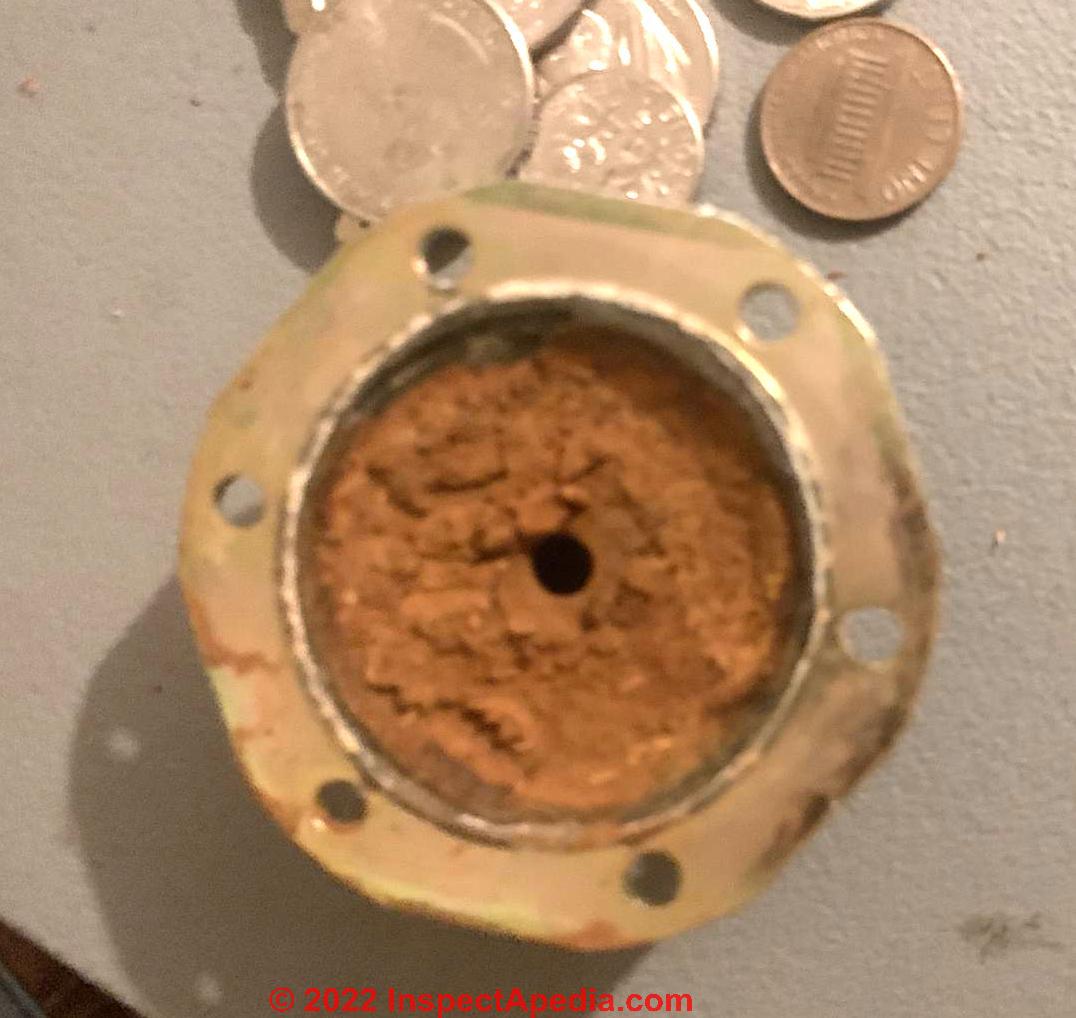
On 2020-10-30 - by (mod) -
Earl a CUT-IN/CUT-OUT switch that was factory set to 30/50psi can be re-adjusted down to a lower pressure range such as 20/40 psi
However if I understand you correctly it's your pump and well system that cannot reach a pressure of 60 psi, so your suggestion of setting to 40/60 won't fix the trouble you're having.
You need to set the switch to 20/40.
Check out the details given in
MAXIMUM PRESSURE SWITCH SETTINGS https://inspectapedia.com/water/Water_Pump_Switch_Maximum_Pressure.php
and
PRESSURE SWITCH NUT ADJUSTMENTS https://inspectapedia.com/water/Pressure_Switch_Nut_Adjust.php
On 2020-10-30 by Earl
Purchased a Water Pump Pressure Switch rated at 50/30. After installation, can it be set to 40/60 and work properly. Mine, while in operational demand never reaches 60 on the high end, until demand is shut off. Thanks
On 2020-08-24 by Anonymous
Who do I call to diagnose and fix a water pump pressure control switch problem? A plumber?
On 2020-08-03 by Harvey
It seemed our deep submersible pump was not shutting off. When I checked the pressure switch, with power off, the contacts were closed on the” white wire side” but only one, on the “ black side”. How will that affect operation.??
On 2020-07-07 - by (mod) -
Grady:
usually the pressure control switch is installed as close as feasible to the pressure tank (to assure proper response and operation of the pump and tank together) - follow the electrical wires.
On 2020-07-07 by Grady
I have a buried pressure tank and can't find the pressure switch
On 2020-05-03 - by (mod) -
Car
That sounds as if your project of filling a pool is exhausting the well and your pump switch has a built-in safety feature that shuts off the pump rather than let it run dry.
Beware that running the pump dry may damage it.
On 2020-05-03 by carusle
filling pool fawcett's Totally open pump shuts off. have to pull lever on switch to reprise pump??
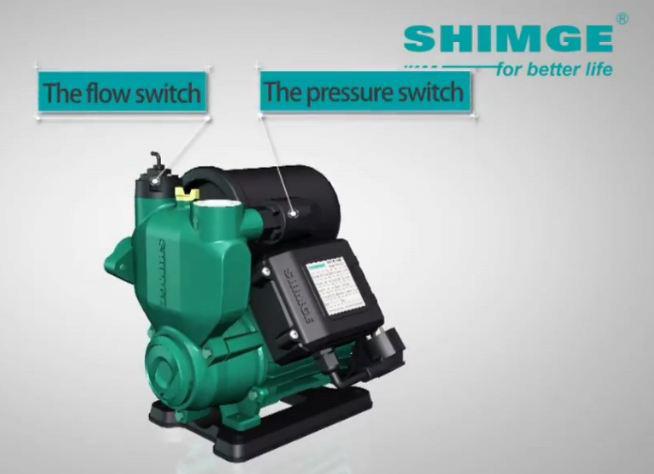 On 2020-02-02 - by (mod) -
Del
I can't recommend that; it'd be useful, however, to take a look at the installation manual for the specific model of your Shimge brand pump.
See this SHIMGE WATER PUMP MANUAL [PDF] Models: SQm、QB、WZB、AWZB、PW
- Shimge Pump Industry Group, Ltd. [a Chinese pump manufacturer] , ref. 2020/02/02 original source: https://www.cn-shimge.com/upload/179/20190215095807801299.pdf
On 2020-02-01 by delfinodi777
Can I install a separate in-line pressure control switch with my automatic pump with built-in pressure switch? Thanks.
On 2020-01-02 by (mod) - PUMP keeps running, 30-50 pressure switch ok, tank is not waterlogged
In the ARTICLE INDEX found on this page please review the Diagnostics giving out
WATER PUMP WONT STOP RUNNING - topic home
On 2020-01-01 by MARK
PUMP keeps running, 30-50 pressure switch seems ok, tank is not waterlogged, can build 0-30psi but will not go above 30psi, pump continues to run, cleaned venture on front of pump, no obstruction, pressure switch seems good no burns on contacts.
Will maintain water flow at 28psi but does not rwXH 30-50psi. Burks pump metal impeller, foiund pump running hot shut down but does pump water
On 2019-11-09 by (mod) - How do I stop my pump for hammering ?
Cecil please take a look at
WATER HAMMER ARRESTOR LOCATION & SIZE - fix banging noise when pump turns on or off
at https://inspectapedia.com/plumbing/Water-Hammer-Arrestor-Installation.php
and let me know if that solves your banging hammering noise problem
Also see WATER HAMMER NOISE DIAGNOSE & CURE
On 2019-11-09 by Cecil Tanner
How do I stop my pump for hammering ?
On 2019-06-23 by (mod) - any way to clean or fix the pressure switch?
Most pressure control switch manufacturers sell a repair kit that replaces the bottom diaphragm
You'd have to do some disassembly and cleaning of both the bottom of the switch and also the tube or pipe in this conducts water pressure to it. Beware that if you don't remember to turn power off you could be shocked or killed.
On 2019-06-23 by BiancaDee
Any way to clean it myself, or would a professional be better? Also, is it damaging the pump?
Does it need immediate attention, or can I wait a while? The pump is usually only needed one or two times a day. Thank you.
On 2019-06-21 by (mod) -
If pressure drops below the cut-in pressure then usually the switch is clogged/failed.
On 2019-06-21 by BiancaDee
Pump was new in 2016, and has been working great until some neighbors moved in (don't know if it is related or just coincidence).
At first it started dropping pressure (below 30) before the pump would start. Now pressure will drop to zero and stay that way for 1 to 2 minutes before the pump will come on. Then the pump sounds louder than normal. Should I call my pump repairman, or is there something I can do myself to remedy the situation?
I'm pretty handy around the house. Thank you. (P.S.) you helped me in 2016 when the irrigation man put the wrong size tank on my system.
I got a new pump and the right size tank [from a different well company] and the other guy's company sent me $$ back. All is good. Thank you for your advice.)
On 2019-04-02 1 by (mod) - New pump does not work
I want to help but don't quite understand the question. The contact switch in a pressure control switch ought to close (turn on the pump) when pressure falls below the CUT IN pressure setting - that will be typically 20 psi or 30 psi on a new control switch.
If the switch closes and the pump doesn't run use the ARTICLE INDEX to find our article on WATER PUMP WON'T START for ten things to check - to see diagnostic steps.
On 2019-03-17 by Joe
Contact made unwired
New pump does not work
New pump switch contact on unwired voltage applied
Switch still in contact does nothing
Bad switch?
On 2019-02-15 by (mod) - well pump pressure switch sticking.
Try clearing or replacing the pressure conducting tube
On 2019-02-15 by Tony
I bought a house in Maryland eastern shore. The well pump pressure switch was sticking. I replaced it with one from Home Depot and is still stick. What am I doing wrong?
Question: well pump tank makes a noise after tank begins to fill
(June 28, 2011) elmer said:
Is a good article but i still with my question because i did not find the answer . My well pump tank make a noise after the tank begins to fill again?..The pressure control works fine.
Reply:
It might be normal to hear a noise at the pressure tank when the pump is running, as water is flowing into the tank. If you hear air gurgling then there may be a leak in your well line causing the pump to also send air into the tank.
See
Question: pump control relay clicks clicks clicks at end of cycle
(July 19, 2011) carter said:
i have a question,,i have a new installed jet pump...6 months,,when i flush my toilet my pump will run for maybe 20/30 seconds,,,it runs fine,,but when its right at the end,,the pressure points will snap on and off right fast 3/4 times,,i adjusted the screw and it worked good for a day now its doing the same thing,,,,runs smooth until right the end,,,then click,,click,click,,
Reply:
Pump pressure control switch contact bouncing?
It sounds as if the contact switch points may be burned; take a look, or try replacing the switch. I am guessing in that direction because at the end of a pump cycle even if the pressure sensor of the switch is not working properly I wouldn't expect pressure sense to drop so far as to fall below the cut-in right at the END of the pump cycle.
Question: pressure drops to zero and pump stops unless manually re-set
(Aug 30, 2011) Janice said:
I have a question. We have a pressure control switch lever (as shown above) that we need to re-gauge if we run two faucets (or demand too much water) at one time. The pressure will drop to zero and we need to engage it in order to get the water working again. Any suggestions on what would be causing this? This also happens if we run the faucet in the tub or the washer. Thanks!
Reply:
Janice if your water pressure is dropping to zero, the problem sounds like more than just adjusting the pressure control switch. It sounds as if the well pump is not keeping up with the water flow rate demand in the building. Or your well itself cannot keep up.
Before trying to adjust the pressure control switch I'd check out the well flow rate itself.
Question: pressure drops below the pump cut-in set pressure before the pump comes on
(Sept 5, 2011) Jim said:
I've adjusted cut on and off pressures, etc. My problem is that when the pressure drops through the cut in point, the switch "tries" to trip. The contacts close briefly, pump just starts to turn, then everything stops and pressure falls. I can start it with the manual switch and it will run fine . Pressure tank is brand new, and adjusted to about two pounds below cut in pressure. Any ideas?
(Oct 18, 2011) Kerry said:
Pressure control switch isn’t turning on the pump - when using the manual cut in switch the pump isn’t turning on either, however, if you manually use a screwdriver and push the contacts down you can get the pump to engage. hold the contacts down and you can get the tank up to pressure, however as soon you run out of pressure you have to go down with your screwdrivers and get the pressure back up
Hmmmm whats going on?
Reply: check for a debris clogged pump pressure switch or sensor port or tubing
Jim,
I realize there could be another problem, such as with the pump itself, but I'd start by replacing the pressure switch. Also replace or clean out the switch mounting tube so we're sure it's properly sensing water pressure.
Kerry:
it's possible that the pressure sensing port on the bottom of your pressure control switch is clogged and not properly sensing water pressure. If the switch thinks that you are above the cut-off pressure it won't turn on the pump. Another possibility is that the switch contacts are burned.
I'd try replacing the switch and making sure the little tube on which it mounts is also unblocked by rust or debris.
Question: pump came on for just 10 seconds
(Oct 21, 2011) Andrew said:
I have a relatively new Gould. Today I noticed the pressure was not right then it finally had no pressure. While in the pump house I re-booted the power. The pump came on for about 10 seconds and then shut off again. Again, I said it is about 3 1/2 years old and all the contacts I looked at look like the day it was put in. What is the most likely problem ? Pressure control switch - capacitor etc... Thanks for your help
(Jan 12, 2012) warren said:
my pressure switch is tapping on/off on/off when i turn my tap on. what could be the cause?
Reply:
Andrew check the actual pressure in your system, then run water. Watch to see the pressure at which the pump cuts on. Then turn off water and watch to see the pressure at which the pump cuts off.
If the pump cuts off very quickly I suspect the water tank is water-logged - it's lost its air charge.
Warren,
(Feb 13, 2012) Rob said:
@Warren - two things come to mind that can cause that (as I just had the same problem). A bad pressure tank can cause your pump to kick in and out repeatedly while running water. The other potential problem is the setting on the pressure switch itself. If the in and out are too close it would cause this
If you haven't adjusted your pressure switch I would check the air pressure in your tank. If you press the valve down and get water, then you've most likely got a ruptured bladder in your tank.
Question: testing my pump switch I saw a spark, then everything went dead - how do I select a new pump switch
(Jan 11, 2012) Steve said:
Square D 9013FSG 2 pressure control switch. While testing with a VOM probe, I got a small spark and everything went from dead to working normally (I think...at least the water is back on). If I eventually need to replace this switch, are there several varieties of the 9013FSG 2? How do I know what version to get? The tank is a red AMTROL H20W-TO WATERWORKER 9015-585 in a residential installation.
Reply:
Steve, just match the new switch to the original one by
brand and model or part number
equivalent brand and model chosen by the factory pre-set cut-im and cut out pressure
Question: new pressure switch not working
(Jan 12, 2012) Archie said:
just repaced breaker, wire, pressure regulator switch on home well pump and still nothing works. I checked the gauge tube for clogs and it was clear, when I open the contact points, there is no spark, but there is power going to them, what am I missing
Reply:
Archie, you need to run water until pressure in the pressure tank drops below the cut-in pressure set in the control.
...
Continue reading at WATER PUMP PRESSURE SWITCH INSTALL / REPLACE or select a topic from the closely-related articles below, or see the complete ARTICLE INDEX.
Or see WATER PUMP PRESSURE SWITCH REPAIR FAQs - pump control switch diagnostic & repair questions & answers posted originally at the end of this article.
Or see these
Recommended Articles
- WATER PRESSURE REGULATOR ADJUSTMENT
- WATER PUMP INTERMITTENT CYCLING - pump turns on for no apparent reason
- WATER PRESSURE REGULATOR ADJUSTMENT - municipal water pressure control
- WATER PRESSURE CONTROL SWITCH ADJUSTMENTS - home for water pump pressure control switch
- WATER PUMP PRESSURE SWITCH DIFFERENTIAL NUT ADJUSTMENT
- WATER PUMP PRESSURE SWITCH RANGE NUT ADJUSTMENT
- WATER PUMP PRESSURE SWITCH SAFETY
- WATER PUMP PUMP PRESSURE SWITCH STANDARD (PSI) SETTINGS
- WATER PUMP PRESSURE SWITCH MAXIMUM PRESSURE SETTING
- WATER PUMP PRESSURE SWITCH SETTINGS TOO HIGH
- WATER PUMP PRESSURE SWITCH INSTALL / REPLACE
- WATER PUMP PRESSURE SWITCH INSTALLATION MANUALS
- WATER PUMP PRESSURE SWITCH HUMMING SOUND
- WATER PUMP PRESSURE SWITCH LEAKS
- WATER PUMP PRESSURE SWITCH LOCATION
- WATER PUMP PRESSURE SWITCH NOISES
- WATER PUMP PRESSURE SWITCH REPAIRS
- WATER PUMP PRESSURE SWITCH SAFETY
- WATER PUMP SHORT CYCLING - home
- WATER PRESSURE TABLE 1: PUMP WON'T RUN, WON'T STOP, or CYCLES
- WATER PRESSURE TABLE 2: PUMP RUNS, WEAK or NO WATER PRESSURE
- WATER PRESSURE TABLE 3: PUMP RUNS, NO WATER or INSUFFICIENT WATER
- WATER PUMP SHORT CYCLING - pump turns on and off to rapidly
- WATER PUMP WON'T START - no water pressure
- WATER PUMP WONT STOP RUNNING - pump just keeps running
- WATER TANK AIR PRESSURE ADJUSTMENT
Suggested citation for this web page
WATER PUMP PRESSURE SWITCH REPAIRS at InspectApedia.com - online encyclopedia of building & environmental inspection, testing, diagnosis, repair, & problem prevention advice.
Or see this
INDEX to RELATED ARTICLES: ARTICLE INDEX to WATER SUPPLY, PUMPS TANKS WELLS
Or use the SEARCH BOX found below to Ask a Question or Search InspectApedia
Ask a Question or Search InspectApedia
Try the search box just below, or if you prefer, post a question or comment in the Comments box below and we will respond promptly.
Search the InspectApedia website
Note: appearance of your Comment below may be delayed: if your comment contains an image, photograph, web link, or text that looks to the software as if it might be a web link, your posting will appear after it has been approved by a moderator. Apologies for the delay.
Only one image can be added per comment but you can post as many comments, and therefore images, as you like.
You will not receive a notification when a response to your question has been posted.
Please bookmark this page to make it easy for you to check back for our response.
Our Comment Box is provided by Countable Web Productions countable.ca
Citations & References
In addition to any citations in the article above, a full list is available on request.
- Thanks to reader Bob Hartman-Berrier for discussing the diagnosis of a pressure switch that would not turn the pump on, traced to a switch tubing fit problem. June 2010.
- Square D Company, Schneider Electric - North American Operating Division, 1415 S. Roselle Road, Palatine, IL 60067, Tel: 847-397-2600, Fax: 847-925-7500
- Square D Pressure Control Switch Catalog
- Square D 9013 series pressure control switches provide these special water pressure control switch features: narrow pressure differential controls, higher horsepower pump control switches, manual on/off switches, automatic low water pressure cut-off, pulsation plugs, and other features.
- Narrow Differential Pressure Switches Schneider Electric provides narrow differential switches including 6-20 PSIG differential switches. Choose from the 9013FSG42/49 or higher HP 9013FYG42/49. Also available is the 9013FRG with reverse action. The 9013FRG pressure switch is non-adjustable differential with 6-14 PSIG cut-in and 1-11 PSIG cut-out ranges.
- Higher HP Pressure Switches Need a larger HP motor for longer runs in deep wells? Then look to the 9013FYG or 9013GHG pressure switches. These switches directly control all types of pumps up to 5 HP and can be used in the control circuit of a magnetic starter for even larger pumps.
- Manual On/Off Switch The 9013 series of pressure switches offer an optional on/off switch. This allows you to manually turn on and off your pump system for extended periods of time.
- Automatic Low Pressure/Water Cut-off If system pressure is lost for any reason, a low water condition for example, the automatic lower pressure/water cutoff feature will open the contacts, turning off the pump.
- Pulsation Plug Pulsation plugs are available to control pressure due to increased start up pressure generated by high speed jet pump motors or by valves prone to a surge in pressure.
- Access Water Energy, PO Box 2061, Moorabbin, VIC 3189, Australia, Tel: 1300 797 758, email: sales@accesswater.com.au Website: http://www.accesswater.com.au/
Moorabbin Office: Kingston Trade Centre, 100 Cochranes Rd, Moorabbin, VIC 3189
Australian supplier of: Greywater systems, Solar power to grid packages, Edwards solar systems, Vulcan compact solar systems, water & solar system pumps & controls, and a wide rage of above ground & under ground water storage tanks: concrete, steel, plastic, modular, and bladder storage tanks. - Grove Electric, Typical Shallow Well One Line Jet Pump Installation [PDF], Grove Electric, G&G Electric & Plumbing, 1900 NE 78th St., Suite 101, Vancouver WA 98665 www.grovelectric.com - web search -7/15/2010 original source: http://www.groverelectric.com/howto/38_Typical%20Jet%20Pump%20Installation.pdf
- Grove Electric, Typical Deep Well Two Line Jet Pump Installation [PDF], Grove Electric, G&G Electric & Plumbing, 1900 NE 78th St., Suite 101, Vancouver WA 98665 www.grovelectric.com - web search -7/15/2010 original source: http://www.groverelectric.com/howto/38_Typical%20Jet%20Pump%20Installation.pdf
- Our recommended books about building & mechanical systems design, inspection, problem diagnosis, and repair, and about indoor environment and IAQ testing, diagnosis, and cleanup are at the InspectAPedia Bookstore. Also see our Book Reviews - InspectAPedia.
- When Technology Fails, Matthew Stein, Chelsea Green Publisher, 2008,493 pages. ISBN-10: 1933392452 ISBN-13: 978-1933392455, "... how to find and sterilize water in the face of utility failure, as well as practical information for dealing with water-quality issues even when the public tap water is still flowing". Mr. Stein's website is www.whentechfails.com/
- In addition to citations & references found in this article, see the research citations given at the end of the related articles found at our suggested
CONTINUE READING or RECOMMENDED ARTICLES.
- Carson, Dunlop & Associates Ltd., 120 Carlton Street Suite 407, Toronto ON M5A 4K2. Tel: (416) 964-9415 1-800-268-7070 Email: info@carsondunlop.com. Alan Carson is a past president of ASHI, the American Society of Home Inspectors.
Thanks to Alan Carson and Bob Dunlop, for permission for InspectAPedia to use text excerpts from The HOME REFERENCE BOOK - the Encyclopedia of Homes and to use illustrations from The ILLUSTRATED HOME .
Carson Dunlop Associates provides extensive home inspection education and report writing material. In gratitude we provide links to tsome Carson Dunlop Associates products and services.
 | HOME | ABOUT | ASK a QUESTION | CONTACT | CONTENT USE POLICY | DESCRIPTION | POLICIES | PRIVACY | |
| © 2024 - 1985 Publisher InspectApedia.com - Daniel Friedman | |||||||||