
InspectAPedia® FREE Encyclopedia of Building & Environmental Construction, Diagnosis, Maintenance & Repair |
Question? Just ask us! InspectAPedia
|
 Set Air Pressure in Water Pressure Tank
Bladder type pressure tank air pressure adjustment
- POST a QUESTION or COMMENT about setting the air precharge pressure in internal-bladder type water pressure tanks
Water pressure tank air pressure adjustment:
How to check & then adjust or set the air pressure in a water tank using an internal bladder:
This article describes how to determine the proper air pressure setting in a bladder-type well tank, when, and how to actually change the air pressure in the water tank.
We explain how to determine the proper air charge for water pressure tank and how to adjust the actual tank air pressure to that number.
We detail how to fine tune the water pressure tank air charge to match the pump pressure control switch settings.
The page top photo shows the author testing the air pressure in a Well-X-Trol bladder type well tank.
InspectAPedia tolerates no conflicts of interest. We have no relationship with advertisers, products, or services discussed at this website.
How to Select the Proper Air Pressure Charge for a Bladder-Type Well Tank
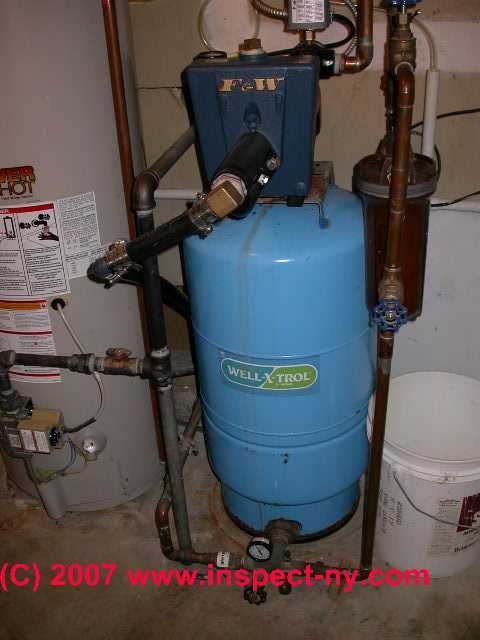 Please permit a safety warning before we get into the specifics of how to set the pressure in your water pressure tank.
Watch out: for very high water pressure readings in your system. If the water pressure is over 70 or 80 psi your system there can be a risk of burst water piping or a burst water pressure tank.
Such an event can both flood the building and can injure anyone nearby. Check the maximum water pressure you're using against the maximum water pressure rating for the pressure tank itself.
That's why your water supply system should have a
WATER TANK PRESSURE RELIEF VALVE (separate article).
[Click to enlarge any image]
Factory air pressure settings in the water pressure bladder tank
According to Well-X-Trol bladder type well tank air precharge: typical factory set air pressure on a bladder-type residential well water tank is 18 psi.
Some models may come with different pressure settings however.
WELL-X-TROL™ water pressure tanks are shipped from the factory with a standard precharge of
- 18 psig for models WX-101 and WX-102
- 30 psig for models WX-103 - WX-203
- 38 psig for models WX-205 through WX-350.
Before discussing doing anything to a bladder-type water pressure tank, read this safety warning from WELL-X-TROL, a leading well tank manufacturer:
DANGER! [Water Pressure Tank] EXPLOSION HAZARD
Factory warnings about changing the bladder tank pressure setting
When the Well-X-Trol has been in service and a change to a higher pre-charge pressure is necessary due to a required change in the pressure switch setting, failure to follow instructions below can cause a rupture or explosion, possibly causing serious or fatal personal injury, and/or property damage.
- Do not adjust or add pressure if there has been a loss of air.
- Do not adjust the pre-charge pressure if there is visible exterior corrosion.
- Do not adjust the pre-charge pressure if there has been a reduction of the pump cycle time or the pre-charge pressure compared to its initial setting.
This is because reduction in pump cycle time can result from loss of tank air pressure which in turn can mean there may be internal corrosion and any repressurization or additional pressure could result in rupture or explosion.
How to Read Water Tank Pressure or any Pressure Gauge Accurately
If you are fine-tuning water tank bladder or air pressure be sure that you are using an accurate pressure gauge and that you know how to obtain an accurate pressure reading.
Watch out: Can you trust the installed water pressure gauge?
A separate round dial-type water pressure gauge is found on many water pump systems, at the pressure tank or near it, often on the pump itself. Sometimes these gauges lie: they get stuck or get debris clogged so they can give improper readings.
If that pressure gauge needle doesn't move when the water is being run or when the pump is coming on or off, it's not working properly.
Throughout this article series you'll see us using an independent pressure gauge to check water tank air pressure by pressing the gauge on the air valve that's usually located on the tank itself, near the tank top.
See WATER PRESSURE GAUGE ACCURACY for details.
Well Tank Air Pressure Setting at Time of Tank Installation
Set the well tank air pressure to 2 psi below the well pump control switch CUT-IN pressure.
We explain exactly how to do this just below.
Remember to use your separate air pressure (tire) gauge to check the actual water tank pressure when your well pump turns on and off - that's because the dial gauge installed on your water tank may be inaccurate.
Watch out: If the pressure tank's air pre-charge pressure is set above the pump pressure control switch CUT-IN pressure then the pressure control switch will never turn the pump on.
Well Tank Air Pressure Adjustment Procedure
If you need to tune your bladder-type water tank to work exactly properly with your pump pressure control switch, or if you know that someone has already modified the pressure in your water tank and you want to restore it to factory specifications, a reasonable procedure is the following recommended by the manufacturer:
- Remove all water from the water tank.
This means turn off the water pump, open a nearby plumbing fixture, run water until the water stops entirely - your water tank should be empty or close to empty.
See WATER TANK DRAIN VALVE for procedures to drain any type of water tank or water pressure tank.
- Check the air pressure in the water tank
by using an accurate air pressure gauge (such as a dial type or digital tire pressure gauge) to measure the air pressure at the schrader valve on the water tank.
The tank pressure should be within 10% of the original factory water tank pressure setting.
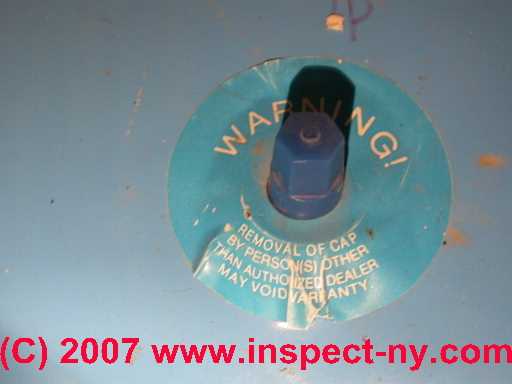
Our photo shows the water tank air inlet valve on the top of our Well-X-Trol well tank. We removed the cap and label for the photo.
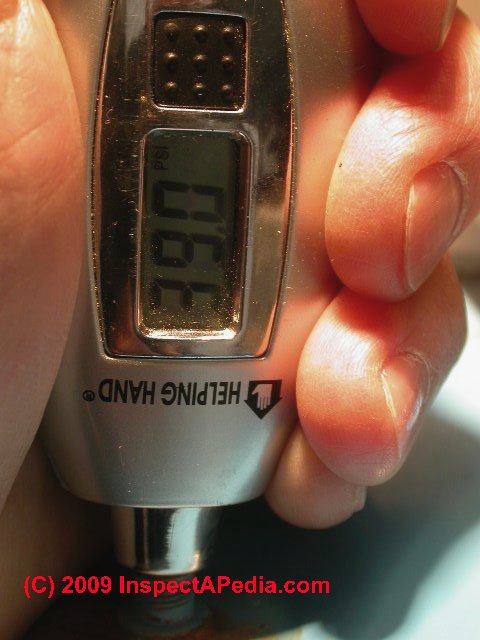
Our photo at above right shows our digital air pressure gauge measuring the air pressure in the water tank.
The reading of 39 psi tells us that the dial pressure gauge that we illustrated
at WATER PRESSURE GAUGE ACCURACY (and located on this same water system) agrees with our pressure gauge within 1/2 psi.
Because water tank pressure controls normally use a pressure difference of 20 psi between the cut-in pressure and cut-off pressure at the water tank, a gauge error of one or two psi is not a concern. Thanks to Jeff Garmel for suggesting text clarification in this discussion of water pressure tank diagnosis. - Set the air pressure in the empty water tank
to 2 psi below the well pump pressure switch cut-in pressure.
Bleed air pressure out
of the water tank,
or add air pressure into the water tank,
until the tank pressure is at the desired set-pressure..
For example, if your well pump pressure control switch is set to "cut in" (start pumping water from the well) at 30 psi, then set the pressure tank to (30 - 2) = 28 psi.
To add air to a pressure tank you can use any source of compressed air - a bicycle pump will do.
See WATER TANK AIR, HOW TO ADD for details.
For help finding the air valve used to add air to the water tank,
see WATER TANK AIR INLET VALVE - Replace the air cap
on the tank air pressure valve and be sure that any warning labels that you took off during cap removal are back in place.
Leaky or Burst Water Tank Bladder Warnings When Adjusting Water Tank Air or Water Pressure
Watch out: these WATER TANK AIR PRESSURE ADJUSTMENT instructions are for an un-damaged water pressure tank that uses an internal bladder.
Reader Robert Ford pointed out by comment (17 Sept 2015) that if the internal bladder in the pressure tank has a leak or has burst you will probably have difficulty getting the water to drain out of the pressure tank. However his suggestion of using air pressure to force water out of the tank was not correct and could be dangerous.
Watch out: do not attempt to use high air pressure at the water tank's air adjustment valve to force water out of a water pressure tank that uses an internal bladder.
Doing so can rupture and destroy the bladder and worse, it can burst the water tank injuring or even killing a bystander.
If the water tank bladder has developed a leak or has burst
water will have left the bladder and entered the air space in the tank making it difficult or even impossible to drain the tank completely.
That's because water that leaks into the tank's air chamber from a small hole in the tank bladder will not readily return to the bladder (water space) as you are draining the tank.
Further, if the water tank bladder has burst completely it can collapse, blocking all or most water from leaving the tank at all. If the internal bladder in a water tank is leaky or burst you'll need to replace either the bladder or the tank and bladder assembly. Adding air pressure will simply press the collapsed bladder more tightly against the water tank's drain opening.
See WATER TANK BLADDER REPLACEMENT.
If the water tank bladder is un-damaged, a
ir pressure in the bladder will push water out of the tank completely leaving some air charge inside the bladder (unless you inadvertently let air out of the bladder through the air valve).
In a bladder type water tank with proper pressure adjustment, when all water has left the tank you'll see air pressure at 2 psi below the pressure switch cut-in setting. Even if the tank air pressure is too low, you should still see some air pressure at the tank air valve when all water has left the tank.
See WATER TANK BLADDERS for an explanation of the difference between a bladderless and an internal-bladder water tank as well as for a description of what goes wrong with the internal bladder in water pressure and storage tanks.
Watch out: high pressures can burst the water tank bladder. Exposing the water pressure tank to excessive water pressures can also burst the water tank's internal bladder. Sometimes a water tank bladder sticks to itself, preventing water from entering the water tank and causing well pump short cycling.
We might un-stick the bladder by slightly and just temporarily over-pressurizing the tank by say 15 psi but we should never exceed or really even approach actual pressures close to the water tank's rated or safe operating pressure.
Typical maximum operating residential water pressures run between 20 psi and 70-80 psi. Higher pressures cause leaks and can burst the water tank or water piping.
How to Fine Tune the Pump Pressure Control Switch to the Water Tank
Well-X-Trol offers excellent advice on adjusting the water pressure control switch which we paraphrase, edit, and expand below:
Because well pump pressure control switches are not precise, "lab grade" instruments, the actual pressures at which a pump control switch turn the pump on or off will sometimes be above or below the stated pressure setting on the package of the control switch or above or below the pressure range shown on the switch itself (if your switch has such markings, most do not).
A difference between the marked pressure settings on a control switch and its actual performance can cause a delay between the time that a water pressure tank becomes completely empty and the time that the pump turns on.
Usually this delay is brief, though some readers have reported that their pump simply did not turn on at all under these conditions.
We want to adjust the water pump pressure switch to be"tuned to the Well-X-Trol (or other brand) bladder-type water tank air pressure that was set at the factory (or is presently the actual pressure in the tank). Here is the procedure:
- Close off all plumbing fixtures
that are using water in the building. - Turn on the water pump
and let the system run until the water pump cuts off. - Open one or more plumbing fixtures to drain the water pressure tank
during this draining, watch and listen to the water tank and pump. - If there is a momentary pause in the water flow
from the time the well water pressure tank is emptied and the time that the water pump starts, adjust pump cut-in setting clockwise slightly to increase the pump cut-in (turn on) setting.
If your water pump is in your well rather than on or next to your water tank, you can't hear the pump run. But you can listen for the "click" of the pump switch cutting in or out. For more photos and description of exactly which nut or screw to turn to adjust the well pump switch cut-in,
see WATER PRESSURE CONTROL SWITCH ADJUSTMENTS. - Close the plumbing fixtures and let the water pump continue
to fill the water tank until the water pump cuts off. - Check time
it took to fill the water tank. - Open the same plumbing fixtures again,
follow the steps above, this time to see if pause in water delivery has been is eliminated. If not, continue adjusting pressure switch.
Reader Comments, Questions & Answers About The Article Above
Below you will find questions and answers previously posted on this page at its page bottom reader comment box.
Reader Q&A - also see RECOMMENDED ARTICLES & FAQs
On 2023-04-10 by InspectApedia Publisher - a tank that uses a bladder should not lose air
@blero,
That is right, a tank that uses a bladder should not lose air.
So either your tank has a leak in its bladder or the tank is MUCH too small for the way you are using it.
I would expect 20 seconds to a minute of running water before the pump would have to come on, but if your water pressure is set very high that number may be smaller.
Don't worry about English. I'm writing to you from Mexico.
On 2023-04-09 by blero
@InspectApedia Editor , Hi thank you for your answer, and im sorry for my english is not my native language.
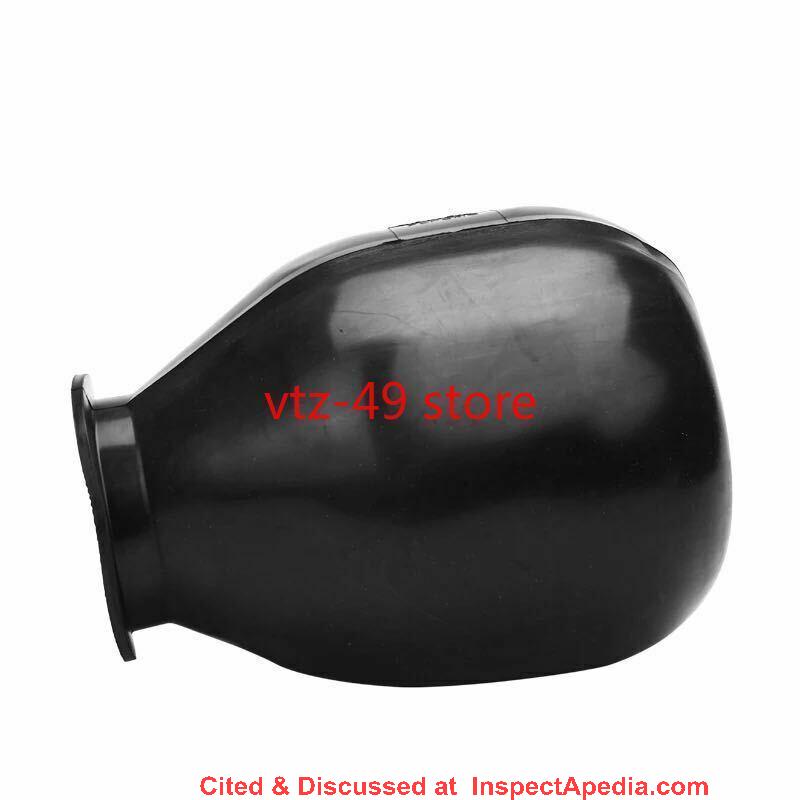
My tank have this type of bladder in picture my old tank was with a bladder like bicycle tires with valve above.
So you say this type of tank with this bladder should never ever lose air? Expect if there is a leak? Small hole in bladder or? Hole in tank.
I had checked my tank two day ago because i installed filter, I drained all system and water from pipes i measured air in tank with digital pressure metter 29 psi when i installed tank i added 38 psi air because i use 40/60 pressure switch switch settings..
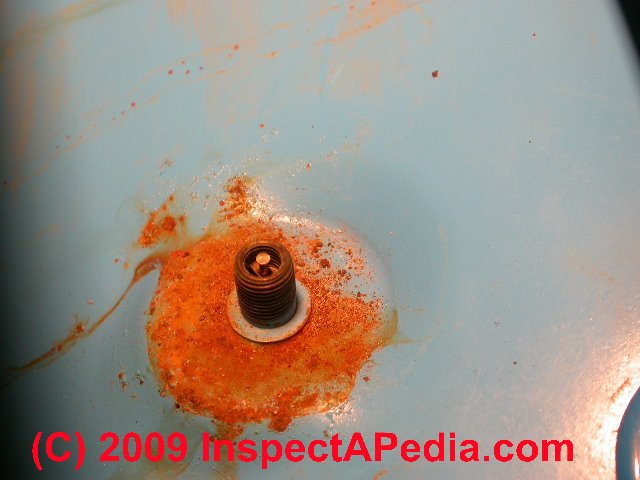
To be more correct i can't accept it because is just damn 8 month old, i saw rust around the air valve. I added strengh to the valve bolt i used foam to check if air leak but i dont saw anything. Now i dont know if rust come from water drops condensation where i keep my tank to be checked again in coming month.
I can't find good tank in my country they all are chinese or from turkey cheap one
Sticker show tested at 217 psi precharged with 30 psi. Added 38 psi.
How many seconds should cycle last from 40/60 if you open faucet by end. How much should be because i concerned about pump
Regards
Thank you
On 2023-04-09 by InspectApedia Editor - "my bladder tank lost air after 8 months"
@blero,
Your question contains several conflicting points - I'll try again to be more helpful.
You're quite right: from the factory, the water pressure tank is light, filled just with air.
At installation, the tank's air pre-charge pressure when the tank is empty must be 2 psi below the pump cut-in pressure.
So if your pump CUT-IN pressure is 38 psi then the empty tank with pump off should show 36 psi.
'm surprised that any residential water pump would normally fill a residential pressure tank in just four seconds.
If the tank is not water-logged now - which you want to confirm - then the tank, at 13 gallons - is quite small and perhaps too small for your application.
About "my bladder tank lost air after 8 months"
IF your water tank is one that uses an internal bladder (the subject of this page) then it should NEVER lose air. The bladder keeps water and the air pre-charge separate.
So if your tank has lost its air charge either the internal bladder has a hole or tear and needs replacement OR someone let air out of the bladder at the air charge valve found at or near the top of the tank.
On 2023-04-09 by blero
@InspectApedia Publisher, hi i dont know now to which one you refering i purchased tank 8 month ago it was like this from begining. There is no water inside tank in air space because tank is light not heavy, a waterlogged tank are heavy because all tank is filled with water but what concern me from 60 to 40 psi gauge drop fast.
How many second need to drop from 60to40 psi to start pump
Thank you
On 2023-04-09 by InspectApedia Publisher - water tank is waterlogged, missing its air charge
@blero,
It sounds as if your water tank is waterlogged, missing its air charge.
On 2023-04-09 by blero
Hello my submersible pump filling so fast my tank in 4sec as my tank is 13gallon and i have set to 38air 40/60 switch and water empty fast.
Pump is 1.1kw 1.5hp and can pump 20gallon in 70feet well my well is 45feet deep
I know i made mistake but this was before i started reading and learn.
Now pump fill fast i think i need 74 gallon tank for my pump but they are to expensive.
Also my bladder tank lost air after 8 month from 38 to 29 is this normal.
And the manometer gauge drop some psi after shut off
Advice needed
Thanks
On 2023-03-26 by InspectApedia Publisher - how to use the large and small adjustments nuts on the pressure control switch
@Bahia Bob,
Thank you for the added details.
You will find in this article series how to use the large and small adjustments nuts on the pressure control switch.
We've made an effort to research your question but haven't found studies reporting on the life expectancy of water pressure tanks as a function of the operating pressure range.
If you look at the maximum pressure rating for a water pressure tank and consider that your operating range is almost always well below that number. You might guess that you're in such a safe zone that the cycling of pressure in the tank is not affecting the life of the tank itself.
On 2023-03-21 by Bahia Bob
@InspectApedia Editor ,
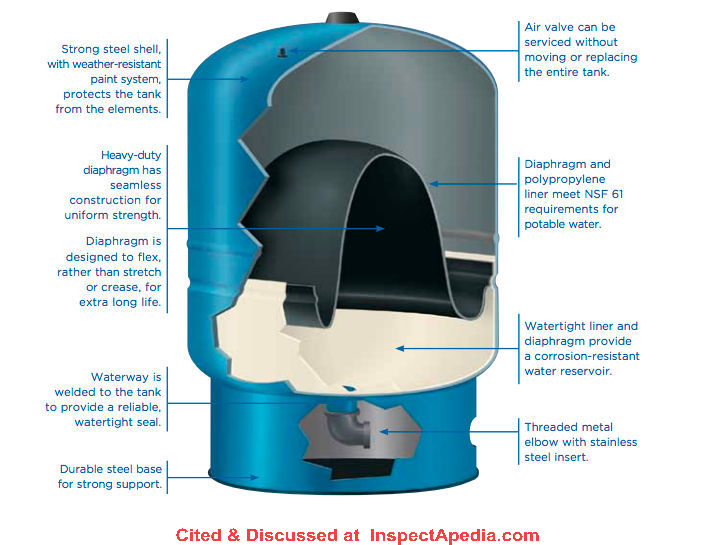
Thanks, The diaphragm on these Amtrol family steel tanks looks as though it might do better pushing down lightly into the poly dome at the bottom of the tank. I think my 20 gallon tank also has a steel dome at the top to prevent diaphragm over extension in that direction.
An air pre-charge pressure of 28 psi above the diaphragm when the tank has zero water pressure below the diaphragm might give about 8.8 gallons draw down for a 20 gallon tank from zero water pressure to 50 PSI.
I would be willing to lose a few gallons of draw down in exchange for less (harmful) diaphragm stretch excursion. Peak water pressures over 60 PSI seem to strain the diaphragm assembly if they are not counter balanced by a high factory pre-charge.
Years ago this would have made a good sporting subject, old tanks reported to last over 20 years with a 30-50 switch. With two equal air pressure charged tank diaphragms counterbalancing the water pressure I found I could turn the big spring Square D nut 200 degrees counterclockwise and get the same system pressure peak. That is apparently easier on the third Square D diaphragm as well.
I wonder if there would be even more tank longevity for a 20-40 PSI system?
On 2023-03-20 by InspectApedia Editor - set the empty tank's air pre-charge at 2 psi below the pressure control switch CUT-IN pressure
@Bahia bob,
No typical residential water pressure tank is going to cycle just once or twice a day - rather, the pump will cycle on and off repeatedly during the day, where the longest draw-down cycle before the pump turns on is usually 45 seconds to a minute and a half.
The object is to prevent more-rapid pump on-off cycling.
Your comment on tanks flexing at pressures over 55 psi is interesting. If you've any data or research citations I'd sure be grateful to have those - and in any case will do some further research on the question.
The only correct bladder-type water pressure tank pre-charge setting is to set the empty tank's air pre-charge at 2 psi below the pressure control switch CUT-IN pressure.
I (DF) have not come across a manufacturer's warning about letting the water pressure drop to zero - which should leave your tank at say 28 psi for a 30 psi CUT-IN - which is how the tank probably comes from the factory.
If you release ALL of the air pressure from an empty water tank there is some risk that the collapsed bladder will stick to itself, requiring a bit of fooling around with excess pressure to get the bladder un-stuck.
You should not have to manually turn your pump on and off if the tank and pressure switch are set up correctly.
On 2023-03-19 by Bahia bob
These new 18 gauge steel tanks don't seem to tolerate short cycling and high pressures as well as the older tanks. The paint/epoxy finish cracks near the weld seams after only a few years apparently from steel flexing with pressures over 55 PSI.
Is there an optimum low pressure setup?
For example if you set your tank air pre charge at 27 PSI and your pressure switch cut off at 54 PSI the diaphragm might stretch up a little further than with the 45 PSI factory precharge. I've got a small second tank that I assume should be kept at the same pre charge PSI.
These new tanks probably could last 10 years cycling once or twice a day but there must be some optimum pressure switch/pre-charge combination that will be easy on the diaphragm.
Does it harm the diaphragm any to let it seat on the poly dome at the bottom of the tank by letting the water pressure go to zero? I've been using my wall switch, leaving it off most of the time so the 1 HP pump only runs about 30 seconds to repressurize the system.
On 2023-02-17 by InspectApedia Editor - what pressure should be maintained in air chamber
@G V R MURTHY,
First a safety note:
Watch out: for very high water pressure readings in your system. If the water pressure is over 70 or 80 psi your system there can be a risk of burst water piping or a burst water pressure tank.
But it seems you're asking about air pressure.
If you are fine-tuning water tank bladder or air pressure be sure that you are using an accurate pressure gauge and that you know how to obtain an accurate pressure reading.
When installing a new water pressure tank or adjusting an existing one, the tank's pressure, with the water pump turned off and no water pressure in the system, is set to 2 PSI below the pressure control switch cut in pressure, for example 18 PSI or 28 PSI, depending on your tank's settings.
In addition to the article's information above on this page, see our full discussion on this topic at
HOW MUCH AIR TO ADD TO A WATER PRESSURE TANK
There we discuss adding air into a water tank, up to some starting pressure.
Once you know the air pressure you need, and if you have questions about how to do so, see
HOW TO ADD AIR TO A WATER PRESSURE TANK
Let us know if you have additional questions.
On 2023-02-17 by G V R MURTHY
what pressure should be maintained in air chamber
On 2023-01-02 by InspectApedia Publisher - pressure gauge accuracy and where and how to read water pressure in buildings
@Fish N Hunt,
Thank you for a helpful question on pressure gauge accuracy and where and how to read water pressure in buildings.
Provided that the water pump has turned off and no water is being run. anywhere in the building, the water pipes, water pressure tank and other plumbing fixtures and components all form - at that time - a closed system.
Excepting subtle differences in pressure ascribed to building height, water pressure will be the same everywhere in the system.
So any difference you read between pressure measured by a tire gauge at the Schrader valve on the water tank and the gauge pressure on the water pressure gauge is going to be due to a difference in the measuring instruments themselves.
I find that tank gauge pressure is most-often in error on older water systems, particularly if the water supply may include rust or debris particles that clog the sensor port on the gauge bottom. These same particles and debris can clog the pressure sensor port on the pressure control switch, too, causing it to behave improperly.
It's also the case that neither tire gauges nor water pressure gauges are precise lab-grade instruments, and I find that they vary individually. In my OPINION a good-quality dial-type tire pressure gauge chosen in a model whose scale runs between 0 and 100 psi will give the most-accurate reading for typical building water pressures that would be expected to be between 20 and 70 psi.
It's a more general concept that any pressure measuring device will give more-accurately and more-easily read pressures if the pressure range on the device is not significantly greater than the anticipated pressure to be measured.
Conversely, if for example you bought a dial type pressure gauge whose scale ran between 0 and 500 psi it may be more-difficult to read precisely pressures in the 0-50 psi range.
Finally, in my OPINION some pressure gauges seem to be inconsistent in their performance. I found that a very low-cost stick-type tire pressure gauge would give a different pressure reading each time I used it on the same tire, even taking care to allow for the slight loss of air pressure at the tire as we applied and removed the gauge.
On 2023-01-02 by Fish N Hunt
I have a question regarding the pressure reading that I get from the schrader valve (using a tire pressure gauge) at the top of my pressure tank versus the reading that shows up on an in-line guage on a pipe leaving the pressure tank.
I'm wondering what the best way to test the difference/accuracy of the two gauges that I am reading.
If the system is fully charged and at the cutoff pressure, then should the gauge being used at the Schrader valve read the same as the in-line guage? If the system is empty and the drain closed, should the gauge being used at the Schrader valve read the same as the inline guage? Thanks.
On 2022-10-21 by InspectApedia (Editor)
@Steve,
Yes, the proper air pre-charge is 38 psi for a pump switch CUT-IN set to 40 psi.
On 2022-10-21 by Steve
My well tank is reading 18 psi when drained and my pump doesn't cut on until 40 psi. I'm getting sporadic water pressure and was wondering if it would be safe to add some air to tank. It hasn't been touched in about 12 years
On 2022-09-22 by InspectApedia (Editor) - Can I set pressure switch and then bladder pressure
@Carl,
Yes, those are independent settings, BUT remember when setting the water tank air charge you will need to turn off the pump and remove pressure from the system first.
On 2022-09-21 by Carl
Can I set pressure switch. And then bladder pressure
On 2022-09-11 by Joe K
@InspectApedia-911,
Thanks for the fast reply! Right now the well is rated at 50gpm and the pump is 1.5hp/20gpm, so I hope it will work this way for a while. Thanks again, your website is amazing.
On 2022-09-09 by InspectApedia-911 (mod) - safe water tank air pre-charge pressure limits
@Joe K,
You're fine setting the water pressure tank pre-charge to 53 and the pressure control to 55/77 - 75 psi is well below the maximum tank pressure allowed (that you report is 125 psi)
BUT
Watch out: if you set the pressure higher than the pump itself is able to achieve, OR if at the higher pressure you run water so fast in the building that your gpm usage rate skyrockets and you run the well dry - you'll have to back off to the old lower range.
On 2022-09-09 by Joe K
I have a 44 gallon pressure tank with default 40/60 setting with air @ 38psi, the tank has a max rating of 125psi.
Can this be adjusted to 55/75 with 53 psi air without issue? Would this create a total pressure higher than 125psi, or would the 75psi include the air pressure? The plumbing would be able to handle the higher pressure if adjusted.
On 2022-06-09 by InspectApedia-911 (mod) - Well Tank Air Pressure Adjustment Procedure
@Mark R,
Glad to hear that it's working now and thanks for the feedback, that will help others.
On 2022-06-09 by Mark R
@InspectApedia , I went through the process again (taking care to open the supply before turning the pump back on), and it's behaving very much like it had before I messed it up. Thanks!
On 2022-06-08 by InspectApedia (mod) - may need to drain the water tank completely
@Mark R,
For the concern that you described, try draining the pressure tank completely.
That means that you turn off water and pump and open and drain near the tank bottom and add water run out until there's nothing else coming out of your tank.
At that point your tank bladder should be close to completely empty.
Air pressure above the bladder will collapse it.
Then set the air charge pressure.
On 2022-06-08 by Mark R
Thanks for the quick response! In addition to the steps you provided, I did these steps:
1.5- shut off the supply to the pump (from a 2500 gallon storage tank)
6- opened the supply to the pump from the storage tank (I think this should have been 4.5)
My concern is that I may have introduced air into the water bladder via the pump while the supply to the pump was shut off between steps 5 and 6).
Perhaps that limited the volume of water that can go into the bladder.
On 2022-06-08 by InspectApedia-911 (mod)
@Mark R,
Thanks for a helpful though challenging question.
If your tank is one that uses an internal bladder, and if you set the air charge properly, the air would not be in the same bladder as is contained the water in the tank. The air valve on a bladder-type water tank connects to the space above the bladder.
But if you didn't quite do the air re-charge properly you could find the short-cycling problem you describe.
Before setting the air pre-charge in the pressure tank you must
1. turn off the pump
2. drain all pressure from the system
3. drain the water tank of water
4. then set the tank air-charge pressure to 2 psi below the pump's CUT-IN pressure.
5. Turn the pump back on.
Otherwise, as your description suggests, you can end up with too little air volume at the right pressure in the tank.
On 2022-06-08 by Mark R
In the process of trying to adjust cut-in/cut-off pressures, I ended up letting a bunch of air out of the tank (intentionally due to brain fart). So, I found this site (lots of great info here!) and went through the Well Tank Air Pressure Adjustment Procedure.
After getting things somewhat back to normal, I've noticed that the system now behaves poorly in one respect: The contents of the tank are consumed more quickly (pump cycles more often, and I can see that the pressure drops more quickly by the height of the water coming out of the sprinklers).
Could this be caused by air having been introduced into the water bladder (resulting in less water in the bladder)? If so, is there a way to remove that air, or do I just need to wait for it to be absorbed into the water over time?
I did accidentally start to fill the bladder before opening the supply valve after having shut off the supply valve to drain the tank. Maybe that partially filled the bladder with air?
Do I just need to empty the bladder again and start over? Would that force the air out (if that's the problem)? I've got a Flexicon Industries Challenger APC266 tank.
On 2022-05-01 by Inspectapedia Com Moderator - proper water pressure tank location
@Paul freeman,
Thanks, that's a helpful question.
At WATER PUMP PRESSURE CONTROL SWITCH CHATTER
in item 5 in our list of pressure control switch bounce, stutter, chatter we state:
The water pump pressure control switch should be within 3 ft. or at most 4 ft. of the tank itself.
Also see WHERE to LOCATE a WATER TANK
There we state
Amtrol™ is quite clear about the proper water pressure tank location:
The Well-X-Trol should be installed as close as possible to the pressure switch.
This will reduce the adverse effects of added friction loss and pressure switch bouncing, and the difference in elevation between WELL-X-TROL and switch.
Water pressure tanks will work rather well if placed located almost anywhere on the piping system on the same level as the pressure control switch.
I'm doing more research on your question and may be able to add other solutions but the short answer is - your plan looks troublesome. I would not go ahead without expert advice from your pump and/or pump control manufacturer.
On 2022-05-01 by Paul freeman
Because of space issues I'm proposing to site a 100L pressure tank some 12 metres distance from the well head and pressure switch. The connecting pipe is 25mm semi rigid plastic with an id of 19mm. Is this going to make the switching 'laggy' ?
(I don't have the option to move the switch nearer to the tank)
On 2022-01-30 by Inspectapedia Com Moderator - what pressure should the tank be set at with no water in it?
@Allan Meiers,
The proper water pressure tank air charge, with the pump OFF and water pressure released from the system (open a faucet until water stops) should be set to 2 PSI below the pressure control switch CUT-IN pressure.
Details are in WATER TANK AIR HOW MUCH TO ADD
For the example you give, with CUT IN = 22 PSI, the air pre-charge would be (22 - 2) = 20 psi.
On 2022-01-30 by Allan Meiers
Have a pressure pump cuts out at 38 psi and cuts back in at 22 psi what pressure should the tank be set at with no water in it ?
...
Continue reading at WATER TANK PRESSURE RELIEF VALVE or select a topic from the closely-related articles below, or see the complete ARTICLE INDEX.
Or see WATER TANK AIR PRESSURE ADJUSTMENT FAQs - questions & answers posted originally at this page.
Or see these
Recommended Articles
- WATER PRESSURE TOO HIGH: DANGERS
- WATER PUMP WONT STOP RUNNING
- WATER TANK AIR, HOW TO ADD
- WATER TANK AIR HOW MUCH TO ADD
- WATER TANK AIR PRESSURE ADJUSTMENT
- WATER TANK AIR VALVE REPAIRS
- WATER TANK BLADDERS & CAPTIVE AIR
- WATER TANK DIAGNOSIS & REPAIR - home
- WATER PRESSURE CONTROL SWITCH ADJUSTMENTS - adjust the well pump pressure control
- WATER PRESSURE IMPROVEMENT - increase well water pressure or flow
- WATER PUMP REPAIR GUIDE - example of diagnosis of loss of water pressure, loss of water, and analyzes the actual repair cost.
- WATER PUMP WONT STOP RUNNING
- WATER TANK PRESSURE RELIEF VALVE
- WATER TANK SAFETY
Suggested citation for this web page
WATER TANK AIR PRESSURE ADJUSTMENT at InspectApedia.com - online encyclopedia of building & environmental inspection, testing, diagnosis, repair, & problem prevention advice.
Or see this
INDEX to RELATED ARTICLES: ARTICLE INDEX to WATER SUPPLY, PUMPS TANKS WELLS & SPRINGS
Or use the SEARCH BOX found below to Ask a Question or Search InspectApedia
Ask a Question or Search InspectApedia
Try the search box just below, or if you prefer, post a question or comment in the Comments box below and we will respond promptly.
Search the InspectApedia website
Note: appearance of your Comment below may be delayed: if your comment contains an image, photograph, web link, or text that looks to the software as if it might be a web link, your posting will appear after it has been approved by a moderator. Apologies for the delay.
Only one image can be added per comment but you can post as many comments, and therefore images, as you like.
You will not receive a notification when a response to your question has been posted.
Please bookmark this page to make it easy for you to check back for our response.
Our Comment Box is provided by Countable Web Productions countable.ca
Citations & References
In addition to any citations in the article above, a full list is available on request.
- Thanks to Jeremy Houser who suggested that we needed to clarify the difference between bladder type and non-bladder type water tanks when discussing air charging and diagnosis of water tank repairs.
- Thanks to Jeff Garmel for discussing clarifications on water pressure tank testing and diagnosis, 8/24/2009.
- Amtrol Extrol™ pressure control tanks, which they call well tanks, are described at the company's website at www.amtrol.com/extrol.htm and installation and operating instructions for these well tanks can be found at www.amtrol.com/pdf/9015A290revcWXT.pdf
- Well-X-Trol: Amtrol Extrol™ pressure control tanks used on hydronic heating and other systems such as models 35LBC, 50 LBC, 85 LBC, and 100LBC to 600 LBC also use a bottom bladder containing air - see amtrol.com/pdf/LBCSeriesEXTROL9017-095.pdf for details.
- Mark Cramer Inspection Services Mark Cramer, Tampa Florida, Mr. Cramer is a past president of ASHI, the American Society of Home Inspectors and is a Florida home inspector and home inspection educator. Mr. Cramer serves on the ASHI Home Inspection Standards. Contact Mark Cramer at: 727-595-4211 mark@BestTampaInspector.com
- John Cranor [Website: /www.house-whisperer.com ] is an ASHI member and a home inspector (The House Whisperer) is located in Glen Allen, VA 23060. He is also a contributor to InspectApedia.com in several technical areas such as plumbing and appliances (dryer vents). Contact Mr. Cranor at 804-873-8534 or by Email: johncranor@verizon.net
- Wessels Company bladder replacement store was found at westank.com/bladder-tank-store.php on 5/22/2009. Wes sell refers to "shock and surge tanks" as ASME replaceable bladder type and pre-charged hydropneumatic tanks used for commercial, industrial, and well water systems.
- Thanks to reader Howard Jackson for technical editing of proper pressure settings for the Well X Trol WX-103 - WX-203 tank bladder pressures - June 2010
- [1] Well-Rite water tanks. Well-Rite water tanks are produced by Flexcon Industries, 300 Pond Street Randolph, MA 02368 Tel: 781.986.2424, based on manufacturer data provided on the shipping carton for a 44 Gallon / 170 Liter internal bladder water pressure tank during installation in Northern Minnesota, September 2011.
- Rasmussen Well Drilling, Inc., 1793 Hwy 61, Two Harbors MN. Jeremy Rasmussen provides third generation well drilling and plumbing services on the North Shore of Lake Superior. Photos by DJF. Tel 218-834-3387. Email: rasmussenwell@frontier.com
Quoting: We serve the north Shore – Lake, Cook, St. Louis, Carlton and Pine counties, including Duluth, Grand Marais, Clouqet, Carlton, Finland, Isabella, Silver Bay, Grand Portage, Saginaw, and everywhere in Northeastern Minnesota. - Crystal Clear Supply provides portable ceramic water filter purifiers and portable reverse osmosis water treatment equipment - see http://www.crystalclearsupply.com/category_s/7.htm
- Handbook of Disinfectants and Antiseptics, Joseph M. Ascenzi (Editor), CRC, 1995, ISBN-10: 0824795245 ISBN-13: 978-0824795245 "The evaluation of chemical germicides predates the golden age of microbiology..." -
This well-focused, up-to-date reference details the current medical uses of antiseptics and disinfectants -- particularly in the control of hospital-acquired infections -- presenting methods for evaluating products to obtain regulatory approval and examining chemical, physical, and microbiological properties as well as the toxicology of the most widely used commercial chemicals. - Potable Aqua® emergency drinking water germicidal tablets are produced by the Wisconsin Pharmacal Co., Jackson WI 53037. 800-558-6614 pharmacalway.com
- Principles and Practice of Disinfection, Preservation and Sterilization (Hardcover)
by A. D. Russell (Editor), W. B. Hugo (Editor), G. A. J. Ayliffe (Editor), Blackwell Science, 2004. ISBN-10: 1405101997, ISBN-13: 978-1405101998.
"This superb book is the best of its kind available and one that will undoubtedly be useful, if not essential, to workers in a variety of industries. Thirty-one distinguished specialists deal comprehensively with the subject matter indicated by the title ... The book is produced with care, is very readable with useful selected references at the end of each chapter and an excellent index. It is an essential source book for everyone interested in this field. For pharmacy undergraduates, it will complement the excellent text on pharmaceutical microbiology by two of the present editors."
The Pharmaceutical Journal: "This is an excellent book. It deals comprehensively and authoritatively with its subject with contributions from 31 distinguished specialists. There is a great deal to interest all those involved in hospital infection ... This book is exceptionally well laid out. There are well chosen references for each chapter and an excellent index. It is highly recommended." The Journal of Hospital Infection.: "The editors and authors must be congratulated for this excellent treatise on nonantibiotic antimicrobial measures in hospitals and industry ... The publication is highly recommended to hospital and research personnel, especially to clinical microbiologists, infection-control and environmental-safety specialists, pharmacists, and dieticians."
New England Journal of Medicine: City Hospital, Birmingham, UK. Covers the many methods of the elimination or prevention of microbial growth. Provides an historical overview, descriptions of the types of antimicrobial agents, factors affecting efficacy, evaluation methods, and types of resistance. Features sterilization methods, and more. Previous edition: c1999. DNLM: Sterilization--methods. - U.S. Army Field Manual 21-10, Field Hygiene and Sanitation, 1988, web search 07/02/2010, original source: http://www.enlisted.info/field-manuals/fm-21-10-field-hygiene-and-sanitation.shtml
The purpose of this manual is to assist individual soldiers, unit commanders, leaders and field sanitation teams in preventing disease and environmental injuries. The manual provides information on preventive medicine measures (PMM) to the individual soldier as well as essential information for the unit commander, unit leaders, and the unit field sanitation team on applying unit level PMM. - When Technology Fails, Matthew Stein, Chelsea Green Publisher, 2008,493 pages. ISBN-10: 1933392452 ISBN-13: 978-1933392455, "... how to find and sterilize water in the face of utility failure, as well as practical information for dealing with water-quality issues even when the public tap water is still flowing". Mr. Stein's website is www.whentechfails.com/
- In addition to citations & references found in this article, see the research citations given at the end of the related articles found at our suggested
CONTINUE READING or RECOMMENDED ARTICLES.
- Carson, Dunlop & Associates Ltd., 120 Carlton Street Suite 407, Toronto ON M5A 4K2. Tel: (416) 964-9415 1-800-268-7070 Email: info@carsondunlop.com. Alan Carson is a past president of ASHI, the American Society of Home Inspectors.
Thanks to Alan Carson and Bob Dunlop, for permission for InspectAPedia to use text excerpts from The HOME REFERENCE BOOK - the Encyclopedia of Homes and to use illustrations from The ILLUSTRATED HOME .
Carson Dunlop Associates provides extensive home inspection education and report writing material. In gratitude we provide links to tsome Carson Dunlop Associates products and services.
 | HOME | ABOUT | ASK a QUESTION | CONTACT | CONTENT USE POLICY | DESCRIPTION | POLICIES | PRIVACY | |
| © 2024 - 1985 Publisher InspectApedia.com - Daniel Friedman | |||||||||