
InspectAPedia® FREE Encyclopedia of Building & Environmental Construction, Diagnosis, Maintenance & Repair |
Question? Just ask us! InspectAPedia
|
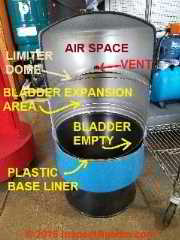 Bladder Type Water Storage & Pressure Tanks
Captive Air Water Tank Diagnosis & Repair
- POST a QUESTION or COMMENT about diagnosing and repairing problems with water tanks that use an internal bladder
Internal bladder type water pressure tank troubleshooting:
This article describes the diagnosis and repair of internal bladder type water pressure tanks: how they work, what goes wrong, how to fix it.
We explain how internal bladder type water pressure tanks work, what goes wrong, how to diagnose the trouble, and how to repair it.
InspectAPedia tolerates no conflicts of interest. We have no relationship with advertisers, products, or services discussed at this website.
How Bladder-type Water Pressure Tanks Work - Pressure Tank Diagnosis
 Private well and pump systems include a well (the water source), piping from the well to the building,
a water pump, and a water tank to which
building water supply plumbing is connected.
Private well and pump systems include a well (the water source), piping from the well to the building,
a water pump, and a water tank to which
building water supply plumbing is connected.
[Click to enlarge any image]
Building plumbing fixtures (sinks, toilets, showers, tubs) are supplied with water from the building water supply piping, and drain into the building drain-waste-vent (DWV) system.
How water pressure tanks work
When water is turned on at a fixture in the building, compressed air in the water tank acts like a spring: it pushes water out of the water tank and into the building water supply piping and thus water is sent on to the building plumbing fixtures.
If many fixtures are being run at once in the building, or if the water flow rate produced by the pump and piping and controls is a modest one, the pump may run continuously all while the fixture is being operated.
More typically, if only one fixture is running and if the pump and well can deliver a high water flow rate, the pump may come on and off several times while the fixture is being run.
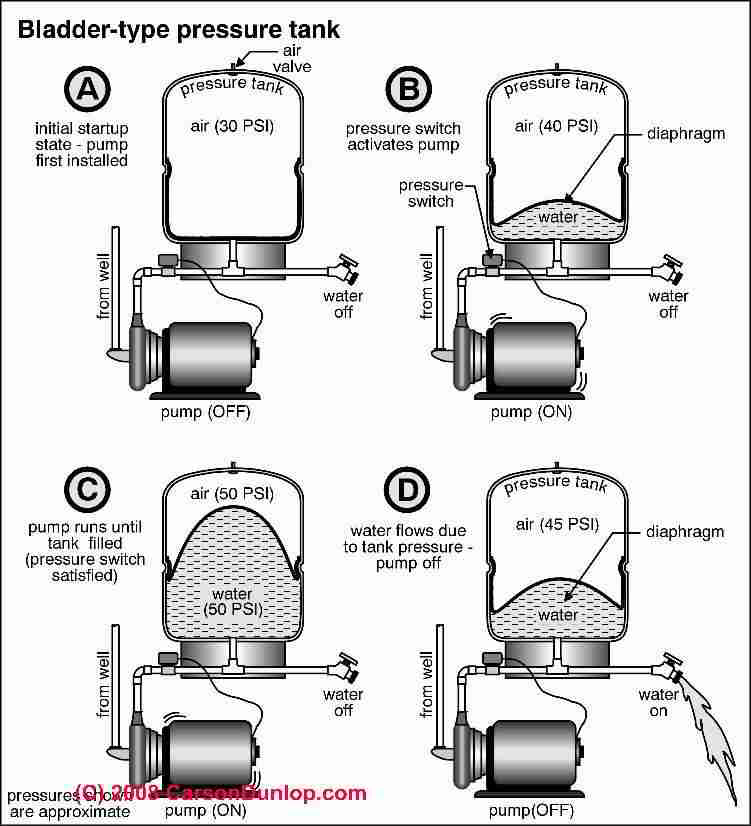 As water leaves the water tank, water pressure in the water tank drops.
Since the water tank also contains air, the air pressure drops too. In the tank water pressure and air pressure will be at the same psi. Sketch courtesy of Carson Dunlop Associates, a Toronto home inspection, education & report writing tool company [ carsondunlop.com ].
A pressure control switch,
usually mounted on or near the water tank, senses the pressure drop, and at a pre-set "pump cut-in pressure" (typically 20 or 30 psi) the pressure switch t
urns on the water pump.
See WATER PRESSURE CONTROL SWITCH ADJUSTMENTS for details of this control.
The water pump,
located at the tank or perhaps in the well,
pumps water to the building from the well, simultaneously re-pressurizing the water tank and providing water to the building.
See WATER PUMP LIFE EXPECTANCY for types of water well pumps, how they work, how they are diagnosed and repaired.
Because the water pressure tank is connected to the water pump (water in from the well) and also to the building water supply piping (water out to the building) the water tank is said to be "floated on the water line" and when the water pump is running water is pushed simultaneously into the water pressure tank and into the building supply piping.
The pressure control switch turns off the water pump
when water pressure in the pressure tank reaches the "pump cut-out pressure" (typically 40 or 50 psi) - pressure switch turns off the well pump.
Readers of this document should also see
WATER TANK BLADDER PRESSURE ADJUSTMENT where we describe adjusting air pressure in a bladder type water tank to factory specs,
and also
see WATER PUMP REPAIR GUIDE an specific case which offers an example of diagnosis of loss of water pressure, loss of water, and analyzes the actual repair cost.
The illustration at page top is courtesy of Carson Dunlop Associates, a Toronto home inspection, education & report writing tool company [ carsondunlop.com ].
What's the Difference Between a Bladder Type Captive Air Water Tank and a Conventional Steel Bladderless Water Tank
Bladder Type Captive Air Water Tanks
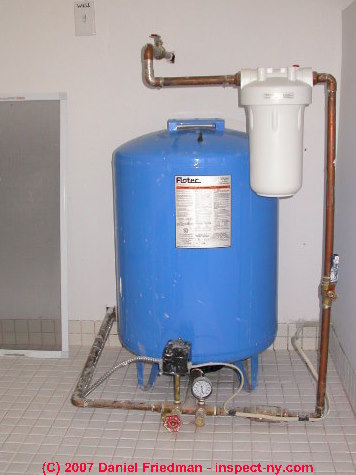 Bladder type or "captive air" water tanks
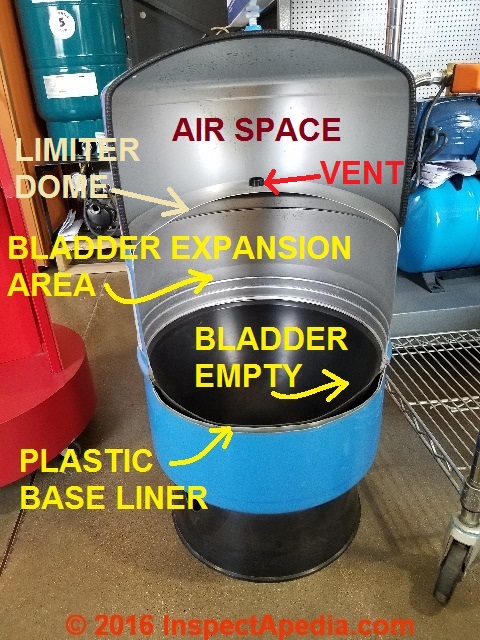
(shown in our photo at left and in the sketch above) store the water tank's air charge in the upper portion of the steel water tank. Water in the tank moves in and out of a rubber bladder in the tank bottom. Because the air charge is kept separate from the water in the tank, air is not absorbed into the water and bladder type water tanks do not normally need to have makeup air added.
On some captive air water tanks this design is reversed. For example on the WellMate™ water tank the water is in the tank and air is in the tank bladder.
This difference can confuse the burst water tank bladder diagnosis procedure which we describe below.
For details of the arrangement of the parts inside of a water tank that uses an internal bladder,
see WATER TANK BLADDER CONSTRUCTION
At WATER TANK CAPTIVE AIR vs TRADITIONAL WellMate we provide separate water tank diagnosis and repair advice.
At WATER TANK BLADDER CONSTRUCTION you will see that in some water pressure tank designs the water is contained in a con-joined plastic+ rubber area in the tank bottom while air is contained in a con-joined rubber and steel area in the upper half of the tank.
Water pressure or water pump short cycling problems with bladder-type water tanks
are usually traced to a problem with the pump controls, with well and water piping leaks, or less often, to a failure of the internal tank bladder itself - a component that may be replaceable.
If the water-containing rubber bladder in a "captive air" water tank is defective
(it can become stuck to itself and remain collapsed), the result can be a rapid on-off short cycling of the water pump.
We test water pressure tanks to see if they're empty or nearly empty of water by seeing if we can gently rock or move the tank.
Details are at WATER TANK BLADDER STUCK to ITSELF
If the water tank is heavy with water
it does not move easily. Be careful not to jiggle and break a pipe!
Water pressure tanks, their different types, how to identify them, and their repairs are described just above and in more detail
at WATER TANK TYPES.
At WHAT GOES WRONG with an Internal-Bladder type Water Tank? we discuss the combination of well pump short cycling and a burst water tank bladder.
Traditional no-bladder Steel or Fiberglass Water Tanks
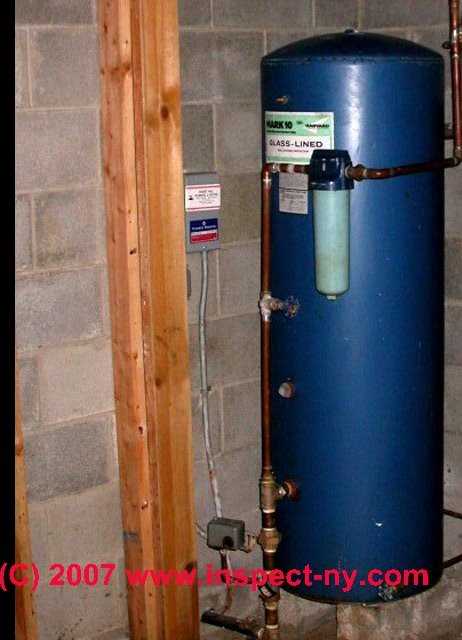
Bladderless Steel Water Pressure Tanks (photo at left and sketch just below) use a single steel tank interior to hold both the air charge and the water supply.
Modern steel bladderless type water tanks may be coated internally to increase the water tank life by resisting corrosion. That's what "glass lined" refers to on some water tanks. (A "glass lined" or "epoxy coated" water tank will not be a bladder type water tank which we discussed above.)
Bladderless water pressure tanks, because the air charge and water are in the same container, can lose their air charge over time (air is absorbed into the water) and may need air added.
See WATER TANK AIR, HOW TO ADD for details.
Bladderless Fiberglass Water Pressure Tanks,
such as the WellMate traditional hydro-pneumatic water tank operate similar to the steel water pressure tank, but incorporate a tank-top mounted air volume control and offer the advantage (over steel water tanks) of no risk of rust perforation and leak at the water tank.
At WATER TANK CAPTIVE AIR vs TRADITIONAL WellMate we provide separate water tank diagnosis and repair advice for this water tank type.
Bladderless Fiberglass Water Pressure Tanks,
such as the WellMate traditional hydro-pneumatic water tank operate similar to the steel water pressure tank, that is, no internal bladder is used to maintain and separate the tank's air charge and water charge pressure.
These tanks incorporate a tank-top mounted air volume control and offer the advantage (over steel water tanks) of no risk of rust perforation and leak at the water tank.
At WellMate Diagnosis we provide separate water tank diagnosis and repair advice for this water tank type.
At OLDER STEEL TANKS - Bladder-less Traditional Steel Water Pressure & Water Storage Tanks we discuss this water tank type in detail.
What Goes Wrong with an Internal-Bladder type Water Tank? Common Water Tank Failures
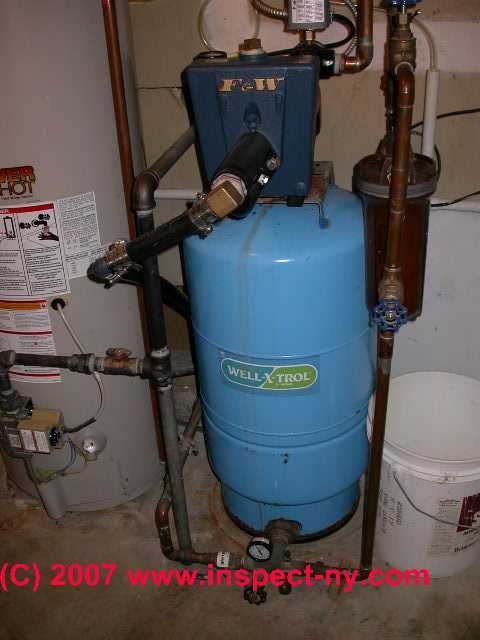 Water pressure or water pump short cycling problems with bladder-type water tanks are usually traced to a problem with the pump controls, with well and water piping leaks, or less often, to a failure of the internal tank bladder itself - a component that may be replaceable.
1. Water tank bladder rupture
If the water containing bladder in a captive air water tank becomes ruptured, torn, or leaky, the result can be a very short water draw-down cycle before the water pump runs,or rapid on-off short cycling of the water pump.
Water from the tank bladder leaks out of the bladder and into the steel tank itself where it replaces more and more of the air charge until finally the behavior of the water system is much as in the water tank bladder collapse discussed just below.
A water tank bladder might rupture from age, an internal defect, or if the pump pressure control switch is defective or is set so high that the water pressure breaks the bladder but this last cause is a bit unusual since the air pressure and water pressure on the two sides of the tank bladder's are normally the same.
Details of burst or ruptured water pressure tank bladders are at
WATER TANK BLADDER BURST / RUPTURED
2. Water tank bladder collapsed
If the water-containing rubber bladder in a "captive air" water tank is defective (it can become stuck to itself and remain collapsed), the result can be a rapid on-off short cycling of the water pump,
A stuck tank bladder prevents water from entering the pressure tank. There will be no appreciable water draw-down quantity and the water tank will remain "light" if gently shaken in place.
Details are at WATER TANK BLADDER STUCK to ITSELF
Watch out: We check water pressure tanks to see if they're empty or nearly empty of water by seeing if we can gently rock or move the tank.
If the tank is heavy with water it does not move easily. If the water pressure tank is empty or nearly so, it will be very light and easy to move. Be careful not to jiggle and break a pipe!
3. Pinhole water tank bladder leak
If if the tank's internal bladder has not burst but has a small leak the tank air pressure will (or might) increase above standard air charge pressure as water accumulates in the air space, also leading to pump short cycling and an apparent water-logged pressure tank even though only air comes out of the tank top air valve
Details are
at PINHOLE LEAKS in WATER TANK BLADDER
4. Water tank bladder sticks to itself
Sometimes when an internal bladder type water pressure tank is emptied completely the collapsed bladder can stick to itself so securely that when the pump cycles back on no water enters the pressure tank. A symptom of this problem is a rapid cycling on-off water pump and a water pressure tank that by weight or by absence of condensate on its exterior, is found to be completely empty.
Details are at
at WATER TANK BLADDER STUCK to ITSELF - water tank bladder stuck to itself: diagnosis and repair
Why don't we just look at the water tank pressure gauge
to see if there is water in the tank? Well we do.
But because debris or other failures can cause a water tank pressure gauge to read pressure even when there is none in the tank (the gauge can get "stuck"), we don't rely on just tank gauge readings. For more about water tank pressure gauges,
see WATER PRESSURE GAUGE ACCURACY and
see WATER TANK BLADDER PRESSURE ADJUSTMENT.
If the water tank is empty or nearly so,
then water is not entering the tank. If the water pump runs but no water is entering the tank, the problem could be a collapsed bladder that is stuck onto itself, not admitting water - as we just described above.
There could also be another problem such as a defective water pump, a well line leak, or other cause for water not entering the tank - so you may need to also
see WATER PRESSURE LOSS DIAGNOSIS & REPAIR.
If the water tank is "full" or nearly so,
then if there is still no water pressure, the tank bladder could be also burst but the tank may have lost its air charge (over time air is absorbed into the water - the burst-bladder water tank is acting like a bladderless water tank discussed just above). In this case you might observe that the well pump (or pump control) is switching rapidly on and off when water is run in the building -
Bladder type or captive-air water pressure tanks and their repairs are described just above and in more detail
at WATER TANK TYPES.
How to diagnose a leaky or burst water tank bladder
If you remove the cap from the air valve on the top of your water tank and momentarily depress the pin in the center of the schrader valve.
Watch out: Don't keep holding this valve pin down or you'll lose the air charge. If water comes squirting out
the is torn or leaky, and repair is needed.
See details now at
WATER TANK BLADDER BURST or LEAKY
Water Tank Not Properly Located can Also Cause Improper Pressure Switch Operation
Iif you place the water pressure tank too far from the pump pressure switch, or at a different elevation from the pressure switch, the pressure switch control may not operate properly. Here is what Amtrol™ says about tank location:
The Well-X-Trol should be installed as close as possible to the pressure switch. This will reduce the adverse effects of added friction loss and pressure switch bouncing, and the difference in elevation between WELL-X-TROL and switch.
Really most pressure tanks will work if placed almost anywhere. But if you have a problem such as pressure switch bouncing (the switch turning the pump on and off rapidly at the start or end of a pumping cycle) you can relocate the pressure switch to the new larger tank and run a longer wire to the pump or pump control relay.
Other causes of pressure switch bounce and well pump short cycling are explained at WATER PUMP SHORT CYCLING CAUSES.
How do We Replace or Repair a Water Tank with a Burst Internal Bladder?
Be sure to review
WATER TANK BLADDER PRESSURE ADJUSTMENT
if you are adjusting, tuning, or replacing the air pressure in your bladder-type well tank.
Details about how to repair or replaced a water tank bladder are
at WATER TANK BLADDER REPLACEMENT.
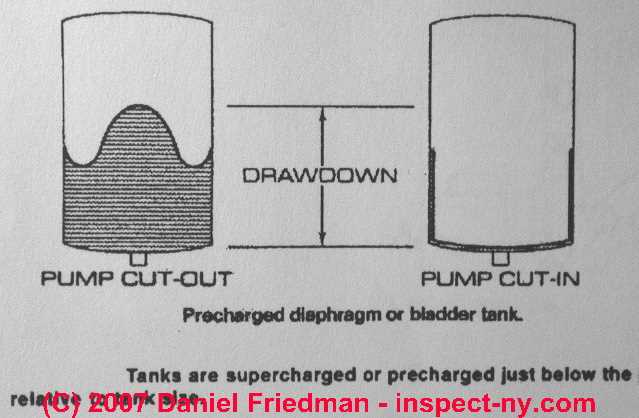
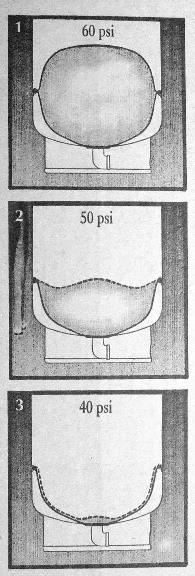
Our sketch at left, courtesy of Well-Rite water pressure tanks [Flexcon Industries] [2] Illustrates how air in the upper portion of the tank compresses water in the flexible tank bladder, acting as a spring to push water into the building water supply piping system during the draw-down cycle.
You'll note that at the end of the 40/60 psi draw-down cycle illustrated, the volume of water in the tank is nearly zero.
Fixing or getting rid of a waterlogged collapsed-bladder water tank:
as we mentioned above, it's also possible that the torn bladder will stick to the water outlet opening, blocking water from leaving the water tank. The result will be short cycling of the water pump.
We discuss water pump short cycling at WATER TANK REPAIRS. In any case the drawdown volume will be reduced and it's likely that this misused water tank will rust through soon.
Water tank bladder replacement:
on some water pressure tanks, the water tank can be disassembled and the bladder replaced. You might want to ask your plumber to try this repair before replacing the entire water tank assembly.
Bladder replacement will involve draining water from the system and removing the water tank pretty much as if the whole tank were to be replaced. Suppliers such as Wessels offer replacement bladders for some models of expansion tanks and hydropneumatic tanks. In general, if you're going to hire a plumber to do this job, we recommend replacing the whole tank.
Problems with an outdoor faucet installed between well and pressure tank
Reader Question: Gary said:
I have an odd situation, my neighbor's set-up is... she just had a new well and pump put in 5 years ago. She called me the other day fearful that her well was dry. (the problem with her first well!) I checked the system and the problem was, as she turned on an OUTSIDE faucet, one that is between the pump and the house, the water would run for 5 minutes then stop.
After 2 or 3 minutes the pump would come on ands pressure would build back up. I replaced pressure switch and pressure gauge and inside the house the system works great! Ran all faucets inside, pressure dropped to 40PSI, switched turned on the pump, back up to 60PSI and shut off.
This ran for several cycles with no problem. Then we turned on the OUTSIDE faucet again, same thing happen. Ran FULL BORE for 5 minutes, pressure dropped to 40 then ZERO and nothing for 2 or 3 minutes until it kicks back on. I feel like the pump is shutting itself off to prevent overheating but not sure why the pump is not kicking on at 40PSI. Any help is greatly appreciated! Thanks Gary 5/26/2014
Reply:
Gary,
Nice going on the debug work done so far.
If you can take a look at the water for sediment or debris level and find that it's high, it's possible that even the new pressure switch is being debris-clogged.
Reader follow-up:
Thanks Dan. We live in a high sediment/iron area (Triad of NC). She has a whole house filter plus a backwashing iron filtration system. She just had (three months ago) the iron system cleaned/regenerated. Of course is all 'post' the pressure tank.
However, when I replaced pressure gauge and switch, I opened the shut off valve from the house ever so slightly to allow water to drain back toward the tank it flowed well through both stems off the line. Also, after turning on the outside faucet and the switch NOT cutting on as it should we retested the system from the inside, flushed toilets and opened faucets and it worked like a charm.
I feel it has something to do with that outside faucet. It is not attached to the house, as it is a frost proof faucet 50 feet from the well near a plant bed which is 50 feet from the house. Is it possible that the outside faucet is creating a pressure issue? Thanks again.
Reply:
Undaunted by the warning not to speak beyond one's competence I note this as a working note not an answer: the water pressure control switch companies tell us to install the switch as close to the pressure tank as possible.
Readers have wondered what difference it makes - thinking that water, not very compressible, should transmit system pressure uniformly through the system regardless. I haven't yet found the reason for the "close to" advice but your report might be a clue.
What if, for example, a check valve on the house side is preventing the water pressure drop in the outside faucet line from being transmitted to the control.
I need a schematic: what are the relative locations of
 Well, piping to building, pump, pressure tank, pressure control switch, outside faucet.
Reader follow-up:
5/29/2014 Gary said
Let me work on that schematic. I am by no means a plumber so I ask this question from a "ignorance is bliss" perspective.
[Click to enlarge any image]
But, is it possible for the faucet to exist and work BEFORE the pressure tank? As I understand the workings of a well system, I thought the water ran from the well to the pressure tank with aid of the pump and that the pressure in the tank 'pushed' the water though out the house.
If the faucet is off the 'main line' from the well to the house, how would that even work?
Reply & Reader Comments:
Well it's nice and neat but I've become still more brain damaged trying to figure this out.
Let's see if we can just write down the sequence of connections or figure out the piping by some tests.
Tell me what's incorrect in the following:
1. Your actual pump is in the well - a deep well pump, either a submersible or a 2 line jet pump (as I don't see "pump" in the aboveground components list)
Correct. A deep well pump. (maybe 200+ feet, with excellent flow)
2. The pressure tank and switch that control the pump are remote from the well, presumably indoors
Correct. Yes the tank and switch are in the basement approximately 100 feet from the well
3. The pressure tank supplies water to the building through a water filter and iron filter
Correct. The water enters the house through the wall of the basement right at the tank/stitch.
4. We are not sure how water is delivered to the remote outside faucet
Correct. It is between the pump and tank in the lawn.
4.1. look indoors for a shutoff between pressure tank and outdoor piping that you can confirm (by closing it) shuts off the outdoor faucet
There is a shut off valve right at the tank for controlling flow to the house. If I shut that off and water still comes from the faucet it must bypass the tank. I will try that over the weekend.
4.2 If there is none then possibly in an odd piping arrangement the outdoor faucet is floated on the line between pressure tank and well
This is possible. I can determine by shutting off the in-flow valve to the house. I will try that over the weekend.
If 4.2 is correct then if there is a check valve near the pressure tank, that would make the pressurized water flow just "one way" from well into tank and on to building. If this were the case then if the pump is not running (pressure switch says it's at cutoff pressure or pressure has not fallen to cut-in pressure) you will see only a brief burst of water at the faucet (from what's in the piping) before flow will drop to zero.
But flow should continue again if enough water is run in the house to cause the pump to turn on.
If this is the case it's a troubling set-up.
Reader follow-up:
I believe there is a check valve right as the well pipe comes into the house just before the tank. It looks kind of like the attached image, except longer and more rectangular in shape. This sounds like the possible culprit.
If the faucet ‘floats’ between well and tank and there is a check valve preventing back flow, where does the pressure come to force the water from the outside faucet? Could the check valve need replacing?
Reply:
all of item 4 makes me suspect the faucet is on the well line between well and house. That would have worked in the past if there were no check valve in the house, just in the well (which is a common design).
But if someone replaced parts, added a check valve in the house (say because the foot valve in the well was losing prime) that would or could result in the snafu you describe currently.
If you get no water at the faucet and then do get water when use of water in the house causes the pump to turn on, that'd be confirming.
Reader follow-up:
I’ll do that check over the weekend. If it looks like the faucet is floated between the well and pump, should the check valve be removed? Just wondering what the fix might be.
Reply:
Removing the check valve at the pump will probably let the faucet work again, but if the check valve was added to counteract a failed footvalve in the well you'll find that the system loses prime.
Still, going back to your initial remarks, you have water running "full bore" for several minutes, then pressure drops down, then pressure stops entirely, then after a "rest" the pump and pressure appear to recover.
To me this sounds like a debris-clogged pressure control switch, with the effects showing up more severely at an outdoor faucet floated on the line between well and pressure tank. That's because the volume of water in the well piping would not be likely to be enough to give 4-5 minutes of water at the outdoor faucet.
Reader Comments, Questions & Answers About The Article Above
Below you will find questions and answers previously posted on this page at its page bottom reader comment box.
Reader Q&A - also see RECOMMENDED ARTICLES & FAQs
On 2021-03-11 by (mod)
@Karen Prater, I haven't seen any research suggesting either
On 2021-03-11 by Karen Prater
What chemicals are leached into the well tank water from bladders versus fiberglass lined tanks?
On 2020-12-16 by Mod
It's possible that the bladder has a leak and the tank has now trapped water out of the bladder and in its air space.
Turn off the pump, drain the system water pressure and gently rock the tank; if it's still heavy it's water-logged and needs repair or replacement.
On 2020-12-16 by Chris
I am experiencing very low water pressure and bladder pressure was near 50 psi. Sound like it has equalized? Needs replaced?
On 2020-11-15 by danjoefriedman (mod) - the pump won't turn off
that sounds as if the pump is damaged or the well has run dry or there is a major leak in well piping
On 2020-11-15 by Frank
I am on a private well with submerged pump which worked fine but after being gone for a couple days i am now experiencing problems.
The pump won't turn off, the tank pressure gauge stays just above zero, water tank has plenty of water, probably even too much.
Cut power, drained tank, cleaned points which are in poor shape, closed valve between tank and house then turned on power.
Was able to get pressure up to 9psi but thats it and cut power again to preserve the pump. Any ideas?
On 2020-09-07 by younus m
air pressure up and dwon garden line i replace the pressure switch tank side noise
On 2020-07-02 - by (mod) - water tank air pre charge set to 2 psi below the CUT IN Pressure.
The tank air pre charge is set to 2 psi below the cut in Pressure.
Typically the pressure is set to 20 or 30 psi cut in and 40 or 50 psi cut out.
On 2020-07-02 by Larry
how much pressure should be on a 20 gal. horizantle holding tank well is 300ft deep under ground pump
On 2020-06-04 - by (mod) - Check the water pressure tank air pre-charge
Jeff
Check the water pressure tank air pre-charge when there is no water pressure in the building and the pump is off. The pre-charge should be 2 psi below the pressure control CUT IN pressure setting.
On 2020-06-04 1 by Jeff
I installed a new holding tank and new switch and the tank is not filling up with water the way it should.
The holding tank is completely emptying before it fills with water; so I have to wait 10 minutes or so before I get water again. What do you think I should do? thanks, Jeff
sorry e-mail for Jeff is catbaker25@outlook.com
Question: why is it taking a long time for the pump to get up to the cutoff pressure after installing a new tank bladder?
(Aug 31, 2014) Carl said:
Hi.
Having just drained my system and installed a new pressure regulator and bladder on my pump and pressure tank, the pump is taking more than half an hour to get to the 50 PSI cutoff. It may indeed have taken a while to refill the bladder, but I was getting concerned and so unplugged the pump. The new regulator is a 30/50 cutoff, while the old one was 40/60.
If I had, say, 38 PSI in the tank, what effect would this have with the new 30 PSI cut-on? From your previous answers, I'm guessing it would just be lower water volume and cause more frequent cycling. I can't see why it should be taking so long to charge.
Reply:
Carl, look for
a damaged or clogged foot valve or strainer, a damaged pump impeller, low voltage, or leaks in the well piping
See WATER PUMP WONT STOP RUNNING
Question: air in water lines spits and sputters
(Sept 1, 2014) dan said:
there is air in my water lines and spits and sputters when water is running
Reply:
Dan
We diagnose this spurting air problem
at AIR DISCHARGE at FAUCETS, FIXTURES
let me know if questions remain
Question: Flotec well tank pressure gauge location
(Sept 9, 2014) Venold Johnson said:
I have a flotec well tank, but no water enters it, I adjusted tank pressure but it hasn't work. Do I have to place pressure gauge after cut-in switch
Reply:
Venold
The pressure gauge won't impact whether or not a water tank fills as it should.
Look for a tank bladder that has collapsed and stuck to itself or debris clogging the tank inlet.
Question: RL 20 pressure tank seems to run every few minutes
(Sept 29, 2014) daryl said:
my RL20 pressure tank is on every 4 min
(Oct 28, 2014) Anonymous said:
My pump is cycling every 3 to 4 minutes. I drained the pressure tank and put in 38psi of air and now it only cycles every 10 seconds. I believe it should only cycle every 20 to 30 seconds. Did I put in too much air or not enough?
Reply:
See the diagnosis and repair at WATER PUMP SHORT CYCLING - home
Question: bladder tank pump system worked fine until we had a burst water pipe
Hi there, we have a bladder tank pump that was working perfectly ok until Friday night when a pipe in the kitchen burst, and all the water was turned off. Now the pipe is fixed and the water back on, but the pump will only run for a few seconds and then goes off.
It also isn't pumping much, if any water into the cold water tank in the loft (just a trickle running into it, mostly after the pump has switched itself off), and the other problem is, there is no water from any of the hot taps in the house.
The hot water tank is full. All valves had been turned back on.
Even running the cold taps won't make the pump come on and stay on. It's currently sitting at approximate 2bar, and when it runs, it cuts out at 3bar.
These figures are usual for our pump. Any clues on why its cutting out too early and why there's no water coming from the hot tank to the tanks? Any advice gratefully received! - Jack
*Sorry, that last line should say "Any clues on why its cutting out too early and why there's no water coming from the hot tank to the taps?"
Also should add that the cold tap in kitchen feeds straight from the pump, but running the cold tap doesn't make the pump stay on either.
Reply:
Jack I wonder if the burst pipe water flow rate stirred debris in the system and clogged the pressure sensor switch. Sorry not to have replied sooner, we were deluged with questions
Question: Buried water pressure tank, now the tank seems waterlogged
Hi. Very informative site. I have a well system that was put in 6 years ago. The bladder or diaphragm tank was buried according to my installer because my double wide had no basement. He also told me the tank would be good for about 20 years.
Recently, I've experienced the symptoms of a waterlogged tank, and after discussing it with the installers front office find they warranty for 5 years (a long way from 20, but I'm certainly not calling them for any further work). 2questions: I'd like to install a new tank in an insulated box under the double wide--is this ok? I'm also wondering if I can just use the existing line coming out of the ground and temporarily not worry about digging up the old tank and rerouting the line. Thanks for any help. - Anonymous
Reply:
Anon: in my OPINION, no one in their right mind would bury a conventional water pressure tank. The tank is not intended for being buried nor for soil contact, nor are its safety controls such as the pressure relief valve that should have been installed at the tank, nor are the pressure sensing controls that should be installed at or close to the tank. Such an installation cannot be serviced.
When you dig up and replace your buried water tank, if it cannot be installed inside the building in a dry heated space, it can be installed in a dry, covered, but accessible "well pit" as was common practice at well heads before the pitless adapter was invented.
Question: water pressure starts strong but quickly falls off to nothing - what might be wrong?
When we first turn on outside faucet near well house we have alot of water pressure, then it goes down to a trickle in a few minutes. Also when we have this outside faucet on, we don't have any water in the house. Our pressure tank feels empty, could the bladder be collapsed? If it is collapsed, is there a way to get it un collapsed or do we need to replace it? - Jorg
We were also wondering if the pressure switch could be causing the drop in pressure?
Reply:
Jorg:
Jorg about the water pump pressure control switch, a bad switch will fail to turn the pump on or off at the proper time; if it were improperly adjusted it might appear to work but lead to lower water pressure.
take a look at the article
titled WATER PRESSURE PROBLEM DIAGNOSIS TABLE
Often when water pressure and flow are good at first but then fall off quickly, either the piping is clogged or the water pressure tank is water logged.
Question: Why is there red cap over our water tank air valve?
Why is there red cap flush mounted inside of the air valve? It blocks access to the stem valve. - Lawrence
Reply: The red cap prevents accidental release of or change in the water tank's air charge
Lawrence,
The red plastic cap on the air valve on your pressure tank is intended to prevent an amateur from messing with the tank's pre-charge of air pressure.
On many internal bladder type water pressure tanks, the water tank is provided from the factory with the manufacturer's recommended air pressure pre-charged in the tank. The manufacturer doesn't want someone accidentally letting the air out or otherwise messing with the air pressure charge if they don't know how it should be set.
Provided you follow the manufacturer's instructions about adjusting the pressure in the water tank, you can remove the red guard to access the air valve itself.
Question: how to troubleshoot air in water lines - collapsed water tank bladder as a cause?
Hi, What a helpful site. We have been experiencing intermittent air in our water lines, and yesterday had the well company come out.
They repaired a couple things: pinhole found in pipe just above the submersible pump (which is 24 years old but appears to be running well). Also a weird bleeder valve arrangement that is no longer needed, and which he replaced with a brass check valve.
Put everything back down in the well and ran the water, seemed okay. However since then we notice very low water pressure, and when the water is on the pump is short-cycling. From reading your articles, I checked the water tank (well-x-trol) and am able to rock it with gentle pressure, leading me to believe there is no water in it.
The pressure gauge is at 60%. My question is, is a collapsed bladder a common result of draining all the water from the system? And I guess the real question, is this repairable or do we need a whole new water tank? Thank you. - Sara
Reply:
Sara,
I haven't run across collapsed water pressure tank bladders due just to emptying the system of water, though I could imagine that if a tank were left empty for some time, the bladder might stick to itself.
Bladders in at least some water pressure tanks are replaceable - some readers have reported success in doing so. Replacement involves shutting down and draining the system, and most likely disconnecting the tank to upend it to gain access to a removable panel through which an OEM replacement tank bladder is installed.
Amtrol is the producer of Well X Trol water tanks. Looking at their list price catalog I don't see replaceable bladders for their water pressure tanks.
See AIR DISCHARGE at FAUCETS, FIXTURES for help in diagnosing and fixing the air discharge in your water piping and fixtures.
Question: water tank removal: how do I abandon a well and water pressure tank when switching to municipal water supply
I have had a water well plumbed and changed to a public water. the blue tank i was told was not in use,,though there was a leak from it. eventually it got rusted and at the end and let away the water from my public connection out. i had to turn mains off..what is going on if this belly tank only belongs to the water well, which is not in use. - Reosemary
Reply:
Rosemary, if you have switched from well water to municipal supply, ALL of your old water input/supply equipment should have been taken out of your water supply system. That's because the municipality worries that contamination in a private residence's equipment could back-contaminate the public water mains.
So typically the plumber connecting up the municipal water supply would connect it at a point in your house cold water supply piping past the original well water supply pressure tank outlet, and the plumber would also cut off your equipment piping from your house plumbing.
If s/he failed to do that, that would explain why a leak in your old water tank meant you had to shut off your municipal supply to fix it.
There are exceptions to this rule if a water pump and pressure tank are in use in a home to BOOST municipal supply. But even if your old well pump and pressure tank were being used to boost municipal supply pressure, your well line can no longer be connected up to that system.
Finally, some homeowners keep the old well, well pump, and pressure tank, but keeping completely separate from the house water supply piping, they connect it just to an outdoor faucet for watering lawns and plants.
Question: We have intermittent water pressure and the water smells - is it a bladder problem?
We are currently experience intermittent water pressure and water has slight smell. In conversing with other people thought our holding tank might have had issues w/the bladder. We haven't lost water completely and as of last night was on full pressure. Any ideas on the problem? - Karin Wilson
Reply: Diagnose the cause of intermittent water pressure first, and smell second
Karin
I'm not sure what to diagnose from your description; there could be a less-than-obvious connection between a water smell and water pressure in that in some wells, when the water level in the well drops (as it may seasonally especially in the dry season) there may also be an increase in odor in the well water as different rock fissures and different components of the aquifer feed into a typical drilled well at different depths.
Certainly we've seen that sulphur odors in well water can vary seasonally.
You could also have a problem with bacteria in the water supply or growing in the water pressure tank.
To be more diagnostic we need to understand if your "intermittent water pressure" means that at different times of the day water pressure is poor versus poor or inadequate water pressure during different portions of the pump cycle (typically just a few minutes).
If it's the latter, then we might try addressing the complaint with an adjustment to the pressure switch to slightly narrow the gap between cut-in and cut-out pressures.
But if the water pressure failures are intermittent during the day, it sounds like there may be a well flow problem.
Question: why is my well and pressure tank water draw-down cycle only giving me 2 gallons of water before the pump has to turn on - short draw-down cycle troubleshooting
I have a private well with a new 7-8 GPM pump set at 300ft installed last year. I have been trying to test our 15 year old pressure tank. It is a WellxTrol WX-202 20 gallon that states it should have a draw down of 6.8 gallons. I have no pressure or flow problems and my pressure switch is set to 30/50.
I ran a draw down test with my garden hose and nozzle hooked up to an outside faucet and only got 2 gallons before pump turn on (at 30psi) into a volume marked pail, but the draw down time was about 1 minute 30 seconds. Time from cut-on to cut-off (50psi) is about 15-20 seconds. There is no short cycling, at least from cut-off to cut-on and we get consistent pressure and flow.
Why am I getting only 2 gallons on draw down? Is there a problem? - Peter
OK, new information after an additional test this morning. I flushed a low volume toilet and the water tank pressure immediately went from cut-off (50psi) to just above the cut-in pressure of 30psi, then as the volume of toilet flow slowed the pressure slowly went down to cut-in pressure. I'll test the tank air pressure later but it looks like I need a new pressure tank. - Peter
Reply: check for a waterlogged water pressure tank, check the air volume controls, add air to the pressure tank
Peter, your description sounds as if the water tank is waterlogged - has lost its air charge.
See WATER PUMP SHORT CYCLING DIAGNOSIS TABLE for help in confirming and diagnosing both short water draw down cycle (too little water before the pump turns on) and frequent pump on-and-off cycling.
And see WATER TANK AIR, HOW TO ADD for help in getting air back into the pressure tank.
Reader follow-up: trying to get air into the water pressure tank
I drained the pressure tank from the well head so that the pressure gauge showed zero. Then tested pre-charge and found it to be less than 10psi. I added enough air to get 28psi (cut-in 30psi) then tested the performance. From zero to cut-off took much more time than before, at least double (guesstimate), and when I flushed the same toilet the pressure went to 42psi, not the 32psi I got before. So defiantly the problem was too little air pressure.
I don't know where the air went though? One thing I noticed was that as I was filling the tank with air the water pressure gauge also went up and I found I had to open the well head tap to get back to zero. This seemed to clear out and I can only assume that the bladder did not fully collapse until air pressure was added.
I re-checked the tank pressure after I had opened the well head tap and the pressure held at 28psi, so I think my bladder may be OK and not (at least completely) ruptured. I'll check the pre-charge in a couple of weeks but I think for a 15 year old tank I'll just replace it anyway. The original plumber only used the smallest marginal tank so I'll go bigger for more draw down. - Peter
Reply:
Peter if you drain water out of a pressure tank down to low or "zero" pressure, that does not alone assure that you've actually gotten air to enter the tank. It could be still nearly full of water but at little or no pressure. You should be able to see at least 30 seconds of draw-down at a typical faucet before the well pump has to turn on. Or taken another way, a water pressure tank is rated for an "equivalent" draw down volume of water, typically 10 gallons or higher, if the tank is properly installed and air-charged.
Question: air comes out of well water lines
(Jan 3, 2012) Jeff said:
Am I happy I found this site, Thank you.
My well water lines intermittently burp air (particularly from the hot lines) and is increasingly becoming worse. I watched the well pressure gauge while an air incident was occurring, and saw the gauge drop down below the cut-in PSI of 40, even though the pump cut in at 40 as it should. There is a plastic device (brown, bell shaped, with a brass bolt in the top) between the well head and the bladder tank. What is it, and what occurs if it goes bad? Any help at all would be greatly appreciated.
Reply:
Jeff Search InspectApedia using the on-page search box for
AIR DISCHARGE at FAUCETS, FIXTURES - that article should help you track down the source of air burps from your water lines.
Send us a photo of the device you are asking about (see our CONTACT link at top, side or bottom of web pages) for details, but it sounds as if you are describing a water pressure regulator.
Question: lose water pressure at faucets but tank pressure goes up when the pump runs
(Jan 4, 2012) Dave said:
Having issues on that the new pressure tank set at 28 psi and the switch is 30/50 and when pump is turn on the tank pressure increases at the same readings on the water gauge. Lose pressure at faucets and tank pressure drops the same time. Solution?
Reply:
Dave, sorry but I don't understand your question.
try the diagnostis at
WATER PRESSURE LOSS DIAGNOSIS & REPAIR
or tell me more.
Question: water tank full of rust and lime
(Jan 18, 2012) linda F. said:
My badder type tank seems to be full of rust and probably lime. I put on a whole house filter but in two weeks I am getting gray water in the dish pan again. Can a bladder be cleaned out? my pressure is good until the filter gets plugged
Reply:
Linda:
an internal bladder type tank can be cleaned out but with difficulty - just trying to run water in from the well and out through the tank drain can be tedious and slow to have effect; Disassembly of some bladder tanks is possible;
I'd look into where the debris is coming from; perhaps you need a water filter.
Question: likes fiberglass, non-bladder type water tanks
(Mar 6, 2012) bryan said:
it seems like a fiberglass epoxy non bladder ( conventional) tank with periodic air adjustment would last the longest. other than physical damadge i dont see what could go wrong with it.
Reply:
Bryan: maybe aggravation trying to keep the proper air charge in the tank.
Question: stain on water pump - leaking
(May 15, 2012) Melanie said:
i have what looks like a large water stain on the front of my steel water pump tank in garage, unit is 2 yrs old, system works fine but think it is leaking, any ideas?
Reply:
Melanie, I think I'd need to see a photo to understand what you are asking about. If the tank is leaking through the steel, not at a fitting, it needs replacement.
Question: pump bursts water line
(May 19, 2012) Sara said:
I have a above ground pump in my shed to water my yard. I replaced the pump a few days ago as I forgot to drain last fall and the pump frooze. Anyway, I have the new pump all connected and primed and after the underground sprinklers fun for awhile, the water line burts from the discharge line causing water all over inside the shed.
I have cleaned out the check valve which had leaves but it continues to do this. What is the problem?
Reply:
Sara, your message does not and perhaps couldn't contain enough information for a reliable guess, but I can suggest that you check that the pump is operating at the right pressure, or if a water pressure regulator was previously installed, that it too was undamaged by the freeze-up.
Then check that your piping connections are made properly, and finally, that none of your water outlets is blocked. If there is a pressure gauge on the system watch to see what pressures are being developed.
Watch out: if you are over-pressurizing your water system due to an improper pressure control switch or a failed switch, the system is dangerous: a tank or pipe can burst, in juring someone.
Question: pump won't turn on
(May 30, 2012) Tammy W. said:
Have been experiencing little to no water pressure within the house. Pump won't turn on. Power is good.
Pressure from the well to the house is good. We have a 20 gallon tank, installed a new square D 30/50 pressure switch and still the pump won't turn on. Could it possibly be a collapsed bladder?
Reply:
Tammy W., if your well pump wont' operate the cause would not be a collapsed bladder in the pressure tank.
But if you installed a new pressure switch atop an old small diameter mounting tube, or if your system has a flexible copper or plastic tube conducting water pressure from the pump to the sensor port on your pressure switch, it could be blocked.
If the switch does not sense the drop in water pressure when you open faucets to run water, the pump won't operate.
A service tech can test for this condition by observing that pressure drops in the water system, that the switch does not turn on by itself, but that the pump will operate if the switch relay is manually closed. WATCH OUT FOR SHOCK and ELECTROCUTION HAZARDS - don't touch electrical parts or connections.
Question: New Bladder Tank Smell
(May 31, 2012) New Bladder Tank Smell said:
I recently installed a standby water tank system as backup to the local water supply. The system employs a DAB 1hp pump and a 50lt Foras horizontal bladder tank. Ive been noticing a strange smell in the water which lasts for about a minute when you let the water run for a short period, then disappear for the most part.
Diagnosis has led me to believe that the smell comes from the water that is held in the bladder and then injected into the house supply. Have you ever encountered a brand new bladder causing/adding a scent to a system? The bladder/sys seems to work perfectly. It is a very annoying almost rubbery/plastic/chemical/sulphury scent. Brand new water system.
Reply:
Water odor diagnosis: no, I have not come across reports of water odors traced to a new water pressure tank bladder, though depending on materials in the system I wouldn't rule it out completely. You could try completely draining the water tank and refilling with fresh water.
If you make that experiment after the tank has sat unused for 24 hours the water coming out of the tank during draining can be smell-tested to see if in your opinion it exudes the odor you are diagnosing. Then fill the tank, drain some water out and sniff that - fresh water sample for comparison - that may permit you to include or exclude the well water source and piping as a possible contributor to odors.
Question: wierd pump pressure gauge behaviour
(June 9, 2012) Brian said:
I just installed a 20 gallon internal bladder type well tank because previously water was "spitting" out. Set the internal pressure to 2psi below the 30psi cut in. After installation, current water pressure seems to be fine, but the pump is short cycling. I have a 30/50 pressure switch. For some reason, the pressure on the gauge rests at 35psi when no water is being used. When I turn on water, it gradually decreases to 30psi, then the pump turns on.
The gauge then jumps to 45psi, and gradually rises to 50psi, as I am assuming water is being pumped into the tank.
Once reaching 50psi, the pump turns off, and pressure immediately drops to 35psi. Then gradually decreases to 30psi, then pump turns on. This cycle continually repeats itself on short intervals. When I feel the tank at 50psi, it is empty, or nearly empty of water. I am not aware of any leaks. I have turned of the water line to house, and water pressure remains constant, so I'm guessing there is no leak on well side of line. Any ideas?
Reply:
Brian, I suspect that debris has clogged both your pressure gauge (try tapping it gently) and the pressure sensor port on your pump pressure control switch. Clogs at those locations can leave the gauge reading pressure higher than the true pressure in the system (or vice versa), and can prevent the pump control switch from operating properly.
Question:
(July 3, 2012) Jim Copeland said:
Iam confused by the "inline pressure tank" and a regular tank, please help as I am trying to set up a system.
(July 4, 2012) Judy J said:
We have a motel and run a Sears Shallow well jet pump to an 80 gal captive air tank to boost city pressure. We jacked up the pressure switch to 60/80, but we still get down to 20psi every morning. I noticed when we checked the air pressure on the tank that a small amount of mist comes out. Is the only way to check for a burst bladder to turn off the water, drain the tank and look for zero air pressure when the tank is empty? Thanks!
Question: water pressure surges & loud noises from water tank
(July 6, 2012) James said:
Hello, I live in a 3-story, 6-unit condo building in Chicago. We have a large Well-X-Trol pressurized bladder tank. Recently, my neighbors and I have noticed extreme increases in water pressure. So much so that the lines to my washing machine start shaking when I do a load of laundry, and that it seems to be close to overwhelming my shower drain. We have also noticed the noise of the tank running to be loud and frequent. It seems to be running at least 30 minutes out of an hour.
The tank is 5 years old and we never noticed this before. In the meantime, we have closed off the valves to the tank and have been running just on city pressure - which is actually fine, I'm not even sure why we need a booster. We had someone come out to look at the tank, and said that it seemed to be working properly it is set at 40/60.
But if it is currently working "properly" - why is it running so much and why is the pressure so extreme? It seems to be very hard to find someone who really knows about these issues, so I appreciate any help!
Reply:
James,
Check the actual water pressures at different times using a gauge. Check for varying municipal pressure. And check for a sticking pressure control switch at the pressure booster pump and tank. The tank itself won't cause high water pressures.
WATCH OUT: if the water pressure tank lacks a pressure relief valve your system is unsafe.
Question: pump cycles on when no water is being used
(July 20, 2012) Trish said:
My WellMate has started turning on and off every few minutes even with no water being used. The pump is rather loud when it turns on and off. It goes from 45psi to 30 psi when it switches on and off. Is this a sign my pump is failing and about to go out? Thanks.
Reply:
Trish please Use the on-page search box at the top or bottom of this page or at page top and search InspectApedia for
Water Pressure Intermittent
and you'll see the diagnostic/repair article for the problem you describe
Question: winterize a water tank with no drain plug, getting a water tank to drain
(Sept 17, 2012) John Kerr said:
I have a horizontal 5 gal water tank with no drain plug in the bottom...how do I winteize
(Oct 14, 2012) Anonymous said:
trying to drain bladder tank for winter storage,will not drain!!
Reply:
If there is a tapping, install a drain;
IF there is no tapping check that this tank is permitted to be installed horizontally. If not it will not work properly , especially if it's an internal bladder tank.
Pumping air throught the system can sometimes help winterize pipes and tanks but really the right approach is to install equipment that can be drained.
The alternative is to keep heat in the area.
See WINTERIZE - HEAT OFF PROCEDURE
Anonymous: open one or more nearby water valves to allow air into the piping system to help get the tank to drain.
Other possibilities:
As this is an internal bladder type tank I suspect that
. The bladder has burst and is sealing the tank outlet
. The tank has a leak or leaky air valve and you've lost the air charge that otherwise would push out the water
Is there pressure in the system?
Question: pressure drops when no water is running
(Sept 28, 2012) nancy said:
water pressure drops when no water is running. as soon as i turn the pump on and the pressure switch shuts off the pressure drops
(Sept 28, 2012) mickey said:
I have just replaced a bladder in my truper 1hp pressurised water tank system but cannot seem to be able to repressurise the system, even though I appear to have no leaks.
Unfortunately the paperwork that came with the system is written in Spanish,which I do not understand and the manufacturers have not answered by questions. Any suggestions would be welcome. thank you - mickey
(Oct 8, 2012) Khaleel said:
The bolted seal on the underside of the water pressure tank is leaking. can i simple open it and re seal it? if so, what kinda of sealant to use?
(Oct 9, 2012) essie bivens said:
Just replaced bladder water tank. everything worked well for the first day. Came home from work the next day and no water. As if it is running out of water. Is this well or water tank issues
Moderator reply:
Usually, if we are CERTAIN that no water is being run in the building and no building water pipes are leaking, then this symptom means that there is a failed check valve or foot valve: water from the tank leaks back into the well.
Question: bacteria in the water tank?
(Mar 10, 2013) Bill Russell said:
You mention that Karin might have bacteria growing in her water pressure tank.
We have a nasty smell in our water at various points. We shock the well, and it goes away for awhile, then comes back at various faucets throughout the house, though not all at the same time. We're wondering whether the pressure tank (Gould, installed in 2000) might be where the bacteria is growing. How would we tell?
Bill
Reply:
Bill,
You want to do some diagnosis on the nasty smell - starting with a water test. If the odor is from sulphur, for example, you'll want a treatment system. Shocking a well can somewhat reduce sulphur odors as can a chlorinator but if the levels are high you need more effective treatment.
...
Continue reading at WATER TANK BLADDER PRESSURE ADJUSTMENT or select a topic from the closely-related articles below, or see the complete ARTICLE INDEX.
Or see WATER TANK BLADDER DIAGNOSTIC FAQs-2 - diagnosis & repair questions for water pressure tank bladders
Or see these
Recommended Articles
- WATER PUMP & TANK I&O & REPAIR MANUALS - installation, operation & repair guides for all brands
- WATER PUMP SHORT CYCLING CAUSES
- WATER TANK BLADDERS & CAPTIVE AIR TANKS
- WATER TANK DIAGNOSIS & REPAIR - home
- WATER TANKS, STEEL - tanks that do not use an internal bladder
Suggested citation for this web page
WATER TANK BLADDERS at InspectApedia.com - online encyclopedia of building & environmental inspection, testing, diagnosis, repair, & problem prevention advice.
Or see this
INDEX to RELATED ARTICLES: ARTICLE INDEX to WATER SUPPLY, PUMPS TANKS WELLS & SPRINGS
Or use the SEARCH BOX found below to Ask a Question or Search InspectApedia
Ask a Question or Search InspectApedia
Try the search box just below, or if you prefer, post a question or comment in the Comments box below and we will respond promptly.
Search the InspectApedia website
Note: appearance of your Comment below may be delayed: if your comment contains an image, photograph, web link, or text that looks to the software as if it might be a web link, your posting will appear after it has been approved by a moderator. Apologies for the delay.
Only one image can be added per comment but you can post as many comments, and therefore images, as you like.
You will not receive a notification when a response to your question has been posted.
Please bookmark this page to make it easy for you to check back for our response.
Our Comment Box is provided by Countable Web Productions countable.ca
Citations & References
In addition to any citations in the article above, a full list is available on request.
- [1] Rasmussen Well Drilling, Inc., 1793 Hwy 61, Two Harbors MN. Jeremy Rasmussen provides third generation well drilling and plumbing services on the North Shore of Lake Superior. Photos by DJF. Tel 218-834-3387. Email: rasmussenwell@frontier.com
Quoting: We serve the north Shore – Lake, Cook, St. Louis, Carlton and Pine counties, including Duluth, Grand Marais, Clouqet, Carlton, Finland, Isabella, Silver Bay, Grand Portage, Saginaw, and everywhere in Northeastern Minnesota. - [2] Well-Rite water tanks. Well-Rite water tanks are produced by Flexcon Industries, 300 Pond Street Randolph, MA 02368 Tel: 781.986.2424, based on manufacturer data provided on the shipping carton for a 44 Gallon / 170 Liter internal bladder water pressure tank during installation in Northern Minnesota, September 2011.
- Thanks to Jeremy Houser who suggested that we needed to clarify the difference between bladder type and non-bladder type water tanks when discussing air charging and diagnosis of water tank repairs.
- Thanks to reader Steven Prior for discussing water pressure tank location, water filter location, and for the water tank air valve photo - July 2010.
- Amtrol Extrol™ pressure control tanks used on hydronic heating and other systems such as models 35LBC, 50 LBC, 85 LBC, and 100LBC to 600 LBC also use a bottom bladder containing air - see amtrol.com/pdf/LBCSeriesEXTROL9017-095.pdf for details.
- Mark Cramer Inspection Services Mark Cramer, Tampa Florida, Mr. Cramer is a past president of ASHI, the American Society of Home Inspectors and is a Florida home inspector and home inspection educator. Mr. Cramer serves on the ASHI Home Inspection Standards. Contact Mark Cramer at: 727-595-4211 mark@BestTampaInspector.com
- John Cranor [Website: /www.house-whisperer.com ] is an ASHI member and a home inspector (The House Whisperer) is located in Glen Allen, VA 23060. He is also a contributor to InspectApedia.com in several technical areas such as plumbing and appliances (dryer vents). Contact Mr. Cranor at 804-873-8534 or by Email: johncranor@verizon.net
- Thanks to Jeff Garmel for discussing clarifications on water pressure tank testing and diagnosis, 8/24/2009.
- Thanks to Bill Kortebein for discussing dealing with a water-logged collapsed bladder water pressure tank 07/24/2010
- Rasmussen Well Drilling, Inc., 1793 Hwy 61, Two Harbors MN. Jeremy Rasmussen provides third generation well drilling and plumbing services on the North Shore of Lake Superior. Photos by DJF. Tel 218-834-3387. Email: rasmussenwell@frontier.com
Quoting: We serve the north Shore – Lake, Cook, St. Louis, Carlton and Pine counties, including Duluth, Grand Marais, Clouqet, Carlton, Finland, Isabella, Silver Bay, Grand Portage, Saginaw, and everywhere in Northeastern Minnesota. - Wessels Company bladder replacement store was found at westank.com/bladder-tank-store.php on 5/22/2009. Wes sell refers to "shock and surge tanks" as ASME replaceable bladder type and pre-charged hydropneumatic tanks used for commercial, industrial, and well water systems.
- Well-Rite water tanks. Well-Rite water tanks are produced by Flexcon Industries, 300 Pond Street Randolph, MA 02368 Tel: 781.986.2424, based on manufacturer data provided on the shipping carton for a 44 Gallon / 170 Liter internal bladder water pressure tank during installation in Northern Minnesota, September 2011.
- In addition to citations & references found in this article, see the research citations given at the end of the related articles found at our suggested
CONTINUE READING or RECOMMENDED ARTICLES.
- Carson, Dunlop & Associates Ltd., 120 Carlton Street Suite 407, Toronto ON M5A 4K2. Tel: (416) 964-9415 1-800-268-7070 Email: info@carsondunlop.com. Alan Carson is a past president of ASHI, the American Society of Home Inspectors.
Thanks to Alan Carson and Bob Dunlop, for permission for InspectAPedia to use text excerpts from The HOME REFERENCE BOOK - the Encyclopedia of Homes and to use illustrations from The ILLUSTRATED HOME .
Carson Dunlop Associates provides extensive home inspection education and report writing material. In gratitude we provide links to tsome Carson Dunlop Associates products and services.
 | HOME | ABOUT | ASK a QUESTION | CONTACT | CONTENT USE POLICY | DESCRIPTION | POLICIES | PRIVACY | |
| © 2024 - 1985 Publisher InspectApedia.com - Daniel Friedman | |||||||||