
InspectAPedia® FREE Encyclopedia of Building & Environmental Construction, Diagnosis, Maintenance & Repair |
Question? Just ask us! InspectAPedia
|
 Treatment Methods for Contaminated Water
- POST a QUESTION or COMMENT about which type of water conditioner system, water treatment system, or water purifier system you should install - how to choose a residential drinking water treatment method and system
This article describes the various options for correcting unsanitary or unsatisfactory drinking water.
Various water treatment methods for contaminated water are reviewed and the pros and cons of each are discussed.
This series of articles explains many common water contamination tests for bacteria and other contaminants in water samples. We describe what to do about contaminated water, listing common corrective measures when water test results are unsatisfactory.
InspectAPedia tolerates no conflicts of interest. We have no relationship with advertisers, products, or services discussed at this website.
Water Treatment for Contamination, Hardness, Odors, Sediment, Etc: choices of systems, recommendations
A comprehensive list of water treatment articles is provided here. We discuss water treatment methods and we also include water testing and water correction measures warnings for home owners and especially for home buyers when certain conditions are encountered, with advice about what to do when these circumstances are encountered.
Article Contents:
See WATER TESTS for CONTAMINANTS for advice on using a private well for drinking water.
When is it reasonable, desirable, or actually necessary to install water treatment equipment:
- Time does not permit thorough diagnosis
and determination of the source of water contaminants (you have to move in and drink the water, or the bank won't issue the mortgage for a property purchase) - Water potability appears to be unreliable
a bacteria problem may have been temporarily masked or "corrected" by "shocking" the well in the past but follow-up testing suggests that it returns, perhaps seasonally as water tables change.
See "WELL CHLORINATION & SHOCKING - Procedure for Shocking a Well to (temporarily or maybe longer) "Correct" Bacterial Contamination". - There is a persistent source of water contamination
a potability or health issue is in the supplying aquifer - not a condition that can be fixed by repairing a well casing, piping, equipment, or by well shocking. - There is a persistent source of an aesthetic water problem
hard water, sulphur odors (rotten eggs), iron, or other such contaminants. - When people in a residence are at unusual health vulnerability
immune impaired, elderly, sick.
Principal Methods Used to Treat or Purify Contaminated Drinking Water
While we distinguish between having to treat water because it is not potable - that is, the water is not safe to drink, and wanting to treat drinking water because of an aesthetic concern like odor, taste, smell, or staining, it is often the case that the equipment used for one purpose can also address the second set of concerns.
Watch out: few if any water treatment or water purification systems can reliably remove all possible water contaminants that may be present in a water supply or may be contributed by contamination of the building's water supply system & equipment. While a "bacteria test" is a good starting point in checking on the safety of drinking water, a check with local water testing labs (and neighbours) can give critical advice about other contaminants that might be present in your water supply and for which tests should be performed.
See WATER TREATMENT RELIABILTY & SAFETY for details.
- Activated carbon or charcoal water filters:
effective for taste & odor removal including chlorine. Some activated charcoal filters complying with U.S. Standard-53-Water Filter Certification can remove heavy metals such as copper, lead, mercury, chlorine or other disinfectant byproducts, parasites like Giardia or Cryptosporidium, pesticides, radon, VOCs, and certain other chemicals such as dichlorobenzene and trichloroethylene (TCE).
Watch out: if not properly selected, and if not changed or renewed on schedule any filter including charcoal filters can convert from being effective at reducing or removing water contaminants to harboring them and even dispensing them into the water supply.
See WATER FILTERS, HOME USE for a discussion of home water filters used for sediment, odors, etc. - Aeration treatments
for water supply systems involve the injection of air into the water supply. Aeration treatment can reduce some odors and is effective for low to moderate levels of iron provided that the water temperature is not too low. Therefore aeration treatment is more effective in warm climates and where water levels are at a higher pH. Aeration is often combined with a filtration system for water treatment for iron. Aeration is not an effective water purification method. - Boil the water
to make it suitable for drinking.
See BOILING WATER for DRINKING - Bleach the water
to disinfect it: Use chlorine (bleach, sodium hypochlorite) to purify the water. (see warnings just above).
See BLEACH DISINFECTANT for DRINKING WATER - Calcite media filters
Calcite media water treatment filters adjust the pH of the water to make it less corrosive (when the startign water pH is at a pH of 5.5 or less) and also to precipitate ionic iron or ionic magnesium from the water supply so that it can be captured by the water filtration system.
Calcite media filters are used principally when water staining that shows up in the water itself or on plumbing fixtures or on laundered fabrics is itself traced to rusty or corroded water mains or in-building water supply pipes (steel or iron piping).
See CORROSIVITY or ACIDITY of WATER - Ceramic water filters
ceramic water filters are capable of removing a broad range of water contamniants and are frequently adapted to portable, camping, or emergency drinking water systems.
See FILTERS for DRINKING WATER PURIFICATION - Chemical Coating systems
a chemical feeder / coating system using sodium silicates along with polyphosphates is used to protect copper water supply piping that is being attacked by a water supply with a high oxygen content.
A polyphosphate feed system may be installed on a building where the water supply is green due to dissolved copper leached from copper piping and / or where green stains are showing up on plumbing fixtures or on fabrics laundered in water from such a water system.
See GREEN STAINS from WATER SUPPLY - Chemical Feed / Neutralization Soda Ash
water treatment systems dispensing a soda ash chemical feed are used to correct high water pH (acidic) conditions by injecting a base (soda ash) into the water supply followeed by filtration. Soda-ash injection to correct acidic water requires a pump and metering device along with an intermediate tank to give the water enough contact time with the soda ash.
Water high in natural acids or high in carbon dioxide (CO2) are acidic and are likely to need a treatment of this type.
See CORROSIVITY or ACIDITY of WATER - Chlorination
where electrical power and water pressure are present and the equipment is already installed, a chlorinator or water chlorine injection treatment system (a chemical feed system), usually combined with a charcoal filter for water treatment may be functional as a water disinfection method (to treat bacterial contaminants).
Chlorination also can remove high concentrations of ionic iron, ionic manganese and tannins as well as organic contaminants that left alone contribute to iron/manganese loving bacterial problems in the water supply system.
See CHLORINATORS & CHARCOAL FILTERS for details. - Colloidal silver
has been used in and has limited application for water purification. Warnings about the limitations of colloidal silver for water disinfection to make drinking water potable or safe
See COLLOIDAL SILVER for WATER DISINFECTION - Distillation of drinking water
Use a water distiller such as a home or portable distillation unit like the portable Sears® Kenmore home water distiller shown at DRINKING WATER EMERGENCY PURIFICATION [live link just below].
A distiller removes contaminants such as heavy metals and can treat parasites or bacterial pathogens (if you boil the water long enough).
Water is boiled and the purified steam is then recondensed. You'll need electrical power or a source of heat to distill water).
This device processes about one gallon of water per cycle. We have been using this Sears Kenmore water distiller, model 5000 for more than fifteen years without a hitch.
A disposable charcoal post-distillation filter is available for use in the drip spout of the unit - a potential source of contamination if it is not changed occasionally.
See DISTILLATION for DRINKING WATER DISINFECTION
and
See SOLAR WATER DISINFECTION - Emergency drinking water filters
and camping-use or portable water filters & purifiiers
See - Filters for drinking water
water filters are provided in a wide range of designs to remove different contaminants such as particulates, sediment, odors, iron. For potability select & use a water filter designed for water purification, particularly ceramic filters and silver-ceramic filters.
See WATER FILTERS, HOME USE for a discussion of home water filters used for sediment, odors, etc. - Iodine tablet for drinking water purification
or a liquid tincture of iodine to purify the water for emergency use. See the chemical & giardia contamination warnings above.
See IODINE for WATER DISINFECTION - Iron Filters
address principally aesthetic contaminants such as iron and manganese that can impart unpleasant odors, tastes, or cause staining of fabrics and plumbing fixtures. Iron/manganese reduction water filters are used when the iron + manganese level in the water supply is relatively low (less than 10 mg/L) and when the water pH is high enough (above pH 6.8) to make this approach effective.
The filter media absorbs and oxidizes ionic iron and manganese. Higher levels of iron and water contaminated with iron/manganese bacteria require other treatment methods.
See WATER STAINING CONTAMINANTS
and
See WATER FILTERS - SEDIMENT & IRON and treatment systems address sediment, iron, manganese, odors, taste - Halogenated resins
have been used for water disinfection - Home Made & Expedient Water Sterilization Methods
Matthew Stein describes a variety of home-made, expedient, and partly effective water filters and water treatment methods in When Technology Fails. With plastic and a few sticks you can build a solar water sterilizer (solar water disinfection or SODIS systems).
See book recommendations found atReferences or Citations for this article.
Stein also explains that slow sand filters have been used for partially cleaning and treating water for a very long time. A crude home made charcoal filter will remove some odors, bad tastes, organic toxic chemicals, and radioactive fallout.
Mr. Stein also describes sari water filters used in Bangladesh after flooding, but includes a critical warning that filtering water through cloth is by no means really safe.
Our favorite of his suggestions is using a plant to form a water collector and filter system, an idea which reminds us of native Americans who knew how to obtain water from desert barrel cactus. - Hydrogen peroxide
may be used (maybe) to purify water for emergency drinking use. [The concentration and exposure time data are still needed for this application.
See HYDROGEN PEROXIDE for WATER DISINFECTION
- Lead filters for drinking water
there are devices that can be installed on the building water supply to reduce lead originating in the building's water supply. Ort a lead filter m ay be installed as a "point of use" treatment method at the kitchen sink.
However if a building's water piping (lead or brass pipes, lead water service main, lead solder joints on copper piping) or fixtures (containing lead or brass) are the principal sources of lead in drinking water, flushing the system before collecting water for drinking or cooking may also be effective.
The US EPA warns that flushing may be ineffective in high-rise buildings that have large diameter supply pipes joined with lead solder.
Companies advertising lead filters are given in the article cited just below.
Watch out for devices sold to reduce lead in drinking water but that do not work. The U.S. EPA recommends that you should verify the lead-reduction claims of device manufacturers by checking the NSF International or the Water Quality Association.
See LEAD IN DRINKING WATER, HOW to REDUCE
where you will also
see LEAD FILTERS for WATER - Pumps with filters for water purification
Use a water purifying pump such as models sold by camping equipment suppliers to purify the water - typically these pumps use a ceramic or other filter.
See FILTERS for DRINKING WATER PURIFICATION for information about pump type ceramic water filters.
- Reverse osmosis - RO systems for drinking water purification
RO systems use a semi-permeable membrane to separate water contaminants by taking advantage of a ready water supply in a pressurized water system. R.O. systems are often combined with an activated carbon or charcoal filter component.
Reverse osmosis can remove most water contaminants including parasitges (Cyrptosporidium & Giardia), heavy metals including cadmium, copper, lead, mercury, and other common water contaminants sometimes found in the water supply itself such as arsenic, barium, high levels of nitrates or nitrites, perchlorate, and selenium.
You can use a reverse osmosis water filtration system to provide emergency drinking waer if water pressure is available or if a portable R.O. system is available.
See REVERSE OSMOSIS WATER TREATMENT for details. RO treatment systems may work where there is no electrical power provided that you have water pressure, such as in some municipal water situations. - Shock the well to fix drinking water problems
using a disinfectant such as bleach can cure a temporary bacterial contamination issue at a water well such as caused by spiders or insects, by having pulled well piping to work on the system, from area flooding, or other temporary conditions.
But shocking a well can also mask a persistent water contamination source so follow-up testing is usually needed.
See WELL CHLORINATION SHOCKING PROCEDURE - Solar water disinfection of drinking water
is a special case of using solar energy to distill water. Photocatalytic enhanced solar disinfection using NF-TiO2 was responsible for complete inactivation of E. coli in those reactors exposed to both solar and visible light radiation.
The presence of NF-TiO2 enhanced the disinfection rate efficiency of E.coli when compared to those experiments where no photocatalyst was used.
Practical application of dye solutions as dosimetric indicator appears as very useful for determining the solar radiation dose necessary for waterborne pathogen deactivation.
SeeReferences or Citations for this article for more about photocatalytic enhnced solar disinfection.
See SOLAR WATER DISINFECTION - UV Lights for drinking water purification
ultra violet light used for water sterilization. UV systems can kill bacteria and some parasites provided that sufficient exposure time and light intensity are provided.
According to the NRDC, Class-A UV systems are rated as adequate against bacteria, viruse, and parasites such as Cryptosporidium and Giardia. Class-B UV water treatment systems are rated as effective against non-disease-causing bacteria (by rendering them "inactive").
See UV ULTRAVIOLET LIGHT WATER TREATMENT
Watch out: Because UV light water disinfection will not remove chemical contaminants and because research indicates that at least some UV treatment systems do not address some persistent cystic contaminants such as Giardia,
See WATER TREATMENT RELIABILTY & SAFETY for details. - Vinegar disinfection of drinking water?
vinegar is sometimes used as a vegetable wash and may be effective against some microorganisms in water - we have not yet found authoritative data on this application.
See VINEGAR for PRODUCE or WATER DISINFECTION - Mixed oxidants for water disinfection
electrochemically generated from brine have been used for water disinfection - Ozone for water purification: ozone or ozonization to remove contaminants from drinking water or from septic effluent discharge and some research suggests that the highly reactive oxygen molecules produced by ozone treatment may help oxidize and remove certain other contamiants in the water supply.
See OZONE for WATER DISINFECTION - Sequestration by Chemical Feed for Water Purification
very high concentrations of iron in the water supply may be treated by the addition of food-grade polyphosphate to the water.
The polyphosphate compunds, in a chemical reaction, "sequester" that is isolate and separate iron (Fe) molecules which keep the iron in solution in the water supply.
This proces prevents iron from separating out of the water, presumably until after the high-iron-content water has been discharged as wastewater. - Water softeners / water conditioners also referred to as cation exchange softeners
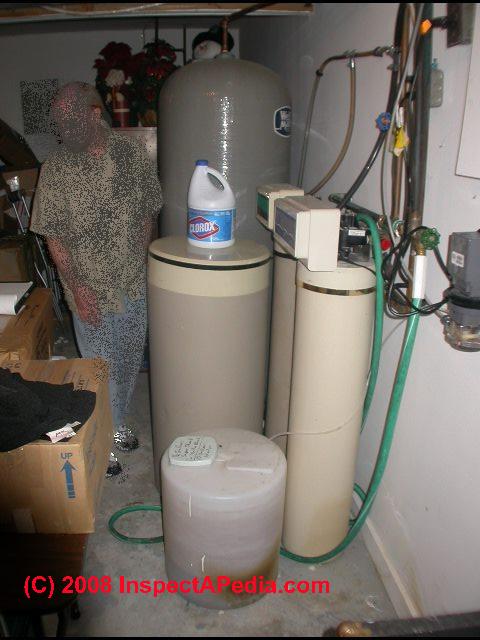
are installed as permanent treatment systems for correcting "hard" water - clogs pipes, poor washing & bathing, mineral deposits, reduced hot water output from water heaters and tankless coils. A water softener swaps sodium (salt) or potassium (a salt alternative) into the water to cause calcium and magnesium as well as limited amounts of ionic iron and ionic manganese to precipitate out of the water supply.
See WATER SOFTENERS & CONDITIONERS
and also
see WHITE STAINS from WATER SUPPLY
Anion-exchange water softener resin for removing tannins
Where there are low tannin contributions to the water supply (yellow staining) a water softener employing a special anion-exchange water softener resin is capable of removing low tannin concentrations in the water.
See YELLOW STAINS from WATER SUPPLY
Iron & manganese removal
Water softeners and conditioners can often also remove modest amounts of iron or manganese or sulphur, but if significant levels of other contaminants are present as well as hard water, a combination of water conditioner and other water treatment steps will be appropriate.
See RED STAINS from WATER SUPPLY
Water Treatment Safety, Reliability & Chemical Safety Warnings
At WATER TREATMENT METHODS TABLE we point out that few if any water treatment or water purification systems can reliably remove all possible water contaminants that may be present in a water supply or may be contributed by contamination of the building's water supply system & equipment.
While a "bacteria test" is a good starting point in checking on the safety of drinking water, a check with local water testing labs (and neighbours) can give critical advice about other contaminants that might be present in your water supply and for which tests should be performed.
Watch out: disinfecting water by bleach, chlorine, or similar methods will not remove other chemical contaminants nor will it reliably remove Giardia in Drinking Water - a review of the health hazards & typical equipment costs for portable and whole house water treatment to remove Giardia cysts from drinking water.
Other treatment steps such as charcoal filtration may be needed for some chemicals, and other treatment methods including ceramic filters can remove Giardia.
See GIARDIA in DRINKING WATER
Drinking water should be tested periodically, at least annually, especially if there is a known contamination issue - to make sure that the well has remained sanitary, or to make sure that the treatment equipment is working properly. Perhaps also to get lucky and find that treatment is no longer needed.
See BACTERIA LEVELS in WATER, INTERPRETATION
A minimum test is to collect a sample of treated water for this purpose. If you also test water collected ahead of the treatment system you can confirm what treatment is needed.
Watch out: Water treatment chemicals can be highly toxic or caustic and should be kept out of reach of children.
And if these watching outs aren't enough,
Watch out: following area flooding or damage from an earthquake, hurricane or other catastrophe, even if community or private wells are back in operating and providing water, do not assume that the water is sanitary and ok to drink until responsible authorities have said so. Even then, local water pipes in a building may be unsanitary and additional cleaning or disinfection may be needed.
If you are looking for camping, portable or emergency use water purification methods,
see DRINKING WATER - EMERGENCY PURIFICATION for a discussion of various methods used to purify water for hiking, campling, and emergency use as well.
In the article above we discuss water treatment, not water testing.
...
Continue reading at WATER TREATMENT EQUIPMENT DISINFECTION or select a topic from the closely-related articles below, or see the complete ARTICLE INDEX.
Or see these
Recommended Articles
- WATER STAINING CONTAMINANTS - water contaminants that result in stains on fabrics, fixtures, etc. and that may also help diagnose some water odors.
- WATER QUALITY & QUANTITY San Miguel de Allende
- WATER TEST CHOICES & WATER TEST FEES - choices of water tests and our advice about choosing among them.
Suggested citation for this web page
WATER TREATMENT EQUIPMENT CHOICES at InspectApedia.com - online encyclopedia of building & environmental inspection, testing, diagnosis, repair, & problem prevention advice.
Or see this
INDEX to RELATED ARTICLES: ARTICLE INDEX to WATER TREATMENT SYSTEMS
Or use the SEARCH BOX found below to Ask a Question or Search InspectApedia
Ask a Question or Search InspectApedia
Questions & answers or comments about which type of water conditioner system, water treatment system, or water purifier system you should install - how to choose a residential drinking water treatment method and system
Try the search box just below, or if you prefer, post a question or comment in the Comments box below and we will respond promptly.
Search the InspectApedia website
Note: appearance of your Comment below may be delayed: if your comment contains an image, photograph, web link, or text that looks to the software as if it might be a web link, your posting will appear after it has been approved by a moderator. Apologies for the delay.
Only one image can be added per comment but you can post as many comments, and therefore images, as you like.
You will not receive a notification when a response to your question has been posted.
Please bookmark this page to make it easy for you to check back for our response.
Our Comment Box is provided by Countable Web Productions countable.ca
Citations & References
In addition to any citations in the article above, a full list is available on request.
- NRDC: Natural Resources Defense Counci, 40 West 20th Street, New York, NY 10011 USA Tel: (212) 727-2700, Website: http://www.nrdc.org/ Email: nrdcinfo@nrdc.org
- NSF International, P.O Box 130140, 789 N. Dixboro Road, Ann Arbor, MI 48105, USA. NSF has offices world wide. USA Tel: 1-800-673-6275, Website: http://www.nsf.org/ Email: info@nsf.org or for standards questions: standards@nsf.org
- WQA Water Quality Association, International Headquarters & Laboratory, 4151 Naperville Road, Lisle, IL 60532-3696 USA, Tel: 630-505-0160, Website: http://www.wqa.org/
- "Actions You Can Take to Reduce Lead in Drinking Water", U.S. EPA EPA 810-F-93-001 (June 1993), retrieved 4 Mar 2015 original source: http://water.epa.gov/drink/info/lead/lead1.cfm
- Solar Disinfection of Drinking Water: "Final Report: Enhanced Photocatalytic Solar Disinfection of Water as Effective Intervention Against Waterborne Diarrheal Diseases in Developing Countries", National Center for Environmental Research, U.S. Environmental Protection Agency, Investigators: Dionysiou, Dionysios D. , Bandala, Erick R. , Castillo, Jordana , Dunlop, Patrick , Pelaez, Miguel A,
Institution: University of Cincinnati , NIBEC, School of Electrical and Mechanical Engineering , Universidad de Las Américas-Puebla
Research Category: Pollution Prevention/Sustainable Development , P3 Challenge Area - Water , P3 Challenge Area - Materials & Chemistry
Quoting from the above report (http://cfpub.epa.gov/ncer_abstracts/index.cfm/fuseaction/display.abstractDetail/abstract/8841/report/F)
Conclusions:
Photocatalytic enhanced solar disinfection using NF-TiO2 was responsible for complete inactivation of E. coli in those reactors exposed to both solar and visible light radiation. The presence of NF-TiO2 enhanced the disinfection rate efficiency of E.coli when compared to those experiments where no photocatalyst was used. Practical application of dye solutions as dosimetric indicator appears as very useful for determining the solar radiation dose necessary for waterborne pathogen deactivation.
Solar water disinfection (SODIS) is a simple, environmentally friendly and low cost point-of-use treatment technology for drinking water purification. However, bacterial re-growth after short storage (24 h) of SODIS treated water has been observed. Seeking for improvements of SODIS performance, reduction of irradiation time and avoidance of bacteria regrowth, solar based-Advanced Oxidation Technologies (AOTs), such as solar TiO2 photocatalysis, are promising enhancements to SODIS. Unfortunately, one of the main problems with the use of conventional TiO2 for solar applications is its limited capability to absorb only the radiation in the UV range, which is only about 5-8% of the total solar radiation. In this study, we employed novel nanotechnological procedures to synthesize visible light activated nonmetaldoped TiO2 (i.e., nitrogen-doped TiO2) with high surface area and immobilized on appropriate support materials that were used in novel photocatalytic reactors for water purification in rural zones in Mexico as a case study. In combination with visible light activated TiO2, we also propose to incorporate in our process the V trough solar collector which has never been applied to solar photocatalytic processes in the past, but has much simpler geometry and demonstrated in preliminary results performance comparable to other types of solar collectors. Because of its simpler geometry, the V trough solar collector is much less expensive and is attractive to applications is developing countries. This overall process for water purification was denominated “Enhanced Photocatalytic Solar Disinfection” (ENPHOSODIS).
A complete inactivation of the bacteria was achieved when using ENPHOSODIS under solar and visible light at three different NF-TiO2 catalyst concentrations. Under dark conditions, no difference in the bacteria count was observed and no inactivation of E. coli was observed when employing visible light only. pH was an important influence on the bacteria resistance to solar radiation. E. coli was able to survive for longer radiation periods at pH 7 and 7.5 than at lower or higher pH values (i.e., 6, 6.5 and 8). An azo dye, acid orange 24 (AO24), was explored for the development of a UV dosimetric indicator for disinfection. Complete color removal was found to be equivalent to that when water submitted to ENPHOSODIS treatment, under the proposed conditions, will get enough energy to deactivate completely the viable helminth eggs present. Different configurations of immobilized TiO2 photocatalytic reactors were tested under real sun conditions. Experiments under full sun and cloudy conditions showed that these photoreactors are capable of disinfection with an optimum configuration of internal and external coating along with a compound parabolic collector.
NOTE: The perspectives, information and conclusions conveyed in research project abstracts, progress reports, final reports, journal abstracts and journal publications convey the viewpoints of the principal investigator and may not represent the views and policies of ORD and EPA. Conclusions drawn by the principal investigators have not been reviewed by the Agency.
- Potable Aqua® emergency drinking water germicidal tablets are produced by the Wisconsin Pharmacal Co., Jackson WI 53037. 800-558-6614 pharmacalway.com
- Principles and Practice of Disinfection, Preservation and Sterilization (Hardcover)
by A. D. Russell (Editor), W. B. Hugo (Editor), G. A. J. Ayliffe (Editor), Blackwell Science, 2004. ISBN-10: 1405101997, ISBN-13: 978-1405101998.
"This superb book is the best of its kind available and one that will undoubtedly be useful, if not essential, to workers in a variety of industries. Thirty-one distinguished specialists deal comprehensively with the subject matter indicated by the title ... The book is produced with care, is very readable with useful selected references at the end of each chapter and an excellent index. It is an essential source book for everyone interested in this field. For pharmacy undergraduates, it will complement the excellent text on pharmaceutical microbiology by two of the present editors."
The Pharmaceutical Journal: "This is an excellent book. It deals comprehensively and authoritatively with its subject with contributions from 31 distinguished specialists. There is a great deal to interest all those involved in hospital infection ... This book is exceptionally well laid out. There are well chosen references for each chapter and an excellent index. It is highly recommended." The Journal of Hospital Infection.: "The editors and authors must be congratulated for this excellent treatise on nonantibiotic antimicrobial measures in hospitals and industry ... The publication is highly recommended to hospital and research personnel, especially to clinical microbiologists, infection-control and environmental-safety specialists, pharmacists, and dieticians."
New England Journal of Medicine: City Hospital, Birmingham, UK. Covers the many methods of the elimination or prevention of microbial growth. Provides an historical overview, descriptions of the types of antimicrobial agents, factors affecting efficacy, evaluation methods, and types of resistance. Features sterilization methods, and more. Previous edition: c1999. DNLM: Sterilization--methods. - Handbook of Disinfectants and Antiseptics, Joseph M. Ascenzi (Editor), CRC, 1995, ISBN-10: 0824795245 ISBN-13: 978-0824795245 "The evaluation of chemical germicides predates the golden age of microbiology..." -
This well-focused, up-to-date reference details the current medical uses of antiseptics and disinfectants -- particularly in the control of hospital-acquired infections -- presenting methods for evaluating products to obtain regulatory approval and examining chemical, physical, and microbiological properties as well as the toxicology of the most widely used commercial chemicals. - When Technology Fails, Matthew Stein, Chelsea Green Publisher, 2008,493 pages. ISBN-10: 1933392452 ISBN-13: 978-1933392455, "... how to find and sterilize water in the face of utility failure, as well as practical information for dealing with water-quality issues even when the public tap water is still flowing". Mr. Stein's website is www.whentechfails.com/
- Cheating on water tests: Testing Water for Real Estate Transactions - make sure your water test is valid
- Drinking Water Testing Advice for home buyers home owners home inspectors
- WATER TEST INTERPRETATION and Correcting Unsatisfactory Water
- Drinking Water Contaminant Levels - Maximum Allowed
- Drinking Water Contamination and Pollution How to Detect, Test, Correct, and Prevent Well Water Contamination - US EPA - Groundwater
- Lead Contamination in Drinking Water: Testing & Correction - Advice
- Lead Testing & Correcting Contamination from Lead Water Supply Lines/Entry Mains - Lead Pipe Problems/Advice
- Extreme Lead Poisoning Symptoms Suggested by Feb. 2006 NY Times Article on Kosovo Roma Camps
- ATSDR: Nitrate/Nitrite Toxicity [Big, Slow-Loading File] U.S. Government ATSDR Science Corner - 2.5MB PDF
- Water testing for Pesticides: comprehensive and pesticides-example parameters
- CONTAMINANT CLASSES, in WATER & links to home buyer advice about water testing, drinking water, water supply
- WELL CHLORINATION & SHOCKING - Procedure for Shocking a Well to (temporarily or maybe longer) "Correct" Bacterial Contamination
- Water Requirements, Home & Outdoor Living
- Typical Water Tests & Fees this water test fee schedule applies when testing is combined with other onsite building inspection services
- Drinking Water testing, contamination, correction - all topics
- General water testing and corrective measure advice: contact your local health department.
- Our recommended books about building & mechanical systems design, inspection, problem diagnosis, and repair, and about indoor environment and IAQ testing, diagnosis, and cleanup are at the InspectAPedia Bookstore. Also see our Book Reviews - InspectAPedia.
- In addition to citations & references found in this article, see the research citations given at the end of the related articles found at our suggested
CONTINUE READING or RECOMMENDED ARTICLES.
- Carson, Dunlop & Associates Ltd., 120 Carlton Street Suite 407, Toronto ON M5A 4K2. Tel: (416) 964-9415 1-800-268-7070 Email: info@carsondunlop.com. Alan Carson is a past president of ASHI, the American Society of Home Inspectors.
Thanks to Alan Carson and Bob Dunlop, for permission for InspectAPedia to use text excerpts from The HOME REFERENCE BOOK - the Encyclopedia of Homes and to use illustrations from The ILLUSTRATED HOME .
Carson Dunlop Associates provides extensive home inspection education and report writing material. In gratitude we provide links to tsome Carson Dunlop Associates products and services.
 | HOME | ABOUT | ASK a QUESTION | CONTACT | CONTENT USE POLICY | DESCRIPTION | POLICIES | PRIVACY | |
| © 2024 - 1985 Publisher InspectApedia.com - Daniel Friedman | |||||||||