
InspectAPedia® FREE Encyclopedia of Building & Environmental Construction, Diagnosis, Maintenance & Repair |
Question? Just ask us! InspectAPedia
|
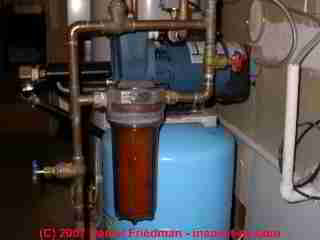 How to Select Filters for Drinking Water Iron, Silt, Dirt, or Sulphur Odors
- POST a QUESTION or COMMENT about selecting, installing, using water filters
This article explains using sediment filters or water softeners as options for correcting unsanitary or unsatisfactory aesthetic contaminants in drinking water such as sediment, dirt, sulphur odors, or minerals. This series of articles explains many common water contamination tests for bacteria and other contaminants in water samples.
InspectAPedia tolerates no conflicts of interest. We have no relationship with advertisers, products, or services discussed at this website.
Sediment Filters & Iron filters for Water Treatment
[Click to enlarge any image]
We describe what to do about contaminated water, listing common corrective measures when water test results are unsatisfactory.
We include water testing and water correction measures warnings for home owners and especially for home buyers when certain conditions are encountered, with advice about what to do when these circumstances are encountered.
How to remove aesthetic water contaminants and treatment systems: sediment, iron, odors, taste:
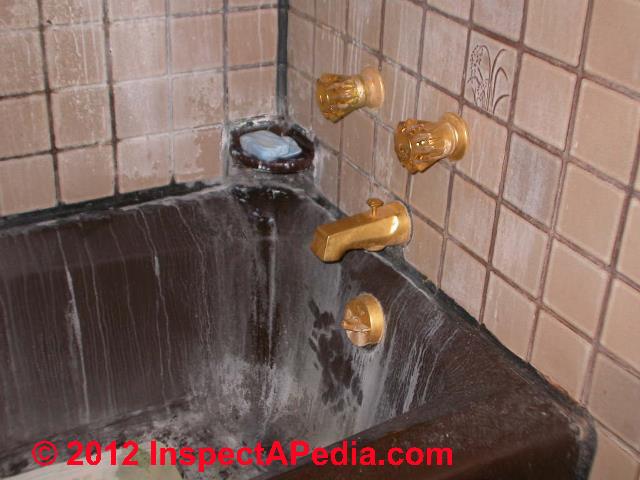
Our photo (above) illustrates heavy white stains and mineral deposits on a tile bathroom wall and on the bath tub itself. These white stains may be soap scum but more likely are due to hard water high in mineral content. Red or brown stains are more likely due to high iron content.
At WATER SOFTENERS & CONDITIONERS we discuss treatment systems that remove these contaminants. Below we discuss other water treatment methods (such as filtration) that remove other water contaminants.
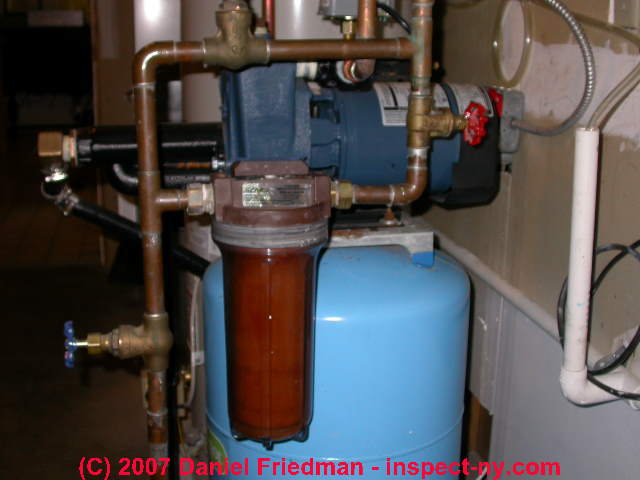
Paper or charcoal or in some cases ceramic filters are installed at the entry point of water into the building to remove sediment, iron, and similar debris.
TIP: when your water pressure declines or your pump begins clicking on and off rapidly, check to see if the filter has become very clogged and change it out. We once replaced a pump pressure switch only to discover that the problem was a clogged filter.
The water filter shown at left is for sediment in the water supply. The cartridge can be changed to handle odors (see Sulphur Odor Filters) below;
The installation of a water filter may affect the water flow rate and pressure in a building, particularly if the filter has become clogged.
The frequency with which the water filter must be changed depends on the filter type and the level of particles or contaminants that the filter is removing from the water supply.
For details see WATER FILTERS, HOME USE about cartridge type water filters
Indications that the water filter needs to be changed include
- Decline in water pressure
- Water pump short cycling on and off (maybe)
- Passage of sediments, debris, or odors through the water filter
Watch out: particulates in the drinking water supply can significantly reduce the effectiveness of water treatment for contaminants such as bacterial or other pathogens. For examples
see WATER DISINFECTION LIMITATIONS
Watch out: also that rapid short cycling of the water pump, as may be caused by a clogged sediment filter, can damage or even destroy the pump.
See WATER PUMP SHORT CYCLING
Sulphur odor filters or Sulphur Treatment Systems
If your water smells like "rotten eggs" the problem is likely to be sulphur dissolved in the water. The level of odor often varies seasonally as the level of the water table changes in the ground.
You may also notice that the sulphur or rotten egg smell is much worse when water is first run in a building after you've been away several days.
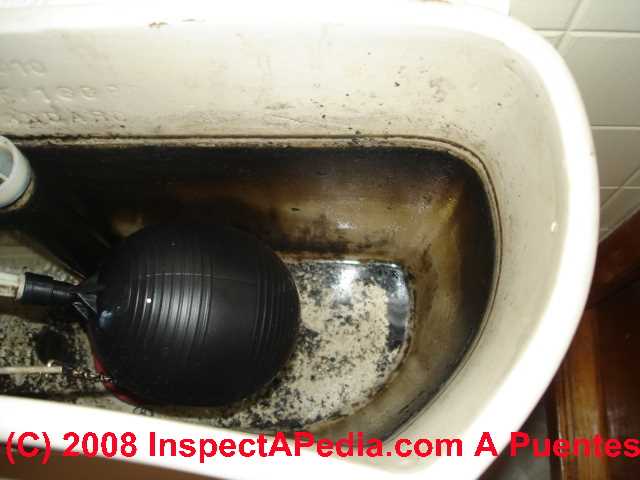
Our photo (left) shows sulphur-bacterial staining in a toilet tank. This cosmetic staining often accompanies high sulphur odors in water and can be addressed by well-established water treatment methods.
While a chlorine injection system will reduce low levels of sulphur odor in water, potassium permanganate ("Green sand" in the words of my Culligan™ man) is used in a treatment system where this problem is severe.
Odors in Drinking Water, provides more detail on the causes of odors in water, health risks associated with certain odors in drinking water, and various methods of treatment for water odors - how to get rid of the smell in water.
For details about sulphur odors in drinking water see
Water Softeners to Treat Hard Water, Iron, Lime, Mineral Deposits, Sulphur, Clogged Piping
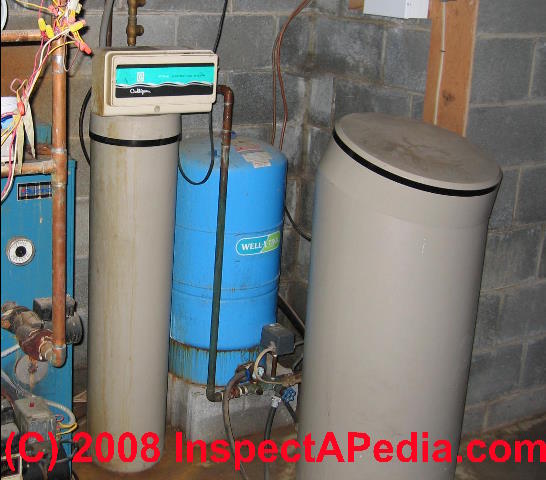
Water softeners principally remove minerals (mostly calcium and magnesium) from a "hard" water supply but may remove some lower levels of other contaminants such as iron and sulphur. If those problems are significant, an additional treatment step may be required.
If your water is hard (measured in "grains of hardness") you want a water softener installed not only for aesthetic reasons (like getting a good lather when shampooing your hair) but also to avoid clogging the water supply piping with minerals (especially the hot water and very especially where tankless coils are used to provide hot water).
Most water softeners work by an ion-exchange process: swapping a small amount of salt or sodium into the water to cause calcium and manganese to precipitate out as dirty sludge (which is periodically removed by back washing the treatment system).
If building occupants require a zero level of sodium in drinking water they may want to install a reverse osmosis point of use supply treatment or in some homes people simply run a water supply line from ahead of the water softener to a single faucet to be used for drinking water.
For complete details about using and maintaining water softeners see the articles listed
at WATER SOFTENERS & CONDITIONERS
Reader Comments & Q&A
On 2016-10-31 - by (mod) -
Hassan
please use the search box on this page and search InspectApedia.com for SULPHUR ODOR REMOVAL and then search for IRON FILTERS or IRON REMOVAL from WATER to see details.
On 2016-10-3 by Hassan
please I need a GREEN FILTER SYSTEM that can remove IRON and BAD SULFUR SMELL from my ground water. I produce 400m3 - 500m3 of water daily, from a mechanized borehole in Ghana.
Can you send me the specifications for the green filter, including the price. You may add other options please.
On 2016-04-27 by Michigan Mark
Hi: Are filters the best way to remove iron from well water? If yes, would a series of fliters be the best or would it just adversely affect water pressure? Thanks.
Question: short cycling pump and sediment in the water
(Oct 8, 2015) Steve said:
About 4 days ago we had a rainstorm drop 150mm in about 14hrs, yesterday my well water had a very fine silt and rust color in it, 1 day later and my less than a year old pump started cycling, on for 15-20 seconds and then off for approx same amount of time, then back on again. It worked flawless until now, where should I check first as the most likely culprit?
Also the water color has gotten better and less silt also. I figure I need to inspect the pump, which is a small tank on pump kind 3/4 HP, I think its a 1 gallon but that I'm not sure of atm.
Where would you guy check first? I have turned the pump off for the time being so it doesn't burn out from all the cycling, not a problem to prime and get working again though. Thanks for your time
Reply:
Steve see WATER PUMP INTERMITTENT CYCLING and look for low well water, debris clogging pressure control switch opening, or a leak in well piping or casing.
...
Continue reading at WATER ODOR DIAGNOSIS - SULPHUR or select a topic from the closely-related articles below, or see the complete ARTICLE INDEX.
Or see these
Recomended Articles
- WATER FILTERS, HOME USE - topic home
- CERAMIC FILTERS for WATER DISINFECTION
- CHLORINATORS & CHARCOAL FILTERS
- DRINKING WATER EMERGENCY PURIFICATION
- GIARDIA in DRINKING WATER
- REVERSE OSMOSIS WATER TREATMENT
- WATER FILTER CARTRIDGE CHANGE PROCEDURE
- WATER FILTERS - SEDIMENT & IRON
- WATER QUALITY & QUANTITY San Miguel de Allende
- WATER STAINING CONTAMINANTS
- WATER TREATMENT EQUIPMENT CHOICES other water treatment options besides filters.
Suggested citation for this web page
WATER FILTERS - SEDIMENT & IRON at InspectApedia.com - online encyclopedia of building & environmental inspection, testing, diagnosis, repair, & problem prevention advice.
Or see this
INDEX to RELATED ARTICLES: ARTICLE INDEX to WATER TREATMENT SYSTEMS
Or use the SEARCH BOX found below to Ask a Question or Search InspectApedia
Ask a Question or Search InspectApedia
Try the search box just below, or if you prefer, post a question or comment in the Comments box below and we will respond promptly.
Search the InspectApedia website
Note: appearance of your Comment below may be delayed: if your comment contains an image, photograph, web link, or text that looks to the software as if it might be a web link, your posting will appear after it has been approved by a moderator. Apologies for the delay.
Only one image can be added per comment but you can post as many comments, and therefore images, as you like.
You will not receive a notification when a response to your question has been posted.
Please bookmark this page to make it easy for you to check back for our response.
Our Comment Box is provided by Countable Web Productions countable.ca
Citations & References
In addition to any citations in the article above, a full list is available on request.
- Potable Aqua® emergency drinking water germicidal tablets are produced by the Wisconsin Pharmacal Co., Jackson WI 53037. 800-558-6614 pharmacalway.com
- Principles and Practice of Disinfection, Preservation and Sterilization (Hardcover)
by A. D. Russell (Editor), W. B. Hugo (Editor), G. A. J. Ayliffe (Editor), Blackwell Science, 2004. ISBN-10: 1405101997, ISBN-13: 978-1405101998.
"This superb book is the best of its kind available and one that will undoubtedly be useful, if not essential, to workers in a variety of industries. Thirty-one distinguished specialists deal comprehensively with the subject matter indicated by the title ... The book is produced with care, is very readable with useful selected references at the end of each chapter and an excellent index. It is an essential source book for everyone interested in this field. For pharmacy undergraduates, it will complement the excellent text on pharmaceutical microbiology by two of the present editors."
The Pharmaceutical Journal: "This is an excellent book. It deals comprehensively and authoritatively with its subject with contributions from 31 distinguished specialists. There is a great deal to interest all those involved in hospital infection ... This book is exceptionally well laid out. There are well chosen references for each chapter and an excellent index. It is highly recommended." The Journal of Hospital Infection.: "The editors and authors must be congratulated for this excellent treatise on nonantibiotic antimicrobial measures in hospitals and industry ... The publication is highly recommended to hospital and research personnel, especially to clinical microbiologists, infection-control and environmental-safety specialists, pharmacists, and dieticians."
New England Journal of Medicine: City Hospital, Birmingham, UK. Covers the many methods of the elimination or prevention of microbial growth. Provides an historical overview, descriptions of the types of antimicrobial agents, factors affecting efficacy, evaluation methods, and types of resistance. Features sterilization methods, and more. Previous edition: c1999. DNLM: Sterilization--methods. - Handbook of Disinfectants and Antiseptics, Joseph M. Ascenzi (Editor), CRC, 1995, ISBN-10: 0824795245 ISBN-13: 978-0824795245 "The evaluation of chemical germicides predates the golden age of microbiology..." -
This well-focused, up-to-date reference details the current medical uses of antiseptics and disinfectants -- particularly in the control of hospital-acquired infections -- presenting methods for evaluating products to obtain regulatory approval and examining chemical, physical, and microbiological properties as well as the toxicology of the most widely used commercial chemicals. - When Technology Fails, Matthew Stein, Chelsea Green Publisher, 2008,493 pages. ISBN-10: 1933392452 ISBN-13: 978-1933392455, "... how to find and sterilize water in the face of utility failure, as well as practical information for dealing with water-quality issues even when the public tap water is still flowing". Mr. Stein's website is www.whentechfails.com/
- Our recommended books about building & mechanical systems design, inspection, problem diagnosis, and repair, and about indoor environment and IAQ testing, diagnosis, and cleanup are at the InspectAPedia Bookstore. Also see our Book Reviews - InspectAPedia.
- Crystal Clear Supply provides portable ceramic water filter purifiers and portable reverse osmosis water treatment equipment - see http://www.crystalclearsupply.com/category_s/7.htm
- Potable Aqua® emergency drinking water germicidal tablets are produced by the Wisconsin Pharmacal Co., Jackson WI 53037. 800-558-6614 pharmacalway.com
- In addition to citations & references found in this article, see the research citations given at the end of the related articles found at our suggested
CONTINUE READING or RECOMMENDED ARTICLES.
- Carson, Dunlop & Associates Ltd., 120 Carlton Street Suite 407, Toronto ON M5A 4K2. Tel: (416) 964-9415 1-800-268-7070 Email: info@carsondunlop.com. Alan Carson is a past president of ASHI, the American Society of Home Inspectors.
Thanks to Alan Carson and Bob Dunlop, for permission for InspectAPedia to use text excerpts from The HOME REFERENCE BOOK - the Encyclopedia of Homes and to use illustrations from The ILLUSTRATED HOME .
Carson Dunlop Associates provides extensive home inspection education and report writing material. In gratitude we provide links to tsome Carson Dunlop Associates products and services.
 | HOME | ABOUT | ASK a QUESTION | CONTACT | CONTENT USE POLICY | DESCRIPTION | POLICIES | PRIVACY | |
| © 2024 - 1985 Publisher InspectApedia.com - Daniel Friedman | |||||||||