
InspectAPedia® FREE Encyclopedia of Building & Environmental Construction, Diagnosis, Maintenance & Repair |
Question? Just ask us! InspectAPedia
|
 Increase the Water Flow Rate or Quantity
Guide to Improving Well Yield, define minimum acceptable well flow
- POST a QUESTION or COMMENT about how to get more water out of the well: increase the well yield or well flow rate
How to get more water out of a water well:
This article describes the minimum acceptable well yield or water flow rate for a well to be functional. Next we describe how to increase the yield or flow rate of a water well using several approaches, and we define hydro-fracturing for well stimulation.
We will discuss these topics: How do We Get Enough Water From a Well with a Poor Recovery or Flow Rate? Well Stimulation Methods.
Well stimulation methods & equipment: hydro-frac packers, DST packers. What is hydro-fracking or hydro fracturing & how does it increase well yield. What is the minimum acceptable well yield or flow rate?
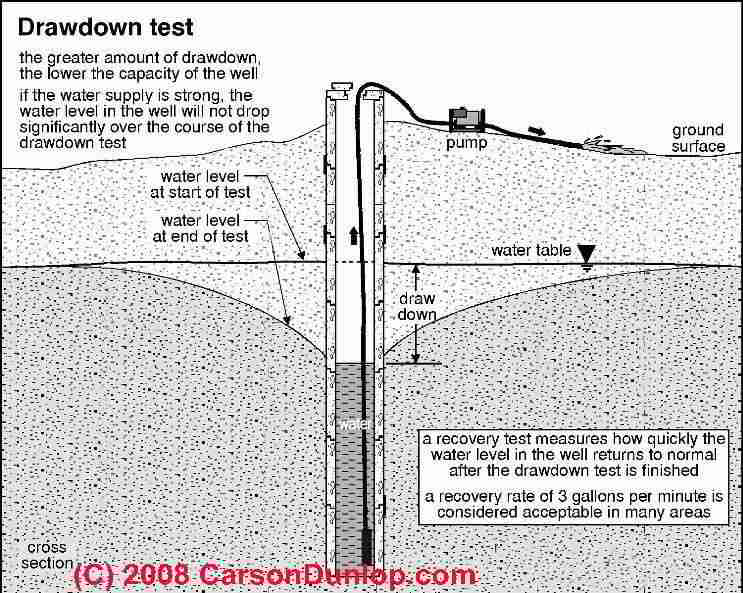
The sketch at page top, courtesy of Carson Dunlop Associates, outlines what happens during a well drawdown or well flow test procedure.
InspectAPedia tolerates no conflicts of interest. We have no relationship with advertisers, products, or services discussed at this website.
What is the Minimum Acceptable Well Yield or Well Flow Rate?
Some wells can produce a flow rate of 20 gallons per minute (gpm) or more. But for a single family home, 5 gpm is good, and 3 gpm is livable. In some communities the health department or building department will require at least 3 gpm (or more) to approve a new well for new construction.
These are general flow rates, but a more accurate answer to the required well yield flow rate for a specific property depends on the anticipated water quantity need for a given home, number of occupants, types of water usage, and thus the anticipated daily water usage, factored against the well yield (and possibly well recovery rate).
A risk with a well that already has a low yield is that the yield is at risk of dropping still further seasonally or permanently (common), or possibly failing entirely (less common).
Therefore in buying such a property it would be prudent to presume that you will face additional costs to provide more or better water quantity.
You might want to consult with local well drillers to get an idea about their experience in success in drilling wells in your immediate neighborhood as well as the typical well depth, yield, and cost.
See WATER USAGE TABLE for a table that will help calculate the water flow rate or daily water usage for a property.
In the worst case with a slow or low yield well people install additional water storage/holding tanks to collect water at the low rate available from a well and provide water and then deliver it at the needed rate.
If a well yield is too low, in addition to reducing unnecessary water usage (conservation), increasing the onsite storage quantity (holding tanks), making sure equipment is working properly (no leaks), and the option of drilling a new well and hoping for a better yield, there are various methods to increase well yield.
Just below we explain How to Improve Well Yield or Improve the Quantity of Water Available.
How do We Get Enough Water From a Well with a Poor Recovery or Flow Rate? Well Stimulation Methods
Before drilling a new well to get more water, some plumbers or well installers will try these things:
- Check for clogged piping or well piping leaks: before doing something costly when you think that the well yield is too low, check that there is not a simpler problem such as a leak in the well piping inside the well casing or between the well and the building.
A leak in the well piping lines will result in less water reaching the building than is being sent up by the pump. Next, if water pressure in the building is poor, the problem could be clogged pipes, perhaps by rust or mineral deposits.
Other problems with the well pump, water pressure regulator, or water pressure tank can also cause bad water pressure in a building.
To diagnose these causes of insufficient water pressure or flow,
See WATER PRESSURE LOSS DIAGNOSIS & REPAIR. - If the well has a very large static head inside the building the occupants may never notice that the well flow rate is poor. However a very poor well flow or recovery rate might mean that the well has a limited future life if minerals are also clogging up the rock fissures through which water is flowing into the well.
- If the well has a small static head and a poor flow rate the installer may place a very large water holding tank inside the building and
control the rate at which the water pump will draw water out.
Building occupants live off of the water tank itself and the pump and well recover slowly, pumping water back into the tank and recovering during periods when occupants are not drawing water out. A large water storage tank is not the same thing as a typical well water pressure tank:
At WATER TANK SIZE & VOLUME we describe the water quantity stored in typical water pressure tanks.
At BIG WATER STORAGE TANKS we describe large holding tanks used to accumulate a large volume of water supply when a well suffers from a low flow rate. - Well yield increase methods
are used when a well's yield has dropped too low or if a well has "gone dry" entirely (due to sediment-clogged rock fissures and
unconnected water-bearing cracks which are preventing water from entering a well).
Patented processes such as AquaFreed™'s "hydrofracking" or similar attempts to open rock fissures in the existing well may be tried using special equipment and gases or ice such as frozen CO2. (We no longer use dynamite to increase well yield but we used to.)
AquaFreed, a water retrieval specialist, claims a 95% "success rate" at improving residential well yields.
In Australia AGE Developments describes well stimulation and well testing: [13]- Hydro-frac Packers are equipment that stimulates and improves the yield of a water well by opening and flushing out previously closed fractures (presumably in underground rock) using high pressure water.
An inflatable "packer" is lowered into the well and operated at various depths in the drilled well segments below the well casing.
The hydro-fracturing process uses pressures up to 10,000 psi (700 bar) to force water through rock fractures. - Drill Stem Testing (DST) is used to isolate and test the water flow rate within different segments (at different depths) of the well in order to diagnose and evaluate the overall well flow rate as well as to target areas for hydro-fracturing.
Drill stem testing allows the well driller to identify and evaluate the multiple aquifers through which a well may have been drilled.
Details about drill stem testing are
at DRILL STEM TESTING
- Hydro-frac Packers are equipment that stimulates and improves the yield of a water well by opening and flushing out previously closed fractures (presumably in underground rock) using high pressure water.
- Limit water use in the building such as by use of gray water recovery systems, low water or no-water flush toilets, general water conservation. Shower with a friend.
- Penn State, Water Fact Sheet #3, USING LOW-YIELD WELLS [PDF], Penn State College of Agricultural Sciences, Cooperative Extension, School of Forest Resources, web search 07/24/2010, original source: http://pubs.cas.psu.edu/FreePubs/pdfs/XH0002.pdf
How to live with a low-flow water well. - Drill a new or auxiliary well this more costly solution may be necessary - though first we'd ask the well driller's experience with cost and necessary well depth for the neighborhood and we'd ask for typical costs for nearby successful wells.
Well Yield Improvement Research
- Access Water Energy, PO Box 2061, Moorabbin, VIC 3189, Australia, Tel: 1300 797 758, email: sales@accesswater.com.au Website: http://www.accesswater.com.au/
Moorabbin Office: Kingston Trade Centre, 100 Cochranes Rd, Moorabbin, VIC 3189
Australian supplier of: Greywater systems, Solar power to grid packages, Edwards solar systems, Vulcan compact solar systems, water & solar system pumps & controls, and a wide rage of above ground & under ground water storage tanks: concrete, steel, plastic, modular, and bladder storage tanks. - Chemours GLYCOLIC ACID WTER TREATMENT & WATER WELL STIMULATION [PDF] The Chemours Company
1007 Market Street P.O. Box 2047
Wilmington, Delaware 19899 US .
Canada: The Chemours Canada Company 151 Bloor Street West - 12th Floor Toronto, ON M5S 1S4 Canada
Offices also in Brazil, Genea, Korrea, Mexico, Shanghai, Singapore
- retrieved 2022/11/19, original source: https://www.chemours.com/en/-/media/files/glycolic-acid/glycolic-acid-treatment-water-well.pdf?rev=cf3d070023444f53a7f210604ebf7579 - Chempoint GLYCOLIC ACID for WATER WELL STIMULATION [PDF] Chempoint, Univar Solutions, 411 108th Ave NE, Suite 1050 Bellevue, WA 98004 USA, Tel: 425.906.6211 Web: https://www.chempoint.com/contact-us - retrieved 2022/11/19, original source: https://www.chempoint.com/insights/chemours-glycolic-acid-for-water-well-stimulation
- NYS DOH, INDIVIDUAL WATER SUPPLY WELLS - Fact Sheet #2", NY State DOH, retrieved 2021/02/27, original source www.health.ny.gov/ environmental/water/drinking/regulations/ fact_sheets/fs2_water_storage.htm
- NC DEP, WELL CONSTRUCTION RECORD [PDF] North Carolina
- NC WELL CONSTRUCTION SETANDARDS, SUBCHAPTER 02C - WELL CONSTRUCTION STANDARDS
SECTION .0100 - CRITERIA AND STANDARDS APPLICABLE TO WATER-SUPPLY
15A NCAC 02C .0110 WELL TESTS FOR YIELD [PDF] - NC WELL TEST STANDARDS FOR WELL YIELD [PDF] North Carolina NC 15A NCAC 02C .0110
- Penn State, Water Fact Sheet #3, USING LOW-YIELD WELLS [PDF], Penn State College of Agricultural Sciences, Cooperative Extension, School of Forest Resources, web search 07/24/2010, original source: http://pubs.cas.psu.edu/FreePubs/pdfs/XH0002.pdf
- Smith, Stuart A., CGWP, RECENT INNOVATIONS in WELL REHABILITATION [PDF] Ground Water Science, 295 S. Lawn Ave.
Bluffton, OH 45817 USA, Tel: 1-419-358-0528 Author's Tel: 1-330-787-0496 - retrieved 2022/11/19, original source: https://groundwaterscience.com/resources/tech-article-library/94-recent-innovations-in-well-rehabilitation.html
Excerpts:
Numerous available text and online references (including two available through our web site) describe methods of well rehabilitation (or as it is also known: well restoration or regeneration). Much technology and methods have been improved in recent years, yet we see specifications for the "same old same old."
This article describes some of those improvements and innovations. Innovations in well rehabilitation methods are improvements that are somewhat more effective than "conventional" methods in some cases. Well rehabilitation or restoration and well maintenance are analogous to war and diplomacy or heart surgery and heart-healthy lifestyle, respectively.
Where the latter is neglected or half-hearted (as recent history testifies), the former often becomes inevitable. Improved well rehabilitation methods in this analogy are simply the bigger, faster cannon: they make a bigger impression, but are still a poor substitute for preventing maintenance actions.
We discuss several representative development areas here. All are "innovative" in the sense of being different than the routine for many since the dawn of modern water well technology, but all are derivative and not revolutionary. That is in itself an important fact to know: there are STILL no miracle cures to well problems. The key is to understand the strengths and weaknesses of any process and to use the best mixture in an informed manner.
Covered in this article: [some paraphrasing by InspectApedia.com editors]
Chemical improvements - Brominated compounds, Chlorine, Hydrogen peroxide, Organic acids, Blends, P-containing acids, Polymers, heat
Blended Methods treatments
Fluid percussion, ultra-high pressure water-jetting
CO2 Injections
Suction flow control
Improvements in materials, comtrollers, monitoring of equipment operation & well ewater levels.
...
Organic acids: Contractors who perform well maintenance (as well as this author) are abandoning the use of chlorine compounds in favor of certain organic acids for use in both well cleaning and preventive maintenance treatments.
You will never sterilize the aquifer and well system, and we are finding that the biofouling bacteria become accustomed to the chlorine and actually make more oxidized iron and organic byproducts.
No total bacterial kill is achieved with chlorine. The clogging zone also simply reestablishes itself further out in the formation, beyond the reach of the treatment process.
In addition, frequent use results in the formation of chlorinated (also brominated) organic compounds (those famous disinfection byproducts DBPs).
... Blended and "extreme" chemical method treatments
Force treatments - Gas Impulse Percussion (in its various forms)
CO2 treatment (Aqua-Freed and Aqua-Gard), chemical reformulations and other derivative concepts
Suction flow control (and other well gizmos and gadgets) - SSWM, WELL REHABILITATION [PDF] SSWM, Sustainable Sanitation & Water Management
seecon
Müligass 7
6130 Willisau
Switzerland
Tel: +41(0)61 261 40 04 - Web: https://sswm.info/ - retrieved 2022/11/19 original source: sswm.info/sites/default/files/reference_attachments/ISWD%204000%20Well%20Rehabilitation.pdf
This copy is from International School of Well Drilling, 5039 Creekview Lane, Lakeland, FL 33811 USA, Tel: 863 648 1565 Email: director@welldrillingschool.com Website: welldrillingschool.com retrieved 2018/06/12, original source: welldrillingschool.com/courses/pdf/WellRehabilitation2.pdf
SSWM Information excerpts:
Water resources around the world are under increasing pressure: Population growth and urbanisation, climate change and rapid industrialisation, expanding and intensifying agricultural production, and increasing demand of water for industry and energy production are all putting pressure on water resources.
...
The SSWM Toolbox is the most extensive collection of knowledge around sustainable sanitation and water management. It compiles thousands of “best of “ instruments – be that technologies, methodologies, behavioural change approaches or planning tools – geared to optimise sanitation and water management intervention at local level all curated in an easy-to-understand yet comprehensive way.
It honours the fact that there are countless ways to approach and understand sustainable sanitation and water management and offers its users different “Perspectives” from which to explore the knowledge around sustainable sanitation and water management.
Article Excerpts:
Well Rehabilitation is defined as restoring a well to its most efficient condition by various treatments or reconstruction methods (Groundwater and Wells). This continuing education unit discusses the causes of deteriorating well performance and methods, both traditional and of more recent introduction, of addressing this area.
There are numerous causes of poor and deteriorating well performance. Causes may include inherent characteristics of the aquifer which supplies water to the well, the well design, its construction, water quality and other environmental factors, and even the operation of the well.
...
Well rehabilitation is the step taken when a well has deteriorated beyond the point when maintenance programs will resolve the decrease in yield or when sand pumping reaches unacceptable levels.
When well rehabilitation cannot restore the water quality and water quantity to acceptable levels the final step has been reached, well abandonment and new well construction.
Obviously the final step is the most costly. No unit of study on well rehabilitation can fail to mention well maintenance.
Rules of thumb in the industry show that preventive maintenance costs are 10-20% of the costs of hiring a well rehabilitation specialist; and that formal well rehabilitation costs will be 10-20% of the costs of new well construction. It goes without saying therefore, that time and attention paid to ongoing well maintenance is a sound investment and always the wisest course of action.
Reader Comments, Questions & Answers About The Article Above
Below you will find questions and answers previously posted on this page at its page bottom reader comment box.
Reader Q&A - also see RECOMMENDED ARTICLES & FAQs
On 2019-11-17 by (mod) -
It sounds as if you need a well company to investigate the flow rate of your will. If that's the limiting factor, and it sounds like it may be, it might be possible to increase the well yield instead of having to drill a new well. That's the subject of the article on this page.
On 2019-11-17 by Debbie Miller
We replace the water line 5 year aho put new pump the water is just barely come out you have to wait 30 minutes tp fill yourtub we try every thing new bladder still nothing only a drip run style open wide
On 2018-08-09 by Mike Rybakowski
I have a bore hole that works under its own. I need to increase the discharge quantity. Will a petrol suction pump achieve this just by connection the suction hose onto the discharge pipe of the borehole?
Regards Mike
On 2016-12-12 y Gape Mmolawa
My borehole went dry but it used to have a good yield of around 1.5 cubic. How can i increase yield?
On 2016-08-06 by Clebia Nunes de senna
Very informative and eye opening. Now I don't feel so ignorant on the subject. Thank you!
On 2016-07-06 by Simon
Good article!
I think other side we should care about is watering for plants. According to my experience, using some water gel (like potassium polyacrylate) can increase 15% yield at least.
On 2016-06-08 by Ken.
Please I just dug a well last month, but to my greatest surprise the rate of flow is very low. Please how can I improve the rate of water flow from the well? The well is just one month old.
On 2016-02-09 by (mod) -
Innocent,
I don't understand the situation nor the question, but it sounds as if you want to build a cistern to conserve springwater; you will probably need a water treatment or sanitization system too.
On 2016-02-09 by innocent
the springs exists but it pours water every day, so i want to get a project on to conserve the water in the area
help me with a project on how to improve on the quality of water in civil engineering
On 2015-09-16 by Bailey
My well is running dry as we are in a drought in NYS. should we try hydro fracturing. We are on a tight budget and want the best advice. Any advice is greatly appreciated
On 2015-06-01 by anthonyb
I have checked it, but even with no water coming into the house the water table drops 50 feet within 10mins, there are no leaks in the house.
Only thought is that there is a leak in the ground to the house, but all I have is dry dirt, you would think I would have some sort of grass growing if that was the case. Any other thoughts?
Question: returning well to use we find it runs out of water after a short time
If a well has not been used for 6 years it was a good well then we hooked up to it again and you can run water about 40 minutes then it quits. With the well setting for that long will this hurt the well, Will it not be as strong as before? - Diana 5/25/12
Reply:
Diana your question seems to have two parts that I can't quite relate.
Running or not running water won't damage the well itself, though a well in use often finds over years that its yield or recovery rate may decline as minerals and crud clog the rock fissures through which water enters the well. Less use, slower clogging.
Running out of water after 40 minutes?? That is a bit unclear - 40 minutes at 1 gallon per minute, or 40 gallons, is an inadequate well. 40 minutes at 10 gpm is 400 gallons and is a lot of water.
Question: well keeps running dry - would installing a more powerful pump help?
We have a well that is about 100' - water starts about 20' below the well cap.
We are forever running "dry" after running the water for about 20 minutes. e.g. I fill my kids kiddie pool with about 40 gallons of water (takes 15 minutes or so) and then run the dishwasher we will run out of water and draw nothing but air in the lines.
We have to turn the pump off (it will keep running) then I turn it back on 30 minutes later and it will build pressure again.
We have a deep well jet pump 1/2hp. Would increasing the hp of the pump to 3/4 allow us to draw more water? or do we just have a crappy well? All of our neighbours have lots and lots of water. - Ella 6/11/12
Reply: No.
RE: will putting a more powerful pump on our well system improve how much water we get?
Ella, from your description your well has a static head of 80 feet. Figuring that the pump is perhaps 5 ft. from the bottom, you have a column of 75 feet of water in the well when it's at rest and fully recovered - that's about 112 gallons of water.
If you draw water out of the well at 5 gallons a minute you have about 20 minutes of water on hand in the static head.
If you are running out of water quickly that means that your well has a slow recovery rate - you are taking water out of the well faster than it recovers so you just get the static head and then run out of water.
Putting on a more powerful (higher hp) well pump will NOT improve matters, it will make them worse. You will draw the water out of the well faster than ever - running out sooner, probably wasting water by running faster than need be.
Your options to get more water are to add local storage tanks or to try to increase the yield of the well (the article found above).
Question: old timer advice to put crawdads (crayfish) in the well to open up clogging
I have heard from some of the old timers that putting crawdads in your well will help to open up the clogging where the water comes in. They should not get sucked up the foot valve and I don't think they would produce enough bodily waste to contaminate the water but I would have the water tested to be safe
If you know any thing about crawdads they like to dig and just a few of them can dig many holes and they are content to stay under water. - Mike 7/2/2012
Reply: balderdash
RE: Should we put crawdads or other animal a drilled well?
Mike I'm doubtful there being any benefit whatsoever from putting crawdads into a drilled water well - we used to find them in our springhouse but not at the bottom of a drilled well - I don't recommend it - they won't like it down there. I doubt that crawdad fecal waste would be an issue - there's nothing for them to eat in a drilled well, they will die, and body parts might even clog the foot valve or intake on a submersible pump.
Water enters most drilled wells through rock fissures - not something a crawdad can excavate. If your well has lost yield, hydrofracking (discussed in the article above) using one of several methods can help improve the well recovery or flow rate, and unlike the crawdads, it has a track record of success. (And costs more too).
Question: well with a small static head: how do we improve it?
I have a a well with 5 " casing that is 45 ft deep. The submersible pump is at 40 ft and water will fill the casing up to about 30 ft. After pumping it starts to pump air.
Will jetting the well help to clear out sand and increase water flow or do I need to deepen the well. How does one go about jetting a well or how does one deepen the well. My neighbor's well is 60 ft and he has plenty of water. - Lee 7/24/12
Reply:
Lee,
Your well has only a ten foot static head - about 15 gallons - or nothing. So it is almost entirely dependent on the inflow rate to the well to provide a functional water supply. The fact that your system is pumping air sure sounds as if the well is getting ahead of the water flow rate into the well.
You should talk to your local well drillers about steps to increase yield; some procedures guarantee the result; if that doesn't work, it's new well or deeper well time.
A makeshift interim measure is to install a cascade of above ground water tanks that are filled slowly, at the flow rate of the well.
Question: how can we help a basement well with very little water - it runs dry and sucks mud
Is there any way to help a well that is located in a basement. My well is 82 years old and is giving me issues. It will run dry (suck mud) after only 50-60 gallons. It will take about 1/2 hour to recover to a point where the jet pump can re-prime and come up to pressure. The well is presumed to be pretty shallow (40-60ft) but needs to be measured.
I have spoken to others in the neighborhood... My neighbor 4 doors down has a 13ft deep well that he has never been able to run dry. He fills his pool! Could the poor recovery be clogging? could this frac packing help? can that be done in a well located in a basement? - Aaron 9/23/12
Reply:
Aaron, a shallow well like your neighbor's 13-foot deep one can be hard to keep sanitary - but that's a different issue from running out of water.
It's not a surprise that well flow rate would decline in an 82 year old well - mineral deposits or silt tend to clog up rock fissures through which water flows to the well.
There are two approaches: this is a drilled well, right? If so you can hire a company to try hydro-fracking to increase well yield;
THe second and in your case not so great approach, is to add water storage tanks.
Question: well yield is too low - about 2 gpm; looking for a well hydro-frack company in western PA
have a low yield well 2 gallons 15 min put 2500 gallon holding tank drilled 200 foot well no water can not find someone to go into 6in casing in old well to clean or hydro frack western pa help - Anonymous 10/3/12
Question: well flow rate of 1/2 gpm
My wife and I are considering moving to a property, but only recently found out that it has a water flow problem where the flow is approximately 1/2 gal per min. We are considering a water storage tank as the property has a large basement big enough to house a high volume tank.
We are concerned however about how much electricity is used by the pump when the tank is filling. Can you give me some idea about that extra cost? - Matt 10/5/12
Reply:
Matt, adding a large water storage tank can help live with a marginal well, though the remaining life of the well may also be in question.
Take a look at WELL PUMP / TANK REPLACEMENT COSTS for details.
Question: irrigation well is inadequate - what are our options for irrigation?
We had a well driller drill a new well for an irrigation system that requires 40 to 50 gpm. He put in a 5" well 255' deep with 40' of screen. We had it tested and it produces 15gpm. What are our options? -Lori 10/6/12
Reply:
Options to improve the service of an irrigation well include:
- Installing very large water storage tank(s) that are filled slowly when irrigation is not in process - you 'll need to calculate the necessary water volume and fill time to see if this option is viable
- Using one of the procedures described here to improve well yield
- Drilling one or more additional water supply wells
- Modifying the crop growth system to make very efficient use of irrigation water, such as found in Israel and in drip-irrigation systems.
Question: how can I refresh the yield of my well given that I don't want to drill a new one
*120' well built 1978
*new pump, wire, pipe, check valves 1/2010. refresh rate was <2gmp
*well sat for 2 years
*turn on well and pumped pump protector shuts off pump after five secs.
put on 20 minute off-time & well pumped up overnight but tried that again and only got about 20lbs pressure.
*the pump initially draws 5amps (normal) but then drops to 3amps and the pump protector shuts off pump. it does the same thing with the pump protector not connected.
So: i'm guessing that my well is running dry, the pump screen is clogged or the well casing / screen is clogging. i'm going to have a man pull that pump next week but i'd like some suggestions on how to 'refresh' that well. i can't afford to drill another hole. - Tim 10/23/12
Reply:
Tim, some of the well yield improvement companies offer a guarantee that if they cannot improve well yield you don't pay.
Question: Conflicting advice about minimum depth required for hydro-fracking a water well
I am getting conflicting info regarding fracking a well that is 78' deep with the info below I am being told you can't frack such a shallow well and expect to get more GPM
type Drilled
Dia of Well 6"
Type of Pump Deep Well Jet
Static Level 15 ft
Pumped well at 3 GPM
Pumped well for 1 hours
to a depth of 79'
well is producing 3/4 GPM at a depth of 78' - realchap9@comcast.net 10/28/12
Reply:
Real
In general I expect the well yield improvement fracking process success depends a lot on the underlying geology and hydrology of the area so I am not sure there is a single correct minimum depth requirement for well fracturing processes.
Question: well pump stopped pumping water, new pump lost pressure after one day
About a month ago our well pump stopped pumping water all together. I called a professional who came out and replaced our ½ HP pump with a ¾ HP pump. The new pump worked great for about 24 hours. After using the new pump for about a day it lost a great deal of it’s pressure.
It was still pumping water into our house, but the pressure/volume of water at all outlets in our home were only getting about 1/4 the pressure or volume of water they had. The whole time we had low pressure the pump was running, and this low pressure continued for hours.
After a few hours of low pressure I tried turning the power to the pump off and bleeding all the water from the outlet right next to our pressure tank. After flipping the power back onto the pump I could hear the water rush back into our pipes. A short time later, maybe 15-40 seconds the pressure switch flipped off and the pump stopped running. We had good pressure for about another day or two and then the problem occurred again.
Anyway I called the pumper and explained the problem. First he replaced the pressure switch.
Didn’t work. Next he dropped the well pump 10 feet, his thought was we we’re pulling the water level down below our pump. This also didn’t work. About a week ago he dropped the pump another 10 feet. We still continue to have the same problem, but it happens every 5-7 days.
I’m not sure if lowering the pump actually helped or not, but it did appear to make the problem happen less frequently.
All of this sounds like what’s described under “Adding a More Powerful Well Pump Can Improve Pressure, Increase Flow Rate at Faucets ... and can Lead to Trouble“ found on the following page ( WELL FLOW RATE ), but I’m not sure. I would greatly appreciate any advice people are willing to offer. - Peter 12/4/2012
Reply:
Peter,
Bleeding water out of the water pressure tank will improve well pump short cycling by allowing an air charge to be restored in the tank, but it won't fix water pressure or flow rates.
The fact that your well contractor lowered the pump suggests that he thinks that the well has a small static head (not much water in the well).
Your description suggests that the well flow rate may no longer be able to keep up with the pump; if the pump drops water level too low in the well, and especially if it includes a pump burnout safety device or tailpiece, then when the water level in the well is low, the pump will simply stop pumping or slow pumping water out of the well.
Some additional things to check include:
- Check the well static head
- Check the well recovery rate and flow rate -
see WELL YIELD DEFINITION and
see WELL FLOW TEST PROCEDURE - Look for dirt or debris blockage at individual faucet strainers, shower heads, etc. - as messing with the well can stir up debris that clogs those fittings
- Also see WELL PIPING LEAK DIAGNOSIS to be sure there are no piping leaks.
Question: improving water yield from a dug well in rock - drilling, explosives, information
I am from southern part of India. I would like to have some advice from you for my domestic well.
The well was dug in 2011 . There was plenty of water for about 1 year. After that the ground water flow reduced to a level that in summer, availability of water is hardly for one family only, if we use minimum amount of water. We never over-used water any time.
The well is full of hard rocks. We dug to about 11 meter depth and the diameter is about 1.8 meter.
We used traditional method , ie, drilling holes in the rock and filling with explosive material and crack the rock.
The interesting part was , we stopped drilling the moment water started flowing in good volume from bottom of well. Later upon inspection while cleaning the well, we found that water was flowing from a drilled hole made for explosives and it wad perpendicular to the well bottom. We left it that way since there was plenty of water flow from that hole almost like water flowing out of a 1 inch diameter pipe.
Now at present situation, we feel we should have dug the well further down at least to the depth of drilled hole from where water was coming.
Please advise me if we dig further down is there a possibility of enough water ? If so how much deep ?
I have attached a diagram of our well for you . Please give me your valuable advise? - S.V. 8/4/2014
Reply:
I'm of course nervous about advising repairs for a system I don't know well and moreso about using explosives, though my older friend Paul grew up with well like yours and describes occasional use of dynamite to restore water flow.
It's reasonable to think that drilling more deeply in the same opening at the well bottom might restore water flow - most likely the aquifer level has fallen due to dry weather and falling water levels everywhere.
Improving well flow is always a lottery since there is also a chance that messing with the well can actually reduce its water flow - for example if we open a passage that drains water away rather than into the well.
If you have close neighbors who use similar wells it would be instructive to ask them what's been happening with their water supply and about the depth of their wells as well.
Still, I would try first drilling the existing hole deeper if you can do so. If that helps, try drilling additional nearby holes.
If you decide to try more explosives to deepen the well over a wider expanse please send me a follow-up email with the results and with an assurance that nobody got smacked by flying rock. Photos of the well and the procedure would be valuable to other readers as well.
Question: How do I determine if I can safely drop a 20 gpm pump in this well?
(May 8, 2015) Sherwood Botsford said:
Another tidbit that may help people who are re-activating an unused well: Locally we have an iron sulfide bacteria that nibbles on iron and hydrogen sulfide in the water. One of our routines is to periodically shock chlorinate the well. In our case that means 2 gallons of 8% concentration bleach mixed with 200 gallons of water, and dropped down the bore.
Then we run a garden hose to the casing, and allow full flow into the casing.
This circulates the slug of chlorinated water down the bore past the screen. Once we get a chlorine smell, we turn the water off, and let it sit overnight. The next day we run each tap in the house for several minutes until we smell chlorine.
Once all the taps have been run, we move that garden hose to the edge of the driveway, and let it run until the smell is gone.
We do this once a year.But what brought me here:
At present we have a 6" steel cased well with a 1/2 hp pump. The well is 140 feet deep, the pump is about 30 feet off the bottom.
Static water level is 8.91 meters below the surface. Pumping at 8 gpm from a local tap using the well's pump results in the well pump running continuously. Readings over the next few minutes 9.74 9.76 9.80 9.82 9.83 9.84
Recovery 9.54 9.08 9.02 9.0 8.98 8.97 8.96 8.955
This well is used for both irrigation and for household use. During the irrigation season it runs 16-24 hours a day. Our operation is limited by the water we can pump.
I asked at the local electrical shop, who also does well wiring if it would be reasonable to replace the 1/2 horse pump with a 1 horse pump.
He was willing to sell me a pump, but cautioned that some wells in the area when upgraded to a higher volume pump started moving sand in the local formations, and in the space of a couple years were reduced to 2 gpm.
I have read the logs for the section I'm in. The logs are not close to consistent. Shale, sandstone, hard sandstone, clay, coal, in any order. Subtracting the static head from the elevation is not consistent. This is in accord with my own experience of the surface 3 feet (I have a tree farm)
Two auger holes 5 meters apart can produce either clay or fine sand or peat once below the A soil horizon.
How do I determine if I can safely drop a 20 gpm pump in this well?
Reply:
Thanks for the comments, Sherwood. They will assist other readers.
About the well bore pumping rate, you can obtain objective data by following what well drillers do: use an adjustable flow rate pump to see what pumping rate can be sustained over 24 hours.
The recommended reading at the end of this page contains well yield articles that may be helpful.
Question: My water goes off an on for about 30mins and then goes down to nothing.
30 May 2015 anthonyb said:
My water goes off an on for about 30mins and then goes down to nothing. So I bought a new tank and pump thinking that would take care of the problem. But now my water stays on for only 15mins and then goes down to nothing.. any thoughts?
Reply:
Anthony you want to check the actual flow rate of the well. It sounds as if the in-flow rate of water into your well bore has become quite limited.
Then see the article above on this page on improving a well with a poor flow rate. .
...
...
Continue reading at WELL FLOW TEST for WATER QUANTITY or select a topic from closely-related articles below, or see our complete INDEX to RELATED ARTICLES. or select a topic from the closely-related articles below, or see the complete ARTICLE INDEX.
Or see these
Recommended Articles
- DEPTH of a WELL, HOW TO MEASURE
- IRON & SEDIMENT REMOVAL
- WATER FLOW RATE CALCULATE or MEASURE - how much water is delivered at a plumbing fixture
- WATER PRESSURE MEASUREMENT
- WATER PRESSURE MEASUREMENT - water pressure in the system, dynamic & static
- WATER PUMP CAPACITIES TYPES RATES GPM
- WATER PUMP DRAWDOWN VOLUME & TIME
- WATER QUANTITY IMPROVEMENT
- WELL CLEANING PROCEDURES
- WELL CLEANING & RESTORATION by GLYCOLIC ACID
- WELL FLOW RATE - how much water can the well deliver
- WELL DYNAMIC HEAD & STATIC HEAD DEFINITION - how much water is in the well
- WELL FLOW TEST PROCEDURE - valid vs. questionable
- WELL FLOW TEST for WATER QUANTITY - how to test the well
- WELL LIFE EXPECTANCY - how long will the well last?
- WELL PIPING TAIL PIECE
- WELL YIELD DEFINITION - required well yield & safe well yield
- WELL YIELD IMPROVEMENT - get more water
- WELL YIELD, SAFE LIMITS - safe total well yield, causes of flow rate change
- WELL WATER PRESSURE DIAGNOSIS
- WELLS CISTERNS & SPRINGS - home
Suggested citation for this web page
WELL YIELD IMPROVEMENT at InspectApedia.com - online encyclopedia of building & environmental inspection, testing, diagnosis, repair, & problem prevention advice.
Or see this
INDEX to RELATED ARTICLES: ARTICLE INDEX to WATER SUPPLY, PUMPS TANKS WELLS
Or use the SEARCH BOX found below to Ask a Question or Search InspectApedia
Ask a Question or Search InspectApedia
Try the search box just below, or if you prefer, post a question or comment in the Comments box below and we will respond promptly.
Search the InspectApedia website
Note: appearance of your Comment below may be delayed: if your comment contains an image, photograph, web link, or text that looks to the software as if it might be a web link, your posting will appear after it has been approved by a moderator. Apologies for the delay.
Only one image can be added per comment but you can post as many comments, and therefore images, as you like.
You will not receive a notification when a response to your question has been posted.
Please bookmark this page to make it easy for you to check back for our response.
Our Comment Box is provided by Countable Web Productions countable.ca
Citations & References
In addition to any citations in the article above, a full list is available on request.
- Mark Cramer Inspection Services Mark Cramer, Tampa Florida, Mr. Cramer is a past president of ASHI, the American Society of Home Inspectors and is a Florida home inspector and home inspection educator. Mr. Cramer serves on the ASHI Home Inspection Standards. Contact Mark Cramer at: 727-595-4211 mark@BestTampaInspector.com
- John Cranor [Website: /www.house-whisperer.com ] is an ASHI member and a home inspector (The House Whisperer) is located in Glen Allen, VA 23060. He is also a contributor to InspectApedia.com in several technical areas such as plumbing and appliances (dryer vents). Contact Mr. Cranor at 804-873-8534 or by Email: johncranor@verizon.net
- Our recommended books about building & mechanical systems design, inspection, problem diagnosis, and repair, and about indoor environment and IAQ testing, diagnosis, and cleanup are at the InspectAPedia Bookstore. Also see our Book Reviews - InspectAPedia.
- In addition to citations & references found in this article, see the research citations given at the end of the related articles found at our suggested
CONTINUE READING or RECOMMENDED ARTICLES.
- Carson, Dunlop & Associates Ltd., 120 Carlton Street Suite 407, Toronto ON M5A 4K2. Tel: (416) 964-9415 1-800-268-7070 Email: info@carsondunlop.com. Alan Carson is a past president of ASHI, the American Society of Home Inspectors.
Thanks to Alan Carson and Bob Dunlop, for permission for InspectAPedia to use text excerpts from The HOME REFERENCE BOOK - the Encyclopedia of Homes and to use illustrations from The ILLUSTRATED HOME .
Carson Dunlop Associates provides extensive home inspection education and report writing material. In gratitude we provide links to tsome Carson Dunlop Associates products and services.
 | HOME | ABOUT | ASK a QUESTION | CONTACT | CONTENT USE POLICY | DESCRIPTION | POLICIES | PRIVACY | |
| © 2024 - 1985 Publisher InspectApedia.com - Daniel Friedman | |||||||||