
InspectAPedia® FREE Encyclopedia of Building & Environmental Construction, Diagnosis, Maintenance & Repair |
Question? Just ask us! InspectAPedia
|
 Measure Well Depth: How Deep is the Well?
How to measure water well depth
- POST a QUESTION or COMMENT about the procedure to make the basic measurements of a water well: diameter, depth, water level, static head.
How to measure well depth & how to abandon a well that will no longer be used.
How to use a string and weight to measure well depth. How much water is in the well?
Water quantity & definitions of well depth, water depth, static head, well volume, water quantity are explained
This article series describes how we measure the depth of a water well.
We caution that the amount of water available and the water delivery rate ability of various types of drinking water sources like wells, cisterns, dug wells, drilled wells, and even artesian wells is not answered just by measuring the depth of the well itself, but still we often need to know this number in order to know how to shock the well or how to prepare pipes, controls, and well pump choices or settings.
InspectAPedia tolerates no conflicts of interest. We have no relationship with advertisers, products, or services discussed at this website.
How To Measure the Depth of a Water Well
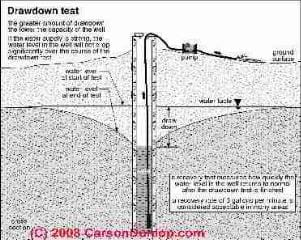
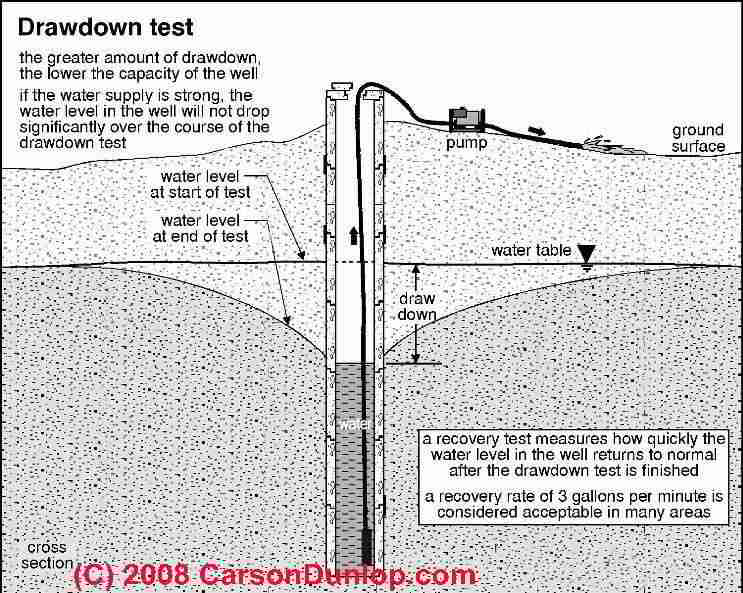
 The sketch at page top, courtesy of Carson Dunlop Associates, outlines what happens during a well drawdown or well flow test procedure.
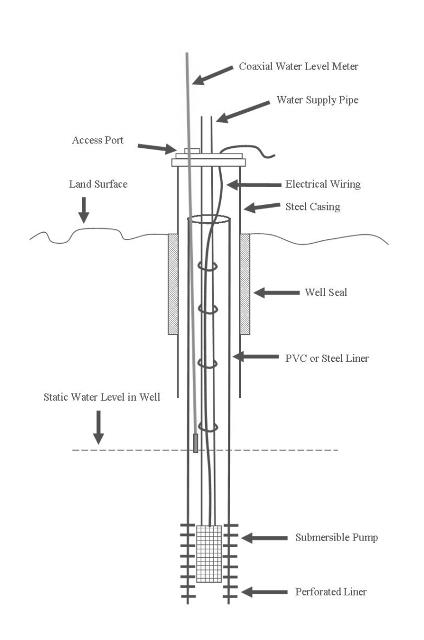
The illustration shown here explains that measuring water level in a well requires avoiding getting hung up on well piping, seals, spacers. Source: How to Measure Water Level in a Well, Oregon Water Department, cited below.
[Click to enlarge any image]
First you have to find the well. Second you need to know what kind of well is installed: driven point, drilled, or hand dug well, for example.
Two Key Questions to Ask About the Water Well
If you are purchasing a property served by a private well of any sort, here are the critical questions to ask about the well itself:
- Where is the well located? Is the well on the property? Can you find it? Sometimes there is a visible well casing above ground, or a visible protective cover over a dug well. Not always. If you can't find the well,
see WELL LOCATION, HOW TO FIND. - What kind of well is it: hand dug well, driven point well, drilled well, spring, stream, (these water source alternatives have implications for sanitation and water quantity as well as safety)
Measurements like the well depth, well flow rate, well recovery rate are all useful, but taken by themselves some of these numbers can give a false reading about the basic question of how much water is in the well?
What we ultimately need to know is the total quantity of water that can be drawn from the well and the quality of that water: is it potable, hard (mineral laden), smelly, dirty, requiring treatment for any aesthetic or health-concern contaminant?
See WELL FLOW RATE and
Well Depth Measurement Tools, Devices, Procedures
 Trimmer (1991) describes three methods to measure water levels in a well: an electronic sounder or depth gauge (device lowered on wire senses distance to water top), a wetted tape (accurate to about 90 ft), and an air line (measures anticipated usage volume not actual well water depth).
Here we describe several more-simple, very low-cost methods for making well and water depth measurements.
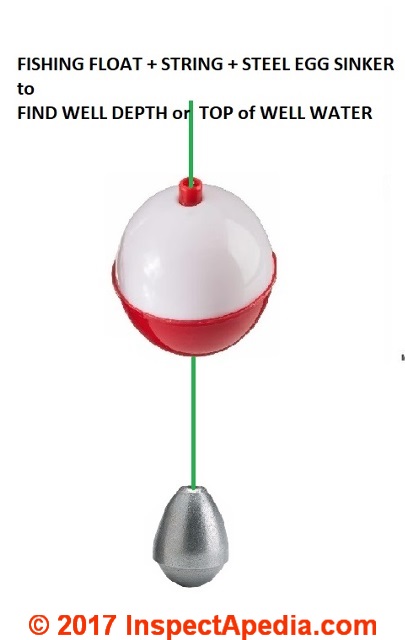
A simple steel egg sinker, 3/4oz or heavier can be used with string to find well depth. Adding a simple fishing float and suspending the weight just below the float can be used to find the depth to the top of well water.
These fishing essentials are sold just about everywhere, including online at Bass Pro Shops (basspro.com). Here are the details:
How to Find the Depth of a Well using a simple String and Weight
I've used a simple float and weight to measure well depth and the depth to the top of the well water in well bores as well as dug wells.
The Water Ace Pump Company [cited atReferences or Citations ] as well as other water equipment companies like Flotec® offer a simple well depth measurement procedure that works for drilled wells or hand dug wells. We have added some details.
1. Tie a small but heavy weight to the end of a piece of string (be sure there is enough string; some wells are very deep). Lower the weight into the well until it reaches the bottom. I use a steel or magnesium fishing weight.
Watch out: be careful putting anything into your well, that you don't send down a weight that gets hooked on pipes or valves in the well bottom.
Use a small (non-lead-containing) fishing weight or a rounded object and tie it carefully. I don't use a lead weight because if I lose it I'll have to retrieve it: I don't want to leave a chunk of lead in the drinking water.
2. Take up the slack and mark the string at ground level. Pull the weight out of the well.
3. Measure from the bottom of the weight to the ground level mark on your string. This is the depth of your well.
For relatively shallow wells, 30' or less, we sometimes use a tape measure directly, but a weight on a string assures that the line used to make a measurement is absolutely straight, so more accurate.
How to Find the Level of Water Top the Well
Except for artesian wells, the top of the water level in the well will virtually always be some depth lower than the top of the ground surface.
As we explain below, there are reasons we want to know the depth from ground to the top of the water level in the well: to calculate the well's static head or volume.
Well Water Water Level by Observation
First be sure that the well is in fully-recovered mode. That means that no water has been drawn from the well (the pump is off or no water is being run at the building(s) served by the well for an interval long enough that the well has fully recovered.
Just how long you need to wait for a well to recover depends on the well's static head, and its flow rate or recovery rate. The time may be anywhere from a few minutes to 12 hours or longer.
If you can see the top of water in your well and if the top is not deep in the well, you may be able to measure to the water top using a simple tape measure.
Watch out: Take care not to drop the tape into the well, or tie a string from the tape's belt clip to your belt if you are clumsy like me.
Oops I dropped the weight into the well! Ok so have I. I also leaned over a well and dropped a fancy pen that my mom had given me. (I left it there and I never told anybody.)
See WELL PIPE RETRIEVAL TOOLS for help getting back stuff you've dropped into the well.
Well Water Level by Using a String & Fishing Float
If you cannot see the top of water in your well then you can tie a fishing float or "bobber" to your string and lower it carefully into the well until it stops dropping. Mark the string at ground level. Measure that string length - that's the depth from the ground surface to the top of your well water.
I hang a small light (non-lead) weight below my bobber to help lower it into the well and I take care to avoid snagging the bobber and string on components along the well pipe.
Well Water Level by Using a String & Water Finding Paste
You can adapt the string and weight method described above by adding a water finding paste to the upper portion of the string. Water finding paste will turn color (such as pink to blue) where it contacts water.
The string and paste will permit you to measure well depth and water top at once if you can first guess at the location of the water top so that you can locate where to put the paste without having to coat the entire string.
For a deep well I'd want a long, strong string, a smooth non-jamming weight.
Well Water Level Using a String and "Popper" (Pipe cap and nipple)
Flotec® describes using a popper or noise-maker assembled from a 4-6" x 1/2" pipe nipple and cap. The cap is sealed to the pipe nipple and the assembly is lowered into the well, again taking care not to snag the assembly in the well bore.
Flotec explains that when you lift the pipe nipple+ cap (open end down) from beneath the water surface back into the air the assembly will make a "pop" sound that is quite audible. Measure your string from ground level at that point to the bottom of the pipe nipple and you've measured the distance from ground level to top of the well water.
What do Well Depth Measurements Mean?
Well depth and well water depth permit you to calculate the static head or volume of water in the well at rest. These procedures are important for matching the well pump capacity to the physical depth of the well opening in the ground.
But knowing the well depth does not tell us much about how much water is actually in the well (though we can calculate that) and it doesn't tell us the rate at which we can take water out of the well and for how long - the well's flow rate.
Watch out: measuring the water level in a well is not the same as measuring well depth.
- Definition of well depth: the distance from the ground surface to the bottom of the bore hole.
- Definition of water level: the height to which water rises in a water well when the well is at rest and fully recovered after recent use.
- Definition of static head: the height of the column of water available to the well pump or foot valve; distance from the water level top to the intake of the pump or foot valve. Multiply the static head height by well diameter or by well volume per foot to determine the actual water volume comprised by the static head.
See WELL DYNAMIC HEAD & STATIC HEAD DEFINITION where we explain how we use well depth and the well bore diameter to calculate the actual volume of water in the well in gallons or liters. - Definition of drawdown depth: the depth to which the pump lowers water in the well when the pump is running.
In a well whose flow rate is greater than the pump's rate of removing water from the well, the drawdown depth will be somewhere below the top of the static head and the water intake at the pump or foot valve.
The drawdown depth of your well is measured when the well driller prepares your well or possibly when your plumber installs a new well pump. - Definitions of water quantity and well flow rate: how much water is in the well bore when the well is recovered and at rest? How much water can we actually get out of a well?
See WELL YIELD, SAFE LIMITS
and see WELL FLOW RATE
How to Find the End of the Steel Casing in a Well Bore
Reader Question: how do I measure the depth of the steel casing part of my well?
The current well casing is 6” steel and rusting, evidenced in the drinking water How do I determined the length of this casing? - J.D. 6/8/2013
Reply: string and magnet method; well camera method
My first preference in finding out details about a drilled well using a steel casing is to look in the building for notes about the well location, depth, and specifications; often the driller or plumber provides that data in writing and it may also be written on a wall or ceiling joist in a basement or crawl area where the well pipe enters the building, or at the water tank and well pump.
I've also had success calling local well drillers to find out who drilled the well as usually the company keeps well drilling record.
But if you are left with no information and need to know just the depth of the steel well casing (as opposed to the total well depth) try this procedure, working carefully to avoid dropping anything into the well or hanging up your cord and weight-magnet.
- Pick up a strong alnico magnet, tie it to a strong but light nylon rope,.
- Lower the magnet lower into the well center until you are sure you are below the casing, or to well bottom.
Watch out to avoid hanging the magnet up on the well pump, pipe connections, wiring. I like a round or cone-shaped magnet that is less likely to get caught up, and one that is just an inch or so in diameter;
- Pull the magnet up slowly until you feel when magnet first grips the steel well casing
- Mark rope at well top (I used a magic marker)
- Pull the magnet and rope out of the well completely.
- Measure the rope length between the casing-top-mark and the magnet.
- This approach may take a couple of tries.
Watch out: Don't drop stuff on the well.
An alternative is to hire a well service company who offer an inspection camera service. Such cameras are lowered into the well to inspect for casing cracks, rust holes, damage;
Matching Well Pump Capacity to Well Depth
Water Ace explains how to select the depth to which your submersible pump or foot valve should be placed in a water well.
Subtract five feet from the depth of your well. This number should not exceed the maximum rated depth for your pump. If it does, it will greatly hinder or prevent the proper operation of the pump.
FYI the five foot deduction from the physical well depth used to estimate pump capacity is assuming that the water pick-up end of your in-well piping will be held about five feet off of the physical bottom of the well. That's because placing the water pick-up too close to the very bottom of the well risks picking up silt and debris, clogging the foot valve, piping, and water pump
Well Depth Tools, Research, Articles, Methods
- Flotec®, "Find Your Well's Depth to Water" [web article], Flotec 293 Wright Street, Delavan, WI 53115 USA, Tel: 800-365-6832, Retrieved 2017/10/25, original source: http://www.flotecpump.com/residentialpage_resource_starthere_4inSub_DepthtoWater.aspx
- HOW to MEASURE the WATER LEVEL in a WELL [PDF], (Using an electric water level meter), Oregon Water Resources Department & Oregon State University Sea Grant Extension (2009), retrieved 2017/10/25, original source: http://www.oregon.gov/owrd/gw/docs/water_level_booklet.pdf
- Trimmer, Walter L. MEASURING WATER WELL LEVELS [PDF] [Corvallis, Or.]: Oregon State University, Extension Service, 1991.
Abstract:
Groundwater is an important resource in Oregon. As more people depend on groundwater, some water tables around the State are dropping, threatening their water supplies. State law requires that groundwater be managed as a renewable resource, and that water tables do not drop permanently.
To assess the size of the groundwater resource and monitor the effects of development and drought, State law requires an aquifer test on every well with a water right.
Part of that test is to measure the depth of water in the well. We’ll discuss three methods of measuring water levels in this publication.
Well Abandonment / Bore-hole Sealing Procedures for Wells Taken out of Service
The steps you need to take to seal off a water well or to de-commission a well - this topic has been moved and expanded and is now found
Readers of this document should also
See WATER TANK TYPES and before assuming that a water problem is due to the well itself,
see WATER PUMP REPAIR GUIDE an specific case which offers an example of diagnosis of loss of water pressure, loss of water, and analyzes the actual repair cost.
In a companion article,
we describe both valid and questionable ways people measure well yield, and we offer some simple steps any home owner or home buyer can take to check the adequacy of water pressure and water quantity at a building.
Reader Comments, Questions & Answers About The Article Above
Below you will find questions and answers previously posted on this page at its page bottom reader comment box.
Reader Q&A - also see RECOMMENDED ARTICLES & FAQs
On 2022-06-27 by InspectApedia-911 (mod)
@Paula Chaapman,
Sorry but I don't understand what
A KB 799 means.
But you will find articles here on how to measure the depth of a well, how to measure the static head or volume of water that's in the Well when the well is at rest, and how to measure the well flow rate or its actual ability to deliver water. Do take a look.
On 2022-06-27 by Paula Chaapman
My well" is AKB799 How mux=ch water do we have?
On 2022-04-09 by Inspectapedia Com Moderator
@PeterC,
I wont pretend to do the calculations or scientific analysis to estimate the amount of lead that might appear in your drinking water from dropping a small fishing weight into a well.
The science would require having an opinion about the water usage rate and therefore the volume of water passing through the well as well as the water chemistry or its corrosivity as well as the condition of the lead weight and perhaps its depth into the muck at the bottom of the well.
So let's put that aside and suggest that you might try, using a more stout line, retrieving The weight by hooking the remains of its line which will also be coiled and fouling the lower portion of your well.
Or you can first send down a well bore inspection camera to see exactly the situation.
On 2022-04-08 by PeterC
My pump went so my friend said put a fishing weight, so I did it was 216 Feet deep on retrieving it the line cut and it dropped to the bottom it was a 3oz led fishing weight should I be concerned it seemed that there was abought foot of muck on the bottom?
On 2022-04-01 by Inspectapedia Com Moderator
@MarkS,
Being safely far away I will hazard a guess that "probe refusal depth" is the depth at which their probe to find well depth seemed to be blocked or stopped. That's the purported "well bottom".
The reason for that fancy-pants term "well probe refusal depth" is a bit of ducking to avoid a later customer depth that what was found was not the true bottom of the well.
For example if a probe or simply a dropped weight on a string hits an obstruction such as a well pipe centering disc or a damaged well casing and then can't go further, that "depth" isn't actually to the bottom of the well.
How would we know what the heck the "probe" hit? We'd need to lower a well bore inspection camera to see what's going on.
Water quantity depth is the well's "static head" - the size of the column of water in the well when the pump has been off, the well has fully recovered from any recent use.
There are several gas burner diagnostic articles listed in the Recommended Articles list on this page, but
So "probe refusal well waster quantity depth" is the depth (or total height) of the water column between the top of the water and the depth to which the probe got.
Since in most wells the water in the casing doesn't come to the top of the well casing, all depth measurements have three components:
A - Top of well down to to xxx depth
B - Top of water down to xxx depth - which has to be a smaller number than A.
OPINON: it's a poor and inexpert well test report that failed to define its terms for the customer who paid for it.
On 2022-04-01 by MarkS
I have moved into a house and inherited a well flow test report, but cannot find explanations of a couple of terms used ie, probe refusal depth, probe refusal well water quantity depth, and probe quantity depth. Would you explain them for me please. Thank you.
On 2022-01-01 by Inspectapedia Com Moderator - send a well bore inspection camera down the well
@MollyH,
If you are not able to drop a weight to the well bottom I would quit dropping objects into the well bore as there's some chance of fouling up the pump or foot valve or other components.
It's also possible to send a well bore inspection camera down the well - a good way to confirm that the casing is un-damaged and that there are no obstructions.
What's left is a bit pricey so you'd do it when needed and not before: you'd have a well service company pull the well piping and pump.
On 2022-01-01 by MollyH
My property, in southern california desert, has a very very deep well. We have tried during with a weight to see how deep but it gets stuck on the way down. When something drops in it, it sounds like bullets hitting it and we don't hear it reach the bottom.
We can't find any records. How do we measure it or find out more about it. There's wells in the subdivisions here for the city but no record of one on our property. How do does it have to be to hear that sound? It's very distinct.
On 2021-08-12 by inspectapedia.com.moderator
@Dennis Angers,
I'm not sure, Dennis but if mud comes up on your weight you probably hit well bottom;
An alternative is to inspect the well bore using a camera.
On 2021-08-12 by Dennis Angers
Hi! I'm trying to find the depth of a well without removing the submersible pump. I've dropped a small weight (about 2 inches by 1 inch) at the end of a nylon rope and I've got a depth of 58 feet on both sides of the pipe going down in the well.
In your opinion, am I reaching the bottom of the well or is the pump blocking the weight and preventing it from going deeper?
Thanks for your time. It's greatly appreciated.
Dennis
On 2021-06-28 by danjoefriedman (mod)
@Anonymous,
You would measure the depth of the well using the procedure above. Know how far the pump is from the bottom you would either hold piping and measure its length or you might get close to that figure using a well camera inspection. Before trying those procedures with shock given above on this page, you might look thoroughly around your property and also contact local well installers who may have installed your pump because it's normal for the installer to document that information for you.
On 2021-06-28 by Anonymous
How do I find out how deep my well pump is?
On 2019-03-24 by danjoefriedman (mod) - tools to measure the amount of water in my well
Jeff
Some simple low-cost means of measuring the height of the water column in the well (its static head) are given in the article above. Please take a look and then ask further questions as needed.
On 2019-03-23 by jeff
I need to monitor the amount of water in my well. The pump is set at 400 feet. What devices are available to measure this? Thanks, Jeff
On 2019-01-27 by danjoefriedman (mod)
Cris
You might hear the penny hit the water if the water is near the top of the well. The depth of the Well from the ground to the well bottom does not tell us where the water top is.
On 2019-01-27 by Cris
If I drop a penny in a 200 foot deep well will I hear it hit the water?
...
Continue reading at WELL LOCATION, HOW TO FIND or select a topic from the closely-related articles below, or see the complete ARTICLE INDEX.
Or see WELL DEPTH, HOW TO MEASURE FAQs - questions & answers about well depth and its measurement, posted originally on this page.
Or see these
Recommended Articles
- STATIC HEAD OF WATER IN THE WELL
- DEPTH of a WELL, HOW TO MEASURE
- WELL YIELD DEFINITION
- WELL YIELD, SAFE LIMITS
Suggested citation for this web page
WELL DEPTH, HOW TO MEASURE at InspectApedia.com - online encyclopedia of building & environmental inspection, testing, diagnosis, repair, & problem prevention advice.
Or see this
INDEX to RELATED ARTICLES: ARTICLE INDEX to WATER SUPPLY, PUMPS TANKS WELLS
Or use the SEARCH BOX found below to Ask a Question or Search InspectApedia
Ask a Question or Search InspectApedia
Try the search box just below, or if you prefer, post a question or comment in the Comments box below and we will respond promptly.
Search the InspectApedia website
Note: appearance of your Comment below may be delayed: if your comment contains an image, photograph, web link, or text that looks to the software as if it might be a web link, your posting will appear after it has been approved by a moderator. Apologies for the delay.
Only one image can be added per comment but you can post as many comments, and therefore images, as you like.
You will not receive a notification when a response to your question has been posted.
Please bookmark this page to make it easy for you to check back for our response.
Our Comment Box is provided by Countable Web Productions countable.ca
Citations & References
In addition to any citations in the article above, a full list is available on request.
- In addition to citations & references found in this article, see the research citations given at the end of the related articles found at our suggested
CONTINUE READING or RECOMMENDED ARTICLES.
- Carson, Dunlop & Associates Ltd., 120 Carlton Street Suite 407, Toronto ON M5A 4K2. Tel: (416) 964-9415 1-800-268-7070 Email: info@carsondunlop.com. Alan Carson is a past president of ASHI, the American Society of Home Inspectors.
Thanks to Alan Carson and Bob Dunlop, for permission for InspectAPedia to use text excerpts from The HOME REFERENCE BOOK - the Encyclopedia of Homes and to use illustrations from The ILLUSTRATED HOME .
Carson Dunlop Associates provides extensive home inspection education and report writing material. In gratitude we provide links to tsome Carson Dunlop Associates products and services.
 | HOME | ABOUT | ASK a QUESTION | CONTACT | CONTENT USE POLICY | DESCRIPTION | POLICIES | PRIVACY | |
| © 2024 - 1985 Publisher InspectApedia.com - Daniel Friedman | |||||||||