
InspectAPedia® FREE Encyclopedia of Building & Environmental Construction, Diagnosis, Maintenance & Repair |
Question? Just ask us! InspectAPedia
|
 Diagnose Water Tank Problems
- POST a QUESTION or COMMENT about troubleshooting well water storage tanks or water pressure tanks.
Water pressure tank or water storage tank troubleshooting guide:
This article describes how and why to diagnose problems right at the water tank in order to help distinguish among intermittent water pressure loss, total water pressure loss, and poor water pressure or flow in a building.
How does the water tank affect building water pressure & how does the water tank affect building water quantity? How does the water tank affect well pump life & how to decide if water pressure tank replacement is necessary & Typical cost of various well, pump, and water tank repairs.
How a Bad Water Pressure Tank Can Cause Water Pressure Loss or Complete Water Supply Loss. Shaking the Water Pressure Tank to Diagnose its Condition.
The process of water tank troubleshooting starting with simple visual clues is explained.
InspectAPedia tolerates no conflicts of interest. We have no relationship with advertisers, products, or services discussed at this website.
How to Diagnose & Fix Water Pressure Tank Problems
 After explaining the relationship between the water tank and water flow or pressure in buildings, this article series provides easy steps to troubleshoot and repair water pressure & water pressure tank problems.
This article explains how a problem with the water pressure tank can cause a variety of problems in a building such as
[Click to enlarge any image]
- Air discharge at plumbing fixtures
- Pulsating water pressure
- Poor water pressure
- Complete loss of water pressure
- Damage to well or water pumps and their controls
- Leaks or wet areas in the building
The process of diagnosis and the costs of the repair for water tanks are explained.
Consumer advice on saving money on well repair costs includes a review of the parts and labor costs of a typical well pump and pressure tank replacement case.
How a Bad Water Pressure Tank Can Cause Water Pressure Loss or Complete Water Supply Loss
If the building water supply stops and takes minutes to hours to recover, you may have problem with the well flow rate. But the problem of lost water supply and pressure could be more mechanical: a bad well pump.
The well pump, in turn, could have been damaged or hastened to the end of its life by a bad water pressure tank which has caused well pump short-cycling. Short cycling of the pump motor can burn up the pump relay control.
- Water tank short cycling: A bad or defective water pressure tank which has lost its air charge or which cannot keep its air charge
will cause well pump short cycling - rapid turning on and off of the water pump.
This frequent pump switching on and off is hard on the pump (damages the pump) and also on the pump switches and controls (switch contacts can become burned).Short cycling is especially risky with an older water pump, and might push it over the edge of failure. When the water pump fails the building will simply lose water pressure (and water supply) completely (unless it by luck the building is served by an artesian well).
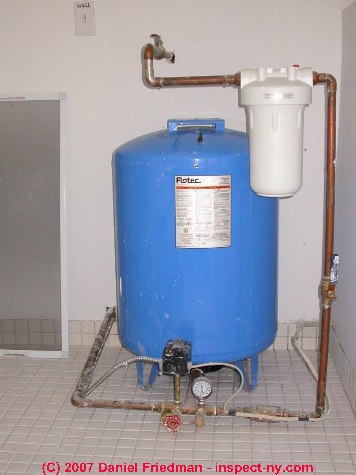
Our photo (above left) illustrates a conventional internal bladder water pressure tank. As no water pump is in view we infer that this system may support a well using a submersible well pump. - Old water pumps may stop when hot: A water pump might be at end of its life and about to burn up but still work after a cool-down cycle.
In other words when the pump has been working hard and the motor is hot the pump may stop running. Since the water pump may have been overheated due to short cycling, the actual root cause of its stopping may be the water tank (loss of air or a bad pump control) not the pump itself.
After the pump has been off for a while it may magically start working again: some water pumps have an internal thermal overload switch that shuts them off combined with an automatic thermal switch reset.This is most likely to be found on water pumps that are inaccessible such as a submersible water pump. In this case water pressure and supply will stop completely but will return after the pump cools down. But this failure is likely to be recurrent.
- More on short cycling, water tank air, and how to fix the problem:: To review loss of air charge, water pump short cycling, water pump pressure control settings, and other water tank repairs be sure to
see WATER PUMP & WATER TANK REPAIRS - Water tank air bladder problems such as a burst bladder or one which has become collapsed and stuck to itself can also cause
water pump short cycling and the loss of water pressure or flow shown above. Less common in our experience but possible is water tank inlet
clogging due to a high level of sediment in the water supply, leading to similar symptoms.
More often water sediment clogs the sensor of a water pressure regulator or it may clog a water filter, both of which lead to reduced water pressure and ultimately complete loss of water supply.
- Our complete list of causes of loss of water pressure is discussed and water problems are diagnosed in detail
at WATER PRESSURE LOSS DIAGNOSIS & REPAIR where we review the all of the things that can cause loss of water pressure or loss of water entirely in a building.
Shake the Water Pressure Tank to Diagnose its Condition?
Testing a home water tank: Some plumbers or homeowners check to see if their water tank contains any water by simply "shaking" the water pressure tank.
Watch out: Be careful: don't get too violent - moving a water tank around can cause plumbing leaks or even a burst pipe.
There may be a trick to this but shaking the water pressure tank alone is not going to reliably diagnoses a ruptured bladder in a captive air water tank).
Gently shaking the tank can tell you that the water tank is empty but not why the water tank is empty.
Why is there no water in the tank?: The water tank could be empty simply because you ran all of its water out into the home and the water pump never came on to replenish the water supply. The possible causes of an empty water tank and no water in the home include causes we list in detail just below:
What are the Causes of Low or Poor Water Pressure or Loss of Water Pressure in a Building?
- Loss of electrical power (pump does not run) to the pump or pump control - nothing is running the water pump. Is power turned on? Is there power at the pump control and is there power to the pump?
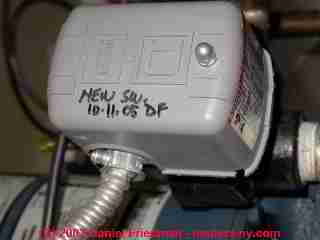
Bad water pressure control switch (pump does not run, pump does not respond to changes in water pressure, pump won't shut off) a failing pressure control switch on the water pump - perhaps the switch is not turning on the pump.
This can be checked by manually closing the pump relay - DON'T TRY THIS YOURSELF - SHOCK HAZARD - unless you are qualified and trained. Pressure Control Switch problems are discussed further
at CAUSES OF SHORT CYCLING.
Also be sure to
review WELL PUMP PRESSURE CONTROL ADJUSTMENT for instructions on how to adjust the water pump pressure control switch.
Our photo shows a new switch we installed on a one line jet pump in 2005.
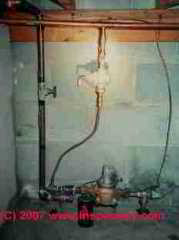
Bad water pressure regulator: (poor municipal water pressure) if the building is connected to a municipal water supply there may be a water pressure regulator installed, usually close to the water meter or where the water supply pipe enters the building.
A detailed guide to water pressure regulators and diagnosis and adjustment advice for these devices are
at WATER PRESSURE REDUCER / REGULATOR.
- Clogged water filter (pump cycles on and off very rapidly, reduced water pressure in the building) a clogged water filter can cause rapid pump cycling on and off - discussed further
at CAUSES OF SHORT CYCLING - Clogged water supply piping (reduced water flow) can cause poor water flow in a building.
This can occur suddenly from debris clogging a delivery pipe, often at a turn or "elbow" in the piping, but that's not common. If the building water supply piping is blocked usually this is a long-standing problem.
We discuss how to diagnose clogged water supply piping or blocked pipes as a cause of reduced or poor water pressure in our article
at WATER PIPE CLOG DIAGNOSIS.
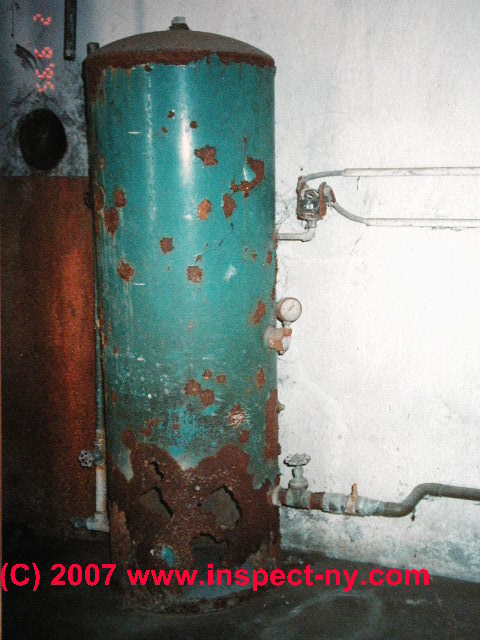 Bad water tank: (pump cycling on and off or "short cycling water pump") where buildings use a private pump and well and on some buildings with poor municipal water supply quantity or pressure, a water pressure tank is installed.
See WATER TANKS HOW THEY WORK
- Gently moving or "shaking" the water tank can tell you if the tank contains any water at all. The water tank could be empty simply because the well ran out of water (water was pulled out of the well faster than it could recover), or perhaps because the water pump never came on to replenish the water supply.
- Some of the possible causes of an empty water tank and no water in the home include other symptoms discussed in this list of loss of water pressure.
Water tanks that use an internal bladder can have a ruptured bladder. - Steel water tanks may not be as badly rusted as the rusty water tank in this photo, but they may have pinhole leaks that result in lost air charge in the water tank.
See WHAT IS SHORT CYCLING or a bladder that's stuck to itself (pump always comes on immediately).
- Well water supply pipe failure (pump runs, reduced or no water flow into the building) A well water supply pipe failure in the well or between the well and the building, so water is not being delivered to the home. (Or in cold climates, the line may have frozen)
Examples of this problem include frozen pipes, pipe leaks causing loss of water (inside the well or underground between well and building), or air leaks into the well piping, causing loss of prime (with jet pump systems).
Even when a submersible pump is located in the well (and there is no loss of prime problem), if the water piping is leaking between the pump and the building water pressure may be reduced or lost.
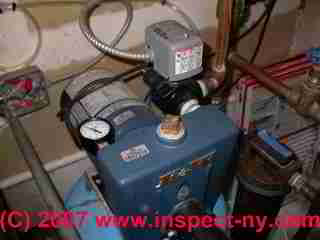 Loss of water pump or well pump prime (pump runs but no water is delivered) in an in-building pump, or an internal pump failure such as broken vanes - the pump motor runs but no water is delivered. An in-building pump could also run and no water be delivered if the well has run dry.
- A shallow well jet pump well line could have a bad foot valve (in the well) and so be losing prime. A leak in the well line can also lead to loss of prime as it lets water out or air into the well piping.
Some water pumps, particularly jet pumps, include a removable plug atop the pump assembly, giving access to the water pumping chamber in order to add water to "prime the pump" in the event that the water pump has become air bound.
This photograph shows such a plug on top of our one line jet pump.
- Water Pump Internal Parts Failure: (pump runs but no water is delivered) a pump failure such as broken vanes in the pump assembly, worn out and leaky internal pump bearings or parts, or clogging with sediment or minerals can result in a pump whose motor runs but whose water output is reduced.
- Water Pump Motor Failure: (pump motor stops or does not start at all): A failed or failing in-well submersible water pump stops delivering water at all, or periodically overheats and temporarily stops working. Such a pump is probably at end of life, unless the problem is traced to a voltage, switch, or wiring problem.
- Water Table Level Fluctuations: (seasonal reduction in water flow or water quantity): in some areas, fluctuations in the level of ground water such as a drop in the level of groundwater during the dry season or during droughts, can result in a reduced well recovery rate or complete loss of well water.
- Water Pressure Intermittent Bad or Lost: When you lose water pressure or lose all water supply for some time period but later it returns, check the possible explanations outlined
see How to Diagnose Loss of Water Pressure which later Returns or Recovers "on its own"
at WATER PRESSURE INTERMITTENT LOSS - Water Pressure Totally Lost: If you lose and do not recover water pressure in the building
see Diagnosis of Loss of Water Pressure which Does Not Recover on its Own
at NO WATER PRESSURE - Well is Failing: (reduced or no water flow, increasingly slow well recovery rate) the well itself may be deteriorating, with less water flowing into the well or water flowing into the more slowly than in the past.
Reductions in well flow rate occur over time when minerals clog the rock fissures that lead water into the well, or sudden reductions in well flow rate (and total water quantity) can occur if the well casing is cracked (perhaps by nearby blasting or equipment movement) or if someone drills another well nearby and happens to tap into the same water aquifer.
See WELL LIFE EXPECTANCY
Key Water Tank Diagnostic Articles
If you have no water pressure at all, see NO WATER PRESSURE
If your water pressure is intermittent, starts and stops, or varies in pressure,
see WATER PRESSURE INTERMITTENT LOSS
Is there some water pressure but the pressure and/or flow are poor?
- Water supply piping problem?
See Bad water pressure due to Clogged Pipes
at CLOGGED SUPPLY PIPES, DIAGNOSIS
and
see WATER PIPE CLOG REPAIR
The following articles pertain if you have a private well, pump, and tank system for your building - Water Tank Problems?
See WATER PRESSURE TANK REPAIRS - Water pump problems?
See - Bad water pressure regulator?
See WATER PRESSURE REDUCER / REGULATOR (not usually installed on private well and pump systems, often present on municipal water supply systems that use an in-building local water pump and pressure tank to boost pressure)
Reader Comments, Questions & Answers About The Article Above
Below you will find questions and answers previously posted on this page at its page bottom reader comment box.
Reader Q&A - also see RECOMMENDED ARTICLES & FAQs
On 2022-07-21 by InspectApedia-911 (mod) - reduced water pressure but pressure gauge reads high
@Jay Howard,
Thank you for a helpful question.
Actually, although it may not be obvious, the connection between a pressure gauge that reads abnormally high and reduced water flow in the house could indeed be traced to the same cause, such as mineral scaling or sediment that both clogs pipes and clogs the water pressure input port opening on the water pressure gauge.
You might start by replacing the pressure gauge.
On 2022-07-21 by Jay Howard
I am on a well system. All is over 20 years old. I have begun to notice reduced water pressure in my home, but also just noticed that the pressure gauge at the bottom of the pressure tank is reading over 70 psi. Why is this if I have reduced pressure in the house?
On 2022-02-01 by Inspectapedia Com Moderator - white film after washing dishes
@cindy lyon,
If you are seeing a white film on dishes that may be a mineral deposit from hard water or salt from an improperly-adjusted or malfunctioning water softener.
On 2022-02-01 by cindy lyon
what causes a white film (almost like a smog) after washing dishes from a stonewall water tank
On 2021-08-30 by inspectapedia.com.moderator - air gets trapped in pipes
@Yash,
Yes almost certainly, but any solution needs to start with an accurate diagnosis of the cause of the problem.
Take a look at AIR DISCHARGE at FAUCETS, FIXTURES
On 2021-08-30 by Yash
I have a problem that everytime we refill our empty water tank , air gets trapped in pipes.
Now each time we have to open the lowestmost tap so that air can release from their....as soon as air release then only water comes with pressure in all over house. What to do why is air getting trapped is there any solution?
On 2021-08-20 by inspectapedia.com.moderator
@Jeff,
I'm sorry but I really don't understand the situation that you describe. I don't understand a relationship between a water pressure tank and roof drainage gutters.
On 2021-08-20 by Jeff
I have a problem where the tank overflow has been set at the same height as the house gutters, so when the tank is full the gutters start to fill. Is there an easy solution to this??
On 2021-04-18 by danjoefriedman (mod) - prime the pump to fix air lock
@Stuart, I didn't think airlock was likely so I ducked that part of the question. Apologies.
However if you are using a pump to move water out of your tank it's true that the pump could be airbound if it's in a location where it needs to be primed and if it isn't automatically primed by gravity by water exiting your large water tank.
In that case you'll need to prime the pump. You'll find pump-priming procedures in the article index.
On 2021-04-18 by Stuart
If the answer to my question is air lock, how do I remove air lock?
On 2021-04-18 by danjoefriedman (mod) - Tank is filling but not feeding back to home system
@Stuart,
I would be looking for a valve that is closed including one who is internal stem broke (a gate valve) so that you think it's open but it has remained closed or debris clogging at a valve or elbow in the water supply piping.
I think that if the problem were air in the piping you would observe that by opening a faucet anywhere in the building and you would hear or see air or an air /water mix emerging.
On 2021-04-18 by Stuart
I just emptied and cleaned 300 gallon water tank. Tank is filling but not feeding back to home system. Is it an air lock in home system
stopping the flow to home. Yes, the home system went empty during process.
On 2021-02-13 by danjoefriedman (mod)
Hannie
I really want to be helpful but cannot offer a reliable guess when I've not a shred of information;
Why not wipe everything dry and then inspect carefully to see where the leak is occurring; then post a photo if the leak cause isn't obvious and I can comment more usefully.
On 2021-02-11 by Hannie
Why is our Bestank water tank leaking? What could be the reason?
On 2020-03-10 by (mod) - pump not turning on
Penny please see the moderator comment below.
Or see the diagnostics at WATER PUMP WON'T START
On 2020-03-10 by Penny
That was me about new pressure switch and power is on, but nothing happens. If ruptured diaphram/bladder, and air pressure won't hold at 28psi, will that keep it from switching on, or not? That's air pressure reading from top air stem.
The water pressure gauge is at 0 and doesn't move, no water coming in at all. Do you think the outside well pump has broken?
On 2020-03-10 - by (mod) - signs that the problem is a water pump that won't start
If the switch contacts are closed - as they should be if the tank pressure pre-set is right and the pressure is below the switch CUT-IN level- and if there is power to the control - and if the pump doesn't run , then it sounds like a pump failure.
On 2020-03-10 by Penny
There's power, switch new and installed correctly. If the outside submersible pump has stopped, would that keep the pressure tank from coming on, or do we have a ruptured diaphram/bladder?
Pressure tank psi dropped from 28 to 25 in half hour. No water in pressure tank because we drained to replace pressure switch, but nothing comes on now. Could the diaphragm have ruptured or do we need landlord to check his submerged pump?
On 2020-03-10 - by (mod) - signs of pressure switch not wired correctly or a well pump not working
Penny
IF the pressure in the water system is below 30 psi and your well pump pressure control switch is a model designed to turn ON at 30 psi (or below),
and
IF the pump relay does not close (no "click") and thus the pump doesn't turn on
THEN
I suspect that there is either no electrical power to the pump circuit or the switch is not properly wired.
A ruptured pressure tank bladder would not directly prevent a well pump from running; instead the pump would probably run with very short on-cycles as the tank becomes waterlogged.
Watch out: however a waterlogged pressure tank, by causing the pump to short cycle, can indeed lead to pump damage.
See WATER PUMP SHORT CYCLING - home
On 2020-03-10 2 by Penny
We are on land that has a well. Had to have a pressure tank in stalled in mobile to get water to come from well pump, into mobile, 5 years ago. Got a WaterWorkers 20gal. Two days ago, no water.
Replaced pressure switch today and put air in tank, to 28psi, as directed. Still, no water.switch doesn't click on. It may be landlord well pump broke.
However, we were told our bladder or diaphragm may have ruptured, because 30 minutes after filled to 28 psi, it was down to 26 psi and you can hear a sound like air, in tank. How do we know if we need to replace our pressure tank?
On 2020-03-08 - by (mod) -
Joseph
Apologies but I don't understand the question.
Install what kind of water tank?
Overhead of what?
What kind of air lock is occurring?
What is the cause of that air-lock?
Without understanding more any solution is a bit speculative.
On 2020-03-06 by Joseph
How can I install over head water tanks to prevent air locks
On 2019-02-07 - by (mod) - water supply sediment problem
Walter:
Knowing there's a history of sediment in the well water and thus entering the pump control switch and system, when replacing the pressure control switch (that can clog quickly), here are some additional considerations:
- check and clear the tube or small diameter pipe that conducts water pressure to the bottom of the pressure control switch
- check the placement of the pump or foot valve in the well to be sure it's not too close to a sediment-filled or muddy well bottom
- if well sediment is a recent problem or increasing, hire a well driller service company who can use a well inspection camera to inspect the entire well casing for cracks, holes, damage, exterior leaks that might be letting not just soil and sediment but other contaminants into the water supply
On 2019-02-07 by Anonymous
Hi,
I have been getting a lot of sediment, but I did just replace the switch ( with a model from tractor supply) I am going to replace it with a Square D 30-50 model from a plumbing supply house.
On 2019-02-07 - by (mod) - signs of clogged water pipes
Walter
When water pressure drops dramatically when a second water-using fixture is run I first-suspect clogged water pipes.
But when your pump runs normally after re-starting I suspect something else: a debris clogged pressure control switch that is not sensing the pressure drop. Try replacing the control.
On 2019-01-28 18:27:08.640664 by walterR
Pressure is good, but when I turn on shower or washing machine, water shuts down, pressure gauge reads <10lbs and i have to hit the manual switch on the pressure switch, but, if i turn on the sink and let it run until the pump turns on it is good for a while even with the shower or the washing machine running. i am wondering if it is a bad check valve?>
On 2019-01-13 - by (mod) - pump won't turn off
Rick we have some diagnostic suggestions for the case you describe. Please see
WATER PUMP WONT STOP RUNNING
and let me know what questions remain
On 2019-01-13 by Rick
Repl. Pressure switch 40-60psi but pressure raises to 60 gauge wavers there and sw will not turn off pump
On 2018-11-04 - by (mod) - letting air out of the pressure tank
Regrets, James but letting AIR out of the water pressure tank does not fix anything to do with excessive water pressure in a building.
Abnormally high water pressure on a pump and tank system is more likely due to a pressure control switch that is not turning the pump off at the proper CUT OUT pressure setting.
That could be due to a debris-clogged control switch.
Watch out: if water pressure exceeds the tank rated pressure the tank could burst, injuring anyone nearby.
Fix or replace the pressure control.
On 2018-11-04 by James Harmon
the water pressure to my house got real high the pressure tank had to much pressure I let some air out and it work fine for a few weeks and then got very high again high enough it was causing the pressure value on the hot water tank to kick off. would this be a bad pressure tank?
...
Continue reading at WATER TANK REPAIR PROCEDURES or select a topic from the closely-related articles below, or see the complete ARTICLE INDEX.
See WATER TANK DIAGNOSIS & REPAIR FAQs for questions & answers posted originally at this article
Or see these
Recommended Articles
- WATER PRESSURE PROBLEM DIAGNOSIS TABLE
- WATER PUMP SHORT CYCLING
- WATER PUMP CONTROLS & SWITCHES - home
- WATER TANK AIR VOLUME CONTROLS - home
- WATER TANK NOISE DIAGNOSIS
- WATER TANK REPAIR PROCEDURES
- WATER TANK vs WATER PRESSURE
Suggested citation for this web page
WATER TANK DIAGNOSIS & REPAIR at InspectApedia.com - online encyclopedia of building & environmental inspection, testing, diagnosis, repair, & problem prevention advice.
Or see this
INDEX to RELATED ARTICLES: ARTICLE INDEX to WATER SUPPLY, PUMPS TANKS WELLS & SPRINGS
Or use the SEARCH BOX found below to Ask a Question or Search InspectApedia
Ask a Question or Search InspectApedia
Try the search box just below, or if you prefer, post a question or comment in the Comments box below and we will respond promptly.
Search the InspectApedia website
Note: appearance of your Comment below may be delayed: if your comment contains an image, photograph, web link, or text that looks to the software as if it might be a web link, your posting will appear after it has been approved by a moderator. Apologies for the delay.
Only one image can be added per comment but you can post as many comments, and therefore images, as you like.
You will not receive a notification when a response to your question has been posted.
Please bookmark this page to make it easy for you to check back for our response.
Our Comment Box is provided by Countable Web Productions countable.ca
Citations & References
In addition to any citations in the article above, a full list is available on request.
- Life Expectancy of Wells & Water Tanks how long should a water well and its components last?
- Grove Electric, Typical Shallow Well One Line Jet Pump Installation [PDF], Grove Electric, G&G Electric & Plumbing, 1900 NE 78th St., Suite 101, Vancouver WA 98665 www.grovelectric.com - web search -7/15/2010 original source: http://www.groverelectric.com/howto/38_Typical%20Jet%20Pump%20Installation.pdf
- Grove Electric, Typical Deep Well Two Line Jet Pump Installation [PDF], Grove Electric, G&G Electric & Plumbing, 1900 NE 78th St., Suite 101, Vancouver WA 98665 www.grovelectric.com - web search -7/15/2010 original source: http://www.groverelectric.com/howto/38_Typical%20Jet%20Pump%20Installation.pdf
- Water pressure tanks - how to diagnose the need for air, how to add air, stop water pump short cycling to avoid damage - water storage water pressure tank safety.
- WATER PUMP REPAIR GUIDE an specific case offers an example of diagnosis of loss of water pressure, loss of water, and analyzes the actual repair cost
- Water pressure tank failures & water pump short cycling diagnosis and repair
- Our recommended books about building & mechanical systems design, inspection, problem diagnosis, and repair, and about indoor environment and IAQ testing, diagnosis, and cleanup are at the InspectAPedia Bookstore. Also see our Book Reviews - InspectAPedia.
- In addition to citations & references found in this article, see the research citations given at the end of the related articles found at our suggested
CONTINUE READING or RECOMMENDED ARTICLES.
- Carson, Dunlop & Associates Ltd., 120 Carlton Street Suite 407, Toronto ON M5A 4K2. Tel: (416) 964-9415 1-800-268-7070 Email: info@carsondunlop.com. Alan Carson is a past president of ASHI, the American Society of Home Inspectors.
Thanks to Alan Carson and Bob Dunlop, for permission for InspectAPedia to use text excerpts from The HOME REFERENCE BOOK - the Encyclopedia of Homes and to use illustrations from The ILLUSTRATED HOME .
Carson Dunlop Associates provides extensive home inspection education and report writing material. In gratitude we provide links to tsome Carson Dunlop Associates products and services.
 | HOME | ABOUT | ASK a QUESTION | CONTACT | CONTENT USE POLICY | DESCRIPTION | POLICIES | PRIVACY | |
| © 2024 - 1985 Publisher InspectApedia.com - Daniel Friedman | |||||||||