
InspectAPedia® FREE Encyclopedia of Building & Environmental Construction, Diagnosis, Maintenance & Repair |
Question? Just ask us! InspectAPedia
|
 Lead in Drinking Water
How to Reduce Lead Contamination in Drinking Water, Flint Michigan & Other Cities
- POST a QUESTION or COMMENT about how to get rid of lead contamination in drinking water
How to reduce the levels of lead in drinking water:
This article explains simple steps you can take to reduce exposure to lead in drinking water; new EPA Standard for lead and copper in drinking water, and requirements placed on community water suppliers. Links to Lead Testing Services are also provided.
InspectAPedia tolerates no conflicts of interest. We have no relationship with advertisers, products, or services discussed at this website.
What to Do About Lead in Drinking Water
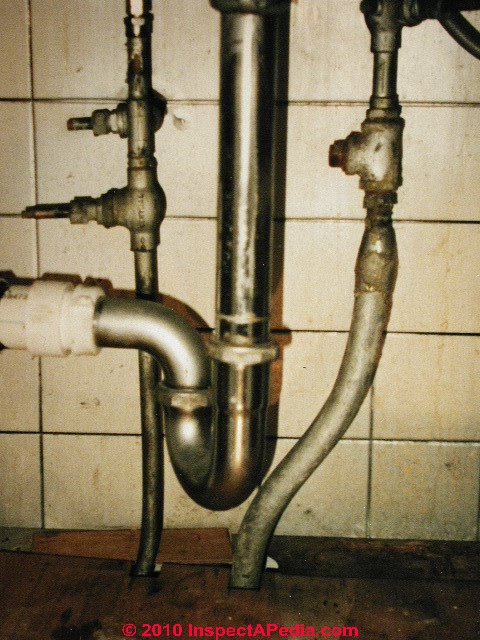
You can spot the lead water supply piping in our photo at left. The right-hand lead water pipe is thicker than the copper water pipe in left side of the photo, and you can see the lead pipe wipe joint as well.
Article Contents
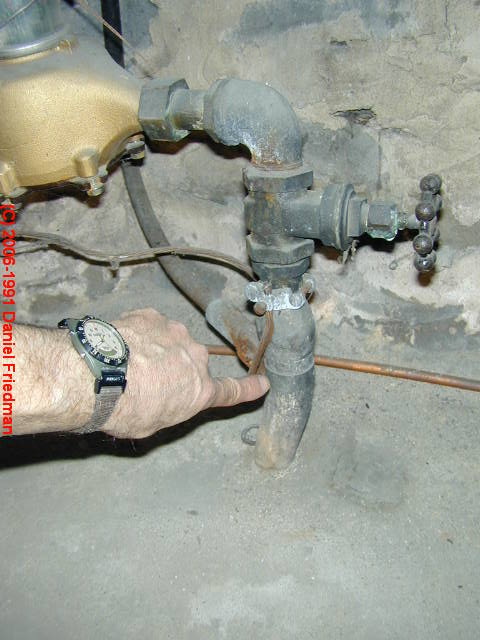
[Click to enlarge any image] More photos of lead water supply (and drain) piping are
Just how serious is lead contamination in private or public water supplies? It depends in part on where you live. In June 2010 the New York Times, citing Reuters reported:
Health workers have set up emergency treatment centers in northern Nigeria for scores of children suffering from lead poisoning and are racing to contain contamination that has already killed more than 160 people.
High levels of lead have contaminated water supplies in at least six villages in Zamfara State, close to where residents were illegally mining for gold. More than 350 cases have been reported over the past few months, and 111 of the dead are children, many younger than 5. The Dutch arm of Doctors Without Borders has brought in drugs to treat villagers found to have high levels of lead in their blood.
Watch Out: Lead Hazard Warning: consumption or absorption of lead into the human body is hazardous, particularly for children but in fact for anyone. [1] & [3-21]. And at least one correspondent has expressed the view that there is no level of lead exposure for which they have not found an adverse effect. [22]
Watch out for devices sold to reduce lead in drinking water but that do not work. The U.S. EPA recommends that you should verify the lead-reduction claims of device manufacturers by checking the NSF International or the Water Quality Association.
Related Articles on lead hazards and citations of authorities on lead hazards, testing, and remediation are atReferences or Citations .
In the U.S. lead levels in public water supplies has been dropping since passage of the 1974-2004 Federal Safe Drinking Water Act, and public water supplies are much less likely to be a lead hazard source. But in-building sources of lead in water may remain.
In November 2010 the New York Times reported that in 2009 only 5.4% of samples had elevated lead, but in 2010 tests of 222 water samples found lead from 16-30 ppb in 14% of the samples. Although at these low levels the city did not consider the lead a clear health hazard, the city advised residents to run water for "at least 30 seconds" before drinking or cooking with it. A similar advisory was issued in 2005.
Watch out: the length of time needed to run water to flush out high-lead-level water that has been sitting in piping overnight depends on the total length of pipe between your tap and the street as well as use by other building occupants. If you run water at a tap until it is cold you have most likely successfully flushed the lines. This same principle applies to private residences.
The United States Environmental Protection Agency (EPA) and various U.S. municipal water suppliers are concerned about lead in drinking water. As late as 1961 major cities such as New York were still installing lead water mains piping.
In 1992, as a result of legislation written in Congress (the U.S. Federal Safe Drinking Water Act), a new US EPA standard for lead and copper became effective. This standard is intended to help communities around the nation reduce their exposure to lead/copper in drinking water, and there by, lower their exposure to lead/copper from all sources, including air, lead based paint, soil and dust. Lead paint is the main source of lead poisoning; however, lead contamination from water can contribute 10 to 20 percent of a person's exposure.
In 1992, more than 60,000 public water suppliers throughout the U.S. tested various homes they served for lead/copper at household taps.
In-building sources of lead in water: Although water supplied from your water treatment plant may be free from lead or copper*, contamination from your piping system may cause lead/copper to dissolve (leach) into your water supply if:
- You have a lead service line connecting your home to the water main in the street; and/or
- Your home has lead water supply pipes; and/or
- You have lead containing soldered joints in your copper supply pipes (installed from 1983-86); and/or
- You have plumbing fixtures containing lead.
- Your building has brass water supply pipes - some brass contains lead
- In rare cases some lead leaching may take place from piping in the street if it is a low flow area, i.e.; dead end streets.
EPA Lead limit: Although most homes have very low levels of lead in their drinking water, some homes in some communities have lead levels above the EPA action level of 15 parts per billion (ppb), or 0.015 milligrams of lead per liter of water (mgL).
Under Federal Law water suppliers are required to have a program in place to minimize lead in drinking water by January 1, 1996. This program includes corrosion control treatment, source water treatment, and public education. We are also required to replace each lead service line that we control if the line contributes to lead concentrations of 15 ppb or more after we have completed the comprehensive treatment program. If you have any questions about how the requirements of the lead regulations are being carried out, call your local water department or health department.
A Brief History of Lead Exposure Level Standards
Gilbert & Weiss cite the history of the U.S. CDC's position on the acceptable levels of lead in children's blood levels as we summarize below:[23]
Acceptable Childhood Blood Levels - U.S. CDC & Other Agencies |
|
| Year Published & Agency | Blood Level in ug/dl |
| U.S. CDC - 1960 | 60 |
| U.S. CDC - 1973 | 40 |
| U.S. CDC - 1975 | 30 |
| U.S. CDC - 1985 | 25 |
| WHO - 1986 | 20 |
| U.S. EPA - 1986 | 15 |
| U.S. CDC - 1990-1991 | 10 |
| U.S. CDC - 2006 ?? | |
Notes to the table above
1. ug/dl = micrograms of lead per decaliter of blood
2. OPINION: in general authorities argue that there is no level below which it can be demonstrated that lead exposure is not hazardous. [23]
3. Table quoted from Steven G. Gilbert & Bernard Weiss, "A rationale for lowering the blood lead action level from 10 to 2 μg/dL", NeuroToxicology, Volume 27, Issue 5, September 2006 [23]
Health Effects of Lead Poisoning and Lead in Drinking Water
Lead is a common, natural, and often useful metal found throughout the environment in lead-based paint. air, soil, household dust, food, certain types of pottery porcelain pewter, and water.
Lead can pose a significant risk to your health if too much of it enters your body. Lead builds up in the body over many years and can cause damage to the brain, red blood cells, and kidneys. The greatest risk is to young children and pregnant women.
Amounts of lead that won't hurt adults can slow down normal mental and physical development of growing bodies. In addition, a child at play often comes into contact with sources of lead contamination - like dirt and dust - that rarely affect an adult. It is important to wash children's hands and toys often, and to try to make sure they only put food in their mouths.
Lead in Drinking Water as a source of lead poisoning
- Lead in drinking water, although rarely the sole cause of lead poisoning, can significantly increase a person's total lead exposure, particularly the exposure of infants who drink baby formulas and concentrated juices that are mixed with water. The EPA estimates that drinking water can make up 20 percent or more of a person's total exposure to lead.
- Lead is unusual among drinking water contaminants in that it seldom occurs naturally in water supplies like rivers and lakes. Lead enters drinking
water primarily as a result of the corrosion, or wearing away, of materials containing lead in the water distribution system and household plumbing. These
materials include lead-based solder used to join copper pipe, brass and chrome plated brass faucets, and in some cases, pipes made of lead that connect your
house to the water main (service lines).
In 1986, Congress banned the use of lead solder containing greater than 0.2% lead and restricted the lead content of faucets, pipes; and other plumbing materials to 8.0%. - When water stands in lead pipes or plumbing systems containing lead for several hours or more, the lead may dissolve into your drinking water. This means the first water drawn from the tap in the morning or later in the afternoon after returning from work or school can contain fairly high levels of lead.
Steps You Can Take in the Home to Reduce Exposure to Lead in Drinking Water
Who is Responsible for Making Drinking Water Safe?
The answer depends on the answer to "Is My Water Supply Public (regulated by the Safe Drinking Water Act) or Private (responsibility of the homeowner)?"
Definition of a public water system (PWSs): a public water supply system, or "community water supply" or "municipal water supply" is one that has at least 15 service connections or serves at least 25 people per day for 60 days (or more) during the year.
Any such system is defined as a "community water system" or in our words, a public water supply and is regulated by federal law. The community government, typically its water department and health departments are responsible for compliance with federal law regulating safe drinking water, including both regular testing and if necessary, treatment of the water supply. The type of water treatment required depends on the water source and water quality.
Occupants of homes served by municipal water supply in the U.S. are receiving water that is required by law to be regular tested for a number of contaminants, including lead. But even if the supplied water and its delivery system are acceptable, in-building piping can be a source of lead contamination, especially for buildings whose piping contain lead or lead solder.
Some cities such as New York City include phosphoric acid to the water supply to help form an oxide coating inside piping to reduce the rate of lead flowing through piping. But water sitting in piping during times of little or no use may still absorb some lead if it's present in the system.
Definition of a non-community or private water system: a private water supply system is smaller in size than the definition above, or serves people for less than 60 days per year. The owners of a private water supply system are responsible for assuring that the water provided by that system is safe to drink. While private water supply systems may not be regulated by federal law, local village, town, state, or county health departments and regulations may indeed apply and may set standards for acceptable drinking water for private wells in their community.
The EPA defines two types of non-community water supply systems: (Quoting from the EPA's Drinking Water Treatment)
- Non-Transient Non-Community Water System (there are approximately 20,000) - A noncommunity water system that serves the same people more than six months per year, but not year-round, for example, a school with its own water supply is considered a non-transient system.
- Transient non-community water system (there are approximately 89,000) - A non-community water system that serves the public but not the same individuals for more than six months, for example, a rest area or campground may be considered a transient water system.
Owners of private wells (serving less than 15 connections or 25 people) are responsible for assuring that their well water is safe. The EPA Recommends (Drinking Water Standards):
People with private wells are responsible for making sure that their own drinking water is safe. Some states do set standards for private w ells, so well owners should c heck their state requirements. U S EPA recommends testing your water once per year to see if it meets federal and state standards.
Call the EPA Safe Drinking Water Hotline at 1-800-426- 4791 or see the US EPA Safewater home page at www.epa.gov/safewater/privatewells to find out how to get a list of certified testing labs in your state.
List of Steps to Take to Reduce Exposure to Lead in Drinking Water
- Test your water supply: Despite our [the local municipal water authority] best efforts mentioned earlier to control water corrosivity and remove lead from the
water supply, lead levels in some homes or buildings can be high.
To find out whether you need to take action in your own home, have your drinking water tested to determine if it contains excessive concentrations of lead. Testing the water is essential because you cannot see, taste, or smell lead in drinking water.
Some local water test laboratories that can provide this information. For more information on having your water tested, please call your health department or water department. Some cities may offer free lead tests. New York City residents can take advantage of a free lead-in-water test kit.
See http://nyc.gov/html/dep/html/drinking_water/lead_test_kit.shtml or in New York Cit call 311 to ask for a free lead testing kit.
Watch out: the amount of lead leaching out of lead pipes into the water supply varies depending on the corrosivity of the water itself (see pH testing discussed just below) as well as on the rate of movement of water through the piping.
As we discuss later in this article, very high lead may be found in water samples testing water that has remained still in pipes overnight during periods of little or no water usage.
This "first draw" water lead level is likely to be much higher than the level of lead detected when the still water has been flushed from the system.
Watch out: At LEAD FILTERS for WATER we note that The U.S. EPA warns against obtaining free lead testing kits from companies selling lead filters.
Watch out: at LEAD LEACHING WARNINGS we report research that found low pH water as a source of corrosion that may leach lead into the building water supply from lead-containing brass water piping fittings (such as are used on PEX water piping systemns) as well as from brass water supply piping or brass faucet components.
See DEZINCIFICATION WATER TESTS for methods to detect these conditions. - Check the pH of your well water. NSF International advises the following:
"If you have a private well and have high lead levels, the problem could be due to low pH. When pH levels drop below 7.0, water becomes acidic which can cause lead to leach from plumbing fixtures. Acid neutralizing systems are generally used to correct this situation.
By adding a chemical like soda ash to the water to boost pH above 7.0, the system can help reduce both lead and copper leaching attributable to low pH." - NSF cited at the end of this article.
Watch out: Any pH level below 7.0 is considered acidic. Never let acidic water contact lead pipe; the acidity of the water will encourage lead to leach out of lead water pipes into the water supply. - Lead in water action level: If a water test indicates that the drinking water drawn from a tap in your home contains lead above 15 ppb, then you should take the following
precautions:
- Flush in-building water supply pipes: Let the water run from the tap before using it for drinking or cooking any time the water in a faucet has gone unused for more than six hours. The
longer water resides in your home's plumbing the more lead it may contain.
Flushing the tap means running the cold water faucet until the water gets noticeably colder, usually about 15-30 seconds.
If your house has a lead service line to the water main, you may have to flush the water for a longer time, perhaps one minute before drinking.
Although toilet flushing or showering flushes water through a portion of your home's plumbing system, you still need to flush the water in each faucet before using it for drinking or cooking.
Flushing tap water is a simple and inexpensive measure you can take to protect your family's health. It usually uses less than one or two gallons of water and costs less than .42 cents per month.
To conserve water, fill a couple of bottles for drinking water after flushing the tap, and whenever possible use the first-flush water to wash the dishes or water the plants.
If you live in a high-rise building, letting the water flow before using it may not work to lessen your risk from lead. The plumbing systems have more and sometimes larger pipes than smaller buildings.
Ask your landlord for help in locating the source of the lead and for advice on reducing the lead level. - Use flushed-out cold-water tap for cooking water: Do not cook with or drink water from the hot water tap. Hot water can dissolve more lead more quickly than cold water. If you need hot water,
draw water from the cold tap and heat it on the stove.
Never use the "first draw" water that has lain in lead pipes over night for drinking or cooking. Run enough water to flush warm water from the pipes. When the water temperature at the faucet drops you have flushed out overnight still-water that absorbed the highest lead levels. - Remove loose lead solder and debris from the plumbing materials installed in newly constructed homes or homes in which the plumbing has recently been replaced by removing the faucet strainers from all taps and running the water for 3 to 5 minutes. thereafter, periodically remove the strainers arid flush out any debris that has accumulated over time.
- Check for legal plumbing work: If your copper pipes are joined with lead solder that has been installed illegally since it was banned in 1986, notify
the plumber who did the work and request that he or she replace the lead solder
with lead-free solder.
Lead solder looks dull gray, and when scratched with a key looks shiny. In addition, notify your health department about the violation. - Check type of piping used to connect to water main: Determine whether or not the service line that connects your home or
apartment to the water line is made of lead. At older buildings even if the municipal water supply lines in the street are lead-free, the laterials or water service piping between the water main and the building, as well as water piping within some old buildings may be made of lead.
While an internal mineral or oxide coating inside such piping may resist movement of lead into the building's water supply, factors such as water chemistry, acidity, or the duration of time that water rests idle in lead piping can increase the lead level in the water delivered at the tap.
The best way to determine if your service line is made of lead is by either hiring a licensed plumber, or a private home inspector or building inspector to inspect the line or by contacting the plumbing contractor who installed the line.
You can identify the plumbing contractor by checking the city's record of building permits, which should he maintained in the files of the City of Poughkeepsie Building Department. A licensed plumber can at the same time check to see if your home's plumbing contains lead solder, lead pipes, or pipe fittings that contain lead.
The public water system that delivers water to your home should also maintain records of the materials located in the distribution system.
If the service line that connects your dwelling to the water main contributes more than 15 ppb to drinking water, after the (possibly) required comprehensive treatment program is in place, the municipality is required to replace the line.
If the line is only partially controlled by the municipality, they are required to provide you with information on how to replace your portion of the service line, and offer to replace that portion of the line at your expense and take a follow-up tap water sample within 14 days of the replacement. Acceptable replacement alternatives include copper, steel, iron, and plastic pipes. - Check electrical wiring & grounding: Have an electrician check your wiring. If grounded wires from the electrical system are attached to your pipes, corrosion may be greater. Check with a licensed electrician or your local electrical code to determine if your wiring can be grounded elsewhere. DO NOT attempt to change the wiring yourself, because improper grounding can cause electrical shock and fire hazards.
- Treat the water supply: to control acidity (keep the pH at 7.0 or above); some municipal water supply managers use sodium silicate to retard corrosion of lead water supply piping. Increased water acidity (low pH) may decrease the effectiveness of sodium silicate. Other communities have experimented with adding orthophosphate to retard the leaching of lead into the water supply.
- Flush in-building water supply pipes: Let the water run from the tap before using it for drinking or cooking any time the water in a faucet has gone unused for more than six hours. The
longer water resides in your home's plumbing the more lead it may contain.
- Check lead level after taking steps above: The steps described above will reduce the lead concentrations in your drinking water. However, if a
water test indicates that the drinking water coming from your tap contains lead concentration in excess of 15 ppb after
flushing or after we have completed our actions to minimize lead levels, then you may want to take the following
additional measures:
- Purchase or lease a home water treatment device. Home treatment devices are limited in that each unit treats only the
water that flows from the faucet to which it is connected, and all of the devices require periodic maintenance and
replacement.
Devices such as reverse osmosis systems or distillers can effectively remove lead from your drinking water. Some activated carbon filters may reduce lead levels at the tap, however, all lead reduction claims should he investigated.
Watch out: Be sure to check the actual performance of a specific home treatment device before and after installing the unit. Not all water filters or lead removing systems are equally effective and some, such as a small physical filter, may be limited in the quantity of water it can handle before the filter loses effectiveness. Don't assume that just because a "filter" is installed that it is removing lead from the water supply.
See WATER FILTERS, HOME USE.
or
for emergency drinking water supply see
FILTERS for DRINKING WATER PURIFICATION - Purchase bottled water for drinking and cooking.
- Purchase or lease a home water treatment device. Home treatment devices are limited in that each unit treats only the
water that flows from the faucet to which it is connected, and all of the devices require periodic maintenance and
replacement.
- More local information on lead in water: You can consult a variety of sources for additional information. Your family doctor or
pediatrician can perform a blood test for lead and provide you with information about the
health effects of lead. State and local government agencies that can be contacted include:
- Your municipal water treatment plant operator, health department, or water department can provide you with information about your community's water supply and a list of local laboratories that have been certified by EPA for testing water quality.
- Your municipal building department can provide you with information about building permit records that should contain the names of plumbing contractors that plumbed your home.
- Your local health department can provide you with information about the health effects of lead and how you can have your child's blood tested.
Key Advice on How to Reduce Lead in Drinking Water
Reader Question: 9/17/2014 Ajay Sankar N R said:
is there any water purifiers for removing heavy metals like "lead"- this question was originally posted at UV ULTRAVIOLET LIGHT WATER TREATMENT
Reply:
Yes Ajay there are some filters that can remove lead from drinking water, but certainly UV treatment (the article on this page) does NOT remove lead, nor other nonbiological contaminants.
Here is what the US EPA advises about lead removing water filters
A number of cartridge type filtering devices [for removing lead from drinking water] are available. These devices use various types of filtering media, including carbon, ion exchange resins, activated alumina and other privately marketed products.
Unless they have been certified as described below, the effectiveness of these devices to reduce lead exposure at the tap can vary greatly. It is highly recommended that before purchasing a filter, you verify the claim made by the vendor. If you have bought a filter, you should replace the filter periodically as specified by the manufactuer. Failure to do so may result in exposure to high lead levels.
Penn State offers more clear lead in water removal than does the EPA
Distillation units, also normally placed on the kitchen counter, are effective in removing lead from drinking water. However, they are relatively expensive to operate and produce only a gallon or so of water per day, depending on their size.
Contrary to some claims, water softeners are not recommended for lead removal. Softeners are inefficient lead removal devices, and they usually are installed in the plumbing system ahead of the piping and fixtures where most of the lead originates. Also, softened water is more corrosive than unsoftened water. Thus in some cases softeners could actually cause an increase in tap water lead concentrations.
Other treatment devices such as granular activated carbon Letting the water run for 1–2 minutes is the easiest and cheapest way to reduce lead levels in drinking water. This method is effective for reducing lead levels below 15µg/L in more than 90 percent of cases. (GAC) filters can remove lead, but their efficiency is questionable. GAC filters, for instance, are only efficient at removing lead when the water pH is near 7.
Small, inexpensive countertop filter units are being marketed for lead removal, but prospective buyers should beware of salespersons who will not substantiate their claims or who use devices that involve questionable treatment methods.
Furthermore, excessively small units are limited in the amount of time that the filter is effective in removing lead. A National Sanitation Foundation (NSF) seal on treatment equipment is one method of ensuring that the unit has been tested for adequate removal efficiency.
A NSF seal does not guarantee, however, that the filter will be effective after many months of continuous use, and filter replacement is always required periodically.
The most effective and most expensive lead removal method is to replace the leaded components in the plumbing system with nonleaded components. This procedure most often involves replacing copper pipes and lead solder with plastic PVC pipes.
Only plastic PVC pipes approved for home plumbing use, as indicated by the letters NSF-pw appearing on the side of the pipe, should be used for replacement.
Replacing home plumbing components will be effective only if the source of the lead is within the home plumbing system. If the lead originates from lead service lines within a public water system, this method may be of limited benefit.
Lead Filters for Drinking Water Supplies
Watch out for devices sold to reduce lead in drinking water but that do not work. The U.S. EPA recommends that you should verify the lead-reduction claims of device manufacturers (including those listed below) by checking the NSF International or the Water Quality Association.
Watch out: also for lead removal water filters or systems that cannot handle high levels of lead that may be present in some water supplies such as the Flint Michigan drinking water lead contamination problem widely reported in 2015 and 2016.
Typical household lead filters may not be adequate for water with high lead levels and drinking water processed through such filters mayu be unsafe.
Please see the details about water filters, including US EPA recommendations, at WATER FILTERS, HOME USE
Lead Water Filter Suppliers
- Aquasana under-counter water filters
- Aqua-PUre water filters
- Brita Water Filters, USA Tel: 1-800-24-BRITA Website: https://www.brita.com
- Elkay Water Filters
- Pelican water filters
- PUR water filters, Website: http://www.purwater.com/why-filter
Water Quality, Treatment, Filters, Authorities
NSF International: NSF International
P.O Box 130140
789 N. Dixboro Road
Ann Arbor, MI 48105, USA. NSF has offices world wide. USA Tel: 1-800-673-6275, Website: http://www.nsf.org/ Email: info@nsf.org or for standards questions: standards@nsf.org
Quoting:
Manufacturers, regulators and consumers look to NSF International for the development of public health standards and certification programs that help protect the world’s food, water, consumer products and environment.
Our mission is to protect and improve global human health. As an independent, accredited organization, we develop standards, and test and certify products and systems. We provide auditing, education and risk management solutions for public health and the environment.
WQA Water Quality Association: Water Quality Association, International Headquarters & Laboratory
4151 Naperville Road
Lisle, IL 60532-3696 USA
Tel: 630-505-0160, Website: http://www.wqa.org/
Quoting
The Water Quality Association (WQA) is a not-for-profit association for the residential commercial, and industrial water treatment industry. WQA represents more than 2,700 member companies around the globe.
Our membership is comprised of equipment manufacturers, suppliers, dealers and distributors of water quality improvement products and services. WQA proudly serves as an educator of water treatment professionals, certifier of water treatment products, public information resource and voice of the water quality improvement industry.
NRDC: Natural Resources Defense Council:
Natural Resources Defense Council, 40 West 20th Street
New York, NY 10011
USA Tel: (212) 727-2700, Website: http://www.nrdc.org/ Email: nrdcinfo@nrdc.org
Quoting:
The Natural Resources Defense Council's purpose is to safeguard the Earth: its people, its plants and animals and the natural systems on which all life depends. We work to restore the integrity of the elements that sustain life -- air, land and water -- and to defend endangered natural places. We seek to establish sustainability and good stewardship of the Earth as central ethical imperatives of human society.
NRDC affirms the integral place of human beings in the environment. We strive to protect nature in ways that advance the long-term welfare of present and future generations.
Lead Contamination in the Flint Michigan Water Supply
Reader Question:
(Jan 21, 2016) Mr V said:
Our city is in a huge mess, with high levels of lead or simply bad water from the source/ water plant system. Is there any know help for the people and the water treatment plant!?!??
Reply: how can a Flint Michigan homeowner get safe drinking water?
V
Depending on where you live national or local laws require the delivery of safe potable drinking water to city inhabitants. Laws specify the allowable level of lead in drinking water. There are lab tests that identify the level of lead in water but those won't tell us the lead source (such as lead in the water source versus lead traced to lead supply piping in a building).
There are also point of use systems that can remove lead from drinking water that might be practical as an interim measure if the community water supply is in trouble.
Certainly if you are referring to the current problems with Lead in the Flint Michigan water supply, the problem is receiving national attention and support in the U.S.
A combination of a change in the source of Flint Michigan's water supply and then continued lead leaching into the water system even when the water supply source was replaced has continued to deliver unsafe drinking water to Flint Michigan residents in 2016.
Class action litigation has begun and names Flint officials for failure to take proper action.
None of that addresses an immediate need for safe drinking water - for which at the very least one would use bottled water or would install a lead removal system.
President Obama has appointed a federal team to assist and Nicole Lurie has been sent to Flint to coordinate federal efforts to correct the water supply problems. Flint officials are looking to the state government for financial aid. By declaring a state of emergency in Flint the state and/or federal government should be able to obtain necessary financial aid to correct conditions at the water treatment plant and in the water source for the city.
However as the New York Times reported (6 Feb 2016) federal financial assistance to Flint Michigan to permit the city to correct its unsafe drinking water supply system was blocked in the Senate by Republicans who raised concerns about how the money might be spent and by demands that the aid be accompanied by other federal spending cuts. - "The Republican Refusal to Aid Flint", The New York Times, Editorial Board 5 February 2016, Opinion Page. a version of this editorial appears in print on February 6, 2016, on page A22 of the New York edition with the headline: The Republican Refusal to Aid Flint.
For safe water to be used for drinking or cooking Flint Michigan residents will want to either use safe bottled drinking water from a reputable source or to use a reverse osmosis or distillation system as we describe below.
Meanwhile for those who can afford to install a point of use method for removing lead from drinking water, typically you'd install one such system at one plumbing fixture - often the kitchen sink, and you'd use that to supply water for drinking and cooking. Types of point of use systems for removing lead include
- Reverse osmosis - a membrane filter system, effective in removing lead, more expensive to install, wastes some water; not high volume. Reverse Osmosis or RO systems are typically installed by plumbing connection to provide a separate tap from which to draw purified water.RO water treatment systems are certified to comply with NSF / ANSI Standard 58 Reduction Claims for Reverse Osmosis Drinking Water Treatment Systems.
REVERSE OSMOSIS WATER TREATMENT - Distillers - including portable distillers are effective in removing lead, can work on a countertop, require electricity, but do not produce high volume. Suitable for providing safe drinking water.
DISTILLATION for DRINKING WATER DISINFECTION
Watch out: don't confuse distillation with simply boling water. Boiling water will not remove lead contamination and in fact may raise its concentration. A distiller, in contrast, condenses clean water vapor from a boiling process and will remove most contaminants including lead. - Water Filters - watch out: not all filters will remove lead, and filters require maintenance or frequent replacement - otherwise they will stop removing lead. Water filters are provided in four types listed in the FILTERS article given below and should be certified to comply with NSF / ANSI Standard 53 Reduction Claims for Drinking Water Treatment Systems.
For information on home water filters to be installed on plumbing systems in regular use, such as filters used to remove dirt, silt, sediment, iron, and odors from well water,
see WATER FILTERS, HOME USE.
For emergency drinkng water see
FILTERS for DRINKING WATER PURIFICATION
and
CERAMIC FILTERS for WATER DISINFECTION
Watch out: many home-use lead removal water filters or systems cannot handle high levels of lead that may be present in some water supplies such as the Flint Michigan drinking water lead contamination problem widely reported in 2015 and 2016. Typical household lead filters may not be adequate for water with high lead levels and drinking water processed through such filters mayu be unsafe.
At WATER TREATMENT METHODS TABLE we point out that few if any water treatment or water purification systems can reliably remove all possible water contaminants that may be present in a water supply or may be contributed by contamination of the building's water supply system & equipment.
Reader Comment - questions adequacy of lead-removing water filters for High Lead Content in Flint
(Jan 23, 2016) Hill Webb said:
I find it unfathomable to believe that water filters can remove the high levels of lead in Flint water enough to make it safe. Am I right that the water would not be safe to drink by using water filters.
Reply:
Hill,
I agree that typical simple filters sold for home use are unlikely to be adquat to remove high levels of lead in the Flint Michigan water supply. It's worth noting that while the Flint Michigan water supply and lead contamination were (in late 2015 and continuing into 2016) a shiny object in the media, other cities world wide have areas where the water supply is as high or higher in lead content and thus in lead hazards. Please see the details about water filters, including US EPA recommendations,
at WATER FILTERS, HOME USE
The highest levels of lead in Flint appear to be in neighborhoods of older homes, most likely because of older lead water service lines and also lead water supply piping that remains in place in those areas. Tests found 15 ppb of lead in some areas.
Watch out: our own tests for lead in water where lead supply piping is present have shown that the very highest lead levels in drinking water will be found in the "first draw" water taken out of pipes in which water has lain overnight. Typically when all of the lead service and supply piping has been flushed out the level of lead found in fresh water that has moved through such pipes will be substantially less.
In the article above we state that
Watch out: also for lead removal water filters or systems that cannot handle high levels of lead that may be present in some water supplies such as the Flint Michigan drinking water lead contamination problem widely reported in 2015 and 2016. Typical household lead filters may not be adequate for water with high lead levels and drinking water processed through such filters mayu be unsafe.
Reader Question: removing lead from water used for bathing - Flint Michigan
2016/02/07: Pam (no email)
COMMENT:My parents live in Flint, Mi, and from reading your articles, I know filters won't remove the lead from their water. Although their water was never discolored, I want to purchase filters (specifically for the shower) that will ar least reduce the lead. What would you recommend?
Reply:
NSF International (National Small Flows) has produced a half-helpful guide to lead-reducing water filters.
See www.nsf.org/newsroom_pdf/water_lead_water_guide_listings-only.pdf
There you will see a long list of manufacturers of lead-reducing water filters that have been NSF certified. But now comes the difficulty:
1. None of the filters listed was tested for its ability to remove lead from hot water such as would most likely be used when bathing or showering (unless you're a "cold shower" person)
2. The filters listed are certified to remove lead up to 150 PPB. If lead is at higher levels the filter cannot be assumed to provide safe water - certainly not for drinking at any rate. Some of the homes in Flint MI were tested at at least 100 ppb and some may be episodically higher depending on when and how the water test sample is collected. I explain this in the article above.
3. The filters listed are intended for use on drinking water supplies, not for higher volume, higher flow rate water flows associated with bathing or showering.
4. The total gallons of water that each filter can process before it must be replaced varies widely, from about 100 gallons (a few showers at most) to 6000 gallons. And some must be installed by a plumber.
...
Continue reading at LEAD in WATER, ACTION LEVELS or select a topic from the closely-related articles below, or see the complete ARTICLE INDEX.
Or see these
Recommended Articles
CORROSIVITY or ACIDITY of WATER - home - highly corrosive water leaches copper or lead from water supply pipes.
LEAD CONTAMINATION in WATER, TEST
LEAD CONTAMINATION HAZARDS in the HOME - home
WATER TREATMENT EQUIPMENT DISINFECTION
Suggested citation for this web page
LEAD IN DRINKING WATER, HOW to REDUCE at InspectApedia.com - online encyclopedia of building & environmental inspection, testing, diagnosis, repair, & problem prevention advice.
Or see this
INDEX to RELATED ARTICLES: ARTICLE INDEX to WATER TESTING
Or use the SEARCH BOX found below to Ask a Question or Search InspectApedia
Ask a Question or Search InspectApedia
Questions & answers or comments about how to get rid of lead contamination in drinkning water..
Try the search box just below, or if you prefer, post a question or comment in the Comments box below and we will respond promptly.
Search the InspectApedia website
Note: appearance of your Comment below may be delayed: if your comment contains an image, photograph, web link, or text that looks to the software as if it might be a web link, your posting will appear after it has been approved by a moderator. Apologies for the delay.
Only one image can be added per comment but you can post as many comments, and therefore images, as you like.
You will not receive a notification when a response to your question has been posted.
Please bookmark this page to make it easy for you to check back for our response.
Our Comment Box is provided by Countable Web Productions countable.ca
Citations & References
In addition to any citations in the article above, a full list is available on request.
- NSF / ANSI 53 - 2015, "Drinking Water Treatment Units Health Effects", NSF or ANSI, ANSI Customer Service contact information: Email: info@ansi.org Phone: 212.642.4900, 212.642.4980 from 8:30 a.m. to 6:00 p.m. EST, Monday - Friday Fax: 212.302.1286 Mailing Address: ANSI Attn: Customer Service Department 25 W 43rd Street, 4th Floor New York, NY, 10036, webstore.ansi.org/RecordDetail.aspx?sku=NSF%2FANSI+53-2015
- NSF/ANSI 58 - 2015, "Reverse osmosis drinking water treatment systems", http://webstore.ansi.org/RecordDetail.aspx?sku=NSF%2FANSI+58-2015, obtained through the contact information given in the citation just above.
- NRDC: Natural Resources Defense Counci, 40 West 20th Street, New York, NY 10011 USA Tel: (212) 727-2700, Website: http://www.nrdc.org/ Email: nrdcinfo@nrdc.org
- NSF International, P.O Box 130140, 789 N. Dixboro Road, Ann Arbor, MI 48105, USA. NSF has offices world wide. USA Tel: 1-800-673-6275, Website: http://www.nsf.org/ Email: info@nsf.org or for standards questions: standards@nsf.org
- WQA Water Quality Association, International Headquarters & Laboratory, 4151 Naperville Road, Lisle, IL 60532-3696 USA, Tel: 630-505-0160, Website: http://www.wqa.org/
- [1] Drinking Water from Household Wells - PDF, U.S. EPA, Original source last retrieved 2/13/2013, original source: http://www.epa.gov/privatewells/pdfs/household_wells.pdf
- [1a] Safe Drinking Water Act (SDWA), U.S. EPA, web search 11/7/2010, original source: http://water.epa.gov/lawsregs/rulesregs/sdwa/index.cfm
- [1b] Understanding the Safe Drinking Water Act, U.S. EPA, EPA 816-F-04-030 June 2004, web search 11/7/2010, original source: http://water.epa.gov/lawsregs/guidance/sdwa/upload/
2009_08_28_sdwa_fs_30ann_sdwa_web.pdf - [1c] Drinking Water Standards & Health Effects, U.S. EPA, web search 11/7/2010, original source:
http://water.epa.gov/lawsregs/guidance/sdwa/upload/
2009_08_28_sdwa_fs_30ann_standards_web.pdf - [1d] Drinking Water Treatment, U.S. EPA, web search 11/7/2010, original source:
http://water.epa.gov/lawsregs/guidance/sdwa/upload/
2009_08_28_sdwa_fs_30ann_treatment_web.pdf [Warning: this file is difficult or impossible to download from the EPA website - 11/2010] - [1e] Text of the U.S Safe Drinking Water Act: 42 USC CHAPTER 6A - PUBLIC HEALTH SERVICE [large PDF file]02/01/2010 web search 11/7/2010, original source: http://uscode.house.gov/download/pls/42C6A.txt
- [1f] Text of the U.S Safe Drinking Water Act: 42 USC CHAPTER 6A - PUBLIC HEALTH SERVICE [large text file - 15MB] 02/01/2010 (large text file), web search 11/7/2010, original source: http://uscode.house.gov/download/pls/42C6A.txt
- [1g] US CPSC Document #426 "How to Protect Your Family from Lead in the Home" with additional information and annotations
- [1h] "Displaced Gypsies at Risk from Lead in Kosovo Camps," Nicholas Wood, New York Times, 5 February 2006 p5.
- [1i] "Nigeria: Lead Poisoning Spreads", Reuters, The New York Times, 8 June 2010 p. A6 - web search 06/08/2010
- [1j] "Higher Levels of Lead Seen in City Tap WaterTh", Mireya Navarro, The New York Times, 4 Nov 20120.
- [3] US CPSC Document #426 "How to Protect Your Family from Lead in the Home" with additional information and annotations
- [4] "Standard Operating Procedure for Determining Lead (Pb) and Its Availability in Children's Metal Jewelery", US CPSC, 2/3/2005
- [5] "Displaced Gypsies at Risk from Lead in Kosovo Camps," Nicholas Wood, New York Times, 5 February 2006 p5.
- [6] Lead in Drinking Water: Advice
- [7] Tests for Lead Contamination in Water
- [8] Lead in Drinking Water - Testing Problems/Advice
- [9] How to Protect Your Family from Lead in Your Home U.S. CPSC publication with additional links and resource references
- [10] Lead Hazards in buildings, Dust, Paint, Water: General Advice, Testing Procedures, Illnesses with additional links and resource references for Lead Hazards
- [11] Lead Testing & Correcting Contamination from Lead Water Supply Lines/Entry Mains - Lead Pipe Problems/Advice
- [12] Extreme Lead Poisoning Symptoms Suggested by Feb 2006 NY Times Article on Kosovo Roma Camps
- [13] "Dally No Longer, Get the Lead Out," Jane Brody, The New York Times," 17 January 2006 p. F6. This is a good article for summarizing the lead issue.
- [14] SOP for Determining Lead (Pb) and And Its Availability in Children's Jewelry
- [15] Toy Industry Policy on Lead in Toys [dead link 2023/12/05 vinyltoys.com/docs/hm/icti_lead [dot] html ] , International Council of Toy Industries, October 8, 1997
"The voluntary standard established in the United States under ASTM F-963 and the European standard under EN-71 for soluble lead in toys (lead which may migrate from the toy and be ingested by the child) is 90 parts-per-million. At that level, any intentional use of lead in paints or other surface coatings containing lead would immediately put the toy over the permitted limit."
"Under federal law, the US Consumer Product Safety Commission (CPSC) enforces a standard for total lead of 600 ppm. Recently, the CPSC refused to lower the lead limit in paint and other similar surface coating materials to 100 ppm after finding that most paints sold in the United States were already at or below that level and, therefore, these materials did not present an unreasonable risk of injury warranting further government regulation."
- [17] Appropriate Methods for Reducing Lead-Paint Hazards in Historic Housing, Sharon C. Park, AIA, and Douglas C. Hicks, U.S. National Park Service.
- [18] "Report on the National Survey of Lead-Based Paint in Housing," - Executive Summary - U.S. EPA, April, 1995 (EPA 747-R-95-003). An Executive Summary of this report is provided in this web page below. The Full report is at this (large) pdf file.
- [19] Using X-ray fluorescence for analysis of lead in paint and applicability of other agencies lead levels OSHA, 03/01/1999 - this is an important document because OSHA does not accept XRF for analysis of lead exposure in the workplace.
"The lead-in-construction standard was intended to apply to any detectable concentration of lead in paint, as even small concentrations of lead can result in unacceptable employee exposures depending upon on the method of removal and other workplace conditions. Since these conditions can vary greatly, the lead-in-construction standard was written to require exposure monitoring or the use of historical or objective data to ensure that employee exposures do not exceed the action level. Historical data may be applied to all construction tasks involving lead. Objective data was intended to apply to all tasks other than those listed under paragraph (d)(2) of the standard.
["OSHA does not consider X-ray fluorescence (XRF) to be an acceptable method of analysis. As stated in your letter, XRF analyzers are generally considered accurate when concentrations of lead in paint exceed 1 mg/cm�. For the purposes of occupational health, these levels are considered substantial and may easily present an exposure hazard. Without having conducted monitoring, or without the benefit of historical or objective data, the employer has no assurance of the employee's exposure."
"Other regulatory agencies, such as Housing and Urban Development, the Environmental Protection Agency, and the Consumer Products Safety Commission (CPSC) have designated levels of lead in paint below which they consider the paint to be non-lead containing. The missions of these agencies differ from OSHA's, and for that reason, OSHA cannot recognize these levels as safe under workplace situations"
We recommend reviewing this position letter from OSHA. -- DF
- [20] How to Identify Lead Paint Hazards, Maryland Department of the Environment, outlines when a lead inspection is necessary, who can perform a lead inspection, and the types of analysis used for lead inspections and testing. Maryland DOE includes suggestions for do-it-yourself lead paint testing using paint chips or scrapings. If you follow this approach be sure your samples accurately represent conditions at the whole building, inside and out -- DF.
- [21] Sample XRF Lead Survey Report, "Lead Paint Inspection and Visual Assessment Single Family Dwelling, Murdock & Assoc., Mattoon, IL.
- [22] Dutchess County New York, Health Department: an original source whose contents were paraphrased, adapted, and expanded for this article include public information document provided by the City of Poughkeepsie New York (Dutchess County) to residents served by city water supply system, December 1995.
- [23] Steven G. Gilbert & Bernard Weiss, "A rationale for lowering the blood lead action level from 10 to 2 μg/dL", NeuroToxicology, Volume 27, Issue 5, September 2006, Pages 693–701, Environment and Neurodevelopmental Disorders, 22nd International Neurotoxicology Conference
Abstract
Fifteen years ago, in 1991, the U.S. Centers for Disease Control and Prevention (CDC) established 10 μg/dL as the lowest level of concern for children's blood lead levels. This value is extremely important because, historically, policy makers and public health officials generally have acted to remove sources of lead exposure only after the CDC's level of concern had been exceeded. A growing body of evidence, however, reveals that blood lead levels below 10 μg/dL may impair neurobehavioral development. There is now sufficient and compelling scientific evidence for the CDC to lower the blood lead action level in children. This review argues that a level of 2 μg/dL is a useful and feasible replacement. Although it can be argued, in turn, that no threshold for the health effects of lead is demonstrable, analytically a blood level of 2 μg/dL is readily and accurately measured and provides a benchmark for successful prevention. Lowering the level of concern would encourage and accelerate the investments needed to ensure that children are protected from lead exposure in their homes, schools, and play settings. Such a program would also offer economic advantages because of the coupling between lead, educational attainment, earnings and anti-social conduct. By lowering the blood action level, CDC will promote policies and initiatives designed to further reduce children's exposure to this potent developmental neurotoxicant. - Lead in Drinking Water: Advice
- Tests for Lead Contamination in Water
- Lead in Drinking Water - Testing Problems/Advice
- Lead Hazards: Advice, evaluation, mitigation, services - lead paint, lead in plumbing, lead in water, air, dust
- How to Protect Your Family from Lead in Your Home U.S. CPSC publication with additional links and resource references
- Lead Hazards in Buildings, Dust, Paint, Water: General Advice, Testing Procedures, Illnesses with additional links and resource references for Lead Hazards
- Lead in Drinking Water : Advice
- Lead Testing & Correcting Contamination from Lead Water Supply Lines/Entry Mains - Lead Pipe Problems/Advice
- "Dally No Longer, Get the Lead Out," Jane Brody, The New York Times," 17 January 2006 p. F6. This is a good article for summarizing the lead issue.
- SOP for Determining Lead (Pb) and And Its Availability in Children's Jewelry
- Toy Industry Policy on Lead in Toys [dead link 2023/12/05 vinyltoys.com/docs/hm/icti_lead [dot] html ] , International Council of Toy Industries, October 8, 1997
"The voluntary standard established in the United States under ASTM F-963 and the European standard under EN-71 for soluble lead in toys (lead which may migrate from the toy and be ingested by the child) is 90 parts-per-million. At that level, any intentional use of lead in paints or other surface coatings containing lead would immediately put the toy over the permitted limit."
"Under federal law, the US Consumer Product Safety Commission (CPSC) enforces a standard for total lead of 600 ppm. Recently, the CPSC refused to lower the lead limit in paint and other similar surface coating materials to 100 ppm after finding that most paints sold in the United States were already at or below that level and, therefore, these materials did not present an unreasonable risk of injury warranting further government regulation."
- Extreme Lead Poisoning Symptoms Suggested by Feb 2006 NY Times Article on Kosovo Roma Camps
- In addition to citations & references found in this article, see the research citations given at the end of the related articles found at our suggested
CONTINUE READING or RECOMMENDED ARTICLES.
- Carson, Dunlop & Associates Ltd., 120 Carlton Street Suite 407, Toronto ON M5A 4K2. Tel: (416) 964-9415 1-800-268-7070 Email: info@carsondunlop.com. Alan Carson is a past president of ASHI, the American Society of Home Inspectors.
Thanks to Alan Carson and Bob Dunlop, for permission for InspectAPedia to use text excerpts from The HOME REFERENCE BOOK - the Encyclopedia of Homes and to use illustrations from The ILLUSTRATED HOME .
Carson Dunlop Associates provides extensive home inspection education and report writing material. In gratitude we provide links to tsome Carson Dunlop Associates products and services.
 | HOME | ABOUT | ASK a QUESTION | CONTACT | CONTENT USE POLICY | DESCRIPTION | POLICIES | PRIVACY | |
| © 2024 - 1985 Publisher InspectApedia.com - Daniel Friedman | |||||||||