InspectAPedia.com InspectAPedia®
Google
InspectAPedia
 

Free Encyclopedia of Building & Environmental Inspection, Testing, Diagnosis, Repair

Ask a Question or Search InspectAPedia

  • HOME
  • AIR CONDITIONING
  • DAMAGE ASSESSMENT
  • ELECTRICAL
  • EXTERIORS
  • HEATING
  • HOME INSPECTION
  • INTERIORS
  • PLUMBING
  • ROOFING
  • SEPTIC SYSTEMS
  • STRUCTURE
  • WATER SUPPLY
  • ENERGY SAVINGS
  • ENVIRONMENT
  • INDOOR AIR IAQ
  • INSULATION
  • MOLD INSPECT TEST REMOVE
  • NOISE
  • ODORS
  • SOLAR ENERGY
  • VENTILATION
  • EXPERTS DIRECTORY
  • CONTACT US


InspectAPedia ® Home

WATER PUMPS, TANKS, TESTS, WELLS, REPAIRS

FILTERS, WATER
GREYWATER SYSTEMS

WATER CONTAMINANT LEVELS
WATER FILTERS
WATER HAMMER NOISE DIAGNOSE & CURE
WATER HEATERS
WATER ODORS, CAUSE CURE
WATER PUMP REPAIR GUIDE
WATER PRESSURE LOSS DIAGNOSIS & REPAIR
WATER PUMP SHORT CYCLING
WATER PURIFIERS
WATER SOFTENERS & CONDITIONERS
WATER TANK REPAIR PROCEDURES
WATER TANK: USES, TROUBLESHOOTING
WATER TESTS, CONTAMINANTS, TREATMENT
WATER TREATMENT EQUIPMENT CHOICES
WELLS CISTERNS & SPRINGS
WELL FLOW RATE
WELL WATER PRESSURE DIAGNOSIS
WELL YIELD IMPROVEMENT
WINTERIZE A BUILDING

More Information

Water Pump Repairs
How to Diagnose & Fix Lost Well Water Pressure + Water Pump & Tank Repair Cost Estimaters
InspectAPedia®  -      

  • WATER PUMP REPAIR GUIDE - how to diagnose bad water pressure or no water pressure(or water flow) in a building
    • Questions about lost water pressure
    • Advice to a homeowner
    • Adjusting Water Pump Pressure Control
    • Well Pump Pressure Control Switch Problems
    • Low water pressure problems, questions
    • No Water Pressure: lost all water pressure, problems, solutions
    • Problems with well pumps, well pumps that run too often (short cycling), well pumps that won't stop running, well pumps won't start
    • Well Piping Problems, well pipe leaks, connections, freezing, routing
    • Well Tank Problems, Trouble With Water Pressure Following Water Pressure Tank Replacement or Relocation, etc.
  • WELL PUMP / TANK REPAIR ADEQUACY & Well Pump & Tank Replacement Costs - separate articles
  • Questions & answers about diagnosing & fixing water pump or well pump problems: no water, pump won't run, pump won't start, pump runs for no reason
  • References

Click to Show or Hide Related Topics

  • WATER PRESSURE LOSS DIAGNOSIS & REPAIR - home
  • WATER PUMPS, TANKS, TESTS, WELLS, REPAIRS - home
  • AIR DISCHARGE at FAUCETS, FIXTURES
  • AIR VOLUME CONTROLS, WATER TANK
  • COSTS: WATER PUMP & TANK
  • MUNICIPAL WATER PRESSURE DIAGNOSIS
  • MUNICIPAL WATER PRESSURE IMPROVEMENTS
  • WATER PRESSURE GAUGE
  • WATER PRESSURE & FLOW MEASUREMENT
  • WATER PRESSURE PROBLEM DIAGNOSIS TABLE
  • WATER PRESSURE DIAGNOSIS, PRIVATE WELL
    • NO WATER PRESSURE
    • WATER PIPE CLOG DIAGNOSIS
    • WATER PIPE CLOG REPAIR
    • WATER PRESSURE INTERMITTENT (comes & goes)
    • WATER PRESSURE FALLS SLOWLY, ERRATIC PUMPING
    • WATER PRESSURE BAD at SOME FIXTURES
    • WATER PRESSURE STOPS, THEN RETURNS "on its own"
  • WATER PRESSURE REDUCER / REGULATOR
  • WATER PUMP ELECTRICAL SWITCHES
  • WATER PUMP PRESSURE CONTROL ADJUSTMENT
  • WATER PUMP PRIMING PROCEDURE
  • WATER PUMP REPAIR GUIDE - home
  • WATER PUMP PROBLEM DIAGNOSTIC TABLE
  • WATER PUMP CAPACITIES TYPES RATES GPM
  • WATER PUMP CONTROLS & SWITCHES - home
    • WATER PUMP PRESSURE CONTROL SWITCH
    • WATER PUMP PRESSURE CONTROL ADJUSTMENT
    • WATER PUMP PRESSURE CONTROL REPAIR
    • WATER PUMP PRESSURE CONTROL REPLACE
    • WATER PUMP RELAY SWITCH
  • WATER PUMP INTERMITTENT CYCLING
  • WATER PUMP PRIMING PROCEDURE
  • WATER PUMP SHORT CYCLING
  • WATER PUMP SHORT CYCLE STOP VALVE
  • WATER PUMP SHORT CYCLING TABLE
  • SHORT CYCLE STOP VALVE
  • WATER PUMP WONT STOP RUNNING
  • WATER PUMPS, TANKS, TESTS, WELLS, REPAIRS - home
    • SUBMERSIBLE PUMP
    • ONE LINE JET PUMP
    • TWO LINE JET PUMP
    • WATER PRESSURE BOOSTER PUMP
  • WATER SUPPLY & DRAIN PIPING
  • WATER TANK: USES, TROUBLESHOOTING - home
    • WATER TANK DIAGNOSIS & REPAIR
    • CISTERNS
    • FIBERGLASS WATER TANKS, BLADDERLESS
    • ROOFTOP WATER TANKS
    • STEEL WATER TANKS, BLADDERLESS
    • WATER TANK AIR INLET VALVE
    • WATER TANK AIR VALVE REPAIRS
    • WATER TANK AIR LOSS SIGNS
    • WATER TANK AIR, HOW TO ADD
    • WATER TANK BLADDERS
    • WATER TANK BLADDER RESSURE ADJUST
    • WATER TANK DRAIN VALVE
    • WATER TANK PRESSURE CALCULATIONS
    • WATER TANK PRESSURE RELIEF VALVE
    • WATER TANK RELATION to WATER PRESSURE
    • WATER TANK REPAIR PROCEDURES
    • WATER TANK REPLACEMENT
    • WATER TANK SAFETY
    • WATER TANK SIZE & VOLUME
  • WELLS CISTERNS & SPRINGS - home
  • WELL FLOW RATE
  • WELL PIPING LEAK DIAGNOSIS
InspectAPedia tolerates no conflicts of interest. We have no relationship with advertisers, products, or services discussed at this website.

This article series describes how to diagnose and repair all types of well water pump problems and includes questions and answers from and to homeowners who lost well water pressure. We outline how to diagnose and fix bad water pressure (and link to articles in greater depth). We describe tracing a water pressure problem to the pump pressure control switch or to a bad water pressure tank (and what to do about it). And we list common water quantity (run out of water) or flow (pressure) problems and solutions. If you don't see information you want, ask us for it using the comments box on This article .

Green links show where you are. © Copyright 2013 InspectAPedia.com, All Rights Reserved. Author Daniel Friedman.

Procedures for Diagnosing and Fixing Bad Water Pressure or Well Pump Problems
Copper tubing on pressure control switch (C) Daniel FriedmanOur complete list of all well & water pump diagnosis & repair articles is found at the end of this page. For a jumpstart on diagnosing water pressure problems see our WATER PRESSURE PROBLEM DIAGNOSIS TABLE. Also see WATER PRESSURE LOSS DIAGNOSIS & REPAIR and WATER PUMPS, TANKS, TESTS, WELLS, REPAIRS for in depth guides to diagnosing and fixing bad water pressure or total loss of water pressure.

The basics process of diagnosis and the costs of the repair are explained. Consumer advice on saving money on well repair costs includes a review of the parts and labor costs of a typical well pump and pressure tank replacement case. If your water supply is from a city or municipal water system, see MUNICIPAL WATER PRESSURE DIAGNOSIS.

  • Bad or No well water pressure? See WATER PRESSURE LOSS DIAGNOSIS & REPAIR for a step by step detailed guide to diagnosing and correcting bad water pressure or total loss of water pressure. Before changing a water pump or control, we need to know why the water pressure or water flow is poor. Also see our separate WATER PRESSURE PROBLEM DIAGNOSIS TABLE in summary table form.
  • Intermittent well water pump cycling is discussed at Intermittent Water Pump Cycling When No Water is Running - this means that the water pump comes on for no apparent reason.
  • Short cycling of a well water pump means that the water pump turns on and off too rapidly or too frequently when water is being run in the building. See What Causes 'Water Pump Short Cycling' and Water Tank Repairs: Diagnose 'Water Pump Short Cycling'.
  • Loss of well water pressure means that the pressure with which water enters a plumbing fixture has become too slow, or is sometimes too slow or weak in water flow rate, or water flow may stop entirely. See WATER PRESSURE LOSS DIAGNOSIS & REPAIR where we describe Water Pump Problems? How to Diagnose & Repair Poor or No Water Pressure. Also see SHORT CYCLING CAUSE: WELL PIPE LEAKS.
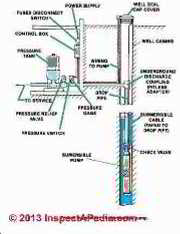
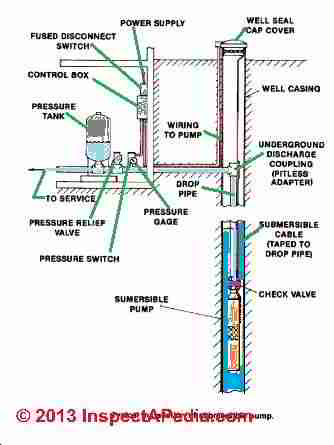
  • Details on how to repair the well water pump pressure control switch are discussed at How to Repair the Water Pump Pressure Control Switch The illustration at page top is courtesy of Carson Dunlop, Inc. in Toronto.
  • How to boost well water pressure in a building by installing a pressure booster pump and pressure tank is discussed in detail at WATER PRESSURE BOOSTER PUMP
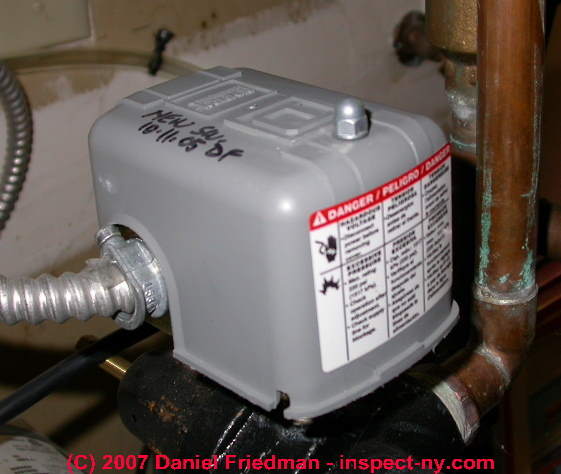
Photograph of a water pump pressure control switch with the cover on

  • Well recovery rate, yield, flow rate: if the building water supply stops and takes minutes to hours to recover, you may have problem with the well flow rate. But the problem of lost water supply and pressure could be more mechanical: a bad well pump.

The well pump, in turn, could have been damaged or hastened to the end of its life by a bad water pressure tank which has caused well pump short-cycling. Short cycling of the pump motor can burn up the pump relay control.

Readers should also see Water pipe clog diagnosis and Water pipe clog repair guide. Also see WATER PRESSURE LOSS DIAGNOSIS & REPAIR in a building and see MUNICIPAL WATER PRESSURE DIAGNOSIS or WELL WATER PRESSURE DIAGNOSIS where we describe the effects of clogged piping on water flow and offer remedies for this problem. If only hot water pressure and flow are poor, also see CLOGGED SUPPLY PIPES, HOT WATER.

Readers of this document should also see Water pressure tanks - how to diagnose the need for air, how to add air, stop water pump short cycling to avoid damage - water storage water pressure tank safety. The illustration at left is courtesy of Carson Dunlop, Inc. in Toronto.

Loss of Well Water Pressure or Poor Water Supply - Diagnosis & Repair Guide

Questions & Answers about pump, water tank, well piping, & well repairs

The following is an actual case of a correspondent who lost water pressure and called a well and plumbing contractor who made several repairs. At the end of the repair water pressure and supply were restored but the owner had a bit of "sticker shock" when he saw the bill. He wrote to ask our opinion. Our reply, which follows the owner's note below, reviews the diagnosis, repair, and repair costs for this well pump and water tank replacement project.

We have a private well with the same components shown on your diagram (well pump, pressure tank, pressure switch etc..) We recently experienced loss of water pressure and actually a lack of any water flow at all from our faucets in our house. As we waited 30 min to 1 hr, the water would return and run normal for several hours, only to return to no water again. This went on for about 24 hours.

We contacted the well contractor shown on our well cap. He quickly determine the bladder in the pressure tank was ruptured by just shaking the water tank.

After installing a new $600 dollar tank, the well contractor waited for the water pump to come on. It didn't. Then the contractor sold us a new well pump.

The total bill: $2000 and some change.

1. Is this a fair price for repair of a water pressure tank or pump or both? Did the contractor make the right repair? Was we overcharged?

2. Can we check his prognosis by inspecting the replaced tank and pump?

-- This question is answered in detail at WELL PUMP / TANK REPAIR ADEQUACY

...


Frequently Asked Questions (FAQs) about Well Water Pump and Tank Diagnosis, Repair or Replacement

Categories of Well Water Pressure & Equipment Questions & Answers

We have sorted reader questions and their answers about how to diagnose problems with private water supply systems into the following rough categories:

  • Pressure control switch problems: problems with water pressure or well pumps traced to the well pump pressure control switch: short cycling, pump won't start, pump won't stop, wrong cut-in pressure, wrong cut off pressure
  • Low water pressure problems, questions, suggestions
  • No Water Pressure: lost all water pressure, problems, advice
  • Well Pump Problems, including well pumps that run too often (short cycling) and well pumps that won't stop running, and how to get the pump out of the well
  • Well Piping Problems, Trouble With Water Pressure After Replacing Well Piping, etc.
  • WATER QUANTITY - water quantity problems. If your well runs out of water check this article where we discuss the ability of a water well to deliver water, at what rate water can be pumped out of the well, and how to improve the well yield or flow rate.
    At WATER TANK SIZE & VOLUME. we discuss how to calculate the volume of water in a water pressure tank. If your well flow rate is very poor, one option is to install a larger or multiple water tanks used not just for pressure regulation but for water storage.
    At WELL FLOW RATE we explain how we determine just how much water a well can deliver and at what rate (gpm), and
    at WELL YIELD IMPROVEMENT we explain how to improve well yield - how to get more water from a well.
  • Well Tank (Water Pressure Tank) Problems, short cycling well pump, tank leaks, tank waterlogged, Trouble With Water Pressure Following Water Pressure Tank Replacement or Relocation, etc.

Also see the well water system diagnosis & repair articles organized at WATER PRESSURE LOSS DIAGNOSIS & REPAIR & WATER PUMP REPAIR GUIDE & WATER TANK: USES, TROUBLESHOOTING

Well Pump Pressure Control Switch Problems

A Guide to Building Water Pressure by Adjusting or Repairing the Water Pump Pressure Control Switch or the Water Pressure Tank

Question: how do I set the well pump pressure control switch on and off or cut-in/cut-out pressures?

I am not sure how to adjust the well pump pressure control switch - what are those two adjustment nuts and which way do I turn them to change the water pressure settings?

Reply:

How to Adjust Water Pump Pressure: The detailed, step by step procedure for inspecting and adjusting the water pressure control switch is discussed in detail at WATER PUMP PRESSURE CONTROL ADJUSTMENT.

Two good starting points for diagnoising all building water pressure problems are

WATER PRESSURE LOSS DIAGNOSIS & REPAIR
WATER PRESSURE PROBLEM DIAGNOSIS TABLE

  • Diagnosing Water Pump Short Cycling on and off: If your water pump is clicking on and off too often or quite rapidly see SHORT CYCLING.
  • Diagnosing Water Pressure Drops without explanation when the pump stops, see Water Pressure Falls Slowly, Erratic Pumping: bad pressure control switch, building water running or leak, bad pressure gauge, bad check valve, bad foot valve.
  • Diagnosing & Repairing Poor or Lost Water Pressure and Flow: we still have water flowing but pressure and flow quantity are reduced. See WATER PRESSURE LOSS DIAGNOSIS & REPAIR
  • Diagnosing & Repairing Lost Air in the Water Tank: The problem of lost air in the water pressure tank along with how to correct that condition are discussed beginning at SIGNS OF AIR LOSS. Also see WATER TANK AIR, HOW TO ADD followed by WATER TANK BLADDERS & CAPTIVE AIR and WATER TANK BLADDER PRESSURE ADJUSTMENT
  • Diagnosing & Repairing a Water Pressure Control or Water Pump Control Switch: We discuss diagnosing and repairing a water pressure control switch that sticks "on" or "off" or simply won't operate, at water pump Pressure Switch Repairs.
  • How to boost water pressure in a building by installing a pressure booster pump and pressure tank is discussed in detail at WATER PRESSURE BOOSTER PUMP

Question: please explain the cause of and cure for pressure switch clogging

We had an issue with water pressure ( water would stop flowing for 20 sec at a time) in a house we are renting. The owner called the local well drilling co. They replaced the pressure switch which was clogged with iron. Is this a wear and tear issue or a water quality issue or something else. - Sue460@ptd.net 9/7/2012

Reply:

Sue, thanks for the important question - it gives us a chance to clarify the problem with debris clogging at well pump pressure control switches and pressure gauges.

Debris in the water supply or sometimes rust in water piping can clog the small pressure sensor port on the bottom of a pressure control switch, causing it to fail to operate properly - that is, the debris prevents accurate sensing of actual water pressure so the switch may fail to turn a pump on or off as it should. In the "turn-off" case the result could be very dangerous as overpressurizing the water system could burst a pipe or even a pressure tank, injuring a bystander and flooding a building.

Similarly, the same problem can cause a water pressure gauge to fail to properly register water pressure accurately. Often we can detect this by tapping the gauge and seeing its pressure reading suddenly change, after observing that the gauge reads an abnormally low pressure or when the gauge pressure reading simply doesn't change.

While these problems can be repaired by replacing the clogged pressure control switch or pressure gauge, the root problem is debris or rust in the system - a problem that can be addressed by installing water filtration ahead of these components.

So in response to your question, the underlying problem is inadequate water filtration, not a wear and tear issue - in my OPINION

Question: water flow stops for 5 seconds at the start of the pump "on" cycle

When pressure in the tank drops to a set point, well kicks on and supply to the house is via well...or so that is my understanding. In the past, when this occurred you would notice a very brief fluctuation in the flow of water at any given outlet, I.e for about a second you could tell something had changed but water was always flowing. Over time this has changed gradually... To the point that now water stops flowing for a good 5 seconds, but then continues just fine. It's not a huge deal...but clearly something needs maintenance or repair. would prefer to do this now. - David Hicks 5/20/12

Reply:

David, there may be a different problem in the case you describe, but I'd start by replacing the pressure control switch. If the pressure sensor port on the switch is debris or rust clogged, an early symptom is a delay in the switch's ability to respond to a drop in water pressure.

If the water tank is not waterlogged then try replacing the pressure switch and any pipe or tubing supplying water to its bottom sensor port.

Question: Will excessive water use change the pump's operating pressure?

Just a question to educate myself with the operation of a residential well pump/tank system:
My tank is about 7 years old, was set to cut in at 40 psi and cut out at 60 psi, it cuts in at 2 psi below 40, so I'm OK there, but I noticed that it's cutting out at around 55-57 psi and then after a minute or so, settles at around 52 psi.

I had thought originally that it was cutting out at 60 psi after it was installed. Now, I was also wondering if excessive water usage for a period of time (ex: watering plants, or the grass) would contribute to what I'm seeing, or if I have an other issue to look at. The pump is about 10 years old, and we do have hard water (dissolved rust, maganese) with a whole house filter installed after the well tank. Thanks for any help with this. - Tony 7/10/12

Reply:

Typical cut-in and cut-out are 20/40 or 30/50 psi for a pump pressure control switch. Tony if you set the pressure too high the risk is that the pump never turns off and burns up the pump motor, or at high pressures, say over 70 psi, faucets are likely to leak.

Hard water clogs pipes and can clog valves or other controls, but I'm not sure how it would change the pump on/off pressure. If you're in doubt about the switch itself I'd just replace it - it's not a costly part.

Low water pressure problems, questions & answers

Question: My water pressure is really low but we don't know where to start in figuring out what's wrong

My water pressure is low and I barely get any flow when I try to fill the tub. The hot water is still hot through out the house but when you flush the toliet the water almost stops if your using the sink or the shower. Any ideas on what the problem might be or where I can start. - Rachel

Reply: check these water pressure diagnosis articles first

Rachel, we have two articles that give step by step diagnosis of water pressure problems. Please see WATER PRESSURE LOSS DIAGNOSIS & REPAIR or for a water pressure troubleshooting guide in table form see our WATER PRESSURE PROBLEM DIAGNOSIS TABLE

And don't hesitate to ask if that material leaves you with more specific questions - I'll do my best to help further.

Question: huge water flow rate design question

My pump flow is 2500 cu meter per hour. The surge system consist of one large tank may be surge tank, one small tank, may be air vessel and 3 compresspor (electric driven). Can you tell what are the system. Also can you tell me what are possibel maintenance?? - Anand 11/22/11

Reply:

Anand, you are describing a commercial grade water supply system with a huge flow rate, but with virtually no information about what's installed - so I'm reluctant to speculate about the system and its particular maintenance needs. You should ask a local plumber who is familiar with commercial water systems to take a look at your system, explain its components and functions, and give you maintenance recommendations.

Question:

I have a well 285 feet deep and I just started to lose water pressure, It will come back after about 2 hours. but I had to add air to the pressue tank. This lasted for about 48 hours and the same problem I mam going to add air again and see how long it will last. any Idea of what I'm looking at replaceing or is my well going dry. - Craig 2012 3/4/12

Reply:

Craig, your description sounds as if your water usage rate exceeds the well recovery rate. The fact that water pressure returns suggests that the well is recovering during that two hour rest period. Especially if this problem is seasonal and shows up during the dry season, I suspect it's the well. You may want to add local water storage or ask your well driller about attempting to improve the well yield.

If you are not losing water pressure and flow totally, it may be that your well and pump include a protection device such as a tailpiece that slows the delivery of water to the home to keep it from exceeding the inflow rate of the well.

If it were a water pressure control switch or water tank problem, I don't think it would be seasonal and I don't think it would recover after two hours of rest.

Question: what could be causing my home to be losing water pressure over time

im having low pressure in my home i have everything underground because im in a double wide mobile home with just a crawl space i have been losing water pressure more and more over time im glad i read this article i went outside and turned on my water from a hydrant attached next to well casing and had strong pressure did not measure pressure no gauage then turned on water in house and lost pressure outside and also not strong pressure inside please need help to fix my set up was installed new in 1993 thank you - armco 9/13/11

Reply:

If water pressure (not flow rate) is deteriorating over time the problem could be with the pump itself (wear and tear), with a a well that is deteriorating in its flow rate (the ability of the well to deliver water), a leak developing and increasing in the well piping, or even a waterlogged pressure tank. I suggest

  • reading through the water pressure problems and solutions in this article
  • see our diagnostic article at WATER PRESSURE LOSS DIAGNOSIS & REPAIR

or for minimum reading and a more concise list of water pressure problems and probable solutions in the form of a table, see

  • WATER PRESSURE PROBLEM DIAGNOSIS TABLE

Question: poor water pressure for our lawn sprinkler systems, no water pressure tank installed

I don't have a tank so the water comes out by the pump so the pump runs the entire time I use my sprinkers. The pump runs but doesn't seem to run as high as it usually sounds so my water doesn't keep coming out. Do I need a new pump? I replaced it 4 years ago. - Debbie 4/15/12

Reply:

Debbie, usually when we see a water pump system with no pressure tank installed, it's a special-purpose single-use system such as the lawn sprinkler system you are describing. In that case the presumption is that when the sprinklers are running the potential water flow rate through the system is greater than the gallons-per-minute capacity that the pump can deliver. In that case, once we turn on the lawn sprinklers by opening a water control valve and then turn on the well pump, the pump will never "get ahead" of the water pressure or flow rate through the system, and it will just keep running indefinitely until you shut the whole system down.

If nothing has changed in your system, valves, controls, equipment, the problem could be any of several things including

  • a leak in the water piping between the pump and the sprinkler system
  • a leak in the sprinkler system piping
  • a control valve partly closed
  • a worn pump that simply can't deliver water pressure as high as when new - such as a damaged pump impeller
  • if the water source is a well (as opposed to a pond or stream) and the well flow rate has deteriorated the pump may simply have less water available and may even be cavitating as water levels in the well drop too low. See WATER QUANTITY - water quantity problems.

Frankly this design makes me nervous because I worry that if the system and its controls were not set up by an expert we could turn on a pump without providing a pressure control switch for it - risking an overpressure in the water piping and bursting a pipe or possibly injuring someone.

Question: water pressure slows to a trickle

I have an in well pump, and what I'm getting is a big drop off of pressure in the house. It recovers after a while but does not last long ( bout a minute)then its just a trickle. I get good consistant pressure on the filter clean out valve but not in the house.

When water is running in the house, the pump cuts on & off while water is running but never the pressure it should.. Any ideas would be appreciated - Rob 9/4/12

Reply:

Rob it sounds as if your water filter may be clogged. Also check for a waterlogged pressure tank - lost air charge.

No Water Pressure: lost all water pressure, problems, solutions

Question: Lost Water Pressure following an Electrical Power Loss - lightning strike?

After a power loss that lasted half a day [my neighbor] ran out of water. When power I was restored the water pressure was only about that of pouring water and would the volume of water rapidly dropped.

I reached down to her water tank and could easily tell it was empty. I connected a water hose to her outdoor spigot, unplugged the pump and allowed the water to fill her tank. The tank only filled about a quarter full. I opened a faucet to try to allow air to leave the system the tank did not fill any further.

The water pressure was at normal flow after I disconnected the hose. The pressure gauge showed a drop from 60 to 40,
with about a minute for recovery to 60. Even though the tank was only a quarter full I thought the problem was resolved only to get a call a few hours later that there was no pressure again. The tank was empty, with no signs of leaking. Water is filling the tank, it is slow and I am not sure what pressure the system might build as before it only filled to a quarter full.

She has what appears to be a submersible well a hundred feet from the well house. A pipe about 8-10 inches in diameter with a cap bolted on, there is wiring on one side of the pipe. In the well house (below grade) she has a blue tank about 18-24 inches
in diameter and a little over four feet tall. A pipe comes through the side of the concrete that tees with the pipe that comes up from the side of the bottom of the tank. Just above the tee is the pressure gauge and then the pressure control switch. On the top of the tank is a plug( and I do have teflon tape if I need to remove it).

I have a few ideas from looking at your website but don't want to screw anything up so I decided I should email and see what you think.

Reply:

We were puzzled too. Sometimes a power loss leads to total pressure loss that leads to disclosing a pre-existing defect like crud inside of a pump impeller, a failing foot valve (loses prime in the well), or a failing pressure control. Also some power outages include an
electrical surge or even a lightning strike that can damage or destroy a pump. But we recommend that you first look for the simplest solution that does not require multiple odd failures to have by chance occurred at once.

Remember that a water pressure tank is never "full" - as it needs to contain an air charge.

First be sure you have an accurate picture of what was happening before the power outage. Then start by reviewing the normal pump sequence operation and comparing it with what's happening at this home.

Follow up from the reader explained that only 120V was being delivered to a 240V submersible pump because one fuse of a pair had blown. -- This question is answered and explained more fully at WATER PRESSURE LOSS DIAGNOSIS & REPAIR

Thanks to reader EK Woodard for these details.

Question: Water pressure loss after electrical power outage - lightning strike & lost well water

Hi,after a power outage that lasted the entire day, I now have no water at all. I'm new to all of this, so please bear with me. Although, thanks to your very informative site I'm learning. I have a single line jet pump and am not sure what the depth of the well is. I tried to reprime with no success, so had a well person check it out. He spent over an hour adding water, turning the pump on and off, gradually bringing the water and pressure back up to the top. Right as he was ready to give up it worked, and water was flowing strong out of the faucet. It didn't last long though, and he said there must be a crack or hole in the piping of the well, which is letting air in.

What I don't understand is I had water before the pwr outage with a supposed cracked or damaged pipe. So since he got the water back up to the top and flowing, why wouldn't it continue and keep the prime since it was before?

He advised that since the well is older (25 years) and the cost to find out what is wrong with it would be $1500 plus the cost of repair, that I would be better off having a new well dug, which is $3800.

I looked into claiming it on my insurance, but was told it had to be caused from a lightning strike, not just a pwr outage. Is it a possibility that whatever is wrong could have been caused by lightning, and if so, how could it be confirmed? - Valora

Reply: check for bad foot valve and replace it; refer to details of well pump priming procedure, check valves, foot valves

Indeed, Valora, a lightning hit can burn up electrical wiring, controls, pumps, and can even damage plumbing pipes. But your description sounds as if there was a loss of prime and difficulty re-priming the pump. If the water system has a bad foot valve (located on the bottom of well piping) and power stays off for some time, you are more likely to lose well prime. The proper repair is to pull the well piping and replace the foot valve.

The reason this problem shows up after a power loss is that even though the foot valve may have been leaking for some time, as long as you had electrical power, when the foot valve leaked the dropping pressure at the water tank caused the pump to turn on by itself, restoring water, pressure in the water tank, and prime before so much water was lost that the pump couldn't recover by itself. But when power was lost for hours, so much water drained back into the well that the well could not re-prime itself when it started again. See WELL PUMP PRIMING PROCEDURE and also   WELL PIPING CHECK VALVES and  WELL PIPING FOOT VALVES

Question: lost water pressure after well took a lightning strike, now find sand in the water

we had a lightning strike last night and lost power to the pump. Replaced the pressure switch which was damaged and now the well is pumping a lot of sand in with the water??? - Barb 5/17/12

Reply:

Barb that's a tough one - how might a lightning strike generate sand pickup in well water?

If the water level in the well has dropped, or if the well casing has become damaged, those could explain the phenomenon.

Presuming we're talking about an in-well submersible pump, I figure if the pump itself or its wiring had taken a hit - which often happens with lightning strikes around wells, either the pump would stop entirely, or if it's getting low voltage or wiring is partly grounded it may be pumping, but more slowly or weakly than normal.

Try flushing everything out and running the system again; let us know if water pressure and pump behavior are normal.

Next will be to investigate the well and well casing themselves. On occasion a severe lightning strike might damage the well casing itself - or damage may have already been present but not recognized. A rust hole or split in a well casing can open wide enough to begin to add sand and debris to the water supply.

Nearby blasting can also change the properties of a water well

In the well that served our lab in New York we had excellent water quantity and quality from the time the well was installed in the 1920's until the 1980's when a road crew decided to move the highway. Local blasting near our well appeared to amend the underground rock cracks and crevices such that our well water suddenly contained debris from the day of blasting onwards to the present.

Question: water pressure lost and pump turned off, won't come on after we left pump turned off for a few days

Gone from home for a few days turned pump on at fuse box ran 2 minutes then shut off will not come on - Dave

Reply: Sequence of steps to check if the well pump is not turning on.

Dave: re "gone from home for a few days turned pump on at fuse box ran 2 minutes then shut off will not come on"

See WATER PRESSURE PROBLEM DIAGNOSIS TABLE for a comprehensive list of things to check when you've lost water pressure, including well pump troubles. By your message alone, and just guessing, as so little information is provided, I'd check things in this order:

  1. Make sure that electrical power is being delivered to the pump. Check for live voltage at the control switch and if a separate pump relay is used, check for voltage there too.
  2. If there is voltage at the pump controls, look for a pressure switch or relay that has become burned or damaged. If there is a separate pump relay control switch, make sure that its cover, removable "on-off" control that some switches use, or fuses are secure and in place and not burned out.
  3. If all of the electrical components have power, but the pump is not turning on, the pump itself could be damaged or the pressure control switch may be clogged and not calling for the pump to turn on. Manually closing the pump pressure control switch should turn the pump on. If not there's an electrical problem to find and fix in wiring or at the pump.

Watch out: for electrocution hazards when checking electrical wiring and devices. If you lack training and equipment have those checkes made by a professional.

Watch out: often when a pump is turned OFF for a few days we discover a pre-existing problem that had been covered-up, namely a bad foot valve or check valve that allows water to slowly leak out of the pressure tank and back into the well.

As long as the pump power is turned on, when the leak causes pressure to drop below the cut-in point the pump cycles on and repressurizes the water system and so the pump never loses prime.

But when power to the well pump is left off long enough, a slow leak can lose all of the water above ground (back into the well) and you lose prime.

So that's where I'd start looking.

Question: We lost all water pressure in the middle of a shower. We turned up the pressure switch. Do we need a new well pump?

I have a well, and this morning was taking a shower when we lost all water pressure in the middle of the shower. There was no water running in the rest of the house, so no pressure was being taken from the shower.. this had never happened. In the past, when you ran water, flushed the toilet or took a shower at the same time the water pressure went down.

We turned up the pressure coming into the house on the water tank to try to "fix" the situation. I'm worried we may need a new pump. Any suggestions in which way to turn? - Amy

Reply: when water pressure is lost do not just turn up the pump pressure switch. First diagnose the problem.

Amy, with no other information but that in your message it sounds as if there may be trouble with the well itself (running out of water), the well pump, or the pump controls.

Watch out: Don't just turn up the pump pressure control switch settings if your system has lost water pressure. Turning up pressure at the pressure control switch will not fix having run out of water and it can make the problem worse. For example, if you set the cut-off pressure higher than the pump can achieve then the pump motor may just keep running on until it burns up.

It is more important to first figure out why you lost water pressure. When the cause is diagnosed we'll know the proper repair needed.

Take a look at WATER PRESSURE PROBLEM DIAGNOSIS TABLE as a starting point for figuring out what's wrong by looking a bit further into more clues. Let me know what you find or what specific questions arise and we'll be glad to research and comment further.

Question: Water pressure switch set to 50/70 cut-in/cut-out for house and irrigation system. Now water pressure drops down to 10 psi. What's wrong?

I have an issue with my well. I have my pressure switch set to cut in at 50psi and cut out at 70psi. Its been this way for years. I run my house and an irrigation system and in the past never had a problem. The last I knew my well recovery was more than 16gpm. I have a lot of iron an have two filtration systems, one for the domestic water in the house and one for the irrigation system.

This year I'm having a problem maintaining pressure when the irrigation system is running. In the past the well maintained a constant 50 to 60 psi flow. Now it drops to as little as 10psi. I thought I had a pump and or yield problem. I bypassed all my filters and ran a facet wide open, approx 7gal/min for an hour and a half. Everything performed normally.

The pump kicked in at 50 psi and off at 70 psi. It pumped faster than the depletion rate. Now the puzzeling part. I turned on my irrigation system and about 20 minutes in the pressure dropped below 30psi and would not build back up unless I turned the system off. At the time that I checked the water was metering under .5gal/minute. I'm perplexed. I would assume if the issue was pump or yield related I would have had a problem when I bybassed all the filters. Does anyone have a logical explanation for this. Thank you. - Tony

Reply: Check the water pressure switch mounting pipe nipple or switch pressure sensor port for debris clogging, or replace those parts

Tony from what you've said I wonder if your pressure sensor switch or its mounting tube are clogged with iron deposits? If the pressure control switch cannot accurately and quickly sense changes in pressure at its mounting point the pump behaviour may become erratic or even stop entirely. Try replacing the switch and cleaning or replacing its mounting tubing, and while you're at it look into those openings for evidence of clogging and let me know what you see (or send along a photo).

Question: Leaks found in well piping, now the pump is not working properly. What may be wrong?

My pump is 20+ years old, however it's been working fine. I recently replaced the pressure switch and it began working again. Tis past Saturday I discovered a hole in one pipe and I replaced the galvinised pipe and PVC. Again it worked fine. The next day the pump will not start and the zone selinode was warm for the zone that was to be on. I'm at a loss. - Bernie

Reply: Leaks in well piping lose pressure & can let air and dirt into the system, clogging the controls or damaging the pump

Bernie: hole in the pipe ... was this a buried pipe? I wonder if dirt can have entered the system and plugged the pressure control switch. Try changing the switch and also checking its mounting tube for blockage.

Question: we have no water coming out of faucets - what do we check first?

water does not work how do i test pressure switch - Doug

Reply:

Doug: under the article series titled WATER PUMP REPAIR GUIDE see these articles on installing, diagnosing, and repairing the pump pressure control switch:

  WATER PUMP PRESSURE CONTROL SWITCH
  WATER PUMP PRESSURE CONTROL ADJUSTMENT
  WATER PUMP PRESSURE CONTROL REPAIR
  PUMP PRESSURE CONTROL REPLACE

Question: no water at all from our deep submersible pump well, Is there any way to tell if the pump is bad with out having to pull it completely out?

I have a private well 365' deep submersible pump aprox 9 yrs old. woke up this morning and have no water at all i replaced the pressure switch a few months ago.

There seems to be power going into the switch. Is there any way to tell if the pump is bad with out having to pull it completely out? - Joe 6/27/12

Reply:

Joe, check the current draw using a clamp on ammeter to see what the pump is doing. That can detect a motor that is seizing. If the pump impeller is broken or damaged, the motor may run without being loaded - no unusual current draw; If it draws zip you've got an open wire; if there is no resistance between the wires they're shorted -

Watch out: to avoid death by electrocution or shorting and burning something up, some of these tests must be done with power off.

Question: the well suddenly went dry and I got an electric shock

I have an odd one for you.

I used to get a lot of taps on my chimney, so I grounded it with a utilities style grounding triangle – tied to the main on the house – seemed to solve the problem.

Sunday before july 4th I was in the basement with my bare foot on the concrete floor, on my computer.

We got tapped again, I yelled “YEOOOOWCH!” and then couldn’t breath in for a while, I was locked up. It felt like my mouse exploded in my hand. Then I was able to breathe again, with no apparent permanent effects – save feeling like I’d been pulling a semi truck all day.

Went upstairs and the wife heard the boom, but it was so close she didn’t hear me yell at all. Several battery backUPS were toasted. Both washing machines – oddly enough both wanted to fill and drain at the same time – although one wanted to spin too, and would not shut off until smoke came out of it. Half the halogen lights in the kitchen wouldn’t come on, the other half would not shut off?

And my well went dry.

That’s the one the insurance company won’t cover – but I had 65# of pressure before the tap – and now have none. The pump draws appropriately, no break in the water lines at all, you can't hear the well filling now - like you used to. The water has literally run out of the well – and it’s over 300 feet deep!

Anyway, I’m looking for information on others who may have had well problems after being tapped. Even if they won’t cover it I’d damned sure like to prove to them that it does happen. What other explanation would cause a 30 gal/min well to go dry overnight?

Got time to help with this? - Brent 7/7/2012

Reply:

Watch out: apparently Brent you're dealing with an electrical shock hazard and possible death by electrocution.

Brent, certainly improper electrical grounding, improper lightning protection installation, shorts and shocks can kill you as well as damaging your equipment, including a pump relay, motor, even the well casing itself.

If a lightning hit knocked out your well pump controls, wiring, pump motor, or even split the well casing, any of those problems would mean that you've lost water completely at your building. A shorted well pump wire could have a similar effect.

Question: lost water pressure, storage tank empty, reset pump and it came back on

Just replaced old water pump and pressure tank (& pipes) with new pump (no more pressure tank)and also new circuit box and breakers.
All has worked well for a couple weeks. This AM no water- the deep well switch had tripped, and the storage tank was nearly empty.
So something caused the breakers to trip, shutting off well pump. After a reset, well pump came on, and is now filling tank again.
Question: what would cause it to trip? we did not have a larger than normal electricity drain, nor were we using extra amount of water.
Is the new stuff putting a drain or something on the older stuff? (the deep pump and its lines?)
Any ideas appreciated! - BTP 7/22/12

Follow up- spoke with plumber- he thinks it is likely the deep pump circuit box-'pumptech'
if I reset- it will run for a few minutes and shut off-
Sadly- its sunday and where i live the one place that might carry replacement is closed.
Any tricks or things to try? Or is it likely the circuit board is simply fried?
Its probably 25 to 20 years old

Reply:

Gary, I'd start by replacing the questionable control switch. You might also check the current draw of the pump to see if you can detect a bad pump motor or a wiring short.

Watch out: there are death by electrocution hazards when messing with electrical wiring.

Question: we are on a well and no water comes out at the taps

My water is not coming out of the taps i am on a well , - Theresa

Reply:

Theresa, take a look at WATER PRESSURE PROBLEM DIAGNOSIS TABLE for a list of no-water diagnostics

Problems with well pumps, well pumps that run too often (short cycling), well pumps that won't stop running, noisy well pump, well pumps won't start

Question: The water pump keeps running and won't shut off, what do I do now?

I lose pressure seconds after turning the well water pump off. When the water pump is running it only gets to 25 to 30 psi and stay srunning all the time. The pump never satisfies pressure switch so I turn the pump off to avoid damaging it. Any idea of what I can do? - Arthur

I live in a mobile home with a point well system (2"). Today the pump kept running while I was sprinkling the garden. It did shut off when I turned the water off. Usually it cycles on & off while the water is running. Any suggestions? - Sharon 9/1/12

Reply:

Arthur and Sharon:

When a well pump keeps on running - just won't stop on its own, you will want to follow the well pump diagnostic steps at WATER PUMP WONT STOP RUNNING.

The cause of a well pump that keeps on running could be any of a number of problems that we list in the reference I gave above, but because you are also losing water pressure, it sounds as if there may be a loss of water supply in the well itself or a serious leak in the well piping.

Question: The water pump keeps running and I hear water running, I may have damaged the pressure gauge

I have a 285ft well. Sometimes the pump goes on when no water is being used in the house. Tonight, after running the outside sprinklers, the pump kept going on. When I went to check the guage, I could hear water running. All water was off in the house and outside. I turned off the valve which is between the pipe to the well and the bladder tank and the noise stopped.

What could be leaking? I opened the valve up and the running water noise slowly subsided. I also made the mistake of shutting off that valve before I turned of the pump and the pressure gauge went crazy. After turning everything back on the gauge shows the pump shutting off at 80psi and on at just below 60psi. Always went between 40-60. Did I blow the gauge? - Doug

Reply:

Doug: Indeed the sequence of closing the valve between a water pump and the tank and pressure control switch that control that pump turning on and off will make the pump "go crazy" rapidly turning itself on and off - risking pump damage. If you caught it quickly and turned off the pump you're probably OK. But wild gauge pressure oscillations might have damaged the gauge. If the gauge is not behaving normally just replace it. See WATER PRESSURE GAUGE ACCURACY for details.

See INTERMITTENT CYCLING WATER PUMPS for a procedure to figure out why the well pump goes on when no water is being used in the house.

Question: Problem with loss of pump prime, water pressure drops, supply to house shut off

800 gal reservoir is full to ground level and impeller style pump is on basement floor. I installed a new foot valve in the well. Pump is three yrs. old. Pressure set between 40/50 psi
Tank bladder at 38 psi.

When pressure gauge shows 50 psi and I isolate the house with a gate valve, the pressure gauge drops below 40 psi and the pump starts but 40% of the time it doesn't deliver any water and at this point I need to open a tap near the pump before the water flows again. When I open this tap I hear air for a few seconds before water starts to run from the tap and at this point the pump will start delivering water.
Whats my trouble and your response................. thanks, Shep

Reply: check for a bad foot valve, check valve, well piping leak

Shep:

regarding "the pressure gauge drops below 40 psi and the pump starts but 40% of the time it doesn't deliver any water and at this point I need to open a tap near the pump before the water flows again. When I open this tap I hear air for a few seconds before water starts to run from the tap and at this point the pump will start delivering water. "

and your title, indeed it sounds as if the pump is losing prime. If you're sure the foot valve is good, I'd look for an air or water leak in the piping between the pump and the foot valve bottom.

If I understand correctly, "and I isolate the house with a gate valve" means you are closing the valve feeding the house from the pressure tank - thus making sure no water is being run in the house that might drop down the pressure you see at the pump and tank = correct procedure for this diagnosis.

See the more complete diagnostic checklist for water pressure or flow loss at WATER PRESSURE PROBLEM DIAGNOSIS TABLE.

Question: my well pump has been running more often that it should and has been louder ...

Pump has been running more often than it should & it has been louder than usual. Never lostany pressure just a little noise. Two days ago the breaker tripped. I reset the breaker and it has been fine. Again no pressure lost. This morning lost pressure and now have no water to the house at all. I checked the breaker and it was not tripped. Where do I start? - Michele S. 3/15/12

Reply:

Michelle, several problems can cause well pump short cycling on and off too often, though the most common one is a water-logged pressure tank. See WATER PUMP SHORT CYCLING for steps in diagnosing and fixing this trouble.

Question: my well pump doesn't run it just hums, how can I fix it?

I have a approx. 10 year old well pump that hasn't been ran in about 2 years. The motor ohms out good but just hums. Is there an easy way to break it free from not running for an extended period. And will just taking the pump out and turning the impeller by hand and then cycling power to run it back in to free it up cause any kind of water logging or vapor locking of water side? - Ken 3/18/12

Reply:

Ken the motor could be frozen - it may be freed by a complete disassembly and cleaning of the pump motor. OR the problem could be a broken or jammed pump impeller. If you disconnect the impeller assembly from the pump motor you can see which part is jammed, and what to replace.

If the pump motor and impeller will both spin by hand (power disconnected so you don't get killed), then the problem could be a bad pump motor start capacitor if your pump uses one. See CAPACITORS for HARD STARTING MOTORS for details.

Question: how much electricity does my well pump use?

how can i find out how much electricity my well head and pressure tank are using? The well pump is 1/2 horsepower. The pressure tank has no label or information on it. I am in the process of installing a back-up generator and I need to know the amount of power consumed at start up by these systems. - Anon. 3/5/12

Reply: some ways to figure out how much electricity an appliance or well pump is actually using

Anon, here are several approaches to finding out just how much electricity your well pump or any other electrical appliance in your home is actually using:

  1. You can record the information on the data tag for your pump motor, noting the RLA figure. See DEFINITIONS of ELECTRICAL TERMS and understand amps, current, volts, watts, and you can calculate the theoretical electricity use.
  2. You can turn off every single electrical thing in your building except the well pump, then watch your electric meter spin. That timing or LCD readout combined with the meter specifications from your electric company can give you a good idea how much electrical power the pump is actually using when it's operating. To that you'll need to monitor how often and for how long the motor runs during an average month.
  3. You can also measure the pump's current draw using a clamp-on ammeter.
  4. You can also rent or buy electrical use metering equipment that you'd hook into the circuit.

To compare the energy efficiency of different versions of a home appliance such as an air conditioner, refrigerator, or heat pump, see SEER RATINGS & OTHER DEFINITIONS.

Question: How to preserve or mothball a submersible well pump for later use

What needs to be done to save a used submersible well pump for later use?

Reply: tips for preserving and storing submersible well pumps:

Jim assuming the pump was previously running and there's no question about the condition of its motor, the minimum is to be sure that the pump is drained of water and stored in a cool dry place.

A more extensive job could include disassembly and inspection/cleaning of the pump impeller assembly to remove any mineral deposits, debris, crud, and to be sure that it is not damaged

Question: At our cabin he well is only used a few times a year - power otherwise left off; lost water pressure

I have a question about a well problem at a cabin in the mountains. The well is only used a few times a year and the power is turned off during the periods of non use. The water has been without problems for years.

More recently the pressure seemed to surge at one point then the next time we used the cabin the water would come on, run for 4 or 5 minutes then the pressure would drop to zero. Then a few minutes later the water would be at full pressure then 4 or 5 minutes later it would drop to zero flow. I turned off the water and when I returned to the cabin again it was the same except this time after three of the above cycles the pressure dropped to zero and didn’t come back.

The next time I returned to the cabin there was no water at all. I replaced the pressure switch and there is no water flow. I noticed something odd, about every minute, the cabin lights would dim slightly for 5 to 10 seconds then return to normal. So, I measured the voltage at the pressure switch and it’s 240 volts then when the light’s dim the voltage drops to 232 volts. When I turn off the well braker the lights stop dimming. When the pressure switch was replaced water freely came up out of the fitting telling me two things, there was water in pipes of the house and the well probably still had a prime. - Well Pump Problems 6/22/12

Reply:

Well Pump Problems:

Dimming lights sounds like a motor that is seizing and drawing high current. Especially if that's a new condition. Check the current draw on the well circuit and figure you've either got a wiring short or a seized pump motor.

Question: well pump noise - noisy well pump or horrible sounds coming from the water pump

The pump keeps running & making a loud noise - Ron 7/10/12

Reply:

Ron, some well pumps are just noisy to begin with, depending on the motor and bearing quality (and cost) of the pump itself. But if your pump has changed in the volume or type of noise it is making here are some common sources of that sound:

  • Lost water pump prime: the water pump noise will be louder when the pump has lost prime or partially lost prime - there's air in the impeller or pump assembly. Often we hear more noise from a jet pump at the beginning of its cycle. A lost prime or partly lost prime could be due to a bad foot valve, check valve, or a leak in well piping.
    Watch out: if you keep running a well pump dry it may be damaged.
  • Damaged water pump impeller: a broken pump impeller or debris inside the impeller aseembly can make a horrible noise when the well pump runs
  • Damaged water pump bearings: worn or damaged bearings at the well pump impeller or motor can also make the pump noise increase
  • Loose pump motor mounts: the water pump may be vibrating and bouncing around on its mounts - fix this promptly to avoid a plumbing leak, electrical hazrd, etc.
  • Pump motor humming and trouble starting: if the pump motor hums but does not start, the motor may be seizing, may need replacement, or a start/run capacitor may need replacement. See CAPACITORS for HARD STARTING MOTORS
  • Also see NOISE, PLUMBING CHECKLIST where we discuss and describe a range of sources of noises in the plumbing system including from well pumps.

Question: well pump is very loud on my sprinkler system

I have a well pump that provides water for my inground sprinkling system (there is no tank). The pump is VERY loud and it seems like the pressure has been gradually decreasing over the past few years. Is there any regular maintenance I could/should do on it? - Bill 7/11/12

Reply:

Bill, check for the pump noise problems I've described just above. I'd add that running a water pump with no pressure tank makes the pump work harder and may lead to shorter pump life.

Question: Summer cabin well pump won't start, can I use solar power to run my well pump?

Can I use solar power to run my well pump? I had a solar power hookup but now the pump has stopped running. Gary 7/13/12

We have a summer cabin in the mtns. Two yrs ago we had a deep well submersible pump put in our well. At this time there are no componets to the well pump. We have the wiring to the pump and that is all. When power was applied at the time the pump was put in, all worked well. The system has not been used since then. We tried to start the pump with solar power from the cabin (extension cord) the pump would not start. My question is, why wont the pump work now, when it did two yrs ago? Thanks for any info. - Gary 7/15/12

Reply: yes but ...

Gary,

About using solar power to run the well pump:

First check that all of the wiring is intact, continuous, without shorts or breaks.
Then check the voltage delivered by your solar converter as well as its current capability (amps) against the pump specs. And if your well pump uses a separate start relay (separate from the pump pressure control switch at the water pressure tank) check for a bad start/run capacitor. There are also resistance tests that with power off can tell you if the pump itself has frozen up.

Question: submersible well pump will not start - it has power

My submersible pump will not start. It is getting power to it but it wont come on. I tested it before putting it in the well and it was fine but now I cant get it to come on. Power is there at the pump but it just wont come on. What is wrong with it. Its only a couple years old. - Joe 8//3/12

Reply:

Joe, check the amps - current draw when your pump switch sends current to the pump; If there is no current then there is an open break in the wiring; high current sounds like a seized motor.

Similarly, with power OFF and the pump wires disconnected from the circuit above ground you can use a VOM to check for a short, open wire, in the pump circuit and motor.

Unfortunately, unless you find a wire damaged or bad switch above ground it probably means pulling the pump and wiring again.

Question: black oil came out of my water pump

Turned on pump before hooking to tank, looks like black oil came out, what did I do wrong? - Michael 7/29/12

Reply:

Michael, I agree it sounds odd to get oil coming out of a water pump; sometimes however when we've been hooking up new plumbing fittings and equipment, the first time we turn things on we see solder paste and oxidized debris in the flush-out of the system. It's a good idea to flush out the water system after working on it. YOu may not have done anything wrong.

Question: well pump circuit breaker trips repeatedly

The circuit breaker for my well puump has tripped twice today. Well pump is 20 years old. This occurred both times when we had outside spigots open for watering flowers. - Dean 7/1/12

Reply:

Watch out: for electrical shorts, fire hazards, shock hazrds - if a breaker keeps tripping, leave that circuit off until it's properly diagnosed and repaired.

Circuit breaker trips could be due to a pump motor that is seizing, or a fault in the circuit, wiring, or control switch.

Question: Shallow well pump keeps shutting off

My shallow well pump shuts off after 15 seconds. Looks like no water is getting to the tank. When the pump shuts down the water flow stops.
I disassembled the pressure switch, cleaned contacts and diaphragm and made sure the hose for the sensor was clear of debris.
Same problem.
Next I removed the tank and let the pump run for a few minutes. It didn't get overly hot and kept on pumping.
So it looks like the tank diaphragm is stuck.

My question is - Could it still be a defective pressure switch or is it definitely the tank?
Thanks - Mike 7/13/12

In reference to my (the) last comment.
I connected the tank to a garden hose from my house water supply and the tank filled up!
So it's either the pump or the pressure switch.
Mike

Reply:

Mike regarding your good steps in well pump diagnosis,

"I connected the tank to a garden hose from my house water supply and the tank filled up!
So it's either the pump or the pressure switch." earlier you said "When the pump shuts down the water flow stops. " which to me indicates that the pressure tank had no charge - it could have been waterlogged and thus full, so no water would enter, but if it had zero air, it would not function to push water into the house when the pump was not running.

Check the pressure tank - and its air charge.

Question: the well pump runs but no water comes out, prime has not been lost

Above ground pump two line. it has water comong out of the primer plug when removed. i replace the plug and turn on the pump no water. cloged jets? - Fred 8/1/12

Reply:

Fred, I agree that it sounds as if the problem is not a lost prime at the pump; but quite a few other problems can explain no water, such as

  • a damaged pump impeller - this can look the same as a pump that lacks adequate lift capacity for your well
  • a leaky or broken well pipe
  • a well that has gone dry

Fred: if the pump was working OK Previously I doubt that the root problem is "weakness" in the pump, and more likely guess that its impeller was damaged or there is a partial clog. But if the pump never worked well then your well guy's suggestion sounds quite reasonable.

Reader follow-up

Well i had a well man look at it and he got us water. He said the pump was week and a cheep one. A new good one would be over $500. No charge this time. thanks for your help. - Fred

Reply:

Fred if the pump were "weak and cheap" since new, I don't understand why it used to work but now no longer does. Perhaps the pump has become damaged as I described above.

Question: we find water on the floor under our well pump

Our water pump is working fine (knock on wood) but there is some water on the floor underneath/next to the pump. Normally our basements leaks when a big rain storm hits, but it hasn't rained that much to warrant this much water on the floor. I.E.: it's not drying up like it normally does. Is this a sign that our water pump is on it's way out? If so, how much does it cost to replace a water pump that is connected to a private well? - Stephanie 8/14/12

Reply:

Stephanie

First wipe off all of the wet components and surfaces so that you can see where water is coming from.

Next, when the pump is running, look for leaks at the pump assembly or piping fittings nearby; also look for leaks at or around the water pressure tank

If you don't see any active water leaks watch for condensation forming and dripping off of the piping, pump, or water pressure tank.

I would not replace the pump before you have an accurate diagnosis of what's going on. It would be a mistake to replace the pump only to find that the problem was a plumbing pipe connection leak.

Well Piping Problems, Trouble With Water Pressure After Replacing Well Piping, etc.

Question: Water pressure problems after replacing the well lines, pump doesn't seem to deliver water

I have a plumbing problem that I cannot seem to solve. I have a shallow well (41 ft. to the water line) with a 1 hp. jet pump with 1 1/4" and 1" black plastic supply lines leading to a jet assembly and a 1 1/4" foot valve but I cannot get the system to draw water from the well continuously. The system was working fine until last winter when the PVC supply lines leading from the pump head to the water pressure tank froze and busted.

So, I replaced the PVC and primed the pump but when I turned it on, it would not draw water from the well. So, thinking that the freeze might have damaged the impellers, I replaced the pump. However, after priming the new pump, it would not draw water from the well either. So, I then pulled the supply lines out of the well and replaced the jet assembly (which was badly corroded) and the foot valve as well.

Now, when I prime the system, close the pressure regulator valve, turn the pump on, wait for the pressure to come up, and then open the pressure regulator valve a bit, water will exit from the side of the pressure regulator valve and out of the supply line but the volume of the flow fluctuates back and forth from a trickle to a jet for a little while and then suddenly ceases to flow altogether.

In addition, my spotter tells me that he can hear water rising up the pipes until just before it reaches the elbows where the supply lines make the turn from vertical to horizontal and then it suddenly falls back down the pipes. So, could you please tell me what you think the problem is?
Thanks, Bill Bernhardt

Reply: Check for well piping leaks first

Bill,

I don't fully understand the details in your message but I'm wondering from your description of fluctuating pressure if the pump is not picking up water at the foot valve. It sounds as if you're looking for water flow BEFORE the water reaches the pressure tank, right? If not, I'd look for a water logged pressure tank or a tank with a stuck bladder.

From your description I wonder if there is a bad connection made during your well line replacement, possibly leaking water back into the well.

Question: New plastic water line from pump to tank, but now water flow is stopped and water pressure lost

I have a 60' water well which I am sure has water due to the rain. I installed a new 1" x 20' plastic water line from the pump to the bladder tank. When I started it back up the water flows out of the spigots for approximately 1 minute and then stops flowing. The pump is still trying to build but takes a while. If I shut the spigots off and let the pump build it eventually builds back up. How do I trouble shoot this?

By the way I have a submersible pump. When checking water I have an outlet prior to the bladder tank and the same thing happens. - Gary

Reply:

Gary if you are sure the pump itself is OK I'd start looking for a well piping leak.
Turn off water into the building at the end of a pump cycle and watch the pressure gauge. If pressure drops there is probably a piping leak or a bad foot valve or check valve. Also be sure that the water pump itself is undamaged and working properly.

Follow-Up: improper pump electrical wiring connections can cause well water pump to lose power

Everything is fixed now but I wanted to share my experience which caused me to replace a steel 1" water line with a plastic 1" line. That's only the beginning. I replaced that plastic line as I thought I had a kink in it. After each of these changes disappointment set in as nothing changed the results of 30 secs of water and then nothing for 5 minutes or so. Next was the pressure switch and all new piping from the pressure tank.

Next was pulling the 65' deep pump and changing it out. Pump went back down in and I was certain things would be looking up. Disappointment...disappointment....frustration on and on. I'll prep you here a little. Early on like a couple of weeks ago when I replaced the line the first time I disconnected the pump connections and since this is a lake house fromt he mid 60's the wiring is not up to my type of wiring although it is sound.

Anyway the 3 wire connection was marked with colored tape so I could get back to the correct hook up. I made an assumption that one of the wires was the ground since later it was untaped the first time that it was a ground wire. When I replace the line the first time and re-connected it I must have gotten the wiring backwards by using the ground as one of the voltage legs. Yes......I have done all of this work taking 2 weekends because I had the wiring wrong. On a good note I have learned and I have shared this experience.......Look at the wiring if the pump turns on and shuts off. Thanks Dan for your attempt to help. It is much appreciated.
Gary

Comment:

Gary, thanks so much for the follow-up on your loss of water pressure diagnosis and repair process. We learn an important diagnostic clue from your description: a well pump might be improperly wired electrically but still "run" only it may not run normally and its power may be cut and thus water pressure may be low to nil.

Ruling out piping leaks and pressure switch problems helps focus in on another item to check out: the pump wiring connections. A similar problem can occur in older fused wiring systems - the fuse on one leg of the 240V circuit can blow, leaving the other side hot or live. A too-quick check for electrical power can miss that problem.

Question: I see water around my well casing and a fountain of water in the yard

I have a question. Yesterday I noticed that around my well there was a lot of water on the ground. My first thought was that the pipe either cracked or has a leak. I started to dig to see if I could find the culprit. Here in CT the zoning states that the pipe should be around 48 inches deep. I dug to that amount, but still didn’t hit the pipe so I need to go deeper. When I run the water in the house, I can see a small fountain not far from the well casing.

The weird thing is when I turn off the water the fountain stops. I left it for a few hours and all of the water was gone. (Seeped into the soil because the ground is not frozen) I then turned the water on inside and the hole started to fill up again. I was told if there was a crack or hole in the pipe that the water would constantly flow. I was told that the feed line going to the house is always charged. I also do not have any water flow drop or air coming from the faucets when I turn them on. I was told that you would have these issues if there was a cracked pipe. I called to plumbers and was told that it would be around 1200.00 to fix this. I am a handy person and can fix just about anything. Does anyone have any suggestions? If it just a cracked or broken pipe I could fix this. - Bill C 1/30/12

Reply:

Bill, it sounds as if you are describing a leaky well pipe between the well and the house. When your well pump runs it pressurizes the water line to the house, squirting water out of the point of leakage. Dig at that "fountain in the yard" first.

Question: When we turn on a faucet air spits out

We have a bored 24 in. well dug in 1987. It has a submersible pump which was installed when the well was first dug and the tank was placed inside the well to protect it from freezing. The original tank was replaced about 5 years ago. We checked the water level in the well, and we have 18 feet of water. The pressure gauge on the tank indicates between 40-70. Other than replacing the tank, we have had virtually no problems with this well. When we turn on the faucet, it spits and sputters from air in the lines. What would be the causes (how many ways) for air in the lines? - Terry 3/24/12

Reply:

Terry, about air spitting out of faucets, see AIR DISCHARGE at FAUCETS, FIXTURES - that's the diagnostic procedure you want to read.

Question: how do I get my submersible pump out of the well for inspection or repair?

I have a Franklin submersible pump, 3 wire, 1/2 hp and lost all pressure. After checking determined most likely problem is pump. How do I lift pump out of casing past pitless adaptor or remove adaptor when it is 7-8 ft down casing? Can I pull the pump by hand or do I need a winch or come-along? - Frank 5/23/12

Reply:

Frank,

Well casing with pull rope (C) DanieL FriedmanIn modern drilled well installations the well riser pipe (the vertical pipe rising inside the well casing from the well pump or foot valve upwards) has to make a right-turn at its top in order to exit the side of the well casing and thence to be connected to a horizontal well pipe that connects the well to the building. This connection through the side of the steel well casing is made by the pitless adapter that you named.

Note: some well riser pipes exit straight up through the top of the well casing cap - without a pitless adapter. In that case the issue of releasing the well pipe riser from the pitless adapter doesn't pertain, but the risk of dropping components back into the well and the possible need for a winch or crane still apply.

If you stop by a plumbing supplier to take a look at pitless adapters you'll see that the fittings include both horizontal parts that bolt through and seal a hole cut in the side of the well casing and a slip-connector that marries a fitting atop the well pipe riser to the pitless adapter.

To remove the well pump from the well the well driller or plumber ties a rope or wire around the top of the well pipe riser just below its slide-fitting that connects the top of the riser to the pitless adapter. The rope is then pulled vertically to lift the well pipe and of course the submersible pump attached to it up past the pitless adapter (that remains bolted through the side of the well casing) and out of the well.

For a shallow well - 25 feet or less - it's reasonable to pull the well pipe and foot valve or submersible pump by hand. Our photo (above left) illustrates a polypropylene rope someone left tied to the well piping for this purpose. (Some experts advise removing the rope out of concern that it may wick contaminants into the well.)

Well pipe and pump lifting crane (C) Daniel FriedmanBut for a deep well the weight of all of the piping and pump may be too great to lift by hand, not to mention the risk that you drop the whole shebang back down into the well - leading to an embarrassing call to a well professional.

So for deep wells and for wells with heavy steel piping, experts use a manual winch or a power winch attached to a tower or to a crane mounted on the well service truck. (Photo at left).

How do I get the well pump past the pitless adapter

Getting the well pump past the pitless adapter is not normally an issue: once we un-hook the top of the well riser pipe from the pitless adapter assembly and begin to lift the well piping and pump out of the well (by hand or by winch or crane), the pump will have clearance to pass by the pitless adapter.

On occasion however a pump or other components can become stuck in a well, particularly if piping has become bent, the well casing has collapsed or been damaged, or the pump has fallen off of the bottom of the well piping.

If you encounter that trouble, it's time to call a well drilling professional who has tools and experience for retrieving stuff that's been dropped into the well. Or if you want to try to recover from this SNAFU yourself, at PUMP, SUBMERSIBLE we discuss repair sleeves for damaged well casings, and in that same article we describe Fishing Tools to Retrieve Stuff from Drilled Steel Casing or Other Water Wells.

Question: Can I unlock my submersible well pump while it is still in the ground?

Can I unlock my submersible while it is still in the ground? - Jeff 5/20/12

Reply:

Jeff, if by "unlock my submersible" you mean that your submersible pump motor has jammed and you want to try to fix it without pulling the well piping and pump out of the ground, I have read some (what I consider very goofy) attempts to free up stuck electric motors by messing with reversing leads or changing voltages - I would NOT try any such stunts. The process is inherently dangerous, risks burning up wiring, starting a fire in the building, shocking someone, and more. Besides we don't know why the pump is "locked" - could be a broken impeller, for example.

If you meant something else - sorry.


Well Tank Problems, Trouble With Water Pressure Following Water Pressure Tank Replacement or Relocation, etc.

How might a bad water pressure tank be related to water pressure or water supply loss symptoms

  • A bad or defective water pressure tank or water tank bladder can cause well pump short cycling which in turn is hard on the pump (damages the pump) and, especially with an older pump, might push it over the edge of failure. When the water pump fails the building will lose water supply completely (unless it is served by an artesian well).
  • A water pump might be at end of its life and about to burn up but still work after a cool-down cycle (some pumps have a thermal overload that shuts them off and an automatic reset - especially one that is inaccessible such as a submersible). In this case water pressure and supply will return after the cool-down problem but the failure is likely to be recurrent.
  • To review loss of air charge, water pump short cycling, water pump pressure control settings, and other water tank repairs be sure to see WATER PUMP & WATER TANK REPAIRS
  • Also see
      WATER TANK AIR VOLUME CONTROLS
      WATER TANK AIR INLET VALVE
      WATER TANK AIR VALVE REPAIRS
      WATER TANK PRESSURE GAUGE
      WATER PRESSURE GAUGE ACCURACY
      WATER TANK DRAIN VALVE
      WATER TANK RELIEF VALVE

Question: my water system has a pump but no pressure tank, now my pump is losing pressure ...

I don't have a tank so the water comes out by the pump so the pump runs the entire time I use my sprinkers. The pump runs but doesn't seem to run as high as it usually sounds so my water doesn't keep coming out. Do I need a new pump? I replaced it 4 years ago. - Debbie 4/16/12

Reply:

Debbie, if you run a well pump with no pressure tank to make the pump's life easier, you have to expect a reduced pump life. Your pump may have a worn internal bushing, damaged impeller, or a similar mechanical part damaged. SPECULATING, I could imagine also that the rapid on-off cycling of the pump (that's what typically happens if you run a pump on a water system with no pressure tank) might have even burned electrical contacts on a switch. Normally I'd expect the switch to just top working, but maybe instead you're seeing increased resistance and/or low voltage in the system.

Question: We relocated our water pressure tank and now can't get any water - what's wrong?

We moved our fresh water tank at the cabin from our driveway above the cabin to under the cabin. The pump has always been located under the cabin. Now the tank sits a few feet below pump level and we cannot get water to the cabin. The tank water level is slightly below the pump. - Pat

Reply: Provided the water pressure tank is not too high above your jet pump the problem is not moving the tank it's more likely a plumbing mistake or pump/pump control problem.

Pat: even a one line jet pump can lift water about 25 feet. So I suspect your pump needs replacement. If that's not the problem then it's lost prime or there is another issue.

Question: Water pressure at shower drops and water temperature varies just after we replaced our bladderless steel water tank with an internal-bladder model

I just replaced my old style steel cold water tank with a pressurized tank. I have a 40-60 jet pump that worked fine with the old tank. Now, when the I turn on the water at the shower, when the pump gets to 40 psi, the pressure drops way off and the water temperature oscillates between hot and cold. The system did not do this before I put in the pressurized tank. - Mike Barber

Reply: Things to check when water pressure behavior is odd following water tank replacement

Mike, This is an tough water pressure diagnosis question for which I have to guess at some things that are worth investigating further, as I'm not sure exactly what's wrong.

Check the operating pressure cycle of the pump and tank system by running water while watching the pump, tank, and pressure gauge.

Note the gauge pressure at which the pump cuts in and out. Typically the range is 20/40 or 30/50 cut in and cut out.

Assuming your pump pressure control switch is set (factory) to 20/40, if the the pressure gauge reads 40 just when the pump cuts OFF then the pressure, switch, and system look normal - so far. (If you run water too fast at a nearby fixture the pump may never reach its cut-off pressure, in which case once the pump is running then turn off the water running in the house so we can see the cutoff pressure).

Watch out: debris or other problems can lead a water pressure gauge to give inaccurate water pressure readings. Try tapping gently on the gauge if it is not responding to the pump turning on and off, and see WATER PRESSURE GAUGE ACCURACY for details.

If the pump cuts off at 40 as above and the gauge reads 40, you should have a fully pressurized water pressure tank with a normal dose of water in the tank. You can confirm this in part by gently rocking the water tank - it should be heavy and not move easily. Don't push around so much as to move pipes and start a leak.

Now turn ono water at the shower. If you do NOT have good water pressure and flow, then I suspect that there is a blockage somewhere in the system. Check pressure and flow at other fixtures. If ALL plumbing fixtures have poor flow, then the blockage is at or close to the water pressure tank.

Some pressure tank bladders can sometimes stick or collapse or tear, interfering with water pressure leaving the tank. Under the conditions above, if the pressure in the house is poor at pump cut off I suspect that may be the problem and some tank diagnosis, a tank installation problem, or a tank bladder defect are worth pursuing. A Minnesota plumber told me they sometimes free up a stuck tank bladder by briefly holding the pressure switch down to force tank pressure 10-20 psi above normal

Watch out: excessive water tank pressure beyond its design pressure can burst the tank and injure someone. This is particularly true if no one installed the necessary pressure relief valve at the water pressure tank. See WATER TANK RELIEF VALVE

If the water pressure drop is just at the shower I suspect debris blocking at the shower head or piping.

The fluctuating "hot and cold" temperature is another important clue to consider.To me that suggests that cold water flow in the whole system has at that point become intermittent but not through the entire system.

By that I mean if pressure leavinvg the water tank were itnermittent then because cold water is flowing BOTH to the hot water tank (where it pushes hot water out to the plumbing fixture) AND to the cold water deliver lines in the home, THEN both hot and cold pressure would fluctuate together (I'd think), so the water pressure would vary at the shower but the temp would vary less as hot and cold are both flowing through the whole system at same rate.

The implication of the case you describe (temperature varies significantly at the shower) implies to me that cold water is being blocked somewhere else than right at the water tank - because you're seeing more cold flow blockage than hot flow blockage.

Another reader found a solution to this problem at a debris block in a piping elbow in a cold water line.

Finally, if your pump pressure control switch is not behaving properly, say not turning on the pump at the CUT IN when it should, I suspect that there may be debris blocking at the pressure control switch. Sometimes changing out a water pressure tank can stir up debris in the whole water supply system, exacerbating a problem with the pump pressure control switch or piping.

This problem is more likely if the water supply suffers from clay or silt or other debris or if the building piping includes rusty iron pipes. A solution is to check and perhaps replace both the pressure control switch and the small diameter pipe nipple that mounts the switch body to the building water piping or pressure tank.

Please look into these possibilities and let me know what you're finding - what you learn will help other readers. And I'll think about and research this question further and add what else I can come up with.

Reader Follow-up from Michael Barber

I finally have gotten the time to get back to my water pressure problem. I replaced the old style steel tank with a "bladder" tank.

My pump is a 40/60. I opened the drain line (I added this to the main cold water line going into the house so I could run the water from under the house where the pump and water tank are) and have set the pump pressure switch so that it shuts off at precisely 60 psi and starts at 40 psi.

With the water line open the pump turns on right at 40 psi, then the pressure drops rapidly to about 20 psi and then slowly drops to between 8 and 12 psi where it stays until I close the water line. I set the tank pressure at 38 psi with the pump off after having drained the line.

When I use the shower, or any other faucet for that mater, the pressure is great for the first 3 to 3.5 mins but then drops off significantly and only partially returns to full pressure (consistent with what I see on the gauge under the house).

The problem I am having is that the water pressure did not act like this prior to replacing the tank.

Is this normal for these types of tanks? If so, should I just have my old tank welded up a reinstall it? I posted this on the site a few days ago but haven't had a response. At least that I could find. Thanks, - mike barber

Reply:

Thank you for the added details. Below I offer some diagnostic suggestions and comments:

Steady state water pressure at maximum flow rate:

It is normal for the water system pressure to remain at a much lower number (8-12 psi in your case) than the pump pressure control switch cut-off number (60 psi) when you are running a faucet and pipe wide open; The pressure you are seeing is the steady-state water pressure that the pump is capable of delivering continuously - a function of the pump horsepower, total lift, pipe lengths, diameter, bends, and other obstructions.

Steady state water pressure at single fixture flow rate:

When you do not have any other plumbing faucet wide open but are running a single fixture such as a shower or sink, and when you report good pressure for the first three minutes, most likely that pressure is being delivered by the water pressure tank that is starting at 60 psi and falls to 40 psi when the pump then turns on.

After that point we have exhausted the stored energy/pressure in the water pressure tank. Thence the water pressure we see in the system is strictly the pressure capability of the pump and piping properties I outlined just above.

Improving steady state water flow rate & pressure:

When the single fixture (or for that matter even multiple fixture) water flow rate is inadequate there are some things to check to fix the trouble. If the poor water system steady state flow rate/pressure has been present since installation or for a long time or developed slowly over months or years, we suspect limitations due to

  • a weak well pump or an electrical problem not delivering full voltage to the pump
  • poor water flow rate into the well (the pump doesn't have more water to deliver and is also protected from running dry by a low water flow rate device in the well)
  • clogged piping or excessive bends, length of piping, or small diameter piping
  • a clogged water filter
  • other problems such as an increasing leak rate in well piping between well and building

see WATER PRESSURE PROBLEM DIAGNOSIS TABLE linked-to in the article above for a more complete list of diagnostic suggestions

When a poor water flow rate and pressure problem has developed suddenly we suspect:

  • a damaged well pump or electrical wiring not delivering full voltage
  • a control valve partly closed in the main supply piping system
  • a solder blob or other similar blockage in newly installed piping
  • stirred debris that has clogged a water filter or a stop valve in the piping system
  • some other problem listed in the table given by the link above

Keep in touch - what you find will help other readers. - Daniel

Question: we have a driven point well with a pump that won't stop running until I turn off the water

I live in a mobile home with a point well system (2"). Today the pump kept running while I was sprinkling the garden. It did shut off when I turned the water off. Usually it cycles on & off while the water is running. Any suggestions? - Sharon 8/31/ 12

Reply:

Sharon

When a well pump keeps on running - just won't stop on its own, you will want to follow the well pump diagnostic steps at WATER PUMP WONT STOP RUNNING. (Search InspectApedia for that title if necessary)

When the well pump stops running when you turn off the water, then the problem is not likely to be the pressure switch, and more likely is instead a problem with the ability of the pump to deliver water fast enough for your usage rate. Since the pump used to be able to "get ahead of" your water demand when the only thing you were doing was running a garden sprinkler, here are some things to check:

  • Check that no water is being used elsewhere at the same time - e.g. running toilets, laundry washing machine, faucets, etc.
  • Check that there is no leak in the well piping or house piping system
  • Check for a damaged pump impeller, or other pump problems such as low voltage to the pump
  • Check for a well that has deteriorated in the well flow rate or yield

Question: Submersible well pump giving a big drop off in pressure, recovers only briefly, good pressure at the water filter cleanout valve

I have an in well pump, and what I'm getting is a big drop off of pressure in the house. It recovers after a while but does not last long ( bout a minute)then its just a trickle. I get good consistant pressure on the filter clean out valve but not in the house. When water is running in the house, the pump cuts on & off while water is running but never the pressure it should.. Any ideas would be appreciated - Rob 9/4/12

Reply:

Rob:

Rob it sounds as if your water filter may be clogged. Or the valve that temporarily bypasses or shuts off the water filter (to allow service) may be damaged, shut, improperly set. Also check for a waterlogged pressure tank - lost air charge.

Question: water pressure cycles between strong and weak; can it be the pressure tank?

i have a ground pump and of late i've noticed my toliets when flushed make a fill pause fill pause fill sound. Today i showered and could fill the water pressure strong and weak, then go strong again?

Can you tell me if it is the pressure tank under my house or the under ground water pump, which i replaced the wiring to the pump with the pipes. We do not know how old the pump or pressure tanke are. This house is at least 18 years old. any comments or suggestions would be greatly appreciated. How do i know when i need a new pump? It is a 3 ft wide, 80 ft. deep well? Please any comment would be greatly appreciated. Thank you so much a concerned mother of 2 youngions :) sk - Suzette Kerr 9/13/12

Reply:

Suzette, it sounds like a waterlogged water pressure tank.

Search InspectAPedia for the article title SHORT CYCLING WATER PUMP using the search box just above to diagnose and fix the problem.

Question:

The pressure sensor on my water pump has a rubber cap. There is a little drip from the small tip which accumulates in the rubber cap. Now I am loosing water pressure to 10 instead of the usual 30-50. I removed the rubber cap and re-seated it with return of the pressure but I am sure this is not a permanent fix as the leak is still there. What do I do now?? - Sandra 9/25/12

Reply:

Sandra,

Tell me the brand and model of switch so that we can review the manufacturers specs, and send me a photo of the drip problem el that I better understand where water is coming from.

Question: Issues with well water system: noisy pump, humming, pump keeps running;

Over the last few days I have had a few issues with our well after system.
Initial symptoms was a noisy pump (droning sound through out the pipes... Like hum hum hum hum), constantly running pump ( noticed recently) Reset pump once or twice and system ran quieter for a few days.
Noise returned and reset the switch and noticed the contacts were a little dodgy. A few days later the pump wasn't on (no pressure) and checked the contacts, cycled switch and all returned to normal.
Contacts looked loose so I replaced the switch and checked the pressures again. Noise at the at switch and gauge area where the pump line comes in is still there but not through the whole house. Pressure is 40 cut in 55out. I wanted to adjust the out up to 60psi but noticed the spring had no pressure on it. I drained the system and checked the tank static charge pressure and it was very low. Went and bought a little air pump and charged to about 38psi. Checked operation and it functions well but noticed the pressure cut out is still 55, (played with cut out and still 55) and pressure drops off fast.
At this point I am still suspecting the check valve but I don't see it by the switch, I thought I would see an obvious fitting that has a direction arrow or something to denote a check valve.... Maybe on pump? So either pump or check valve with pump running all the time and not reaching 60 psi?

This morning no tap pressure or flow, pump shows 20psi. I flicked the switch on and off to the pump and the pump fired up, built pressure to 55 and cut out. After a few cycles the pump I'd back to running all the time and not kicking out at all... Runs about 50psi. Just short of cut out of 55 that it was previously cutting out at which should be 60 but I can't adjust the cut out up as the pressure isn't going that high and I can't lower it to cut out at lower pressure as the pressure is lower than what the minimum pressure cut out setting can be.
It held pressure. So pump runs all the time, and doesn't build pressure past 50.
Pump failing? - Chris 9/26/12

Reply:

Chris,
I don't fully get the picture, but offer that

- you can for the moment set the cut in to 20 and cut out to 40 psi so the pump should be able to reach the cutoff pressure.

- several problems can cause the pump to keep running (search InspectAPedia for

Pump won't shut off

Examples are a damaged pump impeller, a well with poor recovery rate, and a leal in well piping

Reader Follow-up:

Hi Dan,
The pump isn't reaching the minimum pressure for the max setting to be set. The low setting has a min and max setting it will work at and so does the max side. The issue here is that the pump does not reach the lowest setting the cut out high side works at. It must be about 55 is as low as the cut off setting will go.

Today the pressure was bad again and was around 20psi. I turned off the pump and turned it on again and it went up to about 40psi..still too low to set the cut out pressure.... Enough to have a shower though :)

I will say when the pump is turned off the water in the pressure tank empties. You can hear it...and it's odd that when I turn it back on again the pressure runs higher.
Maybe by switching it off, the water runs back through the check valve and pump and washes the impeller or valve clear?
I have read the section you refer to but not sure the symptoms are consistent.
I don't think a leak is the issue as switching the pump on and off shouldnt change the pressure..especially increase it.
Not sure a failing pump would either but it might be weak?
A stuck open or partially open check valve sounds right? Are these on the pump as I don't see it by with switch?

Maybe I could lower the cut in pressure and that would lower the cut out min pressure too?
So I go switch it on and off a few times and it builds back to 55psi and holds pressure for 30 seconds or so(that's long for this system) and cuts out.
Do that once more and only build to 40 and keeps running. Weird.

Time to call the guys who service and installed the system and see what they say.

Reply

Chris,

For now I would lower the cut-out pressure to be sure the pump won't burn itself up; but we need to find why the pump doesn't reach cutout pressure and address that. If the cutout is not set to some level that a pump simply cannot reach (say over 60 or 70 psi for some pumps) then more likely the problem is

  • low water in the well
  • a leak in piping somewhere
  • a damaged pump impeller
  • water is running somewhere fast enough to keep the pump going.

Question: water pump kicks on immediately every time we turn on the water

pump kicks on every time you turn water on? - Debra 10/2/2012

Reply:

Debra

If the pump turns on immediately whenever you turn on the water at a fixture, most likely the water pressure tank is waterlogged - it has lost its air charge.

Question:

We have replaced the pump switch recently, and the problem is getting worse if two things are running at the same time (i.e. toilet flush and washing machine) the pump(?) won't catch (when it hits the certain spot it's supposed to) and we have to manually go downstairs and reset it to get the water going again. What is the problem?? Please help before this problem gets worse!!!

Reply:

Adrienne,

Check for a debris-clogged sensor orifice on the pump pressure switch OR a debris-clogged tube that feeds water pressure to the switch.

Question: Water pressure stopped for 20 seconds at a time - problem traced to iron-clogged pressure switch; is this a water quality issue or a wear and tear issue?

We had an issue with water pressure ( water would stop flowing for 20 sec at a time) in a house we are renting. The owner called the local well drilling co. They replaced the pressure switch which was clogged with iron. Is this a wear and tear issue or a water quality issue or something else. - Sue Sue460@ptd.net - 9/7/2012

Reply:

Sue, thanks for the important question - it gives us a chance to clarify the problem with debris clogging at well pump pressure control switches and pressure gauges.

Debris in the water supply or sometimes rust in water piping can clog the small pressure sensor port on the bottom of a pressure control switch, causing it to fail to operate properly - that is, the debris prevents accurate sensing of actual water pressure so the switch may fail to turn a pump on or off as it should. In the "turn-off" case the result could be very dangerous as overpressurizing the water system could burst a pipe or even a pressure tank, injuring a bystander and flooding a building.

Similarly, the same problem can cause a water pressure gauge to fail to properly register water pressure accurately. Often we can detect this by tapping the gauge and seeing its pressure reading suddenly change, after observing that the gauge reads an abnormally low pressure or when the gauge pressure reading simply doesn't change.

While these problems can be repaired by replacing the clogged pressure control switch or pressure gauge, the root problem is debris or rust in the system - a problem that can be addressed by installing water filtration ahead of these components.

So in response to your question, the underlying problem is a water quality problem combined with inadequate water filtration, not a wear and tear issue - in my OPINION

...

Ask a Question or Search InspectApedia

Questions & answers or comments about diagnosing & fixing poor or totally lost well water pressure, including pump and tank repair repair costs.

Ask a Question or Enter Search Terms in the InspectApedia search box just below.

Technical Reviewers & References

Use links just below or at the left of each page to navigate this document or to view other topics at this website. Green links show where you are in our document or website.

WATER PUMP REPAIR GUIDE - see detailed links at page top & left

  • Thanks to reader EK Woodard, Boise State University, Boise ID, for assistance in diagnosing poor water pressure following an electrical power loss.
  • Pumptrol® Pressure Switch Adjustment, Square D, Schneider Electric Corporation, 8001 Knightdale Blvd., Knightdale< NC 27545 1-888-778-2733 - Square D Technical Library, web search 07/24/2010 original source: http://ecatalog.squared.com/techlib/docdetail.cfm?oid=09008926800a93be
  • 9013 Pumptrol® Commercial Pressure Switches Type F and 9013 Commercial Pressure Switches Type G, Catalog, SquareD, Schneider Electric Industries SAS, Schneider Electric Industries SAS, web search 02/23/2011, original source: http://ecatalog.squared.com/pubs/Machine Control/
    Pressure-Float-Vacuum Switches/Pressure Switches-Water and Air/9013CT9701.pdf
    Square D is a brand of Schneider Electric.
  • Class 9013 Square D Commercial Pressure Switches: Water Pump Pressure Control Switch Class 9013, Type F, G, Manual, Square D Company, 8001 Highway 64 East, Knightdale, NC 27545-9023, USA, (919) 266-3671, www.squared.com, web search 02/24/2011, original source: stevenengineering.com/tech_support/PDFs/45COM.pdf. Quoting:

    The Type FSG, FYG, FRG - PUMPTROL® Water Pump Pressure Switches are used to control Water Pump Pressure Switches are used to control
    electrically driven water pumps and have the following features:
    • The Type FSG is the standard water pump switch, suitable for all types of pumps: jets, submersible,
      reciprocating, etc.
    • The Type FYG is designed to meet higher horsepower and pressure requirements.
    • The Type FRG is reverse acting: the contacts open on falling pressure.
      All are diaphragm actuated.

    The Type G - PUMPTROL® Commercial/Light Industrial Pressure Switch is used to control electrically driven water pumps and air compressors. It has higher electrical ratings for direct control of motors in pump and compressor applications. The Type G switch is diaphragm actuated and has contacts that open on rising pressure.

Books & Articles on Building & Environmental Inspection, Testing, Diagnosis, & Repair

  • Our recommended books about building & mechanical systems design, inspection, problem diagnosis, and repair, and about indoor environment and IAQ testing, diagnosis, and cleanup are at the InspectAPedia Bookstore. Also see our Book Reviews - InspectAPedia.
  • Home Reference Book - Carson DunlopThe Home Reference Book - the Encyclopedia of Homes, Carson Dunlop & Associates, Toronto, Ontario, 25th Ed., 2012, is a bound volume of more than 450 illustrated pages that assist home inspectors and home owners in the inspection and detection of problems on buildings. The text is intended as a reference guide to help building owners operate and maintain their home effectively. Field inspection worksheets are included at the back of the volume. Special Offer: For a 10% discount on any number of copies of the Home Reference Book purchased as a single order. Enter INSPECTAHRB in the order payment page "Promo/Redemption" space. InspectAPedia.com editor Daniel Friedman is a contributing author.

    Or choose the The Home Reference eBook for PCs, Macs, Kindle, iPad, iPhone, or Android Smart Phones. Special Offer: For a 5% discount on any number of copies of the Home Reference eBook purchased as a single order. Enter INSPECTAEHRB in the order payment page "Promo/Redemption" space.

  • GO TO Carson Dunlop's Home Study Course Information - How to Become a Home Inspector: Carson Dunlop's nationally recognized Home Study Course, selected by ASHI the American Society of Home Inspectors and other professionals and associations. This website author is a contributor to this course.
  • GO TO Carson Dunlop's Home Study Course Information - How to Become a Home Inspector: Carson Dunlop's nationally recognized Home Study Course, selected by ASHI the American Society of Home Inspectors and other professionals and associations. This website author is a contributor to this course.
  • GO TO Carson Dunlop's Home Study Course Information - How to Become a Home Inspector: Carson Dunlop's nationally recognized Home Study Course, selected by ASHI the American Society of Home Inspectors and other professionals and associations. This website author is a contributor to this course.
    Building inspection education & report writing systems from Carson, Dunlop & Associates Ltd
  • ...

HOME ABOUT CONTACT COPYING DESCRIPTION POLICIES PRINTING PRIVACY © 2013 Copyright InspectAPedia.com