
InspectAPedia® FREE Encyclopedia of Building & Environmental Construction, Diagnosis, Maintenance & Repair |
Question? Just ask us! InspectAPedia
|
 Drinking Water Testing Advice
- POST a QUESTION or COMMENT about well water testing when buying, maintaining, or selling a home
Well water testing guidelines for home buyers and home owners.
InspectAPedia tolerates no conflicts of interest. We have no relationship with advertisers, products, or services discussed at this website.
Should You Have Your Water Tested?
 "The question of whether or not to have your water tested is a serious one that concerns the health of you and your family.
Your water should be safe to drink and acceptable for all other household uses." -- Water Quality Fact Sheet #4, Cooperative Extension System, Cornell University, University of Maryland - advice about deciding when to test water and what sorts of testing should be used to check home water supply for contaminants.
[Click to enlarge any image]
Article Contents
- WATER TESTING ADVICE
- WATER QUALITY TEST CHOICES & WATER TEST FEES - how to decide just which water tests to order.
The question of whether or not to have your water tested is a serious one that concerns the health of you and your family.
Your water should be safe to drink and acceptable for all other household uses. in addition to illness, a variety of less serious problems such as taste, color, odor and staining of clothes or fixtures are symptoms of water quality problems. Even water that appears problem-free may not necessarily be safe or acceptable.
Not everyone needs to test their water and it is impractical and unnecessary to test for all possible contaminants. This fact sheet provides a few guidelines for deciding whether or not to have your water tested, and if so, what tests would be appropriate for your situation. Your Cooperative Extension agent can offer you further assistance and information.
Supplies, Should You Test Your Municipal Water Supply?
 Many homeowners get water simply by turning on the faucet and making a monthly payment to a municipal water system. others provide their own water.
Your water supply is either public (you and others are connected to the same water system) or private (you supply your own water). Public water systems draw water from rivers, reservoirs, springs or ground water wells. Most private drinking water comes from wells, though springs and ponds are sometimes used.
If your water comes from a public or municipal water system your water is regularly tested for contaminants regulated by Federal and state standards, such as pathogens, radioactive elements and certain toxic chemicals.
Watch out: However, some public water supplies may have water quality problems caused by inadequate municipal water treatment facilities or distribution systems.
For example, at PUBLIC MUNICIPAL WATER TESTS we include research citations describing Cryptosporidium and Giardia contaminants found in some public water supplies in various countries.
Some rural water supply districts do not have enough money to hire trained specialists or to immediately comply with expanding government requirements. In addition, corrosive water or deteriorating pipes in the house may add contaminants to municipal drinking water after it enters your home.
[DF-note: excluding the cases cited above by the authors, if your home is served by municipal water, regular tests by the municipality or its agent are required by federal, and possibly state and local law such as the Federal Clean Drinking Water Act (available at the US EPA). Barring cases of concern for inadequate or under-funded municipality testing, or reports that testing is being performed improperly, my opinion is that additional, and more limited in scope, testing by individual home owners is generally not warranted.]
If you obtain drinking water from your own well, you alone are responsible, for assuring that it is safe. For this reason, routine testing for a few of the most common contaminants is highly recommended. Even if you currently have a safe, pure water supply. regular testing can be valuable because it establishes a record of water quality. This record can be helpful in solving any future problems and in obtaining compensation if someone damages your water supply.
For more details about municipal water supply testing and FAQs about testing the municipal water supply see
When Should You Test Your Water?
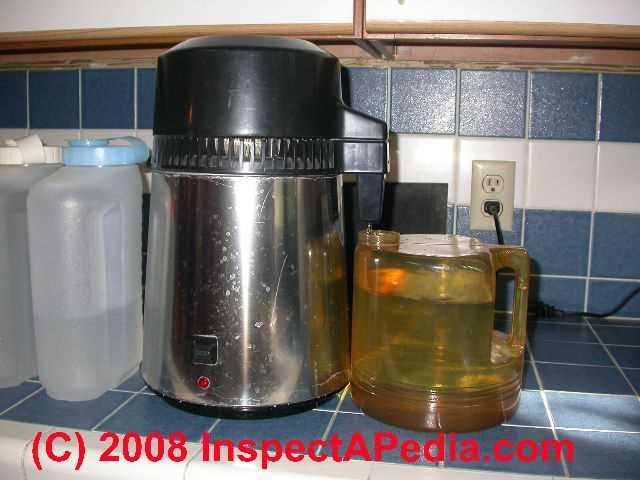
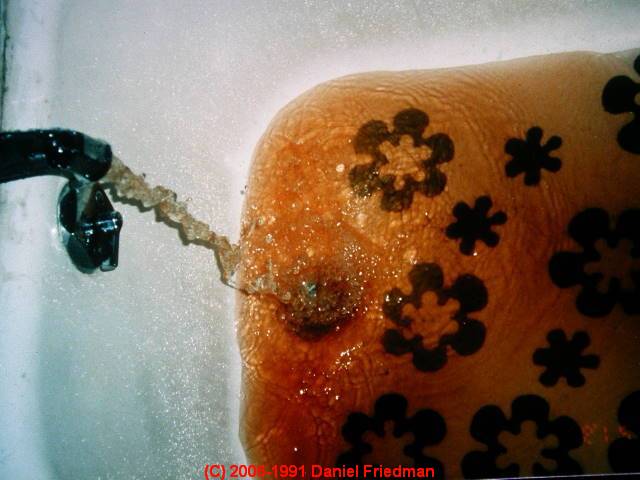 While it looks disgusting, the water in this photograph was colored from rust. We ran this fixture after water had been shut off in the building for months.
Rust in water can be a problem, for example if it is at high levels it may stain laundry or even contain enough iron to be a health concern for some people. It might also indicate that the water supply is particularly corrosive or "aggressive."
Whether you have a public or private water supply, you should have your water tested if the following situations arise:
- If family members or house guests have recurrent incidents of gastrointestinal illness:
Test for coliform bacteria, nitrate and sulfate. - If household plumbing contains lead
pipes, fittings, or solder joints: Test for pH, \corrosion index, lead, copper, cadmium and zinc. [DF-note:
see LEAD WATER SUPPLY LINES / Entry Mains - Testing, Problems, Advice. Depending on exactly how a water sample is collected, you can under-state or over-state the level of lead exposure to occupants drinking the water.
Also see LEAD in DRINKING WATER - Advice for an overview of the health concerns and advice on reducing lead exposure.] - If you are buying a home
and wish to assess the safety and quality of the existing water supply: Test for coliform bacteria, nitrate, lead, iron, hardness, pH, sulfate, total dissolved solids (TDS), corrosion index and other parameters depending on proximity to potential sources of contamination. - If a water softener is needed
to treat hard water: Test for Iron and manganese, which decrease the efficiency of action exchange softeners, before purchase and installation. - If you wish to monitor the efficiency and performance of home water treatment equipment:
Test for the specific water problem being treated upon installation, at regular intervals after installation, and if water quality changes.
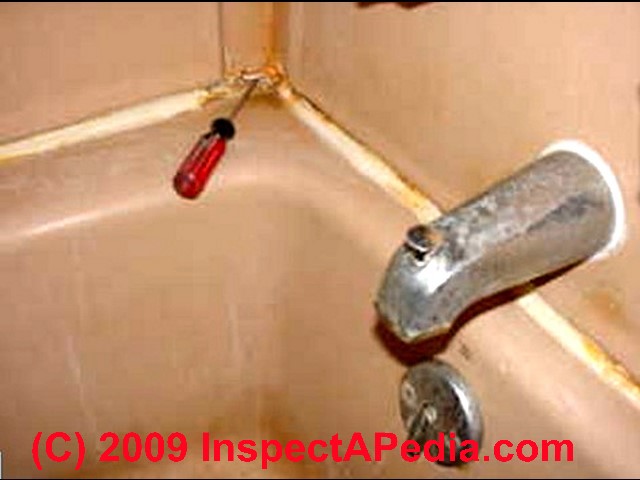
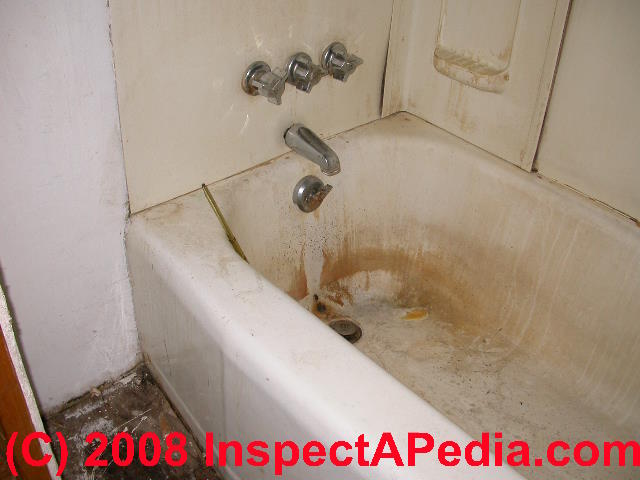
- If water stains plumbing fixtures and laundry:
Test for iron, manganate and copper. (Photo at left courtesy of reader B.H.) - If water has an objectionable taste or smell:
Test for hydrogen sulfide, pH, corrosion index, copper, lead, iron, zinc, sodium, chloride and TDS. - If water appears cloudy, frothy, or colored:
Test for color, turbidity and detergents. - If pipes or plumbing show signs of corrosion:
Test the water supply for its LIS or corrosion index, pH, lead, iron, manganese, copper and zinc.
Watch out: as we discuss
at PEX BRASS CONNECTOR LEAKS
water chemistry including corrosivity, acidity, temperature, flow rate, quantity flowed, and the presence of chlorine all are contributors to corrosion or leaks in copper and brass or other metallic piping or pipe connectors.
The Langelier Saturation Index (LSI) and Aggressive indices are commonly-used measures of the corrosivity of water for which Hach provides convenient water tests. - If water leaves scaly residues and soap scum,
and decreases the cleaning action of soaps and detergents: Test for hardness. - If water supply equipment (pump, chlorinators, etc.) wear:
rapidly: Test for pH, corrosion index.
HOW OFTEN to Make A Routine Water Potability Test or other Water Tests
The testing frequencies in this fact sheet are general guidelines. Test more often if you suspect there is a problem with the quality of your drinking water.
Once each year test for coliform bacteria, nitrate, pH and TDS.
It is best to test for these contaminants during the spring or summer following a rainy period. These tests should also be conducted after repairing or replacing an old well or pipes, and after installing a new well or pump.
Every 3 years test for
sulfate, chloride, iron, manganese, lead, hardness and corrosion index.
If a new baby is expected
in the household it is a good idea to test for nitrate in the early months of a pregnancy, before bringing an infant home, and again during the first 6 months of the baby's life.
DRINKING WATER CONTAMINANT LEVELS - New York State Maximum Allowed for examples of typical allowable limits.
WATER TREATMENT for CONTAMINATION, Hardness, Odors, Sediment, Etc: choices of systems, recommendations
How to Conduct A Well Water or Drinking Water Test
This topic has been moved to a separate article.
Water Test Costs for Testing Private Water Supplies, Typical Tests, Costs, Suggestions for Test Packages
Most water testing labs, both those run by your local health department and private water testing labs offer packages of tests for clusters of common private water supply contaminants. If you want water tests not offered through your local health department don't hesitate to use a private water testing laboratory, provided the lab is licensed by your state.
Beware - a few labs offer water tests in states where they have no license to do so, possibly using methods which are not approved by state authorities. Remember to ask.
If you are moving into a home and are testing water for the first time, we recommend ordering one of the more extensive test packages, typically costing $200. to $300.
If that test detects no problems, we recommend follow-up testing of the water supply annually, using a less costly minimum screen for bacteria or coliform bacteria, typically costing less than $50.
Another tip: if a home is new to you, ask the neighbors, the local health department, and local labs if they are aware of any special contamination issues on your street or near your home. On rare occasions I've learned about and thus could order tests for unusual contaminants which otherwise no newcomer would have thought to look for.
CHOICES of Water Tests & Fees: A Summary of Types of Water Tests, Degrees of Comprehensive Water Testing, Details of Water Test Parameters
Special Situations Deserving Water Testing
Where you live, or what you are living next to, can sometimes affect the quality of your well water. If someone in your family becomes ill, or the taste, odor or color of your water changes, your water supply may be contaminated.
If your well is in an area of intensive agricultural use: Test for pesticides commonly used in the area, coliform bacteria, nitrate, pH and TDS.
If you live near a coal or other mining operation: Test for iron, manganese, aluminum, pH and corrosion index.
If your well is near a gas drilling operation: Test for chloride, sodium, barium and strontium.
If your water, smells like gasoline or fuel oil, and your well is located near on operational or abandoned gas station or buried fuel storage tanks: Test for fuel components or volatile organic compounds ('OC's).
If your well is near a dump, junkyard, landfill, factory, or dry cleaning operation: Test for volatile organic chemicals (such as gasoline components and cleaning solvents) pH, TDS, chloride, sulfate and metals. -
If your well is near seawater, a road salt storage site, or a heavily salted roadway and you notice the water tastes salty or signs of corrosion appear on pipes: Test for chloride, TDS and sodium.
Water testing advice based on information from Cornell University of Maryland with extensive edits, text additions, and additional references by DJF New York State License #16000005303
Judith C. Stawan Extension support aide, Ann T. Lemisy associate professor, College of Human Ecology Cornell University, Sharon 1. Hogan communications consultant, Richard A. WeIsmiller soil end water resource specialist Department of Agronomy, The University of Maryland. [Edits and comments added by Daniel Friedman, [researcher/author] 5/22/2009 4/25/2007, 11/2006, 4/2006]
...
Reader Comments, Questions & Answers About The Article Above
Below you will find questions and answers previously posted on this page at its page bottom reader comment box.
Reader Q&A - also see RECOMMENDED ARTICLES & FAQs
On 2019-01-18 7 by Robo
My water has a ppm of 250 and an ec of 500 help?
On 2017-09-07 by Matt
My water in my apartment has a really bad smell to it. Which should I do?
On 2017-09-05 by Anonymous
I live in a building that is 2 years old in Los angles. I noticed hair loss after living here for less than a year. Now the drain will often times have an orange residue. The management also sent a letter around saying that someone was coming in to work on plumbing but that everyone including animals would not be allowed in the building at the time. Tenants complained and it never happened. So I am left wondering if something is going on with the water system in my building. Any ideas ?
Thank you
On 2016-08-16 - by (mod) -
JOe,
Ask him what he's going to do and what and how he's going to report to you.
If you have the patience to search InspectApedia.com for WELL FLOW TEST and also for WATER QUANTITY to read about these procedures and their pitfalls then you'll be prepared to assess just what you're getting for your money.
Just as an example: if nobody knows any specifications for the well, particularly its static head, then running water at a faucet doesn't tell us much since we don't know when we're actually seeing the true rate of water flowing into the well vs. just taking water out of the static head. If your inspector doesn't know what a static-head is he doesn't know much about wells.
A true well flow test would probably have to be done by a well driller.
On 2016-08-16 by Joe
So how can you find out if a home inspector is qualified to perform the well flow test? We have an inspector coming to our house, but we have doubts as to whether or not this person is truly qualified. He was here once already and denied testing any part of the well, but we had absolutely no water the morning after. We called our well company and they had to come out and replace the control box.
On 2016-08-15 - by (mod) - Can any inspector perform a well flow test?
Joe:
No; a many home inspectors do not offer water or septic testing and even among those who do, their test of the well will be limited by their on-site time.
See details at WELL FLOW TEST for WATER QUANTITY and you'll see that there are brief, crude tests that really only measure the pump's output rate not the well's ability to give water over time.
Elaborating: "Inspector" - what sort? If you are asking about a home inspector, depending on where you live, the home inspection laws or standards that apply probably excuse the home inspector from being *required* to test well flow but usually such laws or standards *do not prohibit* the inspector from offering additional services (water flow test, water quality test, radon test, pest inspection, septic testing, even engineering services) IF she or he is qualified to do so. (Most engineers who do home inspections are careful NOT to claim they're providing engineering services as those are quite different as are their standards and requirements.)
What many home inspectors do is a crude functional test: run a few fixtures and form an opinion about whether or not the flow rate at the faucets is functional.
That is NOT a well flow test. A true well flow test needs to be done over a longer time with a calibrated pump or using other means to determine the well's recovery rate.
Search InspectApedia.com for WELL FLOW TEST and also for WATER QUANTITY to read about these procedures and their pitfalls. Or pratfalls if the home inspector is stupid enough to tell you that opening a faucet is a test of the well flow rate.
On 2016-08-15 by Joe
Can any inspector perform a well flow test?
On 2016-07-13 by (mod) - after well fails a coliform test
There are other watere treatment systems that can remove coliform, such as reverse osmosis, or cholorinators & filters, but before spending anything on more water treatment equipment:
You will want
- to understand that there is a significant coliform source that is contaminating your well
- to have the well and piping installation inspected to see if there are groundwater leaks into the well
- further testing to see what other contaminants are in the well water,
and provided you don't find a mechanical problem that can be fixed and the well then sterilized,
- you'll want to install a suitable water treatment system that addresses not only bacteria but also other contaminants that may be present, such as chemicals, pesticides, etc.
On 2016-07-13 by Fern Perry
What can I possibly do if my well water fails the coliform test after I've had a 5 micron filter and a UV light tube installed?
On 2015-12-01 - by (mod) -
John:
Sorry I don't understand your question. 640 what? Call your water test lab or the person who performed the test for you and ask for something that has more meaning than a number.
On 2015-12-01 by John Lee
My drinking water testing reading is 640. Is it bad to drink?
On 2015-04-07 - by (mod) -
George, thanks for asking - we've corrected the article. Please Use the "Click to Show or Hide FAQs" link just above to see recently-posted questions, comments, replies including our reply to your comment.
Question: what are the water test parameters you recommend on corrosivity
7 April 2015 George B. said:
In the sentence: "Test for corrosion index, PS, lead, iron, manganese. copper and zinc." what is PS?
Reply:
George thank you very much for asking.
It's a mistake.
PS should have read pH - the acidity level of the water.
I'll fix the article and add clarification on the LSI corrosivity index as well.
We appreciate all the editing help we can get, so thanks again.
Daniel
...
Continue reading at WATER QUALITY TEST CHOICES & WATER TEST FEES - how to decide what to test for in your water supply, or select a topic from the closely-related articles below, or see the complete ARTICLE INDEX.
Or see these
Recommended Articles
- CHEATING ON WATER TESTS - buyer beware
- CHOICES of WATER TESTS & Fees: A Summary of Types of Water Tests, Degrees of Comprehensive Water Testing, Details of Water Test Parameters.
- COLIFORM STANDARDS for DRINKING WATER - what are the allowable levels of total coliform and e-coli in drinking water?
- FAILED WATER TESTS - WHAT TO DO - water testing procedural errors can foul up water test results
- FAILED WATER TESTS - WHEN to RE-TEST
- LANGLIER SATURATION INDEX LSI
- SIX STEPS to WELL WATER SAFETY
- TOTAL COLIFORM TESTING for details about coliform bacteria test procedures and standards./li>
- WATER CONTAMINANT LEVELS & LIMITS for allowable water contaminant limits
- WATER FILTERS, HOME USE
- WATER ODOR DIAGNOSIS - SULPHUR
- WATER QUALITY TEST CHOICES & WATER TEST FEES
- WATER TESTING ADVICE - what water tests should you order, when, and how often?
- WATER TREATMENT EQUIPMENT CHOICES for treating contaminated water
- WELL CONSTRUCTION & MAINTENANCE for methods of building a safe water well
- WELL WATER CONTAMINATION: CAUSES, CURES - home
Suggested citation for this web page
WATER TESTING ADVICE at InspectApedia.com - online encyclopedia of building & environmental inspection, testing, diagnosis, repair, & problem prevention advice.
Or see this
INDEX to RELATED ARTICLES: ARTICLE INDEX to WATER TESTING
Or use the SEARCH BOX found below to Ask a Question or Search InspectApedia
Ask a Question or Search InspectApedia
Try the search box just below, or if you prefer, post a question or comment in the Comments box below and we will respond promptly.
Search the InspectApedia website
Note: appearance of your Comment below may be delayed: if your comment contains an image, photograph, web link, or text that looks to the software as if it might be a web link, your posting will appear after it has been approved by a moderator. Apologies for the delay.
Only one image can be added per comment but you can post as many comments, and therefore images, as you like.
You will not receive a notification when a response to your question has been posted.
Please bookmark this page to make it easy for you to check back for our response.
Our Comment Box is provided by Countable Web Productions countable.ca
Citations & References
In addition to any citations in the article above, a full list is available on request.
- Penn State, Water Fact Sheet #3, USING LOW-YIELD WELLS [PDF], Penn State College of Agricultural Sciences, Cooperative Extension, School of Forest Resources, web search 07/24/2010, original source: http://pubs.cas.psu.edu/FreePubs/pdfs/XH0002.pdf
- Crystal Clear Supply provides portable ceramic water filter purifiers and portable reverse osmosis water treatment equipment - see http://www.crystalclearsupply.com/category_s/7.htm
- Handbook of Disinfectants and Antiseptics, Joseph M. Ascenzi (Editor), CRC, 1995, ISBN-10: 0824795245 ISBN-13: 978-0824795245 "The evaluation of chemical germicides predates the golden age of microbiology..." -
This well-focused, up-to-date reference details the current medical uses of antiseptics and disinfectants -- particularly in the control of hospital-acquired infections -- presenting methods for evaluating products to obtain regulatory approval and examining chemical, physical, and microbiological properties as well as the toxicology of the most widely used commercial chemicals. - Potable Aqua® emergency drinking water germicidal tablets are produced by the Wisconsin Pharmacal Co., Jackson WI 53037. 800-558-6614 pharmacalway.com
- In addition to citations & references found in this article, see the research citations given at the end of the related articles found at our suggested
CONTINUE READING or RECOMMENDED ARTICLES.
- Carson, Dunlop & Associates Ltd., 120 Carlton Street Suite 407, Toronto ON M5A 4K2. Tel: (416) 964-9415 1-800-268-7070 Email: info@carsondunlop.com. Alan Carson is a past president of ASHI, the American Society of Home Inspectors.
Thanks to Alan Carson and Bob Dunlop, for permission for InspectAPedia to use text excerpts from The HOME REFERENCE BOOK - the Encyclopedia of Homes and to use illustrations from The ILLUSTRATED HOME .
Carson Dunlop Associates provides extensive home inspection education and report writing material. In gratitude we provide links to tsome Carson Dunlop Associates products and services.
 | HOME | ABOUT | ASK a QUESTION | CONTACT | CONTENT USE POLICY | DESCRIPTION | POLICIES | PRIVACY | |
| © 2024 - 1985 Publisher InspectApedia.com - Daniel Friedman | |||||||||