
InspectAPedia® FREE Encyclopedia of Building & Environmental Construction, Diagnosis, Maintenance & Repair |
Question? Just ask us! InspectAPedia
|
 Steam Heat Radiator Pipe Connections & Types
Definitions of one pipe vs two pipe steam heat, upflow vs downflow steam distribution, vacuum/vapor steam systems &c
- POST a QUESTION or COMMENT about steam radiator piping, one pipe vs two pipe, upfeed vs downfeed, and other piping questions
Guide to steam heat radiator piping connections: this article describes the piping connections for steam heating radiators. We explain the difference between one pipe and two pipe steam heating systems.
We illustrate upfeed steam pipes, downfeed steam pipes, and we make clear how to figure out what type of steam heat is installed in a building - insofar as the steam heat distribution is concerned. We explain how steam rises or enters radiators and how condensate in a steam radiator gets back to the steam boiler.
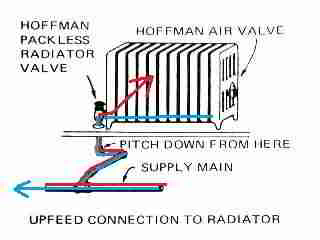
We also describe antique vacuum / vapor steam heat systems. Our page top sketch, adapted from ITT's The Steam Book, shows piping connections for a one pipe steam heating radiator.[14]
InspectAPedia tolerates no conflicts of interest. We have no relationship with advertisers, products, or services discussed at this website.
Steam Radiator Piping Connections & Definitions
Question: where do steam pipes enter steam radiators: top, bottom, or both?
 I had a question about the article
at RADIATOR VALVES & HEAT CONTROLS.
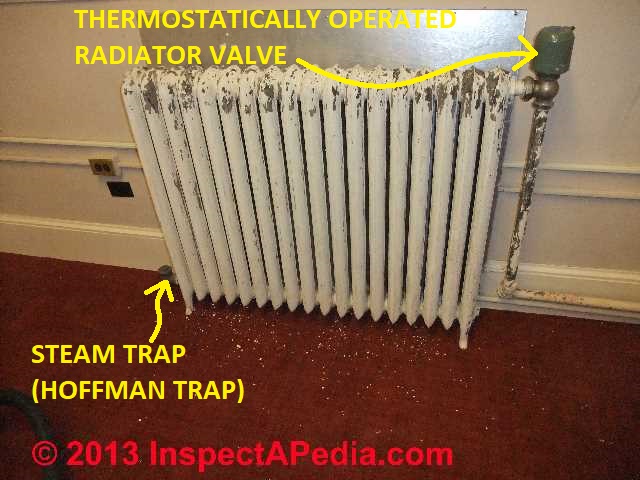
I’m looking at the sub-section “Types of Radiator Valves: Hot Water vs. Steam” and here is a copy of the 1st paragraph; the writing becomes nonsensical and near the end and it may turn out that some of the information is [was - we've fixed it] incorrect: “In our photo at left you can see not only the radiator control valve, but lots more information:
[Click to enlarge any image]
We can conclude that this is a hot water heating system, not a steam heat system because first, the valve is mounted at the top of the radiator (water, not steam - steam enters at a radiator bottom but sometimes so does not water; the reverse is never true).”
Photo at above-left illustrates a two pipe steam heating radiator installed at Vassar College.
The control shown on the inlet end at the upper right of the radiator is a No. 8 / 3000-2 Piston Operator from Johnson Service Company, Milwaukee, now Johnson Controls. [22]
I was trying to make sense of what was written and discovered another article (which also has nonsensical syntax- it must be hard to describe these hot water and steam heating systems) which seems to indicate that in fact steam DOES often enter a radiator at the top.
At this point I am just lost. We don’t have many residential systems with radiator systems (steam or hot water) so I am trying to edumacate myself but don’t have anything in front of me to compare what I think I understand.
I am totally reliant on clear, logical, linear and detailed examples which your site usually has in abundance (thank you by the way.) Here is the link to that other article (refer to the 5th question/answer pairing): oiltechtalk.com/pages/cast_iron.htm
Kind Regards, -Doug
Up-feed - Down-feed, One-pipe - Two-Pipe Steam Piping & Radiators - What's the Difference?
 Doug, the other page (not at InspectApedia) that you gave provides information from Dan Holihan [1] - Dan is probably the most-expert fellow alive when it comes to steam heating systems. Dan's text to which you refer includes these two statements:
- Older steam radiators have nipples across just the bottom portion of the sections. This is because steam is lighter than air. When the steam enters the bottom of a radiator (as it always will in a one-pipe steam radiator), it flows upward into the sections, displacing the air as it goes.
- Two-pipe steam systems usually have the steam entering through a pipe at the top of the radiator. [1]
Mr. Holihan is a steam heat expert - I absolutely defer to Dan, but I'm not sure that the word usually in the Dan H's second statement can be taken to mean always. [1][12][16][17]
Most two-pipe steam heat radiators will indeed show up with the steam entering the radiator at one end at the radiator top (photo at left), and the condensate return will exit at the bottom of the radiator at its opposite end.
We do on occasion find a two pipe steam system with both steam in and condensate out connections at the radiator bottom, and for sure, all one pipe steam radiators are fed with a pipe connection to the bottom of the radiator.
All one pipe steam heat radiators are fed from the radiator's bottom at one end - as we explain and illustrate later in this article.
At above left is a top-fed two pipe steam radiator at Google Headquarters in New York City.
Steam to Water Radiator Conversions
at left is a bottom-feed (two pipe) hot water (not steam) heating radiator. What's interesting about the radiator at above right is that it was converted to hot water heat from prior two-pipe steam heat.
Notice that crazy location of the air bleed valve on the left side of the radiator?
That's where a steam vent used to mount. You'll have a heck of a time getting all of the air out of this radiator now that it's converted to hot water - at least not through that bleeder.
This was originally a two pipe top-fed steam radiator when it was first installed. A steam vent worked correctly in the location we show and where now an air bleeder (for hot water heat) has been installed.
This won't work.
On a hot water heating radiator we need the air bleed to be at the top of the device - where the air will be.
In clarifying what we are talking about here I will include some sketches from ITT's now antique Steam Book. [14]
Up-Steam Pipe Feed Direction: Down-feed vs Up-Feed: Two Pipe Steam Heat Radiator Connections
 First let's clear up the direction from which steam is being fed into a steam radiator:
Downfeed Steam Risers Entering at Radiator Top
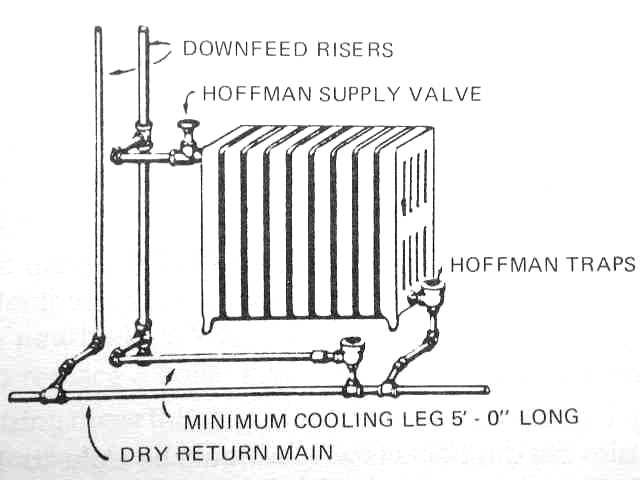
Yes of course Dan is right that there absolutely are also "downfeed steam risers" on some two pipe steam systems (sketch at left).
These "downfeed steam risers" (sounds like an oxymoron) push steam into the radiator from a valve entering at the top
Sketch at left - ITT [17]
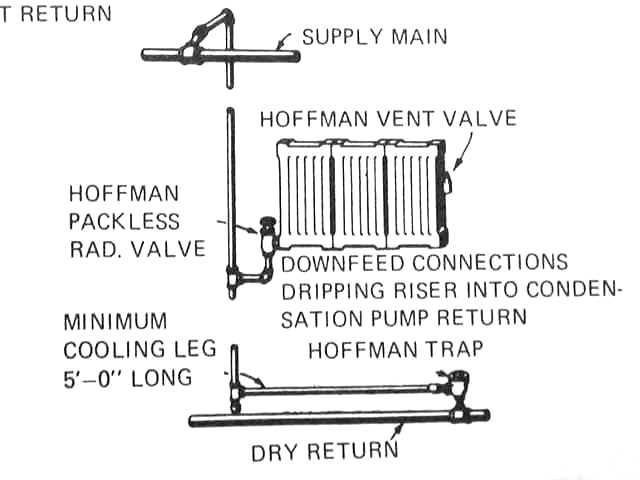
Downfeed steam piping that enters at a radiator top will always be two-pipe steam heat systems and the condensate return will always be take off of the bottom of the radiator.[14] . Shown in the ITT sketch are Hoffman Traps. A steam trap, check valve or other device is required on two pipe steam systems to keep steam from entering the condensate return line.
In very early steam systems radiator sections were connected (to permit steam flow) only across the radiator bottom. Steam entering a steam radiator at its top would have been forced down through that radiator section and through bottom nipple connections into the remaining radiator sections.
Holohan points out that two-pipe steam designs became common in the U.S. around 1905 and made use of hot water radiators whose sections are connected to permit [more rapid] heat flow through nipples at both top and bottom of each radiator section.[1]
C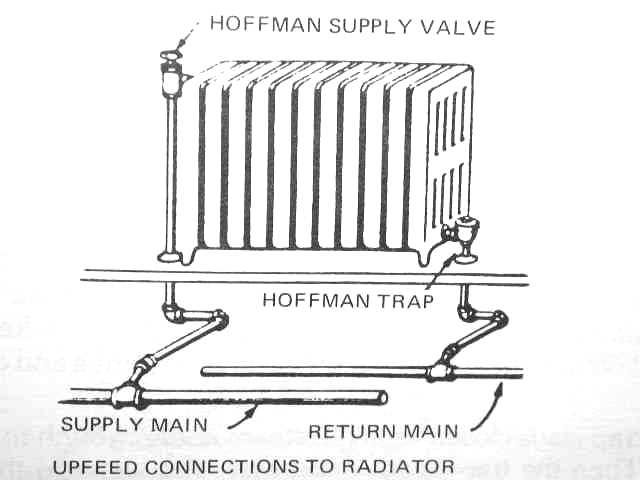 conversely, hot water radiators are usually connected by nipples at each radiator section top and bottom..
Up-feed Steam Risers Entering at the Radiator Top
There are also upfeed steam pipe systems that may feed into the steam radiator at its top - through a Hoffman Supply Valve (sketch at left - ITT).
These systems will also always be two-pipe steam heat systems and the condensate return will always be take off of the bottom of the radiator.[14]
Certainly some of the two pipe steam heat radiators I have found in homes are bottom-fed steam radiators, have both entering and exiting pipes at the radiator bottom.
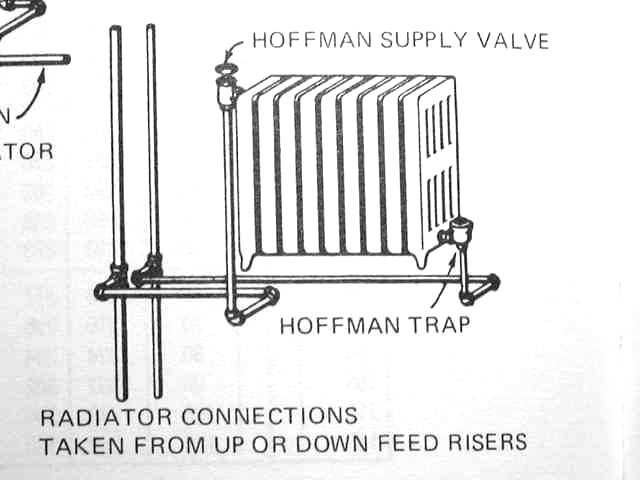 It's hard to push steam "down".
The sketch at left shows that two-pipe radiator connections may be taken from either an upfeed or downfeed steam supply line - with just the information in the sketch we don't know which way steam is flowing in this system.
Holohan points out that because steam moves across the top of the radiator and condensate drips down along the sides of each radiator section, heat from a two pipe steam radiator system will be more "even" as the radiator is heating up.[1]
In our OPINION, once either radiator has become hot their heat output will be about the same regardless of one pipe vs two pipe design.
One Pipe Steam Radiator Piping Connections
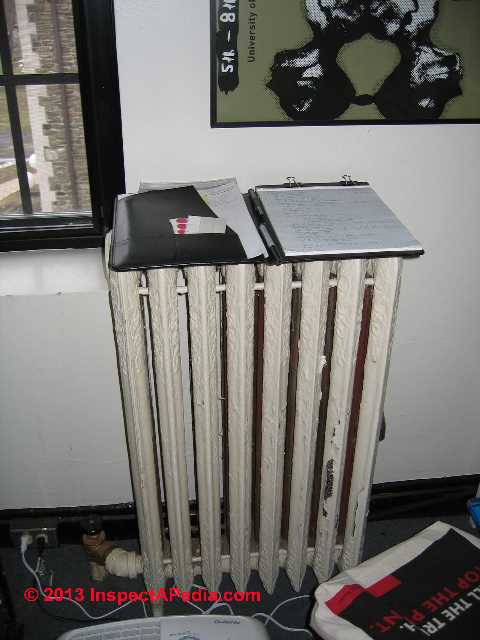
At left is a one pipe steam heat radiator.
You can just make out the steam vent on the right side of the radiator, and at the radiator's lower left you can see the steam pipe and radiator valve - the steam enters and the condensate returns through the piping and valve at the radiator lower left end.
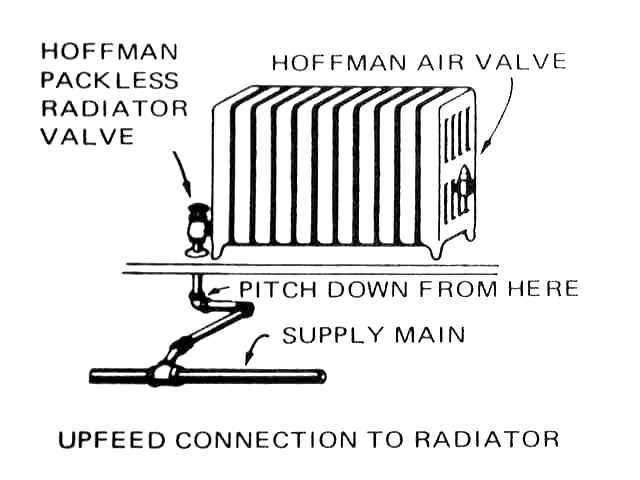
This is the most common one-pipe feed steam heat radiator piping we see in private homes.
An up-feed steam connection brings steam into the radiator through the Hoffman valve and that same valve allows condensate to return through the valve and into the steam line where it returns in the same steam pipe, flowing back to the steam boiler.
There are upfeed steam risers that flow steam into radiators at the radiator bottom in both one pipe and two pipe steam systems.
A one pipe steam system would not work if its steam entered at the radiator top - the radiator would fill up with condensate and would stop heating.
Wet Return vs Dry Return Steam Piping on One Line Steam Heat Systems

The number of steam radiator piping arrangements is quite large, I'm not showing all of the 20+ configurations commonly listed, though I can do so if there is a need.
Wet Return Line Steam Piping
The one pipe steam heat radiator and piping shown at left is connected to an overhead steam supply main and uses a wet return - condensate flows in the return line. [14]
Dry Return Line Steam Piping
At left is a one pipe steam radiator connected with a dry return line.[14]
Indeed there is a wide range of both hydronic and steam radiators. A reasonable approach would be to
- recognize that we have steam heat (look at the boiler, see steam vents or other steam controls at radiators)
- recognize that we have hot water heat (the photo you cite offers that clue by its position on a cast iron radiator and also by the vent seen on the side of the valve itself). Keep in mind that some steam boiler systems may ALSO include hot water radiators on lower floors in the same building, often with a separate circulator pump.
- recognize the type of radiator and thus follow its piping
- older steam radiators of the type above will always have steam entering at the bottom and will have a steam vent on the opposite side of the radiator from that in which steam enters, and placed at or above the radiator's mid-height
- distinguish between one pipe and two pipe steam systems for important reasons we can cite
- some commercial or other newer steam radiators may have steam entering at the top of one end of the radiator. IN that case the construction of the radiator will be most likely serpentine - from the point of entry the steam may have to be pushed down one passage, then up the next to the far end of the radiator where there is a steam vent and a condensate return line, or probably more often, the radiator internals give a horizontal pathway.
More often these will be convector units not conventional radiators..
Vacuum / Vapor Steam Systems
Some older steam systems, less likely to be encountered now were a vapor/vacuum design, now considered obsolete with oil and gas-fired heating equipment, but you may still encounter piping in older buildings built before or at the time when vapor/vacuum steam systems were being installed.
Vacuum steam heating systems are all two-pipe systems, but include a mechanical vacuum pump at the end of the condensate return piping system.
Vapor / Vacuum steam systems could be designed as either a one-pipe or two-pipe steam heating system and look much like modern steam heating systems but a vapor/vacuum steam system used special air vents to eliminate air from the heating pipes and system.
Vapor steam systems (just to add to the confusion) run at very low pressure but never at a vacuum. These systems used an oversized steam supply pipe to provide nearly-constant flow of steam vapor.
Reader Comments, Questions & Answers About The Article Above
Below you will find questions and answers previously posted on this page at its page bottom reader comment box.
Reader Q&A - also see RECOMMENDED ARTICLES & FAQs
 On 2019-11-16 by (mod) - What pipe fitting are used to connect the steam radiator valve to the radiator?
Jon,
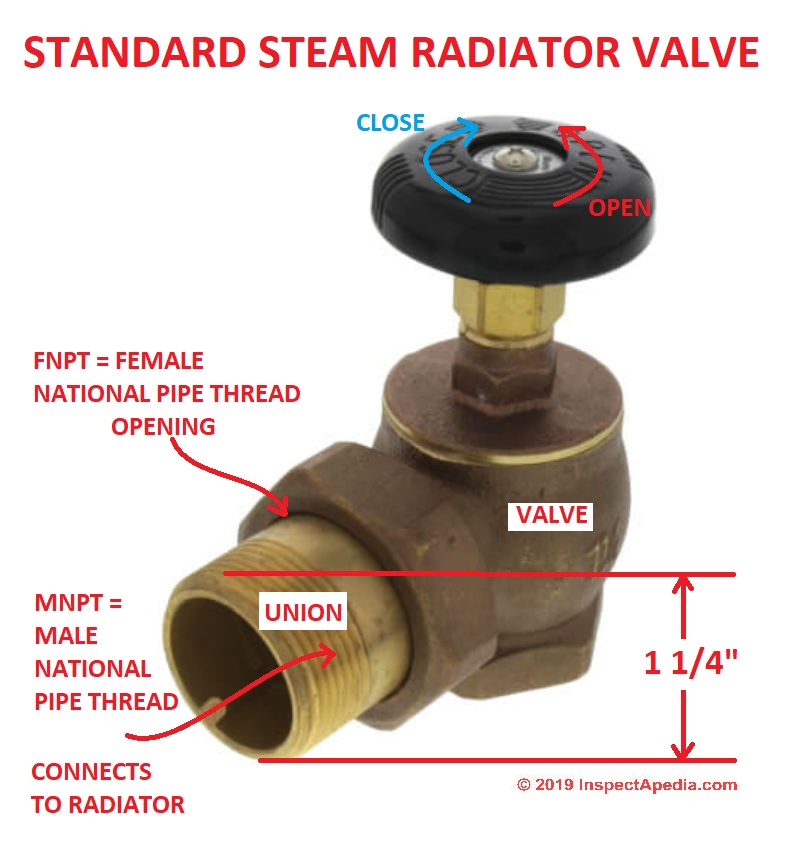
The pipe diameter sizes will vary across sine radiators, but most-common in the absolute simplest form is a standard radiator shutoff valve joined to the NPT opening at the radiator top or bottom that's shown below.
The valve, this one a Bluefin RVST125 sold by supplyhouse.com uses a 1 1/4" male union to join the rad valve to the rad.
In plumbing lingo the valve-to-radiator opening is an FNPT (Female National Pipe Thread) and is connected to the FNPT on the radiator by using an MNPT (Male National Pipe Thread) brass Union.
And hey Jon, good luck on your test.
On 2019-11-16 by Jon
What pipe fitting are used to connect the steam radiator valve to the radiator?
On 2019-02-13 by (mod) - signs of a leak inside the steam boiler: steam or water at chimney base
Nice tip. Thanks Spence.
On 2019-02-13by spence12
@J BOUGHTON, Look for steam coming out of chimney or water at the base of chimney , if you have those conditions you may have a bad chamber in boiler
On 2019-01-27 by (mod) - why is my steam boiler using so much water?
JB
I would look first for steam vents that never shut off - running continuously,
then perhaps follow - as best you can, the condensate return piping to look for a leak. When you can't find a leak - as you haven't, and when you don't think it's a bad steam vent, I'm puzzled too.
Is it possible that the boiler water level is reading incorrectly and so they're never filling it to the right level?
Is there unusually cold weather?
Is there a change in thermostat settings or amount of heat being distributed?
Leaks at a remote, forgotten radiator?
On 2019-01-27 by J BOUGHTON
In a 60 year old store that used to be asears store....Part of the boiler system is one pipe and part is two pipe.
They tell me that they have been adding water every two days during the heating season. Just where can that much water go?
The air vents don't seem to be dumping water or steam . No leaks in piping have been found. No piping underground. Boiler replaced 8 years ago. I'm telling them that they have a big problem.
On 2018-04-05 2 by (mod) - possible to connect two radiators to one steam pipe with some sort of y-connector?
Sure, though for the cost of adding a radiator in some locations you might consider other options for auxiliary heat or better, for insulation and for sealing drafts;
your plumber will have to inspect the radiator that's installed, its piping, its type (1 pipe or 2 pipe system) and the available space for routing and connecting more pipes.
On 2018-04-05 by Ann
Is it possible to connect two radiators to one steam pipe with some sort of y-connector? The room is too cold and needs another radiator in the room.
Thanks
On 2015-06-12 by (mod) - some steam radiators can convert between 1-pipe and 2-pipe
Check the radiator model: most have the necessary tappings for installation of the steam vent that you need.
But be sure that you have the right valve: on a 1 pipe steam system the radiator control valve has to let steam in and let condensate return back out of the same valve.
On 2015-06-10 by Anonymous
I have to buy some steam radiators but they are two pipe and my house has a one pipe system. Can the 2 pipe radiator be converted into a one pipe radiator?
Monique Perkins
On 2014-05-27 by (mod) -
Ziggy
In concept, sure, provided the piping handles steam in and condensate out without a snarl-up. Which is probably why we don't see that arrangement. Condensate from the uphill one pipe steam radiator has to return out of its inlet and drain through the downhill steam radiator to the steam line.
This works fine with radiators at very different levels, say on different floors, but for two radiators in the same area the higher radiator will have to be just that - higher.
On 2014-05-26 by Ziggy
Hello, can I serial connection one pipe steam radiator.
Thank you.
...
Continue reading at STEAM VENTS or select a topic from the closely-related articles below, or see the complete ARTICLE INDEX.
Or see these
Recommended Articles
- CONDENSATE RETURN PIPES, PUMPS, STEAM
- RADIATOR STEAM VENTS - home
- STEAM HEATING SYSTEMS & CONTROLS - home
- STEAM VENTS
Suggested citation for this web page
STEAM RADIATOR PIPING CONNECTIONS at InspectApedia.com - online encyclopedia of building & environmental inspection, testing, diagnosis, repair, & problem prevention advice.
Or see this
INDEX to RELATED ARTICLES: ARTICLE INDEX to STEAM BOILERS
Or use the SEARCH BOX found below to Ask a Question or Search InspectApedia
Ask a Question or Search InspectApedia
Try the search box just below, or if you prefer, post a question or comment in the Comments box below and we will respond promptly.
Search the InspectApedia website
Note: appearance of your Comment below may be delayed: if your comment contains an image, photograph, web link, or text that looks to the software as if it might be a web link, your posting will appear after it has been approved by a moderator. Apologies for the delay.
Only one image can be added per comment but you can post as many comments, and therefore images, as you like.
You will not receive a notification when a response to your question has been posted.
Please bookmark this page to make it easy for you to check back for our response.
Our Comment Box is provided by Countable Web Productions countable.ca
Citations & References
In addition to any citations in the article above, a full list is available on request.
- [1] Dan Holihan, "Your Most Frequently Asked Questions About Cast-Iron Radiators – Answered! by Dan Holohan", http://www.oiltechtalk.com/pages/cast_iron.htm, retrieved 3/7/2013.
- Barnes & Jones Corporation, 91 Pacella Park Drive Randolph, MA 02368, Tel: 781-963-8000calibrated steam traps and vents, Email: bnesbitt@barnesandjones.com. Vent-Rite steam vents for radiator control.
- Energy Savers: Heat Distribution Systems, Steam Radiators & Hot Water Radiators, U.S. Department of Energy, web search 12/27/2010, original source: http://www.energysavers.gov/your_home
/space_heating_cooling/index.cfm/mytopic=12580 - Gorton Heating Corporation, 546 South Avenue East, Cranford, New Jersey 07016, Tel: 908-276-1323, email: info@gorton-valves.com, fast venting valves for steam heating systems.
- "Rv-4 One-Pipe Steam Radiator Valve", available from Armstrong International,
816 Maple Street, Three Rivers, MI 49093 USA, Tel: (269) 273-1415, Armstrong has offices in Beijing, China, Belgium, India and Mexico. Web search 12/27/2010, original source:
http://www.armstronginternational.com/thermostatic-valves-rv-4-one-pipe. - [6] "Special Steam Vents", Hoffman Specialty heating products, web search 12/27/2010, original source:
http://www.hoffmanspecialty.com/pdf/hs900/HS900-3474.pdf - [7] "Steam and Water Vents, Selection Guidelines - Steam Vents", Hoffman Specialty, web search 12/27/2010, original source:
http://www.hoffmanspecialty.com/pdf/hs900/HS900-stvents.pdf - Hoffman 1A adjustable steam vents, available from Hoffman Specialty, ITT, web search 12/27/2010, original source:
http://www.drillspot.com/products/51570/Hoffman_1A_Adjustable_Automatic_Air_Vent_For_Steam_Radiators - Hoffman Convector Steam Vents, available from Hoffman Specialty, ITT, web search 12/28/2010, original source:
http://www.hoffmanspecialty.com/pdf/hs900/HS900-conv109.pdf - [10] Report 95-14, PB96-198163 Thermostatic Radiator Valve (TRV) Demonstration Project, contact NYSERDA. 17 Columbia Circle, Albany, NY 12203-6399 Toll-Free: 1-866-NYSERDA, Tel:(518)465-6252, Ext. 241. Web Search 12/27/2010, original source: http://www.homeenergy.org/archive/hem.dis.anl.gov/eehem/96/960509.html
- [11] VariValve® Quick-Vent from Heat Timer, adjustable radiator and main line vent valves for one pipe steam systems, web search 12/27/2010, original source: http://www.heat-timer.com/enFiles/ProductDocument/literature/VariV056082C.pdf
- [12] "Care & Feeding of Air Vents", Dan Holohan, Old House Journal Online, November 2004
- [14] The Steam Book, 1984, Training and Education Department, Fluid Handling Division, ITT [probably out of print, possibly available from several home inspection supply companies] Fuel Oil and Oil Heat Magazine, October 1990, offers an update, (see next item in this list). ITT Fluid Technology,
1133 Westchester Avenue
White Plains, NY 10604, tel +1 914 304 1700 fax +1 914 696 2950 www.ittfluidbusiness.com - [15] Principles of Steam Heating, $13.25 includes postage. Fuel oil & Oil Heat Magazine, 389 Passaic Ave., Fairfield, NJ 07004.
- [16] The Lost Art of Steam Heating, Dan Holohan, 516-579-3046 FAX
- [17] Principles of Steam Heating, Dan Holohan, technical editor of Fuel Oil and Oil Heat magazine, 389 Passaic Ave., Fairfield, NJ 07004 ($12.+1.25 postage/handling).
- [18] "Residential Steam Heating Systems", Instructional Technologies Institute, Inc., 145 "D" Grassy Plain St., Bethel, CT 06801 800/227-1663 [home inspection training material] 1987
- [19]< The Heat Efficiency of Steam Boilers, Bryan Donkin
- [20] Steam Boiler Operation, Principles & Practice, James J. Jackson
- [21] Thanks to reader Paul Ruud for discussing improved steam heat controls and thermostatically operated steam radiator valves and air vents, 12/27/2010. Quoting:
"The modern version of this control is Johnson's V-3000-8012 (Exposed) and V-3000-8003 (Enclosed) Pneumatic Valve Actuators, Part No. 14-1078-32. Quoting from Johnson Controls, "The V-3000-8012 and V-3000-8003 Pneumatic Valve Actuators are designed to accurately position steam or water valve modulating plugs in response to a pneumatic signal from a controller. A V-9502 Valve Positioner can be ordered separately for use with the V-3000-8012 only, in applications where sequential operation is desired or additional positioning power is necessary. The actuators have a molded synthetic rubber diaphragm design. This molded diaphragm provides a constant effective area throughout the actuator stroke." - [22] Johnson Controls, "V-3000-8012 (Exposed) and V-3000-8003 (Enclosed) Pneumatic Valve Actuators Product/Technical Bulletin", Part No. 14-1078-22, 507 E. Michigan Street, Milwaukee, WI 53202, www.johnsoncontrols.com, retrieved 3/7/2013
- Heating, Ventilating, and Air Conditioning Volume I, Heating Fundamentals,
- Boilers, Boiler Conversions, James E. Brumbaugh, ISBN 0-672-23389-4 (v. 1) Volume II, Oil, Gas, and Coal Burners, Controls, Ducts, Piping, Valves, James E. Brumbaugh, ISBN 0-672-23390-7 (v. 2) Volume III, Radiant Heating, Water Heaters, Ventilation, Air Conditioning, Heat Pumps, Air Cleaners, James E. Brumbaugh, ISBN 0-672-23383-5 (v. 3) or ISBN 0-672-23380-0 (set) Special Sales Director, Macmillan Publishing Co., 866 Third Ave., New York, NY 10022. Macmillan Publishing Co., NY
- Installation Guide for Residential Hydronic Heating Systems
- Installation Guide #200, The Hydronics Institute, 35 Russo Place, Berkeley Heights, NJ 07922
- The ABC's of Retention Head Oil Burners, National Association of Oil Heat Service Managers, TM 115, National Old Timers' Association of the Energy Industry, PO Box 168, Mineola, NY 11501. (Excellent tips on spotting problems on oil-fired heating equipment. Booklet.)
- In addition to citations & references found in this article, see the research citations given at the end of the related articles found at our suggested
CONTINUE READING or RECOMMENDED ARTICLES.
- Carson, Dunlop & Associates Ltd., 120 Carlton Street Suite 407, Toronto ON M5A 4K2. Tel: (416) 964-9415 1-800-268-7070 Email: info@carsondunlop.com. Alan Carson is a past president of ASHI, the American Society of Home Inspectors.
Thanks to Alan Carson and Bob Dunlop, for permission for InspectAPedia to use text excerpts from The HOME REFERENCE BOOK - the Encyclopedia of Homes and to use illustrations from The ILLUSTRATED HOME .
Carson Dunlop Associates provides extensive home inspection education and report writing material. In gratitude we provide links to tsome Carson Dunlop Associates products and services.
 | HOME | ABOUT | ASK a QUESTION | CONTACT | CONTENT USE POLICY | DESCRIPTION | POLICIES | PRIVACY | |
| © 2024 - 1985 Publisher InspectApedia.com - Daniel Friedman | |||||||||