
InspectAPedia® FREE Encyclopedia of Building & Environmental Construction, Diagnosis, Maintenance & Repair |
Question? Just ask us! InspectAPedia
|
 Planting Trees or Shrubs Near Septic or Sewer Lines
What is safe to plant over the septic tank or septic drainfield?
- POST a QUESTION or COMMENT about recommended distances from septic drainfields to various trees and shrubs
Guide to Planting Trees or Shrubs Over or Near Septic System or Sewer Lines:
This article describes the types of trees, shrubs, or similar plants that should or should not be planted over or near septic fields or other septic system components.
Planting trees, shrubs, and even some ground covers over septic system components are causes of septic system failure in the drain field, leach field, seepage bed, or similar components.
InspectAPedia tolerates no conflicts of interest. We have no relationship with advertisers, products, or services discussed at this website.
Planting Guidelines for Septic Drainfields, Mounds, Raised Beds, Septic Tanks and other Septic Components
 Watch out: While not all sewage or septic system effluents will always make nearby fruits or vegetables unsafe, in at least some conditions planting fruit trees, or vegetables (or anything else edible) over the septic drainfield might produce food that is unsafe to either because watering or rain splash-up sends sewage-contaminated water droplets onto the surface of the edible fruits or vegetables OR because in some cases pathogens may enter the plant system by means of its roots.
Wee SEWAGE CONTAMINANTS in FRUIT / VEGETABLES for details.
Guide to Planting Trees or Shrubs Near or Over Septic Absorption Systems
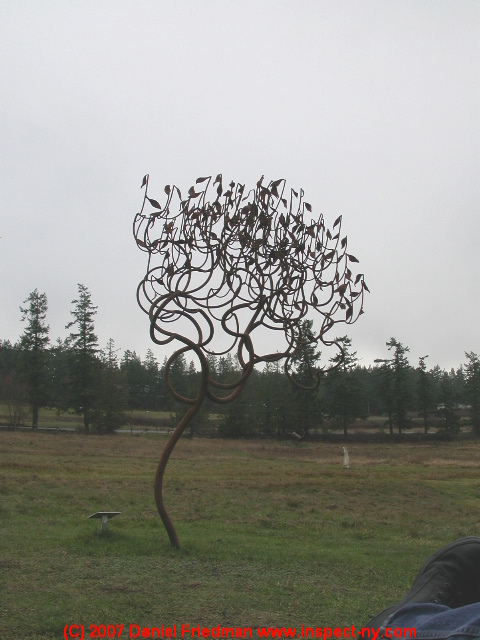
This is the only sort of tree that we suggest can be placed over septic system components with little risk of damage.
This is actually a metal sculpture. Even the placement of this "tree" could have damaged a septic field if during its installation heavy equipment was used to deliver the tree to this spot. Real trees will damage septic components by root movement or clogging.
If you have a shrub for which you have reliable knowledge about the maximum extent its roots will normally reach, you might think it’d be ok to plant it exactly that distance from the nearest drainfield trench.
Watch out: the extra levels of nutrients delivered to the soils by the drainfield may attract roots from nearby trees or shrubs and cause them to travel farther than usual.
OPINION: keep shrubs with a “known” root travel distance 25% farther than that distance from the edge of a drainfield.
In this photo the light and excavated area is where the new home owner saw and dug into a smelly wet spot that appeared in the yard the morning after moving into their new home - a house built 30 years before and one which employed a home made septic tank.
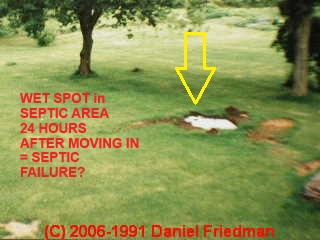
While there were tree roots in the drainfield pipes of the system, the septic tank itself, which was too small, never pumped, and fully blocked, was the "root" cause of system failure in this case. (Pardon the pun).
How much distance is needed between trees and septic drainfields?
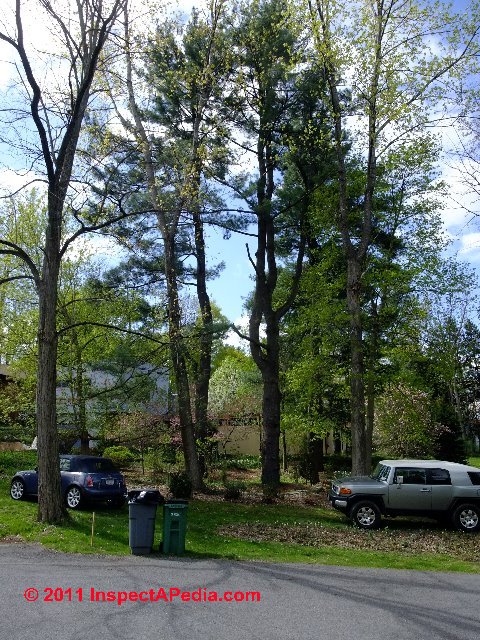
Whether you are planting trees or planning a new septic drainfield, keep the drainfield or septic leach field away from trees or shrubs which are likely to put down deep or aggressive roots.
The pines in our photo (above-left) are white pines approximately 30 years old.
The roots will quickly invade and clog the buried effluent lines and may also cause them to move, break, or become disconnected.
The actual tree to septic distance needed depends on the tree variety and its normal root growth range.
Keep at least as much distance between the tree and the nearest drainfield component as the anticipated height of the tree at its maturity.
So if the tree will be 30' tall at maturity keep it at least 30' from the drainfield.
Some trees should be kept at much greater distances, up to 100' from septic fields, as we discuss just below.
What kinds of trees should be kept farthest away from septic systems?
Trees considered to have deep and/or aggressive roots that are likely to damage a drainfield include those listed below.
Trees or Shrubs That Should NOT be Planted Near Drainfields |
||
| Common Name | Botanical Name | Comments |
| Aralia elata | Aralia elata | Japanese Angelica Tree, considered invasive in the U.S. Warning: dense root system may kill nearby plants and block soil oxygenation. See also Aralia spinosa in table below. |
| Bamboo | Bambusa vulgaris | Fast growing, aggressive roots, spread wide |
| Beech trees | Fagus sp | |
| Birch trees | Betula sp. | |
| Cypress trees | Cupressus | |
| Elm trees | Ulmus sp. | |
| Eucalyptus | Eucalyptus globulus | |
| Fraser Fir | Abies fraseri (Pursh) Poir | Slow growing, though accustomed to shallow soil, may send deep roots near septic |
| Japanese Knotweed | olygonum cuspidatum | Invasive species, roots to 2 metres deep, "Japanese bamboo" |
| Pepper trees | Schinus molle | cashew family |
| Philadendron | Philodendron | Invasive roots spread to 100 ft. |
| Pine trees | Pinus, Pinus muricata D | Monterey pine |
| Poinciana trees | Delonix regia | semi-evergreen |
| Poplar trees | Populus sp. | |
| Maple trees, | Acer rubrum / Acer saccharinium | particularly red and silver maples |
| Walnut trees | Juglans, Juglans nigra | black walnut |
| Willow trees | Salix sp | long root systems seek water or sewage effluent |
Notes to the Table Above
Sources
- MNDA, JAPANESE KNOTWEED [PDF] (2023) Minnesota Department of Agriculture, retrieved 2023/01/03, original source: https://www.mda.state.mn.us/plants/pestmanagement/weedcontrol/noxiouslist/knotweed#:~:text=Rhizomes and roots can grow,with more heart shaped bases.
- USDA, U.S. Department of Agriculture Website: https://plants.usda.gov/
- USFS, U.S. Forest Service, Website: https://www.fs.usda.gov/search/node?keys=tree+database
- Kahn, Allen, Jones (book cited at Septic Systems Home-References) point out that certain of these trees such as bamboo, weeping willows, eucalyptus, cypress, Monterey pine, pepper, and walnut have particularly aggressive and deep roots. Keep such trees at least 100 feet from the nearest septic field component.
- U.S. EPA, PROPER LANDSCAPING ON & AROUND YOUR SEPTIC SYSTEM [PDF] (2015) U.S. Environmental Protection Agency, retrieved 2022/04/25 original source: https://www.epa.gov/sites/default/files/2015-06/documents/septicsmart-week-landscaping-final.pdf
Can I Plant Non-aggressive Rooting Trees near Septic Drainfields?
 ...
... 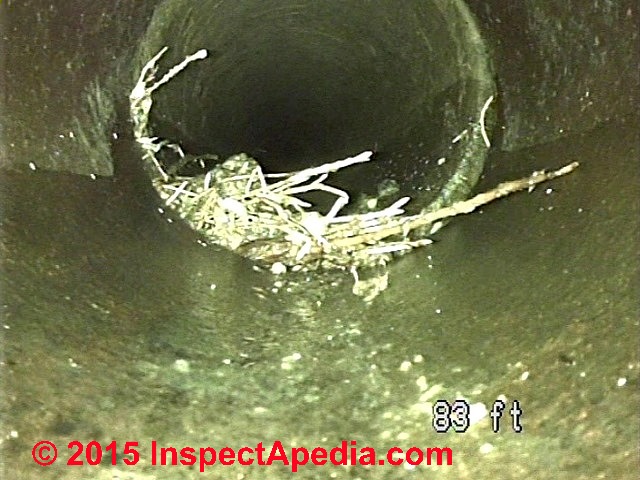
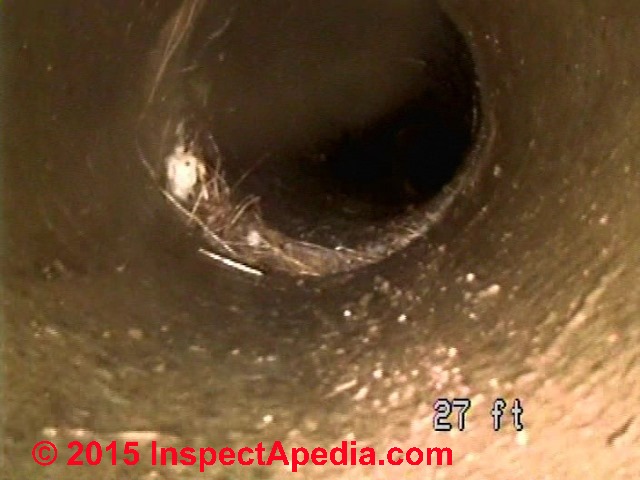
Above: the video camera line inspection shows a modest dislocation in a sewer line pipe joint through which roots are growing.
Even a small root intrusion or pipe joint dislocation can accumulate or block the flow of solid waste leading to slow gurgling drains and ultimately to a complete drain blockage. Our photos above show root invasion at 27 feet and at 83 feet in this buried sewer line in Seattle, WA.
See SEWER / SEPTIC PIPE CAMERAS
Some trees have less aggressive roots and may do less rapid or less extensive damage if they are a bit nearer to septic fields. These include:
- Ornamental trees such as Cherry, Crabapple trees, and Dogwood trees.
- Other trees with less aggressive root systems such as Oak trees (red oak, scarlet oak, and white oak)
- Some Pine trees (but not the Monterey pine) and Sourwoods.
OPINION-DF: Some authors accept the near-septic use of these less aggressive trees with the advice that "... their damage is likely to be less severe". This seems silly to me. Any root clogging of septic systems is likely to be costly and inconvenient.
If you have a shrub for which you have reliable knowledge about the maximum extent its roots will normally reach, you might think it’d be ok to plant it exactly that distance from the nearest drainfield trench.
But I’d be careful: the extra levels of nutrients delivered to the soils by the drainfield may attract roots from nearby trees or shrubs and cause them to travel farther than usual.
OPINION-DF: I’d keep shrubs with a “known” root travel distance at least 25% farther than that "known root travel distance" from the edge of a drainfield.
Guide to Planting Trees near Septic Mound Systems
Some experts (Kahn, Allen, Jones) also point out that if you're planting on the edges and lower toe of a septic mound, those plants need to be able to tolerate the higher moisture levels found in those parts of the mound system.
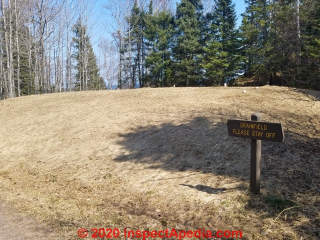
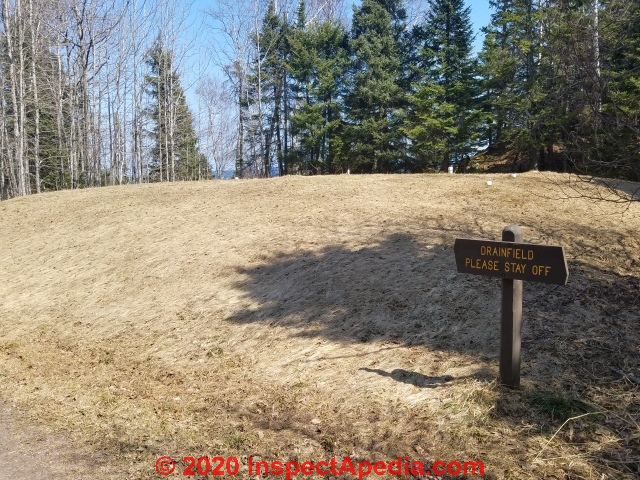
In the photo at the top of this page, our field in northern Minnesota provided ample room to place septic system components more than 100 feet from the nearest tree. But what about those tire track that show up in light snow? Driving over the drainfield can also damage it.
Shrubs or Trees Recommended as Suitable for Planting Over / Near Evaporation-Transpiration Septic Systems
The following table of native (to New Zealand) or introduced species of shrubs and trees lists species that are considered suitable for planting over an evapo-transpiration system and should be acceptable over a mound system or conventional drainfield as well.
Note that other native species local to your area might also be suitable. [3] Separately at Grasses or Flowers we provide a similar table of suitable grasses.
Shrubs or Trees Suitable for Planting Over / Near Evaporation-Transpiration Septic Systems [3] |
||
| Common Name | Botanical Name | Comments |
| Aralia spinosa | Aralia spinosa | Shallow root system, Native in South-Eastern U.S. Common names: devil's walkingstick, prickly ash, Hercules club, angelica tree, prickly elder, pick tree, toothache tree, shotbush Watch out: see Aralia elata in table above. |
| Arborvitae | Thuja occidentalis | Root depth 8 to 24" depending on species; non-aggressive, shallow spreading roots. Might be ok over drainfield trenches more than 24" deep but safer to keep at least 25 ft. away or distance = canopy diameter + 10 ft. . |
| Begonias | Begonia x semperflorens-cultorum | |
| Cabbage tree | Cordyline Australias | fast growing |
| Canna lilies | Canna indica | |
| Cherry | Prunus spp. | |
| Coprosma | Coprosma propinqua | |
| Crabapple | Malus spp. | |
| Dogwood | Cornus spp. | Shallow roots - 3 1/2" |
| Flax | Phormium Tenax | fast growing |
| Fuscia | Fuchsia magellanica | |
| Hebe | Hebe | |
| Heketara | Olearia Rani | |
| Hemlock | Tsuga spp. | |
| Hetz Wintegreen | Thuja occidentalis | 18-24" deep, 5 ft. spread roots |
| Hydrangea | Hydrangea macrophylla | 6" deep, 6' in diameter keep 10 ft. away |
| Kohuhu | Pittosporum Tenufolium | fast growing |
| Lacebark | Hoheria Populnea | fast growing |
| Pokaka | Elaeocarpus Hookerianus | slow growing |
| Rangiora | Brachyglottis Repanda | fast growing |
| Ribbonwood | Plagianthus Regius | fast growing |
| Manuka | Leptospermum Scoparium | |
| Oak, Red, Scarlet, White | Quercus: | Rubra, Coccinea, Alba oaks |
| PhilodendronsPoataniweta | Carpodetus Serratus | |
| Pines | Pinus spp. | |
| Sourwood | Oxydendrum arboreum | |
| Taro | Colocasia esculenta | |
| Weeping mapou | Myrsine Divaricata | |
Notes to the table above
Original sources:
- USDA, U.S. Department of Agriculture Website: https://plants.usda.gov/
- USFS, U.S. Forest Service, Website: https://www.fs.usda.gov/search/node?keys=tree+database
- Kahn, Allen, Jones (book cited at Septic Systems Home-References) point out that certain of these trees such as bamboo, weeping willows, eucalyptus, cypress, Monterey pine, pepper, and walnut have particularly aggressive and deep roots. Keep such trees at least 100 feet from the nearest septic field component.
Watch out: even when trees are listed as OK to plant near a drainfield that NEVER means planting right atop the drainfield, and some of these trees must be kept considerable distance away.
Keep trees at least twice as far from the drainfield as canopy height or twice as far as the tree's expected root spread.
- "Looking after your household sewerage system," New Plymouth District Council, Taranaki NZ, [3]
- Also see GRASSES or FLOWERS ok to plant over septic systems and drainfields or soakaway beds.
Table of Recommended Septic Distances from Trees or Shrubs
Table of Recommended Shrub or Tree Distances from Evaporation-Transpiration Septic Systems [3] |
||
| Common Name | Botanical Name | Recommended Minimum Horizontal Distance to Septic Soakbed or Drainfield |
| Blue Spruce trees | Picea pungens | 50 - 75 feet. Blue sprue roots are shallow, just 2-3" deep,and slow growing, but the roots may extend 2-3 times the diameter of the drip line or the largest diameter of the tree canopy. See Fechner, Gilbert H., BLUE SPRUCE Picea Pungens [PDF] USDA |
| Cherry tree, weeping | Prunus pendula | 25 feet or more; roots may be 24" or deeper |
| Chokeberry Chokecherry |
Prunux virginiana | 25 feet; minor aggressive behavior because of rhizomatous roots |
| Dogwood | Cornus spp. | 25 feet; shallow root system. |
| Dwarf Alberta Spruce trees | Picea glauca 'Conica' | 30 feet |
| Forsythia | Forsythia Vahl | 25 feet |
| Fraser Fir | Abies fraseri | 50 - 75 feet |
| Hazelnut trees | Corylus | 50 feet |
| Honey-Crisp apple tree | Malus domestica | 1.5 x anticipated tree height or about 30 feet for a typical fruit tree, plus safe distance from wind-borne aerobic septic effluent sprays |
| Linden trees | Tilia | 100 feet |
| Oak trees | Quercus | 70 feet |
| Palm Trees | Arecaceae | 25-30 feet (minimum 4 meters) |
| Neem trees | Azadirachta indica | 50 feet or more; deep tap root. |
| Poinciana trees | Delonix regia | 100 feet or more; roots spread horizontally 4-10 feet / year and grow to 10+ feet in depth |
| Redbud trees | Cercis canadensis | 25-30 feet |
| Red Pine / Norway pines | Pinus resinosa | 60 feet |
| Red Spruce trees | Picea rubens | 100 feet |
| Sumac Staghorn Sumac |
Rhus typhina | 75 feet or more; shallow roots (10") but extremely invasive |
| Tamarind trees | Lysiloma latisiliquum | 100 feet |
| Witch Hazel | Hamamelis virginiana | 25-30 feet; some are surface rooting but can spread 20+ feet. Hamamelidaceae. |
Notes to the table above
Also see GRASSES or FLOWERS ok to plant over septic systems and drainfields or soakaway beds
Day provides suggestions for using a root barrier - excerpting:
Another effective, although expensive, technique that may be worth trying is installing a root barrier between your drainage field and tree plantings. Geotextiles, impregnated with a long-lasting herbicide that moves only a short distance in the soil, have been used successfully to restrict root growth in street tree plantings.
To effectively stop tree roots, the barrier should extend from the soil surface to a depth of at least 2 feet.
Some roots may still grow under the barrier, but intrusion into the drain field should be greatly reduced. Install the barrier fabric at least 3 feet from the drain field so as not to disrupt the system. Allow at least 5 feet (the more the better) between the tree and the root barrier - more if it will be a very large tree.
Finally, never encircle the tree with the barrier material; this could effectively containerize your tree and prevent it from thriving. Instead, run the material the entire length of the drain field to prevent roots from getting into the field by going around the barrier.
- Beck, Donald E., FRASER FIR Abies fraseri [PDF] retrieved 2020/04/30 original source https://www.srs.fs.usda.gov/pubs/misc/ag_654/volume_1/abies/fraseri.htm
Excerpt:
The largest tree on record measures almost 86 cm (34 in) in d.b.h., 26.5 m (87 ft) tall, and has a crown spread of 15.8 m (52 ft). Because of the high elevation at which Fraser fir grows, its primary value is for watershed protection and scenic attraction.
- Day, Susan D., and Ellen Silva, PLANTING ON YOUR SEPTIC DRAINFIELD [PDF] Virginia Cooperative Extension, Pub. 426-617, retrieved 2019/08/27 original source: https://www.pubs.ext.vt.edu/content/dam/pubs_ext_vt_edu/426/426-617/426-617_pdf.pdf
- NDSU, CHOKECHERRY [PDF] North Dakot state University, Agriculture & Extension,
NDSU Dept. 7070
7 Morrill Hall, P.O. Box 6050
Fargo, ND 58108-6050 USA, Phone: (701) 231-7881 Website: https://www.ag.ndsu.edu/ndsuag/ retrieved 2020/04/30 original source: https://www.ag.ndsu.edu/trees/handbook/th-3-13.pdf
Excerpt: This small suckering hardy tree or large shrub is nativethroughout North Dakota. Purple-leaved selections are popular landscape plants.
Fruits commonly used for jellies and jams. The largest tree form in North Dakota is 41 feet tall with a canopy spread of 28 feet. - NDSU, STAGHORN SUMAC [PDF] North Dakot state University, Op. CIt.
- PVC, SUMAC CONTROL [PDF] Pleasant Valley Conservancy, State Natural Area, 4609 Pleasant Valley Road Black Earth, Wisconsin 53515 USA, retrieved 2022/08/26 original source: https://pleasantvalleyconservancy.org/sumac.html
- Plumb, Heather, BLACK CHOKECHERRY PLANT FACT SHEET [PDF] USDA, NRCS, retrieved 2020/04/30 original source: https://plants.usda.gov/factsheet/pdf/fs_prvim.pdf
How far from a drain-field should I plant a Honey-Crisp apple tree?
This discussion has moved to TREE or SHRUB DISTANCE FROM SEPTIC FAQs
Reader Comments, Questions & Answers About The Article Above
Below you will find questions and answers previously posted on this page at its page bottom reader comment box.
Reader Q&A - also see RECOMMENDED ARTICLES & FAQs
Question: how do we get rid of Japanese knotweed growing near our septic mound system?
 We live in Vermont, USA. A local company installed a new Presby mound septic system at our home in the country last summer. Two weeks after construction was complete, Japanese knotweed plants began to sprout on the one acre septic site.
We need to talk with a UK engineer about the potential impact that knotweed roots can create.
Please contact me with information. It appears that the UK has lots more experience with this invasive than the US does.
Thank you.
Winton Goodrich - winton.goodrich@gmail.com - 2023-01-03
This Q&A were posted originally
at U.K. OFF-GRID SEPTIC REGULATIONS & SEWAGE SYSTEMS
Moderator reply:
@Winton I Goodrich,
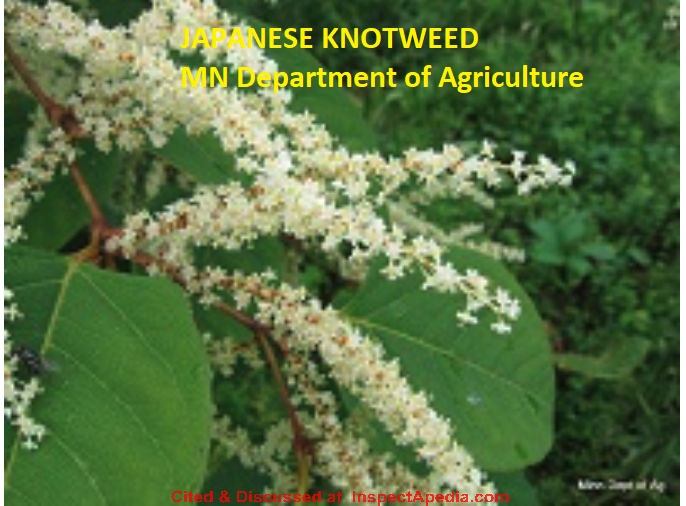
Photo above: Japanese knotweed flowers & leaves, photo by the Minnesota Department of Agricultyure, cited herein.
Thank you for your question about Japanese knotweed of which we need to do further research. And yes, you are correct in being concerned about the impact of an invasive species on your septic system and drainfield.
Knotweed is an invasive species that has a rhizome root system that can grow 6 feet down into the soil - easily ruining a septic drainfield. It is a plant that's difficult to eradicate.
In the UK, according to Schedule 9 of the Wildlife and Countryside Act (1981), it is considered an offence to cause Japanese knotweed to grow in anywhere, especially in the wild. This means that property owners have responsibility in controlling and managing the spread of this weed. - japaneseknotweedspecialists [dot] com 2023-01-03
In the UK the government describes several means of control of Japanese Knotweed:
- Chemical treatment (requires licensing, permits, special disposal etc)
- Burying (requires notification of the Environment Agency at least a month in advance)
- Burning (requires notification of the Environment Agency and other local agencies & permits)
- Hiring a company specialising in treating knotweed
- Disposing of removed knotweed offsite at an approved location
- Watch out: do not mow Japanese knotweed. Cutting or mowing has been found to be ineffective and may, in fact, make ultimate removal of this plant even more-difficult as its rhizome root system will continue to spread and to grow more-deeply into the soil. (Jones 2020)
We will research this topic further but in the meantime, if you are wanting contact information for a UK resource that you can ask questions of, please see the references given below.
Japanese Knotweed Control
- Child, Lois, and Max Wade. The Japanese knotweed manual: the management and control of an invasive alien weed. Packard Publishing Ltd, 2000.
- HOW TO STOP JAPANESE KNOTWEED FROM SPREADING [PDF] (2016) - retrieved 2023/01/03, original source: www.gov.uk/guidance/prevent-japanese-knotweed-from-spreading
an informative article from the UK Environmental Agency that includes their contact information. Reviewing this article's information would be a good starting place for you to learn more about knotweed.
Excerpts:
Japanese knotweed is the most common of 4 invasive knotweed plant species in the UK. These are:
Japanese knotweed
Dwarf knotweed
Giant knotweed
Bohemian (hybrid) knotweed - Jones, Daniel, Mike S. Fowler, Sophie Hocking, and Daniel Eastwood. PLEASE DON’T MOW THE JAPANESE KNOTWEED! [PDF] NeoBiota 60: 19–23. https://doi.org/10.3897/neobiota.60.56935
- Jones, Daniel, Gareth Bruce, Mike S. Fowler, Rhyan Law-Cooper, Ian Graham, Alan Abel, F. Alayne Street-Perrott, and Daniel Eastwood. "Optimising physiochemical control of invasive Japanese knotweed." Biological Invasions 20, no. 8 (2018): 2091-2105.
- MNDA, JAPANESE KNOTWEED [PDF] (2023) Minnesota Department of Agriculture, retrieved 2023/01/03, original source: https://www.mda.state.mn.us/plants/pestmanagement/weedcontrol/noxiouslist/knotweed# - Rhizomes and roots can grow,with more heart shaped bases.
Excerpts:
Japanese Knotweed Prevention and Management
- Do not plant knotweed as an ornamental and eradicate any existing plants from your property.
Do not move soil that may contain knotweed rhizome fragments to uninfested areas. A sound management plan is necessary to manage this species and will take a commitment of several years to ensure that the population has been eliminated.
- Foliar and stem injection application of herbicides that translocate their active ingredients into the root system can be very effective.
Treatments will need to be repeated for several years to eradicate a population.
If using herbicide treatments, check with your local University of Minnesota Extension agent - www.extension.umn.edu/offices/ , co-op, or certified landscape care expert for assistance and recommendations.
There are several businesses throughout the state with certified herbicide applicators that can be hired to perform chemical applications. Japanese knotweed also grows commonly in riparian and wetland habitats.
If treating plants near water with herbicide, please be aware of the state pesticide laws - www.mda.state.mn.us/pesticide-fertilizer/pesticide-use-sales-datawww.mda.state.mn.us/pesticide-fertilizer/pesticide-use-sales-data - and use only products labeled for aquatic use. - Do not cut or mow knotweed. Cutting or mowing increases spread and can stimulate growth. Bending stems out of the way can be useful if knotweed blocks pathways.
- Always clean and inspect equipment after working in an infested area to prevent transport of plant fragments and seed to new areas.
- Do not plant knotweed as an ornamental and eradicate any existing plants from your property.
- KNOTWEED LIFECYCLE & TREATMENT TIMING [PDF] - original source: bugwoodcloud.org/mura/mipn/assets/File/Educational%20Resources/Knotweeds%208_5x11%20(locked).pdf
- UK Japanese Knotweed Specialists, "Japanese Knotweed Roots: What's the Big Deal", [private company, Web: japaneseknotweedspcialists.com UK Tel: 0800 122 3326] - retrieved 2023/01/03, original source: www.japaneseknotweedspecialists.com/news/japanese-knotweed-root
On 2022-02-21 y Kendell S
@Inspectapedia Com Moderator, Thank you for your response and recommendations.
On 2022-02-21 by Inspectapedia Com Moderator (mod) - keep Elaeagnus away from the drainfield
@Kendell S,
From what I've read Elaeagnus has both a deep tap root and a spreading more-shallow root system. You should not plant this over your drainfield nor close to it. Normally we keep such plants well away from the septic drainfield - a distance greater than the expected canopy diameter which often predicts the minimum horizontal roof spread.
The plant is said to grow to > 9m in height and at least 4 ft or 1.3m wide and are usually kept 3m or more apart even from one another.
That planting separation recommendation you'll find at various plant sites for Elaeagnus would say your plants need to be 9 ft. apart and I'd figure for safe avoidance root invasion of your septic field you'd want plants no closer than 10-12 ft from the edge of the drainfield.
My reasoning is the experience that the high concentration of nutrients in septic effluent act as a sort of magnet that can attract the roots plants from greater than normal plant root horizontal or vertical distance.
On 2022-02-21 by Kendell S
How safe are Elaeagnus for a privacy shield say 6 feet apart over or near my septic drain field which distributes pumped effluent?
On 2022-02-12 by Inspectapedia Com Moderator (mod) - how to remove trees over the septic field
@Jill S,
Sorry, you're both right to ask for clarification of my earlier reply.
You can remove the trees if you like - saw down, cut up, carry away.
Leaving tree roots (and stumps) won't in and of itself cause trouble.
If roots are already in the drainfield piping then they're already causing trouble, dead or alive - by clogging the system and reducing its capacity - that's why I suggested a sewer line cam inspection.
Left in place tree roots and tree stumps of many species will ultimately begin to grow anew - so you haven't necessarily "killed" the trees and you might still in the future see a root invasion problem.
Watch out: driving heavy equipment over the fields such as a stump grinder or a truck to pick up tree parts can compress soil or collapse a drainfield line - damaging the system
On 2022-02-12 by Jill S
My husband and I interpreted your response differently. If we would like to remove a few pear trees, should we be concerned that it might negatively impact the septic leach field?
On 2022-02-11 by Inspectapedia Com Moderator (mod) - Ornamental Bradford Pear over the septic?
@Jill S,
Ornamental pears like the Bradford tend to have shallow roots: perhaps you've been lucky and they haven't invaded your septic drainfield.
Why not have a sewer line camera inspection of the leach lines: if you see they are root free you might stop there.
On 2022-02-11 by Jill S
We live in North Carolina and our septic system is almost 20 years old. There are ornamental pear trees and holly trees planted over the leach field. The pear trees are now three stories tall.
We have not had any problems with the septic system and are not sure if it’s better to just leave the trees or cut them down?
In particular, if we remove the trees and the roots have invaded the septic field could this cause problems when the roots start to decompose? Thanks, Jill
On 2022-01-24 by Inspectapedia Com Moderator (mod) - Yucca root system is invasive
@BRIAN RASMUSSEN,
The root system for Yucca plants are invasive, aggressively-seeking water (and storing it too), combined of a shallow root system seeking water and a deeper tap-root.
I've found that "normally-shallow" root systems will be attracted to a drain line if there are openings (hub type older drainfield pipes) and will absolutey be attracted to the drainfield trenches of septic systems.
So you'd want to keep such plants 2-4 x the plant's canopy size diameter away from the drainfield. 20-30 feet or more may be safe.
See details in this
- YUCCA PLANT INFORMATION GUIDE - USDA [PDF] USDA, retrieved k2022/01/24 original source: www.nrcs.usda.gov/Internet/FSE_PLANTMATERIALS/publications/nmpmcrb12162.pdf
On 2022-01-24 by BRIAN RASMUSSEN - Adams Needle yucca variety damaging to drain pipes and septic systems?
Are Adams Needle yucca variety damaging to drain pipes and septic systems? Thanks, Brian
On 2021-12-19 by Inspectapedia Com Moderator (mod) - Kelsey fools InspectApedia editor
 @Field Inspector K-Sneak,
You did a GREAT JOB KS - by working by hand and carrying off the cut-up logs from the septic mound.
That means you didn't drive heavy equipment over the mound system.
Now as long as there was no evidence that the tree-fall broke a pipe - which from your photos and our onsite inspection seem to be the case,
and as long as the remaining end of that big tree is not on any part of the constructed septic mound, you can leave the rest of it alone if you like.
That sawdust won't hurt a thing - it's only of cosmetic import - because of its limited thickness and because it's spaced out. (You would not want to pile many inches of sawdust or any other compost atop the mound) as in too much thickness you might interfere with transpiration or with the availability of oxygen to the aerobic bacteria in the soil top layers.
On 2021-12-19 by Field Inspector K-Sneak
@inspectapedia.com.moderator,
Update on the tree that fell across our septic mound system:
As you can see in my photo, I got that nasty old chain saw working an cut the tree into short segments that I could carry off of our septic moun.
I stopped cutting back the fallen-tree once I had removed everything back to the bottom edge of the mound.
1. Is it OK for me to leave that sawdust on the septic mound or might it cause a mold problem?
2. Is it OK for me to leave the rest of the tree in place?
On 2021-12-19 by Inspectapedia Com Moderator (mod) - How far away should I plant elderberry trees from my septic system?
@Ericka Johnejack,
Elderberry trees have a shallow roots system but can grow rapidly and are known as being invasive.
You would want the tree to be no less than a distance from the septic drainfield that is equal or even better, greater than the diameter of the tree canopy.
These are trees that could grow to 30 ft. tall and 20 ft. in diameter.
It'd be smart to keep them 25 feet from the septic field.
On 2021-12-18 by Ericka Johnejack
Hi! ¿How far away should I plant elderberry trees from my septic system? Thanks so much.
On 2021-07-29 by inspectapedia.com.moderator (mod)
ames and other readers, except Field InspectorK,
Please find your recently-posted question(s) or comments along with our reply now at the Reader Q&A section in the article above on this page. You may need to clear or refresh your browser cache to see the updated page. We welcome your further photos, comments, questions.
FIK: we have also copied your helpful photo and our discussion of tree falls onto septic mound to
MOUND SEPTIC SYSTEMS inspectapedia.com/septic/Septic_Mound_Design.php and welcome any further questions, comments, suggestions.
You might want to compare the still-standing tree at the left of your photo with the trees at left in the page top photo found on that page.
On 2021-07-29 by inspectapedia.com.moderator (mod)
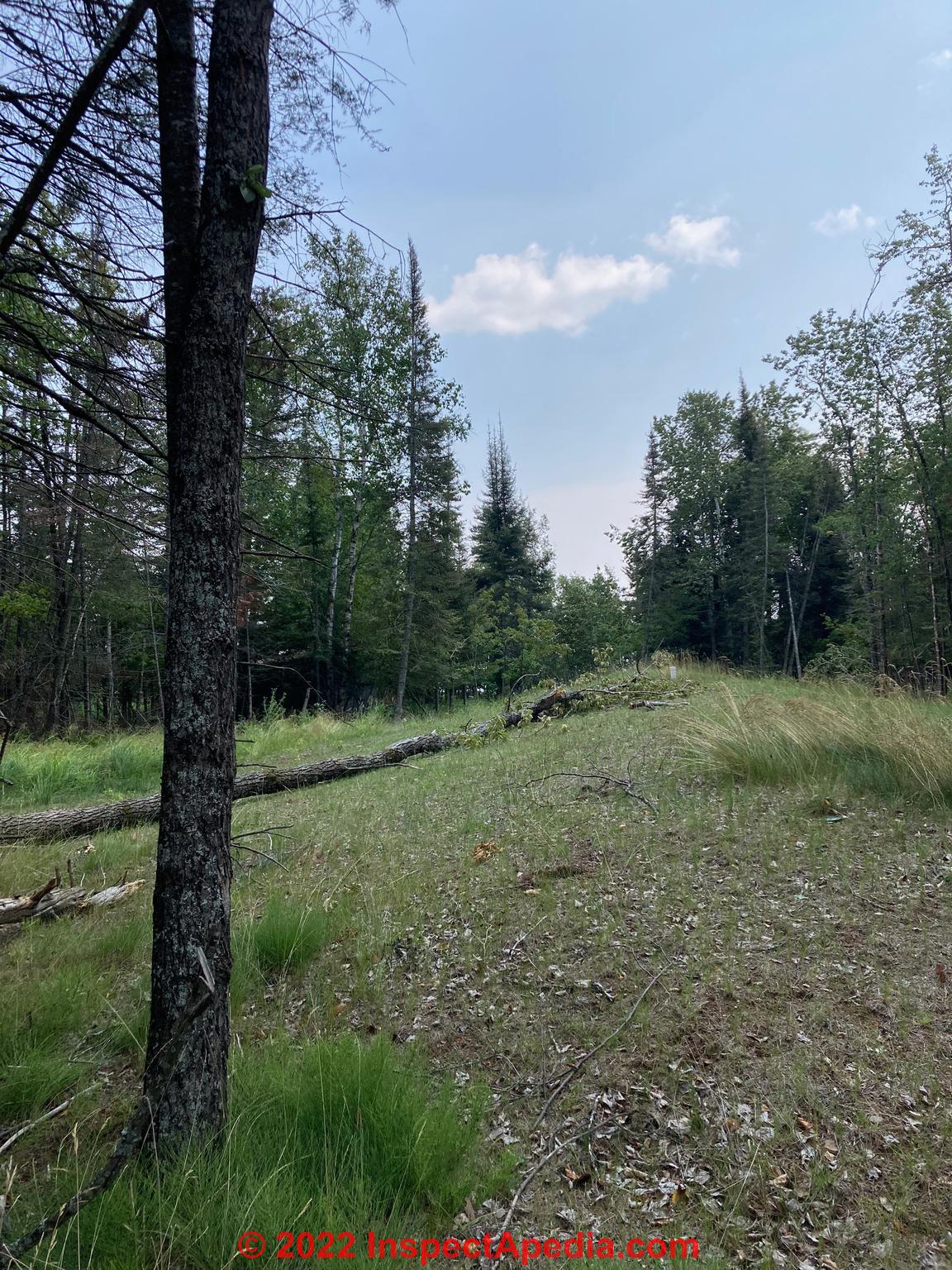 @Field Inspector K,
In my opinion, while it's not an emergency, you should clear fallen tree(s) from the septic mound for several reasons:
1. you can then inspect to be sure that no tree branch punctured and damaged one of the effluent lines - you'd want to repair that. Look for branches that speared into the soil, especially along the more-flat top of the mound area. Normally inspection ports will mark the location of each line.
2. you want to avoid further soil compression
3. you want to avoid the development of runoff channels that might over time erode the mound soil cover
but
Watch out: don't let some heavy handed bloke drive his backhoe or other heavy equipment over the mound for any reason, including tree removal, as doing so risks compressing the soil and damaging the mound.
Thanks for the helpful question and photo - we'll move this discussion to
MOUND SEPTIC SYSTEMS https://inspectapedia.com/septic/Septic_Mound_Design.php and welcome any further questions, comments, suggestions.
On 2021-07-29 by Field Inspector K
A medium-large tree fell on top of the septic mound system during a recent storm. Should I worry about it lying there? Would it damage the septic mound to just leave it there? It's too large for me to move by myself.
[Photo above - Ed.]
On 2021-07-19 by mak.church (mod)
@James in Ohio,
As noted in the above article, keep trees at a distance of at least the expected height of the tree.
Watch out: Since white pine can grow to 80+ feet, your 28 feet is too close. “Keep at least as much distance between the tree and the nearest drainfield component as the anticipated height of the tree at its maturity.”
On 2021-07-19 by James in Ohio
Are White Pines planted within 28 feet of drain field okay? I am not sure how deep my drain bed is, but it was installed new in 2019.
On 2021-04-28 - by (mod) -
@phyllis,According to gardenguides.com a Leyland Cypress has roots that are small and very shallow, staying close to the surface of the soil. Additionally, the spread of the roots is minimal, especially for such a large tree.
Still you would want the tree to be no less than a distance from the septic drainfield that is equal or better, greater than the diameter of the tree canopy.
These are trees that can grow to 40 ft. tall and 20 ft. in diameter.
It'd be smart to keep the 25 feet from the septic field.
So what can you expect?
At 5 feet distance, and considering the appeal of sewage effulent as a plant nutrient that draws roots, I would not expect the trees to behave themselves nor to keep out of the septic field piping
On 2021-04-28 by phyllis
What can be expected in regard to leyland cypress tress planted near a septic drainfield? they are less then five feet away
On 2021-04-01 - by (mod) -
@Kim Smith,Arborvitae roots are fairly shallow, ranging, depending on the Arborvitae species, from 8" deep to 24" deep; I SUSPECT, but don't know, that these "standard" root depths might actually not be obeyed by any plant growing over a septic drainfield where there may be an attractive nutrient in the soil, but that's the best data we've got.
So if your Arborvitae bushes are over a field where the drainfield trench tops are less than 24" deep in the soil, you'd not want to plant these over the soakaway area.
On 2021-04-01 by Kim Smith
Can Arborvitae bushes be planted along a septic field?
On 2020-10-01 - by (mod) -
DsveLilac Bush roots generally go to an 18" to 24" depth in soil and will spread horizontally roughly one and a 1/2 times with of the plant.
I have not seen an authoritative source on this but in my opinion it would be safest to keep your lilacs 10 to 12' away from the drainfield.
On 2020-09-30 by Dave
I am curious about planting lilacs Over a septic field. I have to take down a number of trees where the field is going in and want to do some replacement planting this fall. I was hoping it would be safe to plant some bulbs, lilacs and other shrubs this fall, and then perennial wildflowers in the spring.
On 2021-06-05 by Morris - spruce trees clogging the septic drainfield lines?
@Elmer,
Hi Elmer. It's pretty unlikely that your trees have a tap root that could reach 10' into the ground! Blue spruce isn't normally a deep rooter, it's more of a spreader.
Most plants are spreaders since the surface of the soil is where the water and oxygen come from (roots take up O2). That said, septic systems where I live in central NC are not buried 10' in the ground - are you sure yours is that deep?
Most septic systems in these parts are only about 18 inches from the soil surface. Generally speaking the vast majority of tree roots are close to the soil's surface (within a foot) though some will go deeper, and easily 18" deep, especially if there's a convenient water source down there.
I sincerely doubt that the roots are burrowing down 10' though. I taught horticulture for a few decades and my thoughts are in line with all I have read as well as all the trees I've seen ripped out of the ground during our all too frequent hurricanes. Just for future reference - root SPREAD is an all together different story - assume 3x the width of the canopy. Best, Morris
On 2020-09-27 by (mod) - are these spruce trees clogging the septic drainfield lines?
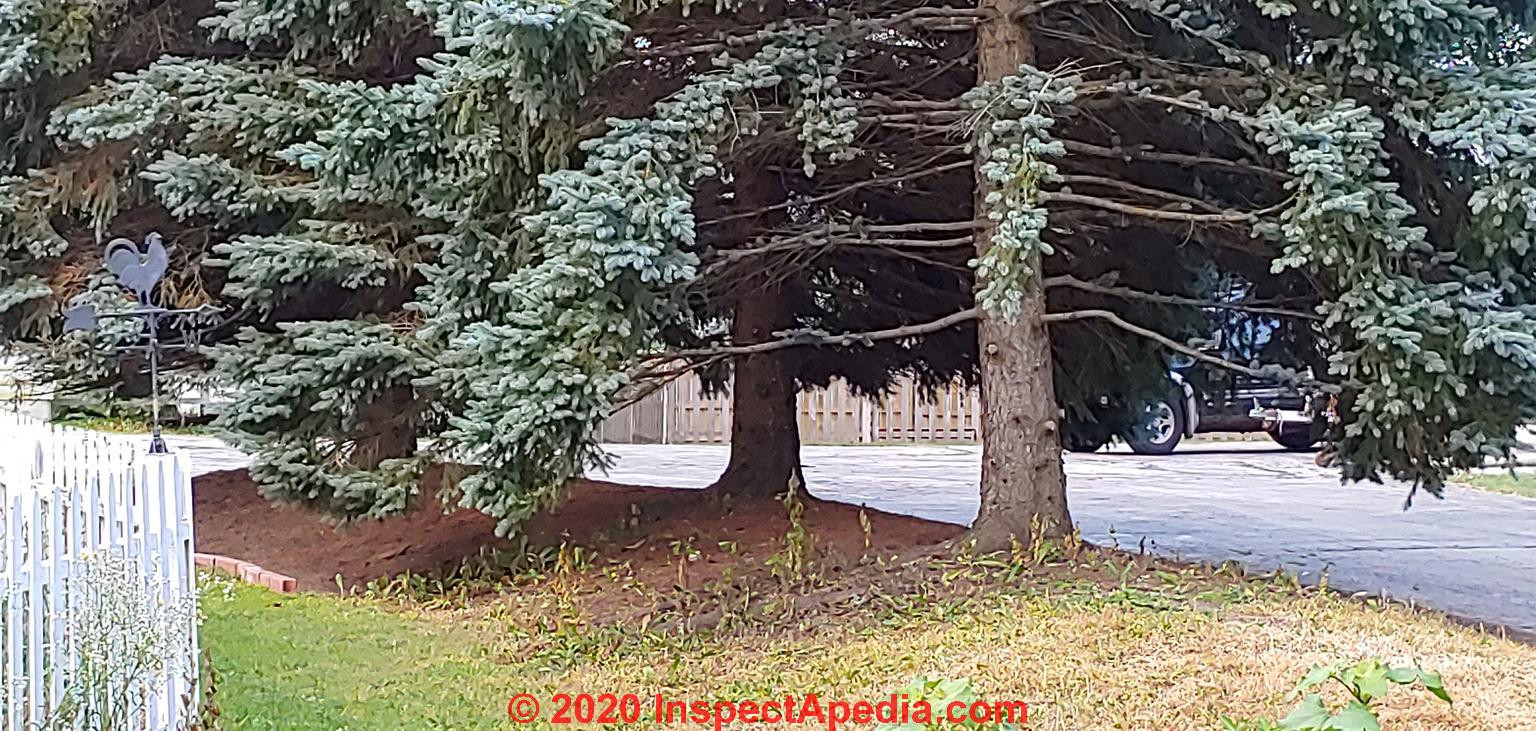 Elmer
Elmer
Spruce tree root depth, shape, and septic system invasion.
Spruce tree roots are typically rather shallow, moving mostly at an 18" depth from the soil top. The larger flare roots, some visible at the tree boles in your photo, will reach out about as far as the diameter of the tree canopy.
From your own information it is nevertheless possible that some finer roots may be attracted to the nutrients found in septic system effluent and therefore it's possible that your lovely spruce trees have roots have invaded and will continue to invade the septic system.
From your photo I see and speculate:
- Watch out: The weight of trees or the weight of equipment that may need to drive close to the trees to maintain them or some-day remove-them risks drainfield damage even if the tree roots themselves are not going to reach the depth of your drainfield piping
- The total area in your photo looks awfully small for a functional septic effluent disposal system
- If your drainfield piping is really 10 feet deep in the soil, it may be successfully disposing of sewage effluent but the effluent treatment, reduction of pathogens, will be limited by lack of bacteria, increasing risk of contaminating nearby waterways or wells.
Happily this question is pretty easy to answer without having to rely on speculation.
Hire a plumber or septic contractor who can provide a sewer line camera.
Find the D-box or distribution box for your drainfield piping.
How to do that is at SEPTIC D-BOX LOCATION
Use the camera to scope or inspect each of the drainfield lines.
Because there are no other shrubs, plants, trees near your drainfield other than these spruce trees, if your inspector confirms that the drainfield lines are root-clogged, regrettably we know the culprit.
I would not consider cutting down these trees before we have that definitive answer.
Unfortunately, with the trees in place, when your drainfield needs replacement you will have two options:
1. remove the trees AND their roots and stumps, and install new septic drainfield in that location
or
2. if your property has space, install he new drainfield to another spot.
Thanks for a helpful question.
On 2020-09-26 6 by Elmer
We have several Blue Spruce [trees - photo above ] (could be Colorado Spruce, but cannot be sure) planted over top our six inch sewer line.
Several plumbers have told us these roots are invading our line, plugging it, and must be cut down to avoid further damage. A neighbor says Blue Spruce are shallow roots and are not invading the line. The trees are between 25 an 35 feet tall and stand on a mound directly over the line ten feet under the trees.
On 2020-06-25 - by (mod) -
Thanks for asking Chris and forgive the COVID-19 delayed reply
TreeLogic tell us that about root space for Prunus Cerisfera Nigra)
Based on a mature size specimen of ‘Nigra’ would require approximately 20m2 area or 12m3 root volume (crown projection method). - https://treelogic.com.au/
With a typical canopy spread as a mature tree of 13 ft., if you keep your Blossom Tree 15 feet or more away from the septic drainfield and any septic piping or tank(s) you should be OK.
On 2020-06-10 by Chris O Connor
How far away should I plant a blossom tree (Prunus Cerisfera Nigra) from my concrete septic tank that was put in 10 years ago ? I have a spot in the garden that's 23 foot from the septic tank..Any advice that you can give me would be very welcome ?
On 2020-06-06 - by (mod) -
You'll probably kill the pines, Anon, but that doesn't tell us whether or not there's already root damage.
On 2020-06-05 by jim (previously anonymus
I forgot to say, they are about 5-7 years old and I believe are white pine. I think their roots are shallow but, still think they should go>?
On 2020-06-05 by Anonymous
I have scrub pines growing directly over my septic field. If I cut them off at the ground, will I kill them or will the root keep growing.?
On 2020-04-29 - by (mod) -
Mike,
According to the USDA, the Fraser fir (Abies fraseri (Pursh) Poir.) has these properties, upon which I base an OPINION about a reasonably safe distance from drainfield at the conclusion of this remark.
Rooting Habit- The root system of Fraser fir is usually shallow because it customarily occupies shallow soils. Root growth is more rapid and rooting depth greater, however, than that of its frequent associate, red spruce (8). - source: USDA, www.srs.fs.usda.gov/pubs/misc/ag_654/volume_1/abies/fraseri.htm 2020/04/28
Watch out: from that text one could infer that planted near a septic system the Fraser fir may send roots deeper than in its usual shallow soil habitat, thus invading the leach field.
While a Fraser fir will grow slowly when it is seeded under dense foliage, out in the open and with deeper soil available it may grow faster and larger than you'd guess. The largest recorded Fraser fir crown diameter was 52 ft.
I would keep the Fraser Firs no less than 1.5 x the usual canopy diameter of a mature tree, safer would be 2X that distance or more.
Considering that a Fraser fir can live for 150 years, yours will out-live your septic system. But over the course of 20 - 40 years it'd be smart to keep such trees 50 to 75 feet from the drainfield.
Thank you for asking
On 2020-04-28 by Mike
I’m wondering how far away fraser fir trees should be from a leach field?
On 2019-12-16 by Anonymous
Helana thanks for asking about Forsythia or Chokeberry near a septic field.
The answer depends on plant root depth.
Forsythia roots include a tap root that can go several feet into the soil - best kept off of a drainfield.
https://www.ag.ndsu.edu/trees/handbook/th-3-13.pdf says that Chokeberry roots are shallow (and "suckering") so possibly ok over septic systems.
On 2019-12-15 by Helana
Are forsythia and chokecherry bushes ok near water/septic lines or will their roots cause a problem?
On 2018-08-14 - by (mod) -
Frances
Now that you are connected to a public sewer and your septic system has been abandoned you can plant whatever you want.
On 2018-08-13 by frances
septic tank broken up and city sewer lines installed five years ago. What flowering bush can be planted in that area with shallow roots such as a snowball bush or azalea
...
Continue reading at ROOT KILLERS in SEWER LINES or SEPTIC PIPES or select a topic from the closely-related articles below, or see the complete ARTICLE INDEX.
Or see TREE or SHRUB DISTANCE FROM SEPTIC FAQs - questions & answers posted originally at this article
Or see these
Articles on Plants & Grasses On or Near Septic Systems
- PLANTS & TREES OVER SEPTIC SYSTEMS
- ROOT KILLERS in SEWER LINES or SEPTIC PIPES
- SEPTIC DRAINFIELD FAILURE CAUSES
Suggested citation for this web page
TREES or SHRUBS OVER THE SEPTIC FIELD or TANK at InspectApedia.com - online encyclopedia of building & environmental inspection, testing, diagnosis, repair, & problem prevention advice.
Or see this
INDEX to RELATED ARTICLES: ARTICLE INDEX to SEPTIC SYSTEMS
Or use the SEARCH BOX found below to Ask a Question or Search InspectApedia
Ask a Question or Search InspectApedia
Try the search box just below, or if you prefer, post a question or comment in the Comments box below and we will respond promptly.
Search the InspectApedia website
Note: appearance of your Comment below may be delayed: if your comment contains an image, photograph, web link, or text that looks to the software as if it might be a web link, your posting will appear after it has been approved by a moderator. Apologies for the delay.
Only one image can be added per comment but you can post as many comments, and therefore images, as you like.
You will not receive a notification when a response to your question has been posted.
Please bookmark this page to make it easy for you to check back for our response.
Our Comment Box is provided by Countable Web Productions countable.ca
Citations & References
In addition to any citations in the article above, a full list is available on request.
- "Planting Over Septic System Components", Daniel Friedman (author/editor, InspectAPedia.com), The Innovator, Winter/Spring 2008, BCOSSA, British Columbia OnSite Sewage Association, 201-3542 Blansard St., Victoria BC V8X 1W3 Canada
- "Planting on Your Septic Drain Field", Susan D. Day, Extension Associate; Ellen Silva, former Extension Technician; Horticulture, Virginia Tech. publication Number 426-617, Posted December 2000, published by the Virginia Cooperative Extension
- [3] "Looking after your household sewerage system," New Plymouth District Council, Taranaki NZ, newplymouthnz.com, retrieved 4/4/13, [copy on file as Septic_Maintenance_Taranaki_NZ.pdf]
- Indicator organisms, testing for sewage contamination in buildings Aerotech Labs
- [1] "The Virtual Nature Trail at Penn State New Kensington", the Pennsylvania State University, 2002, web search 04/30/2011 original source: http://www.psu.edu/dept/nkbiology/naturetrail/speciespages/redpine.htm
- [2] "Main Tree Species Fact Sheet: Red Spruce (Yellow Spruce, West Virginia Spruce, Eastern Spruce, He-Balsam" Picea rubens, The Maine Tree Club, University of Maine, http://extension.umaine.edu/mainetreeclub/FactSheets/even-year-htm/RedSpruce.htm
- [3] "Vitality and chemistry of roots of red spruce in
forest floors of stands with a gradient of soil
Al/Ca ratios in the northeastern United States",
Philip M. Wargo, Kristiina Vogt, Daniel Vogt, Quintaniay Holifield, Joel Tilley,
Gregory Lawrence, and Mark David", NRC Research Press, NRC Canada 2003. The relationship between the root area (and vitality) and tree crown area is complicated by soil chemistry and other factors and may be more difficult to guess by rule of thumb. - http://www.nrcresearchpress.com/doi/pdf/10.1139/x02-195 - In addition to citations & references found in this article, see the research citations given at the end of the related articles found at our suggested
CONTINUE READING or RECOMMENDED ARTICLES.
- Carson, Dunlop & Associates Ltd., 120 Carlton Street Suite 407, Toronto ON M5A 4K2. Tel: (416) 964-9415 1-800-268-7070 Email: info@carsondunlop.com. Alan Carson is a past president of ASHI, the American Society of Home Inspectors.
Thanks to Alan Carson and Bob Dunlop, for permission for InspectAPedia to use text excerpts from The HOME REFERENCE BOOK - the Encyclopedia of Homes and to use illustrations from The ILLUSTRATED HOME .
Carson Dunlop Associates provides extensive home inspection education and report writing material. In gratitude we provide links to tsome Carson Dunlop Associates products and services.
 | HOME | ABOUT | ASK a QUESTION | CONTACT | CONTENT USE POLICY | DESCRIPTION | POLICIES | PRIVACY | |
| © 2024 - 1985 Publisher InspectApedia.com - Daniel Friedman | |||||||||