
InspectAPedia® FREE Encyclopedia of Building & Environmental Construction, Diagnosis, Maintenance & Repair |
Question? Just ask us! InspectAPedia
|
 Clay Tile Roof Inspection & Installation Details
Home page
- POST a QUESTION or COMMENT about clay tile roof installation, maintenance, inspection & repairs
Clay tile roofs: types, sources, inspection, repair, sources & suppliers.
This article series explains clay tile roofing types, clay roofing tile inspection, tile roofing diagnosis, & tile roof repair.
In this article series we describe the types of clay roofing tiles, clay tile roof life expectancy, and clay tile roof installation details. S-style Clay & Flat Rectangular Tiles and Tapered & Barrel Mission Tiles as well as other clay tile forms, shapes, and history are discussed.
Photographs of types of clay tile roofs in the U.S., Korea, Norway, Mexico and other countries, Clay tile roof inspection, failures, repair, product defects, Roof inspection, leak detection, roof diagnosis, roof repair, Key design details & references for clay roofing tiles, Duralita & other clay roof tile alternative products, Sources of clay roofing tiles, clay roof tile manufacturers' list.
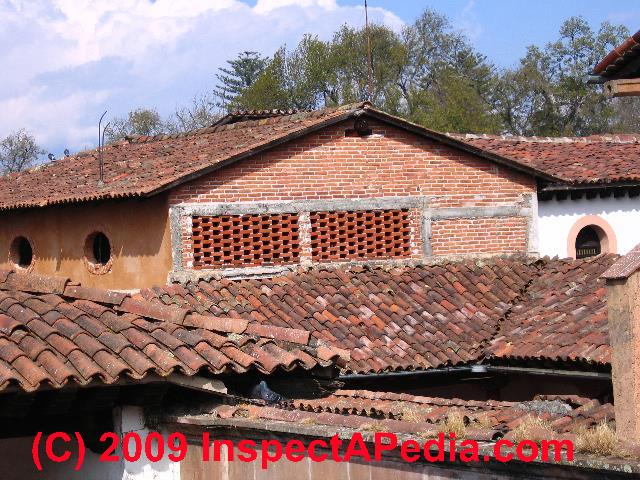
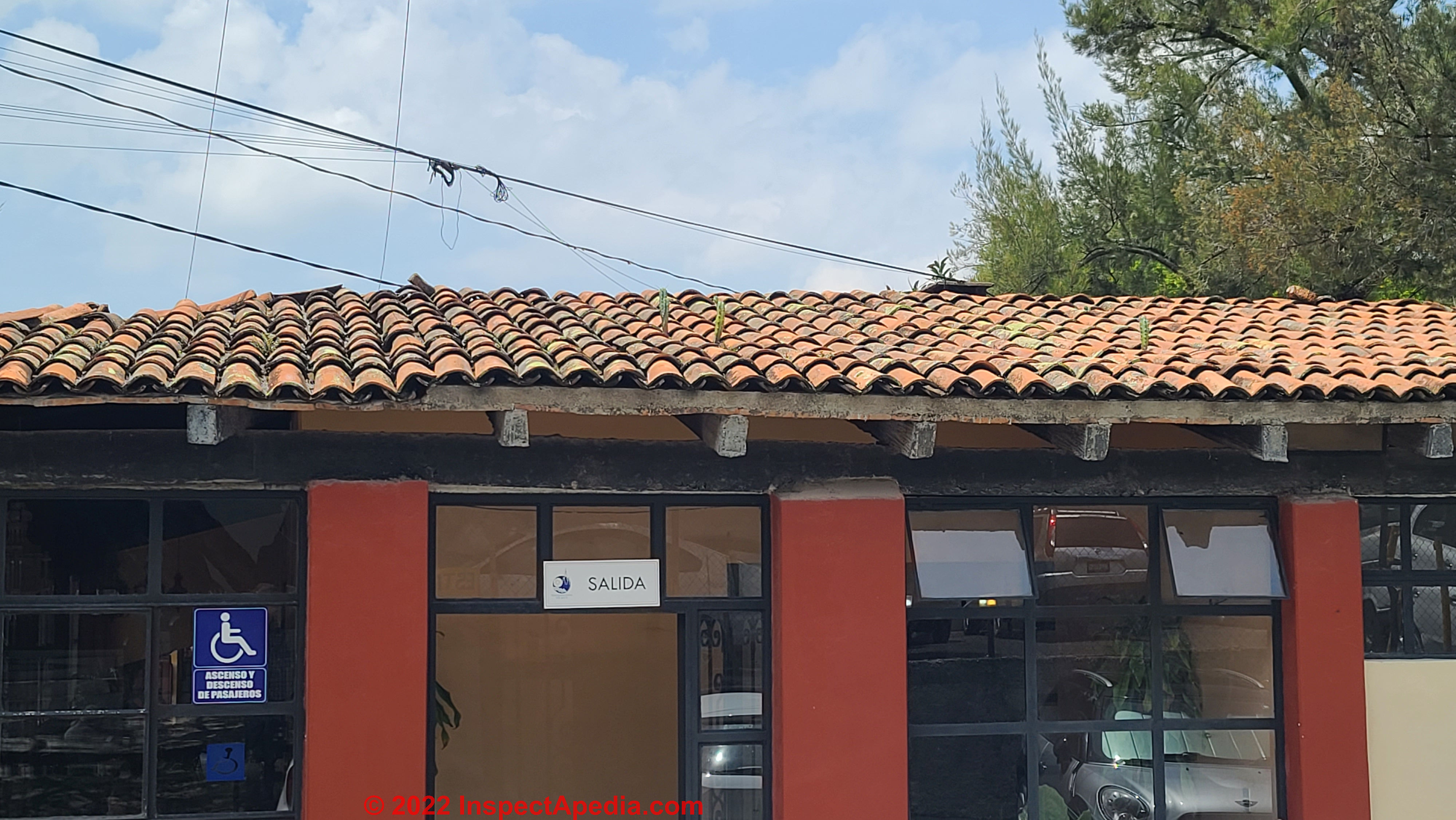
Our page top photo shows clay roofing tiles installed in Patzcuaro, Mexico. Clay roofing tiles have been used in Europe, the Middle East, and Asia, since the Greek and Roman Empires, and the Americas since Europeans arrived there.
Clay tile roofing material is costly to purchase and install, but it can have an indefinite life expectancy.
InspectAPedia tolerates no conflicts of interest. We have no relationship with advertisers, products, or services discussed at this website.
Clay Roofing Tile Types, Patterns, Installation, Inspection & Repair Guide
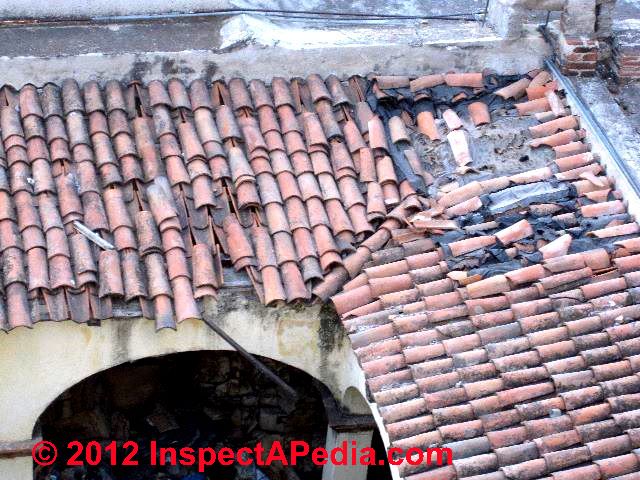 Real clay tile roofs compared with cosmetic clay tile roofs:
The clay roof tile systems we discuss in this article series are "real" clay tile roofs on which the tiles themselves are intended to provide the water shedding and drainage necessary to form a dry covering over a building.
At left the very damaged clay tile roof depended on the tiles themselves to carry away rainfall.
But other roofs use clay tiles to protect a waterproof underlayment from sun and for aesthetic reasons.
Such "cosmetic" clay tile roofs are commonly installed in some areas (Boca Raton, Florida) over a completely functional waterproof membrane.
Cosmetic clay tile roofs also protect the roof membrane from deterioration from sunlight, but the tiles themselves are not forming the waterproof covering.
Just below we give a history of clay roof tile use around the world. You will see that clay roofing tiles have an ancient history and a record of serving as a durable roofing material.
A Little History of Clay Roofing Tiles in the U.S. & Other Countries
 Clay roof tiles have been used since Roman times, are still widely used in Europe, Asia, throughout North America as well.
Our photo (Daniel Friedman, Seoul Korea, 1966) shows decorative clay roofing on Yongnyong-jon hall, a Korean shrine forming part of the oldest shrine in Korea Jeongjeon, the Jongmyo Confucian shrine constructed by King Jaejo beginning in 1394.
Koreans believed that the royal spirits achieved peace only after their tablets were brought here from Chongjon. Thus, Chongjon enshrined the souls still roaming the earth, while Yongnyong held those who had achieved eternal rest.
As NPS historic preservation expert Sweetser points out,
European settlers used clay tile for roofing as early as the mid-17th century; many pantiles (S-curved tiles), as well as flat roofing tiles, were used in Jamestown, Virginia.
In some cities such as New York and Boston, clay was popularly used as a precaution against such fires as those that engulfed London in 1666 and scorched Boston in 1679.
Wikande (1990) reports on the spread of popular use of clay roof tiles by studying clay roofs dated from 700 to 600 B.C.
Other expert discussions detail of the manufacture of clay tile roofs in Greece are dated to the 7th century B.C. (Sapirstein 2009).
Pan-type and S-profile clay roof tile shapes are perhaps the oldest known, dating back at least to 3000 BC in Greece.
Similar clay roof tile styles were used in China as well as in the Roman empire. Roman terms for this roof tile shape include imbrex and tegula.
Even older durable roof coverings were made of slate and of flat slabs of stone.
Tile roofs found in the mid-18th century Moravian settlements in Pennsylvania closely resembled those found in Germany. Typically, the tiles were 1415" long, 67" wide with a curved butt. A lug on the back allowed the tiles to hang on the lathing without nails or pegs.
Photo below: curving pattern in clay tile roof, San Miguel de Allende, Guanajuato, Mexico. [Click any image for an enlarged, detailed version.]
 The tile surface was usually scored with finger marks to promote drainage. In the Southwest, the tile roofs of the Spanish missionaries (mission tiles) were first manufactured (ca. 1780) at the Mission San Antonio de Padua in California.
These semicircular tiles were made by molding clay over sections of logs, and they were generally 22" long and tapered in width.
The plain or flat rectangular tiles most commonly used from the 17th through the beginning of the 19th century measured about 10" by 6" by 1/2," and had two holes at one end for a nail or peg fastener. Sometimes mortar was applied between the courses to secure the tiles in a heavy wind.
In the mid-19th century, tile roofs were often replaced by sheet-metal roofs, which were lighter and easier to install and maintain.
However, by the turn of the century, the Romanesque Revival and Mission style buildings created a new demand and popularity for this picturesque roofing material.
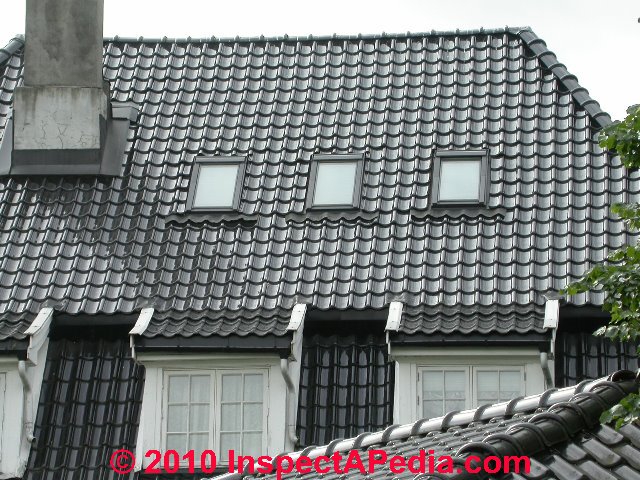
Our glazed roof tiles shown below were on homes in freezing climates of Norway (below left) and Duluth, MN (below right). Best Practices Guide to Residential Construction points out that
To make tiles, moist clay is extruded through a die or cast in a mold and then fired in a kiln until the clay “vitrifies,” fusing the particles together.
Complete vitrification will create a strong tile with very low water absorption, which protects tile from freeze-thaw damage in cold climates or damage from salt air in coastal areas.
Where regular freeze-thaw cycling is expected, roof tiles should comply with ASTM C1167 Grade 1, which allows minimal water absorption. Grade II tile provides moderate resistance to frost action, and Grade III tile is porous and should not be used in freeze-thaw areas.
 ...
...
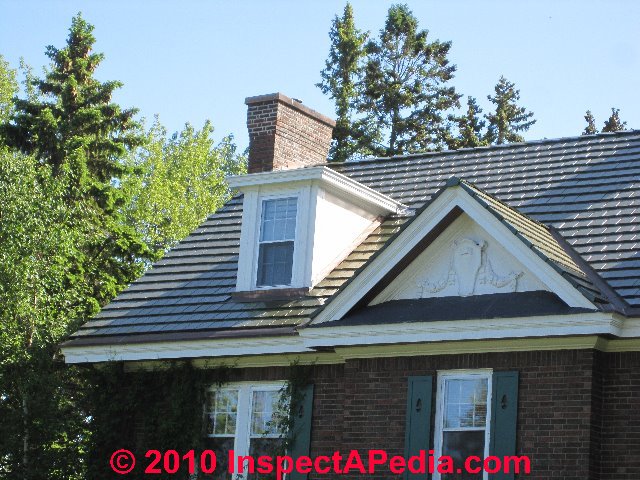
Photo above left: highly vitrified glazed clay tile roof in Molde, Norway. At above right, a vitrified clay glazed flat tile roof in Duluth, Minnesota. Both of these roofs tolerate freezing climate and other harsh weather conditions.
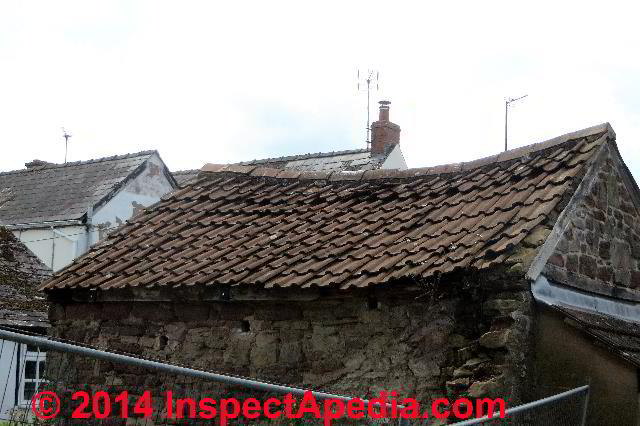 The antique clay tile roof shown at left is on a building in Ross on Wye, Herefordshire, in the U.K. near Goodrich Castle.
[Click to enlarge any image]
Clay roof tiles, typically 7" x 13" are 1/4" to 1/2" in thickness and are shaped in molds and fired in a kiln to 2000 degF to cause the clay to vitrify. The vitrification (glasification) process makes the tiles hard and waterproof by melting and fusing silicas and aluminas in the clay.
Clay roofing tile surfaces may also be decorated with an embossed pattern to resemble wood, slate, or stone.
Un-glazed tiles are terra-cotta red, a color provided by iron oxide in the clay.
Clay roof tiles may also be made with a colored glaze, adding both color and an additional layer of hard surface protection.
While traditional clay tile glazing was performed by hand dipping and pouring glazing compound over the tiles, Carson Dunlop point out in their Home Study Course for home inspectors, since the 1970's glazing on clay tiles has been spray applied and the tile backs are left un-glazed, both reducing tile cost and permitting moisture to escape from the back surface of the tile.
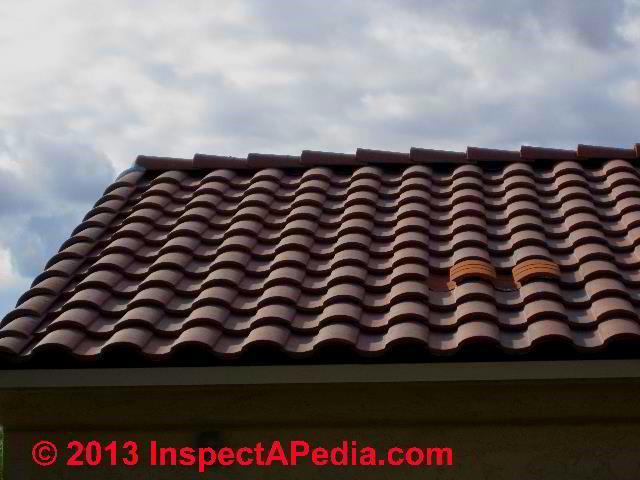
In between the soft, fragile un-glazed low-fired clay tiles of Mexico and South America and the hard-fired glazed roofing tiles used in northern climates are harder-fired but unglazed clay roofing tiles we see in frequent use in Arizona where tolerance for sun makes these a long-lived material compared with lower-cost asphalt shingle roof coverings.
The clay tile roof shown above is located near Phoenix, Arizona.
The clay tile roof shown below is on a building located in Surprise, Arizona.
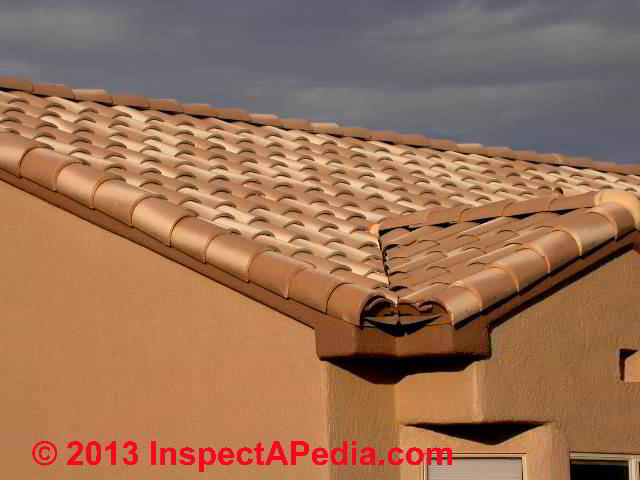
Both flat and curved clay tiles are in wide use in the American Southwest.
Higher quality clay roofing tiles are kiln fired to a higher temperature, are harder, less porous, and thus more durable. Inexpensive clay roofing tiles that are fired to lower temperatures insufficient to achieve vitrification are soft, easy to break, and less water resistant.
Description of Tapered Mission Clay Tiles & Barrel Mission Clay Roofing Tiles
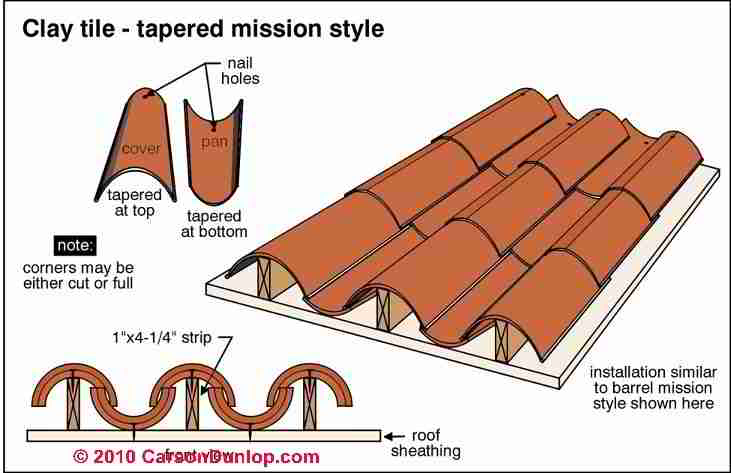
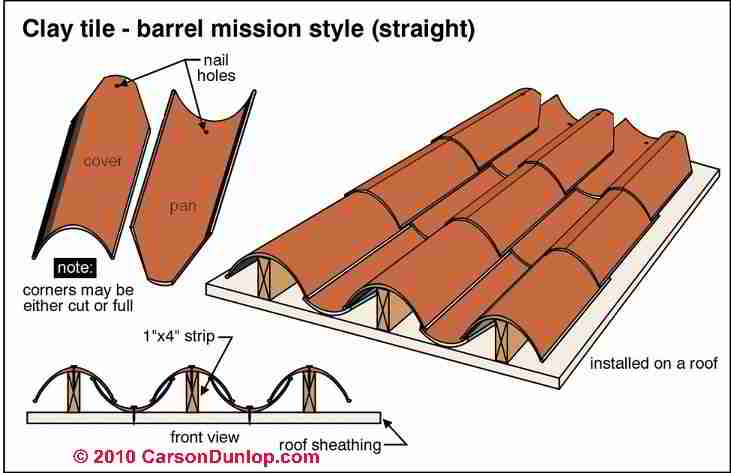
Carson Dunlop Associates' sketch above illustrates the traditional tapered mission style clay roof tiles, and below, the less-rounded barrel-mission style clay roof tiles.
[Click to enlarge any image]
Description of S-style Clay Roofing Tiles & Flat Rectangular Interlocking Clay Roof Tiles
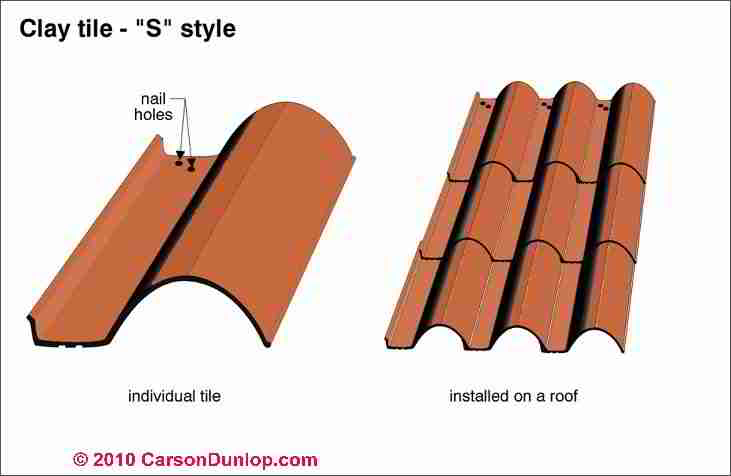
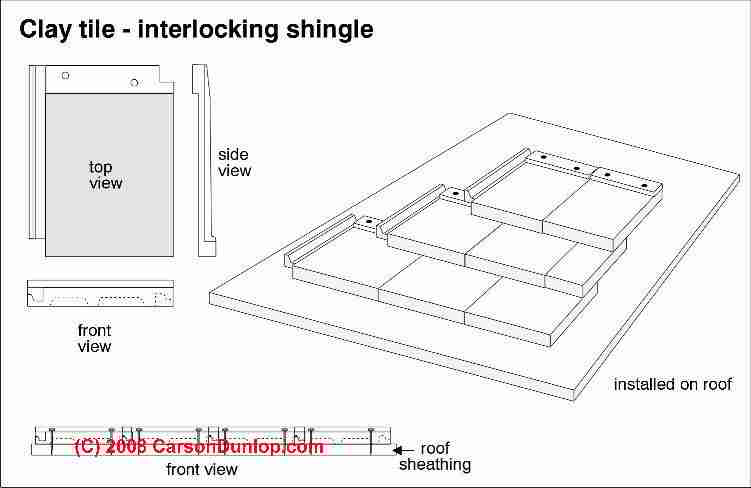
Carson Dunlop Associates' sketch (left) illustrates the Spanish roofing tile that is roughly "S" shaped, including the pan or drainage trough on the left side of the tile and the raised tile surface on its right side.
Variations of these interlocking tiles include a lower-profile "S" tile and also Greek and Roman clay roof tiles.
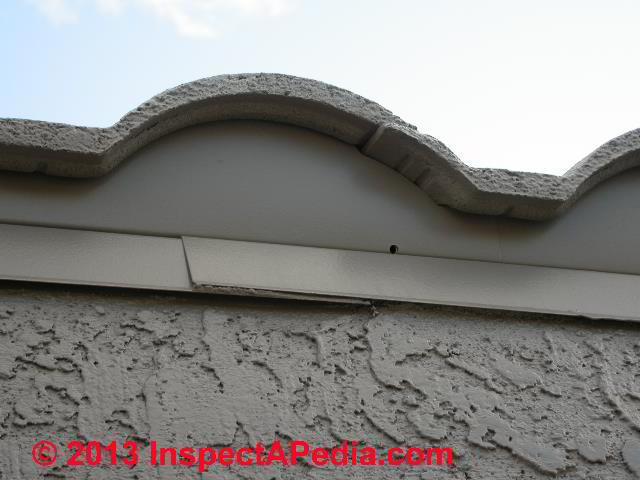
All of the rounded mission tile roofing materials need to be enclosed at the eaves or lower roof edge to avoid blowing rain and wind (wind-lift damage) and animal entry. Tile end closure is discussed at How clay roofing tiles are secured.
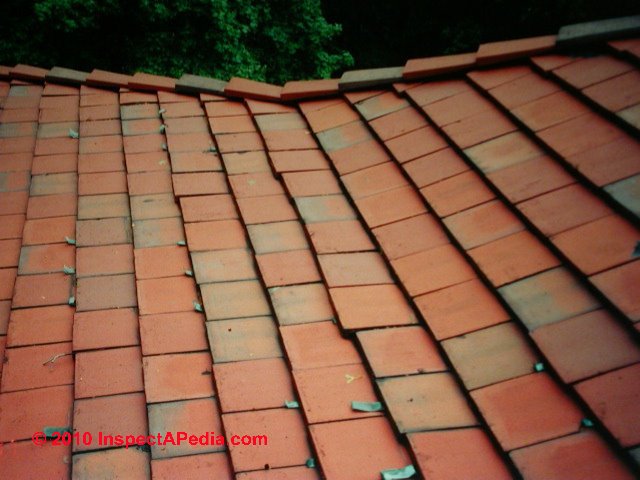
Our photo (left) and Carson Dunlop's sketch (above right) illustrate a typical interlocking roofing tile that is flat.
In our photo you can see metal tabs that mark the location of inserted replacement or repair clay tiles.
The tabs should be bent up over the tile edges but appeared to have been flattened by snow sliding down the roof.
This clay tile roof was located near New York City. Lots of these tiles were broken, particularly on the low slope roof section: we suspected some of the clay tile roof damage was due to foot traffic.
See ROOF INSPECTION SAFETY & LIMITS where we provide more photographs of this roof (Walking on Clay Roofs) and This article explains roof safety and roof damage issues when inspecting, repairing, or otherwise walking on clay tiles as well as other roof materials such as asphalt, slate, and wood roofs.
We recommend against walking on clay tile roofs as you are likely to damage the roof leading to the need for costly repairs.
Our photo of broken clay roof shingle-tiles (above right) was taken during an inspection made without walking on the roof surface - for obvious reasons: we didn't want to shoulder the blame for this damage.
Our photo of a tarred roof valley and damaged interlocking clay roof tiles (above) was taken from a ladder at roof edge.
Question: do Greek-style Roof tiles require concrete for installation?
2018/05/21 Lesley said:
 Is concrete used when laying Greek s shaped roof tiles?
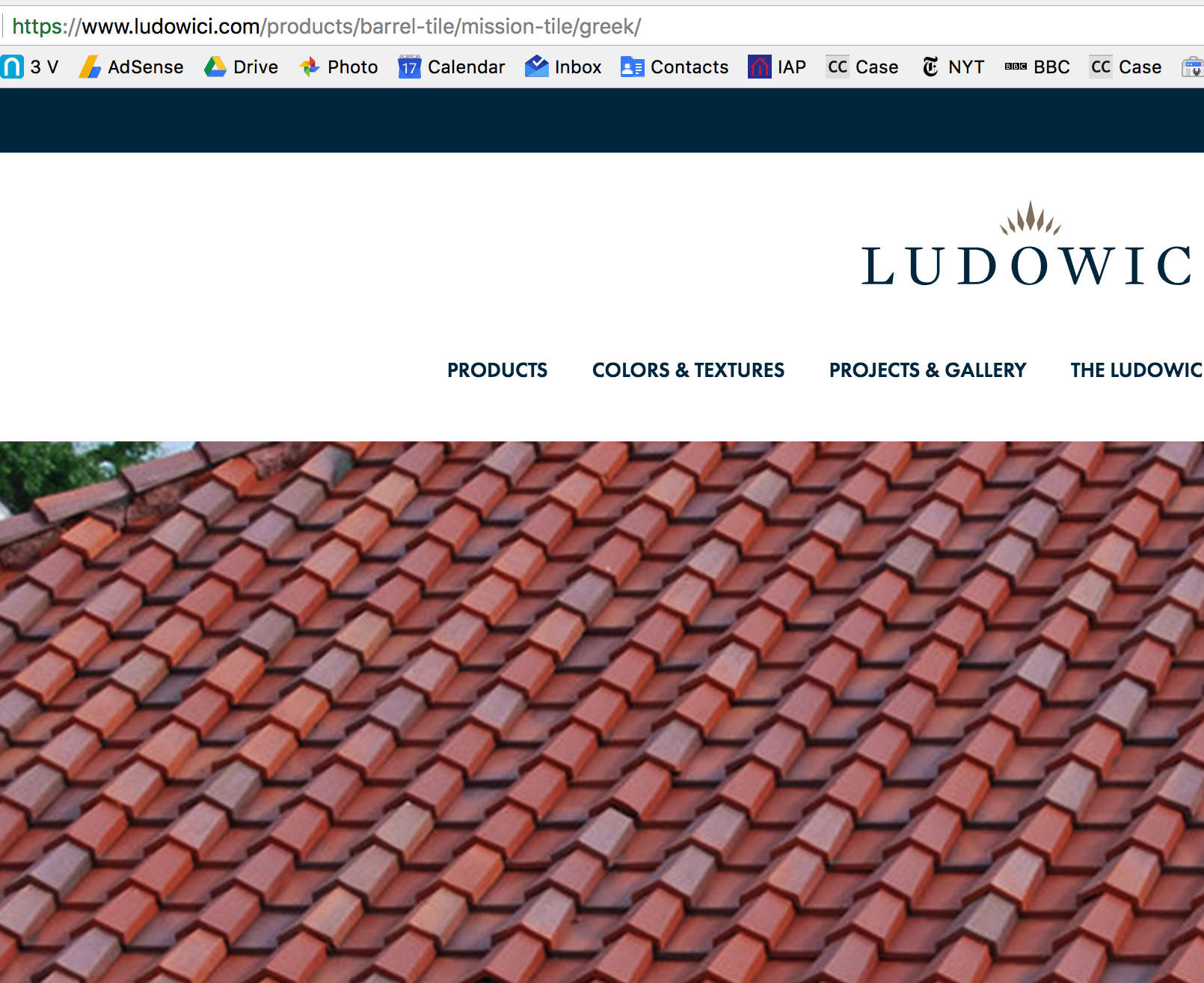
Illustrations: Greek roof tiles, a peaked S-shaped or pan-style clay roofing tile produced by Ludowici roofing and others, cited in detail just below. Contact the company for additional details about this product and its installation.
[Click to enlarge any image]
This question and answer were posted as a comment at CLAY TILE ROOFING
Reply: No.
Lesley,
No, no concrete or cement is used in the field of the roof.
Greek pan-type roofing tiles, also described as pan tiles or mission tiles, are not installed using concrete.
Noticing that Ludowici's Greek style clay roof tiles are a pan tile design we infer that that Lesley's question confuses "Greek roof tiles", S-tiles, and Pan-tiles since Lesley referred to Greek S-tiles.
Below I will include an excerpt from Ludowici's BARRELL TILE INSTALLATION MANUAL [PDF] cited below.

These tiles are also described as "Roman tiles" - the tile has a flat lower pan or for curved tiles, a concave pan on one side (usually the left) and a convex pan or (usually the right side). S-tiles and pan-tiles interlock side-to-side.
Distinguish between pan tiles and s-tiles simply by noticing that pan tiles have a wider, flat area such as is shown in these Greek tiles illustrated here.
Details about clay roofing tile shapes, profiles, styles, types are
at CLAY TILE ROOF STYLES, DESIGNS for detailed descriptions of different clay roof tile styles and characteristics.
Also
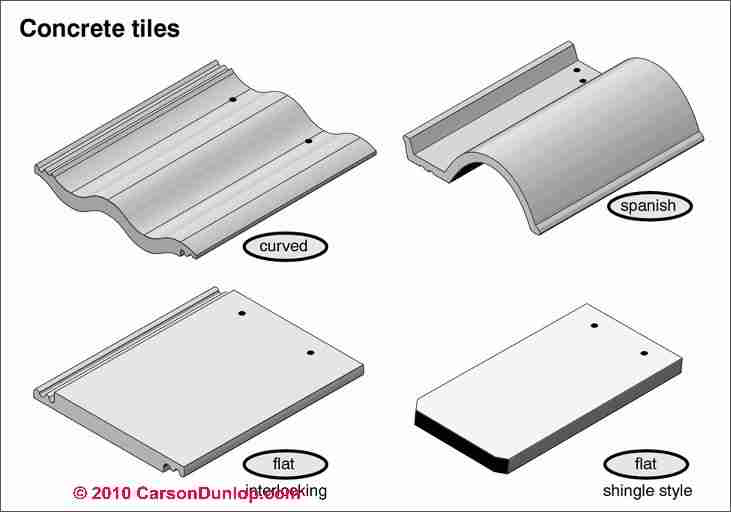
see ROOFING TILE SHAPES & PROFILES where, using concrete roof tiles as an example, we discuss the basics of roof tile profiles and what they mean.
How Clay Roof Tiles are Secured On the Roof & How Open Eaves are Closed
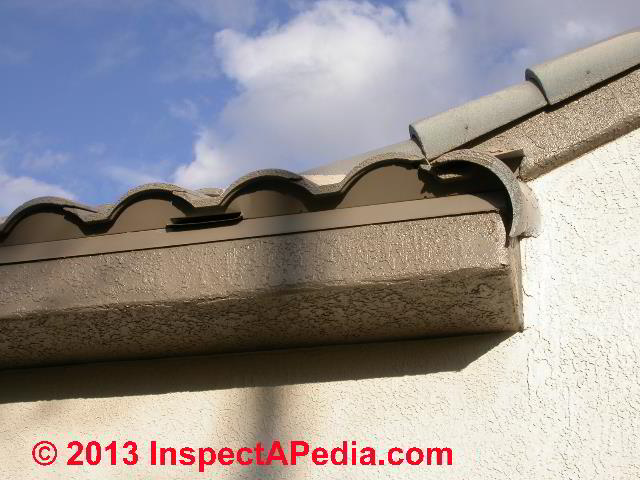
The illustrations of of how clay roof tiles are secured (below left) and of typical eaves closure of the open ends of Spanish or mission style roof tiles was provided courtesy of Carson Dunlop Associates, a Toronto home inspection, education & report writing tool company [ carsondunlop.com ].
The tile roof eaves closure and drain openings shown below are on homes in Surprise, Arizona. Notice the larger drain opening in the eaves closure for the roof at below right. [Click to enlarge any image.]
Details about clay roofing tile fastening specifications are
at CLAY TILE ROOF CONNECTIONS.
 ...
... 
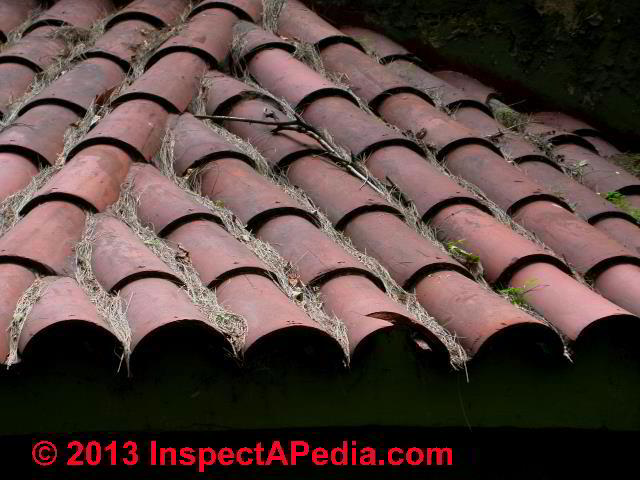
Photos below: at below left is a mission style clay tile roof with an open eaves design, Buenos Aires, Argentina. At below right is an open eaves clay tile roof design in Molde, Norway.
 ...
... 
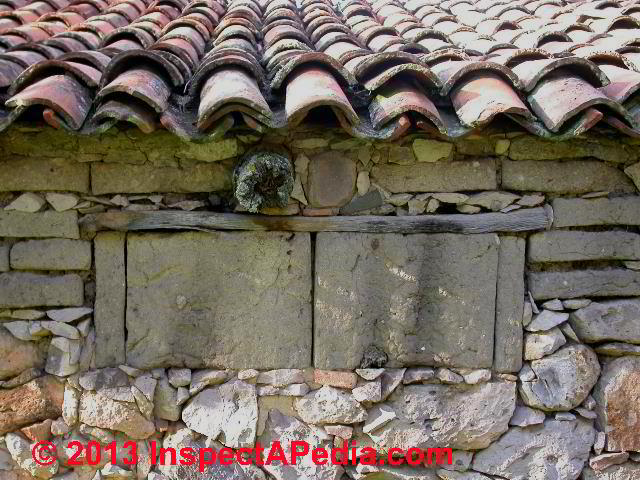
Clay tile roof eaves are also left open routinely in warmer climates such as Mexico, Central and South America, as we illustrate below with this roof from Xotolar, Guanajuato, Mexico.
Clay Roof Tile Roofing Associations, Manufacturers, Sources, Standards History, Manuals
- Clay Roof Tile Standards:
European standard PN-EN 538:1999
US ASTM Grade 1 rating for clay roof tiles
Sources of clay roofing tiles, roof tile fastening systems, & Clay Tile Roof Installation Details
- Altusa, Clay Forever LLC, website: www.altusa.com
- Boral Roofing, CONCRETE & CLAY ROOF TILE VALLEY FLASHING INSTALLATION, RIBBED [PDF] (2016) Boral Roofing, Website: www.BoralRoofComponents.com Tel: 1-800-669-TILE, retrieved 2020/02/26, original source: https://www.boralroof.com/wp-content/uploads/boral-resource/Ribbed-Valley-Metal-Installation.pdf
Also see CLAY TILE ROOF FLASHING LEAKS - Crown Building Products, LLC.,
- Dow Building Products, website:
www.dow.com/buildingproducts
Tile Bond polyurethane foam tile adhesive - Duralita: produces cement & cardboard corrugated and clay tile-like roofing products: Duralita is a combination of cement and cardboard - see www.duralita.com/ Si tiene alguna pregunta, por favor escribanos a: sales@duralita.com - El Salvador: +503 22.25.57.44 ext.31 USA +1 305.677.3597 Web: http://www.duralita.com/
- Eagle Roofing Products,
- Fabryka Ceramiki Budowlanej Sp. z o.o. ul. Powstańców Wlkp. 13 63-500 Ostrzeszów NIP: 514-02-13-069 Regon: 251470205 KRS: 0000080021 Sąd Rejonowy Poznań Nowe Miasto i Wilda w Poznaniu IX Wydz. Gospodarczy KRS Kapitał: 2.640.000,00 Export Manager Klaudyna Falkowska tel. +48 665 555 434 tel. +48 62 732 34 44 klaudyna.falkowska@fcbceramika.pl [Poland, ships across Europe & North America]
- Fomo Products, website:
www.fomo.com
Handi-Stick polyurethane foam tile adhesive - FRSA, CONCRETE & CLAY
ROOF TILE INSTALLATION MANUAL [PDF] (2001) Florida Roofing, Sheet Metal and Air Conditioning Contractors Association, Inc., retrieved 2020/02/26 original source: https://www.eagleroofing.com/installation_guides/FRSAInstallationManual.pdf
Excerpt:
These guidelines were developed to summarize for the designer, applicator or developer good roofing practice and industry guidelines for the installation of the mechanically-set and mortar/ adhesive-set tiles, which have been developed over a period of time from actual trade practice and the requirements of various building code agencies.
These guidelines may not be applicable in all geographical areas.
It is the responsibility of those individuals who are referring to these guidelines to independently research and determine which is best for their particular project.
Accordingly, the Florida Roofing, Sheet Metal and Air Conditioning Contractors Association and the Tile Roofing Institute and their members expressly disclaim any express or implied warranties or any liability for any damages or loss that might be incurred as a result of the use of these guidelines. - FRSA/TRI FLORIDA HIGH WIND CONCRETE & CLAY TILE INSTALLATION MANUAL [PDF] (partnership with TRI cited below), 5th Ed. (2014) retrieved 2020/02/26 original source: https://tileroofing.org/wp-content/uploads/TRI-Florida-HW-Tile-Installation-Manual-Revised-5th-Ed-9-24-14.pdf
- Grimmer, Anne E. & Paul K. Williams, The PRESERVATION & REPAIR of HISTORIC CLAY TILE ROOFS [PDF] (1992), U.S. National Park Service, Preservation Brief No. 29, retrieved 2022/10/08, original source: https://www.nps.gov/tps/how-to-preserve/briefs/30-clay-tile-roofs.htm
Excerpt:
Clay tile has one of the longest life expectancies among historic roofing materials—generally about 100 years, and often several hundred. Yet, a regularly scheduled maintenance program is necessary to prolong the life of any roofing system.
A complete internal and external inspection of the roof structure and the roof covering is recommended to determine condition, potential causes of failure, or source of leaks, and will help in developing a program for the preservation and repair of the tile roof.
Before initiating any repair work on historic clay tile roofs, it is important to identify those qualities important in contributing to the historic significance and character of the building.
This Brief will review the history of clay roofing tiles and will include a description of the many types and shapes of historic tiles, as well as their different methods of attachment.
It will conclude with general guidance for the historic property owner or building manager on how to plan and carry out a project involving the repair and selected replacement of historic clay roofing tiles.
Repair of historic clay tile roofs is not a job for amateurs; it should be undertaken only by professional roofers experienced in working with clay tile roofs. - Ludowici Roof Tile, Inc. 4757 Tile Plant Rd. P.O. Box 69 New Lexington, OH 43764 USA, Tel: 1-800-945-8453 4757 Tel: 1-800-945-8453 Website: www.Ludowici.com
Ludowici's BARRELL TILE INSTALLATION MANUAL [PDF] - retrieved 2018/05/21, original source: www.ludowici.com/products/barrel-tile/mission-tile/greek/
- MCA Superior Clay Tile, website:
www.mca-tile.com
CONCRETE & CLAY ROOF TILE INSTALLATION MANUAL [PDF] (2015) Tile Roofing Institute & Western States Roofing Contractors Association, TRI/WSRCA, MCA-Tile, retrieved 2020/02/26 original source: https://www.mca-tile.com/wp-content/uploads/2016/10/TRIDesignManual2015.pdf - Newport Fastener, website: www.newportfastener.com - Twisted wire systems, hurricane clips, nose clips, and the Tyle-Tye TileNail
- OSI Sealants, website: www.osisealants.com RT 600 synthetic rubber tile adhesive
- Polyfoam Products, website: www.polyfoam.cc Polyset and Polyset One polyurethane foam tile adhesives
- Redland Clay Tile,
- Santafe Tile has been a manufacturer of clay roof tiles for over 18 years, supplying Florida, Texas, North and South Carolina, Georgia, Mississippi, Tennessee and Hawaii. Website: www.santafetile.com, Contact: Andrea Pascual, Sales & Marketing Manager, 1-888-305-TILE (8453), Email: arodriguez@santafetile.com
- Roebuck, Mary C. "Archaic architectural terracottas from Corinth." Hesperia: The Journal of the American School of Classical Studies at Athens 59, no. 1 (1990): 47-63.
- Sapirstein, Philip, HOW THE CORINTHIANS MANUFACTURED THEIR FIRST ROOF TILES [PDF] Hesperia (2009): 195-229. retrieved 2018/05/21, original source: http://www.ascsa.edu.gr/pdf/uploads/hesperia/25622692.pdf
Abstract excerpts:
The earliest known terracotta roof postdating the Bronze Age belongs to the 7th century B.C. Old Temple at Corinth.
Analysis of the surface markings preserved on its tiles suggests a hypothesis for the forming and finishing stages of tile manufacture. Individual tiles were built right side up on a mold, with a pair of profiled templates guiding the shape of the top.
Replication experiments reveal that the template design for these tiles is much simpler than formerly believed. Nonetheless, it is likely that the Corinthians created their first tiles in imitation of an earlier terracotta roofing system with separate cover and pan tiles, perhaps developed outside the Corinthia. - Stevens, Gorham Phillips. A TILE STANDARD in the AGORA of ANCIENT ATHENS [PDF], Hesperia: The Journal of the American School of Classical Studies at Athens 19, no. 3 (1950): 174-188. retrieved 2018/05/21, original source: http://www.ascsa.edu.gr/pdf/uploads/hesperia/146775.pdf
Excerpts: Representations of curved roof tiles are carved in full size on the two marble fragments. From the above observations we may conclude that the monument was a standard for roof tiles, and, further, that it was a municipal standard, as it was located in front of the Civic Offices.
The tiles carved on the standard are curved and thin (Fig. 2, plan E-F)-they are representations of Laconian tiles. All Laconian titles, so far as the writer is aware, are made of terracotta and are thin (sometimes as thin as 0.012 m.). Curved tiles, especially if thin, could not easily be cut in marble, and they would, moreover, be liable to break in transporting and setting.
A highly paid stonecutter would have to be employed to produce such marble tiles, and it would take him a long time to make even one tile. All examples of marble tiles known to the writer are of the Corinthian type (flat pan tiles and hipped cover tiles). On account of the expense involved, marble tiles were used only for very important buildings.
The contention that the standard represents terracotta Laconian tiles is supported by the fact that many such tiles have come to light in the excavations of the Athenian Agora, while not one curved marble tile, thick or thin, has thus far been dug up.
The Laconian and Corinthian types of tile are well illustrated by the tile standard at Assos, where curved pan and curved cover tiles as well as flat pan and hipped cover tiles are cut in full size on the same block.5
We may think of the curved tiles of the Assos standard as models for terracotta tiles, and of the flat pan and hipped cover tiles as models not only for marble tiles but also for terracotta tiles, for there are many examples of terracotta flat pan and terracotta hipped cover tiles in Greece.6
Our Athenian standard, then, is concerned solely with the control of terracotta tiles. Now, ancient terracotta tiles have certain characteristics all their own-characteristics which it will be profitable to discuss briefly. ...
Felsch, Rainer CS.
FURTHER STAMPED ROOF TILES FROM CENTRAL GREECE, ATTICA, and the PELOPONNESE [PDF] Hesperia (1990): 301-323. op. cit. retrieved 2018/05/21, original source: http://www.ascsa.edu.gr/pdf/uploads/hesperia/148145.pdf
Contact: in Greece:
ASCSA, 54 Souidias Street, GR-106 76, Athens, Greece Telephone: (+30) 213 000 2400 Fax: (+30) 210 725 0584 Contact Via Email
In U.S.: 6-8 Charlton Street, Princeton, NJ 08540-5232, USA Telephone: (+1) 609-683-0800 Fax: (+1) 609-924-0578
Excerpt:
Founded in 1881, The American School of Classical Studies (ASCSA) provides graduate students and scholars from affiliated North American college and universities a base for the advanced study of all aspects of Greek culture, from antiquity to the present day.
It also contributes considerably to the dissemination of information about Greek history and archaeology to the Greek public, as well as to the international and Greek scholarly communities. - Tile Roofing Alliance, TILE ROOF MAINTENANCE GUIDE [PDF] Tile Roofing Alliance, TRI ALLIANCE
2150 N 107th Street, Suite 205, Seattle, WA 98133 USA, Tel: 206-209-5300, Web: tileroofing.org, retrieved 2022/09/21 original source: https://tileroofing.org/wp-content/uploads/TRIAmaintenanceprotocol_final_single.pdf
TRA or TRI or TRIA (below, apparently an alternative name for the same association, also identified as TRIA - Tile Roofing Industry Alliance ) is an industry trade association - website excerpt:
The Tile Roofing Industry (TRI) Alliance is dedicated to building awareness of clay and concrete roof tile benefits, providing technical expertise, training and certification for code-approved tile roof installation. We’re the tile roofing industry’s voice for code development and installation best practices.
CLAY / CONCRETE ROOF TILE HIP & RIDGE MORTAR GENERATED SURFACE EFFLORESCENCE [PDF] (2014) Tile Roofing Industry Alliance TRIA - cited above, retrieved 2022/09/21, original source: https://tileroofing.org/wp-content/uploads/2019-01-hip-ridge-mortar-generated-surface-efflorescence-r1.pdf
Excerpts: The use of mortar for the attachment and weather blocking of hip and ridge tiles is a code approved option for tile installations.
When mortar is used as a component, either for fastening or weather blocking, there is the opportunity for hip and ridge mortar generated efflorescence to occur on the surface of the underlying roof tiles.
Efflorescence is a temporary surface discoloration common to all concrete based building materials including mortar and concrete roof tiles.
It is superficial and in no way detrimental to the overall quality, structural integrity, or functional properties of the tile.
FLORIDA HIGH WIND CONCRETE CONCRETE & CLAY TILE ROOF INSTALLATION GUIDE [PDF] Tile Roofing Industry Alliance TRIA - cited above, retrieved 2022/09/21, original source: https://tileroofing.org/wp-content/uploads/2020-12-01-TRI-Florida-6th-Ed-Manual-Adoption.pdf
Excerpts: The Tile Roofing Industry Alliance (TRIA), formerly the Tile Roofing Institute (TRI) has recently received the formal code approval on our TRI/FRSA 6th edition of the Florida High Wind Concrete And Clay Tile Installation Guide – 6th Edition. It has been reviewed by the Florida Building Code and has been adopted as part of the new building codes that take effect on 12/31/2020.
While this is the industry-based guide that all our members will refer to, it now requires our manufacturing members to declare that this manual will be part of their official written installation guides as required by code.
The following TRIA Producer member companies have agreed to the above transition date:
Eagle Roofing Products Co. Boral Roofing Crown Building Products, LLC Ludowici Roof Tile. MCA Superior Clay Tile Redland Clay Tile Vande Hey Raleigh Roof Tile Manufacturing Inc. The following Foam Adhesive Manufacturers are also included: ICP Adhesives & Sealants.
OBSOLETE CONCRETE ROOF TILES FORMERLY PRODUCED in FLORIDA [PDF] Tile Roofing Industry Alliance TRIA - cited above, retrieved 2022/09/21, original source: https://tileroofing.org/wp-content/uploads/2020-03-TRI-Tech-Brief-Discontinued-Tiles.pdf
Excerpt: The following roof tiles are obsolete and do not interlock with the profiles currently offered by our existing member roof tile manufacturers. Identifying marks on the back of each tile may include Pioneer, Currier, Entegra, Wallin, Pioneer, Bender and/or Hanson.
POST STORM REPAIR of CONCRETE & CLAY ROOFING TILES [PDF] (2022) Tile Roofing Industry Alliance TRIA - cited above, retrieved 2022/09/21, original source: https://tileroofing.org/wp-content/uploads/TRI_2022-02_Harvest-Tile_F.pdf
Excerpts: Roof tile damage is typically visible to the naked eye. Broken roof tiles often result from large hailstones and flying debris such as tree limbs, yard décor, etc. Broken tiles rarely occur as a result of wind exposure. In order to ensure the integrity of your tile roof, broken roof tiles must be properly repaired or replaced.
... When considering replacing roof tiles, the tile manufacturer should be consulted to determine all viable options, if any, for tiles that will properly interlock and seat with the existing tiles.
Failure to properly seat can lead to leaks, breakage, and improper fit of coursing preventing the tiles from properly performing as designed.
If no tiles exist that can sufficiently interlock and seat with the existing tiles, harvesting tiles from another roof plane or a complete roof replacement may be required. Harvesting tiles from another roof plane and replacing those tiles with new tiles may or may not be a viable option ...
TILE REPLACEMENT CONSIDERATIONS for TILE ROOFS [PDF] (2012) after storms, impact damage, etc. Tile Roofing Industry Alliance TRIA - cited above,
Excerpt: Damage from weather related storms, installation or other impact events can potentially break a roofing tile resulting in the need for a tile repair or replacement.
Perform due diligence of the viable options when locating a replacement tile. While most concrete and clay tiles in the market are still in production, some may no longer be manufactured..
TILE ROOF EVALUATION AFTER HIGH WIND EVENT [PDF] (2012) Tile Roofing Industry Alliance TRIA - cited above,
Excerpt: Unfortunately, misinterpretations of codes typically as a result of insufficient information or misunderstanding in some cases, has led to confusion in the marketplace.
One example is a claim that if the nose of the tile is lifted over 2” the entire roof is not code compliant and must be replaced. This is not representative of testing protocols in the code language.
To better understand, a brief history on the code development for fastener uplift resistance is provided. It should be noted that broken tiles on the roof does not necessarily indicate evidence of wind uplift of tiles. Rather, in a high wind event, tiles are typically broken by impact from airborne debris.
WALKABILITY of CONCERETE or CLAY ROOF TILES [PDF] (2014) - how to walk on clay or concrete roof tiles with more safety and without breaking tiles.
Excerpt: To avoid breaking tiles, there are certain methods of traversing that may minimize damage.
Typically, it is recommended to step at the bottom 3" of the installed tile. This is the portion of the tile that is supported by the lapped tile beneath it and the weight is transferred through it to the deck below.
Orient your feet in a direction parallel with the ridge and try to distribute your weight evenly and walk as softly as possible.
On high-profile “S” tiles, it is recommended to distribute your weight with the heel and toe on the high points of adjacent tiles. It is also recommended to stay away from hips or valleys to avoid breaking cut tiles that would be more difficult to replace.
Watch out: this advice may hold for hard-fired North American clay and concrete roof tiles, but in our experience it is virtually impossible to walk on the much softer and more-fragile clay roof tiles used in Mexico and other Latin American countries. - Ed. - Tile Roofing Institute, 2150 N 107th St. Ste 205
Seattle, WA 98133
USA Tel: 206-209-5300
Website: http://tileroofing.org/ Email: info@tileroofing dot org TRI's Tile Roofing Installation Guides [web page]: http://tileroofing.org/resources/installation-guides/
FRSA/TRI Florida High Wind Installation Manual, Rev. 5th Ed. (2014) download PDF also at https://tileroofing.org/wp-content/uploads/TRI-Florida-HW-Tile-Installation-Manual-Revised-5th-Ed-9-24-14.pdf
or high-resolution at https://tileroofing.org/wp-content/florida/TRI-Florida-Revised-5th-Edition-Tile-Manual-HR.pdf
TRI Concrete and Clay Roof Tile Installation Manual (2015) download PDF also at https://tileroofing.org/wp-content/uploads/TRI-Installation-Guide-2015.pdf
The TRI provides contact information for tile roofers who are members of their association.
Website excerpt:
Founded in 1971 (Incorporated in the state of California, non-profit 501C6), TRI – originally named the National Tile Roofing Manufacturers Association (NTRMA) – has produced technical manuals on code language and preferred installation practices within all the major code bodies nationwide.
TRI has played a major role in testing tile under severe weather and seismic conditions, as well as developing legislation of building codes.
- TRI CONCRETE and CLAY ROOF TILE INSTALLATION MANUAL – 2015 [PDF] lossless-compressed file, 8MB for faster loading,retrieved 2017/0-8/07, original source: http://tileroofing.org/wp-content/uploads/TRI-Installation-Guide-2015.pdf op. cit.
- TRI, "Concrete and Clay Roof Tile Installation Manual for Moderate Climate Regions, Design Criteria", The Tile Roofing Institute, 23607 Highway 99, Suite 2C
Edmonds WA 98026
P: 425.778.6162
F: 425.771.9588
Email: info@tileroofing.org, Website: http://tileroofing.org
supported by the Western States Roofing Contractors Association. retrieved 5/2/2014, original source: http://www.tileroofing.org/tri/wp-content/uploads/2014/01/ TRI_Moderate_Guide_HIGH_RES.pdf - TRI, Tile Roofs Inc., 9505 Corsair Road Frankfort, IL 60423 P: (888) 708-TILE F: (708) 479 7865 EMAIL: INFO@TILEROOFS.COM Vintage & New Clay Roof Tiles & Fittings, Web: https://www.tileroofs.com/
- U.S. Tile Co., website: www.ustile.com
- Vande Hey Raleigh Roof Tile Manufacturing Inc.
- Western States Roofing Contractors Association, WSRCA, 275 Tennant Ave., Suite #106, Morgan Hill CA 95037, Website: www.wsrca.com Email: info@wsrca.com
- Wikander, Örjan. "Archaic roof tiles the first generations." Hesperia: The Journal of the American School of Classical Studies at Athens 59, no. 1 (1990): 285-290.
Excerpts:
This paper further discusses is... : Why did the tiled roof appear at all, why did it spread as fast as it did, and how was this diffusion achieved.
The basis for my argument is a comparison between documented finds of roof tiles from the period 700-650 and those from 650-600 B.C.
- Wire works, Inc., website:
www.wireworks-inc.com
Tile hooks, hook nails, copper and stainless-steel nails - See also the suppliers listed
at CONCRETE ROOFING
- Portions of this page were adapted with permission from Best Practices Guide to Residential Construction (Steve Bliss, J Wiley & Sons) .
Reader Comments, Questions & Answers About The Article Above
Below you will find questions and answers previously posted on this page at its page bottom reader comment box.
Reader Q&A - also see RECOMMENDED ARTICLES & FAQs
On 2023-01-12 by InspectApedia Publisher -- examples of impact resistant roofing products
@jAMES LINDEN,
... continuing
Since before 2019, clay and concrete roof tiles sold in North America (you don't give your country of location) are required to meet a CLASS 4 Impact Rating as described in UL 2218. This standard is descibed as developed by UL (Underwriters Laboratories) for assessing the impact resistance of "new flexible roofing products, like metal panels or metal shingles.
Reading lists of roofing products that meet that standard I don't see clay roofing tiles in the list but my survey was not exhaustive.
For a roof tile to meet the standard it's probably going to be made of synthetics such as a plastic formulation.
Examples of IMPACT RESISTANT ROOFING PRODUCTS [PDF] (as listed by Texas), 2022/01/12, original source: https://www.tdi.texas.gov/company/roofing-discounts.html
include (*examples, not an exhaustive list)
Crowe Building Products Ltd.
Ontario, Canada
Phone: 905-529-6818
Web Address: www.authentic-roof.com
Baljen TPO Polymer Roof Tiles - Class 4
DaVinci Roofscapes, LLC.
Kansas City, KS
Phone: 800-328-4624
Web Address: www.davinciroofscapes.com
Premium Polymer Roofing Tiles - Class 4
EcoStar LLC
Holland, NY 14080
Phone: 800-211-7170
Web Address: www.ecostarllc.com
Molded Polymer Roof Tiles - Class 4
On 2023-01-12 by InspectApedia Publisher - Impact standards for clay & concrete roof tiles
@jAMES LINDEN,
Thank you for a helpful and important question.
@jAMES LINDEN,
I'm sorry we can't give an unequivocal answer but as my friend Mark Cramer says ... "It depends" ... clay roofing tiles are manufactured world-wide, for centuries. The standards to which clay roof tiles were manufactured in 1999 depend on the country where they were made, and the standard to which they claim to meet.
We'd need to identify the specific clay roofing tile about which you're concerned, naming its manufacture and the specific product identity and of course where it was made. The clay tile product literature will (or should) give us the standards to which the clay tiles were manufactured. But I'm doubtful of most clay roof tile products - ones made really of clay, not of a plastic or metal lookalike.
For other readers:
UL 2218 Impact Resistance of Prepared Roof Covering Materials (2018) that specifies hail damage resistant certain roofing products. This impact test standard is a steel ball drop test to evaluate the impact resistance of prepared roof coverings. I'd provide a copy but I'm not going to spend between $400 and $1000. USD on this.
Abstract:
UL 2218, 2nd Edition, November 29, 2022 - UL Standard for Safety Impact Resistance of Prepared Roof Covering Materials
This test method provides impact resistance data for the evaluation of prepared steep slope roof covering materials. For purposes of this Standard, prepared roof covering materials are considered to be small units, sheets or panels designed for installation with multiple layers of such materials installed in overlapping rows on slopes of 2:12 (16.67%) and greater.
Impact resistance testing for the evaluation of low slope roofing systems are covered under UL 2218A, Impact Resistance of Roofing Systems.
The test evaluates the effect of impact from the steel ball at locations on the test assembly selected to be most vulnerable, such as (but not limited to) edges, corners, unsupported sections and joints.
This test method does not evaluate the effect of weathering, temperature, aging or similar effects on the impact resistance of prepared roof covering materials. These and other factors, including time, roof slope, roof system configuration and application influence the performance of prepared roofi covering materials in the field. It is not the objective of this test to address all of these factors.
The impact energies used in this Standard were derived from impact energies of actual hailstones (see Appendix A). However, largely due to the effects discussed in 1.3, there is no currently established direct correlation between the performance of prepared roof covering materials when impacted by hailstones versus steel balls. Consequently, this test method does not provide a direct basis to compare expected performance under all hail conditions, but does provide a basis for comparison of the response of the prepared roof covering materials when subjected to the impact energies described herein.
--
IMPACT STANDARDS for CLAY & CONCRETE ROOF TILES
FM 4473 - Class 4 - Factory Mutual Research, using pure water frozen ice balls to test the impact resistance of new rigid roof coverings like concrete roof tiles, clay roof tiles, and roofing slate. Ice balls are shot at the roof using a sling or an air cannon, and the product must still be "functional" following two impacts in the same spot hit by 2-inch ice balls (to achieve a Class 4 Impact Rating).
IBHS, HAIL RESISTANCE SUPPLEMENT, FORTIFIED HOME [PDF] Fortified IBHS Program, Web: fortifiedhome.org - retrieved 2023/01/12 original source: https://fortifiedhome.org/wp-content/uploads/2020-FORTIFIED-Home-Hail-Supplement.pdf
Website excerpt: FORTIFIED is a voluntary construction and re-roofing Program designed to strengthen homes and commercial buildings against specific types of severe weather such as high winds, hail, hurricanes and even tornados.
ASTM C1167-22 Standard Specification for Clay Roof Tiles
Abstract
This specification covers clay roof tiles with such durability and appearance that can provide a weather-resistant surface of a specified design. Each tile should be manufactured from clay, shale, or similar naturally occurring earthy substances and subjected to high-temperature firing. The heat treatment should develop a fired bond between material particles that provides the required strength and durability.
The tiles should be shaped by molding, pressing, or extrusion during manufacture. Generally, the tiles are planar or undulating rectangular and are classified into three grades according to the degree of resistance to weathering. Materials are also grouped into three types according to profile and rise-to-width ratio.
Colors and textures produced by application of inorganic coatings are allowed except when the coloring is done by flashing or the texturing by sanding where the sand does not form a continuous coating. Each tile should conform to the specified values of durability, freezing and thawing, transverse breaking strength, efflorescence, reactive particulates, and permeability.
Scope
1.1 This specification covers clay tiles intended for use as roof covering where durability and appearance are required to provide a weather-resistant surface of specified design.
1.2 Tiles are manufactured from clay, shale, or similar naturally occurring earthy substances and subjected to heat treatment at elevated temperatures (firing). The heat treatment must develop a fired bond between the particulate constituents to provide the strength and durability requirements of this specification (see firing and fired bond in Terminology C1232).
1.3 Tiles are shaped during manufacture by molding, pressing, or extrusion and it is permitted to use the shaping method to describe the tiles.
1.4 Tiles are generally planar or undulating rectangular shapes available in a variety of cross-sectional profiles, shapes, sizes, surface textures, and colors.
1.5 Three grades of tile having various degrees of resistance to weathering are covered in this specification. Three types of tile are defined to cover the features that influence appearance.
1.6 The text of this specification references notes and footnotes which provide explanatory material. These notes and footnotes (excluding those in tables and figures) shall not be considered as requirements of the standard.
1.7 The values stated in inch-pound units are to be regarded as standard. The values given in parentheses are mathematical conversions to SI units that are provided for information only and are not considered standard.
1.8 This standard does not purport to address all of the safety concerns, if any, associated with its use. It is the responsibility of the user of this standard to establish appropriate safety, health, and environmental practices and determine the applicability of regulatory limitations prior to use.
1.9 This international standard was developed in accordance with internationally recognized principles on standardization established in the Decision on Principles for the Development of International Standards, Guides and Recommendations issued by the World Trade Organization Technical Barriers to Trade (TBT) Committee. - https://www.astm.org/c1167-22.html
Other References on Hail & Impact Resistant Roofing
The IIBHS (Insurance Institute for Business & Home Safety, ibhs.org) has published a report summarizing
the RELATIVE IMPACT RESISTANCE OF ASPHALT SHINGLES IN UL 2218 TESTS (AUGUST 2014) [PDF] but does not report on clay roof tiles nor other materials - 2023/01/12 original source: https://ibhs.org/wp-content/uploads/member_docs/Relative-Impact-Resistance-of-Asphalt-Shingles_IBHS.pdf
The Class 1 projectile is 1.25 in. in diameter,
Class 2 is 1.50 in., Class 3 is 1.75 in., and Class 4 is 2.00 in.
This is about hail damage resistance as I b
On 2023-01-12 by jAMES LINDEN
Do clay tile roofs manufactured in 1999 meet the UL 2218 classification for impact?
On 2022-11-21 by InspectApedia (Editor) - percentage of the roof that's damaged partly dictates repair or replace
@Martin,
About deciding whether to repair or replace a tile roof, usually the roofer will make a statement about the percentage of the roof that's damaged.
If that's a sufficiently high number that the cost of repair approaches the cost of new roof then you would, of course, consider it.
For the information shown by just your photos, it appears to me that you have small areas of damage.
Those are certainly worth fixing.
Keep in mind that you're having to hire someone who has expertise in that particular kind of roofing and that they're working on a high steep slope roof which is more difficult and more dangerous, and therefore more time consuming and more expensive to perform.
On 2022-11-21 by InspectApedia (Editor)
@Martin,
Keep in mind that the roofing may have been stored outside or exposed to dirt and debris.
But it looks new to me.
Look closely at the nail holes.
If it was previously nailed to a roof and then removed you would probably see some shipping around the nail holes and even around the edges of the tile. In any case, if the tile's in new condition, I think we're worrying about something that isn't a concern.
On 2022-11-17 by Martin
Here is the image of the replacement tiles I got from the roofer. It has a code "0221" on it, could it be February 2021? It doesn't look new to me, though.
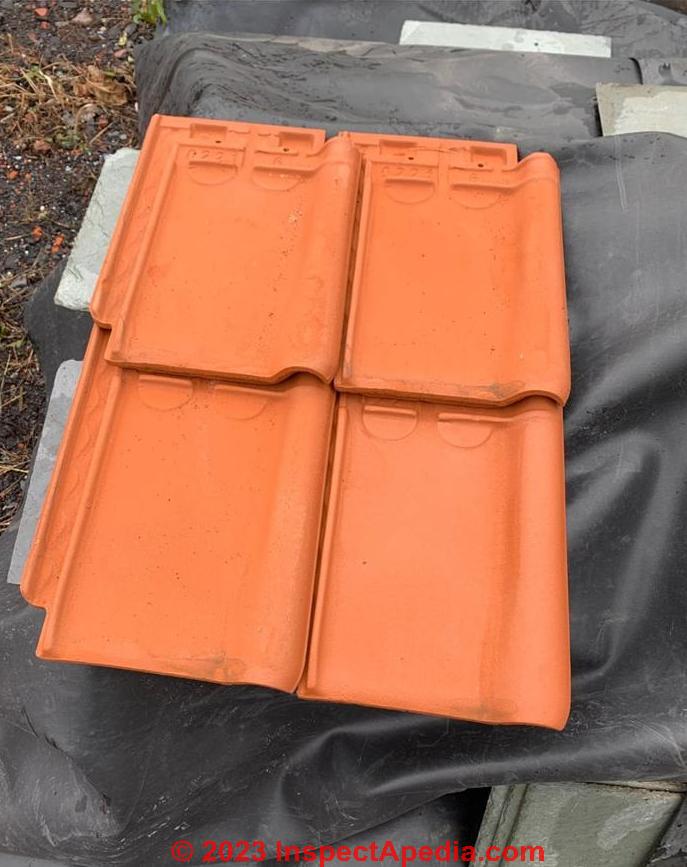
On 2022-11-17 by Martin
Another image, same corner, from below
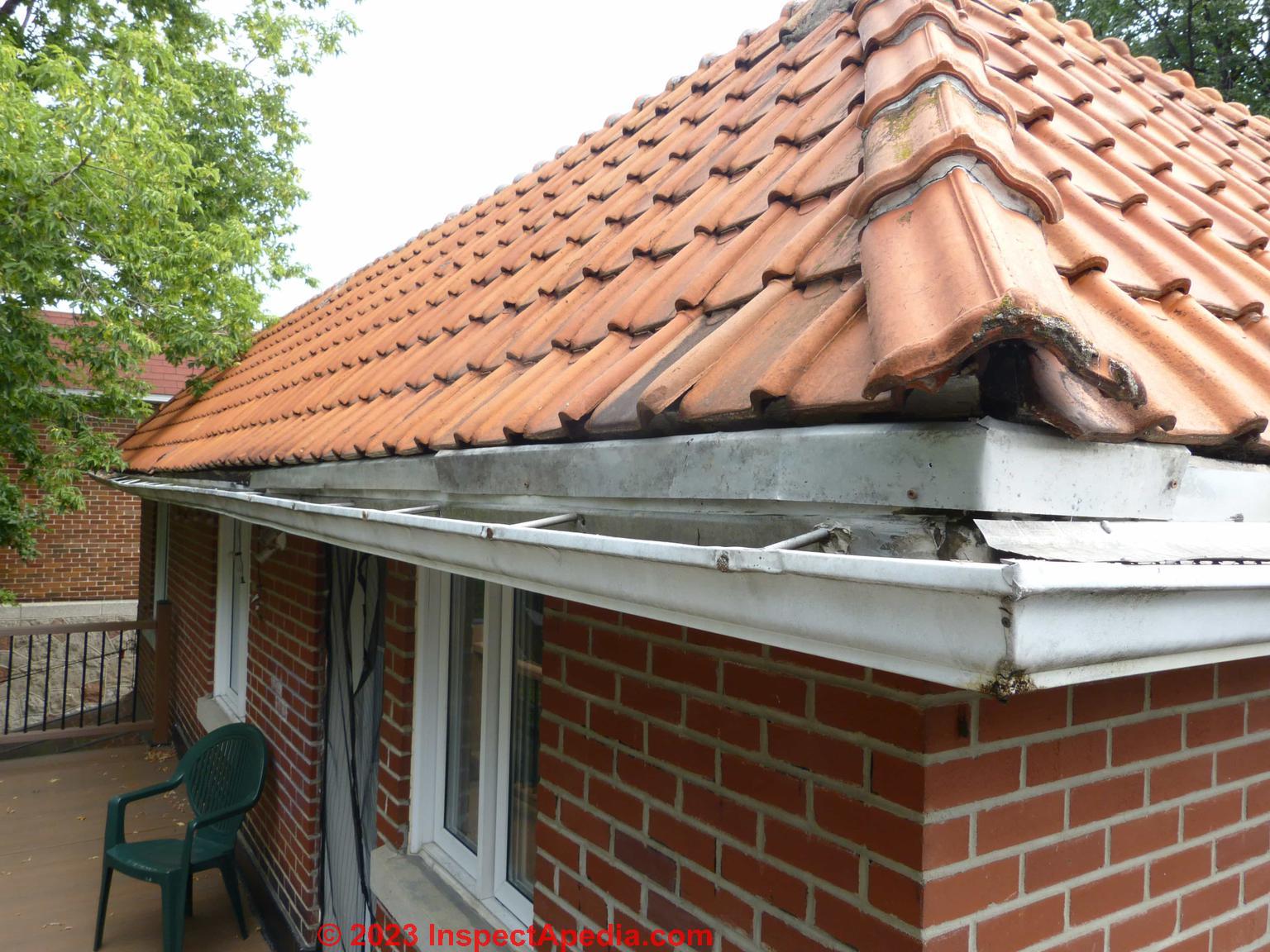
Here is an image of the roof, northwestern corner.

On 2022-11-17 by Martin
Here are some more photos of the roof. I'm getting a bit uncertain whether its better to repair or to replace the roof. The roofer says its getting fragile. It has endured 70 years of Montreal climate, I for myself cannot really judge, but I remember bits and pieces of tiles coming down when I placed a ladder against the roof.
The first pic shows where I found defective tiles. South is to the left, West to the top. Western and Northwestern part have less damage, maybe due to better accessibility from the surrounding balconies.
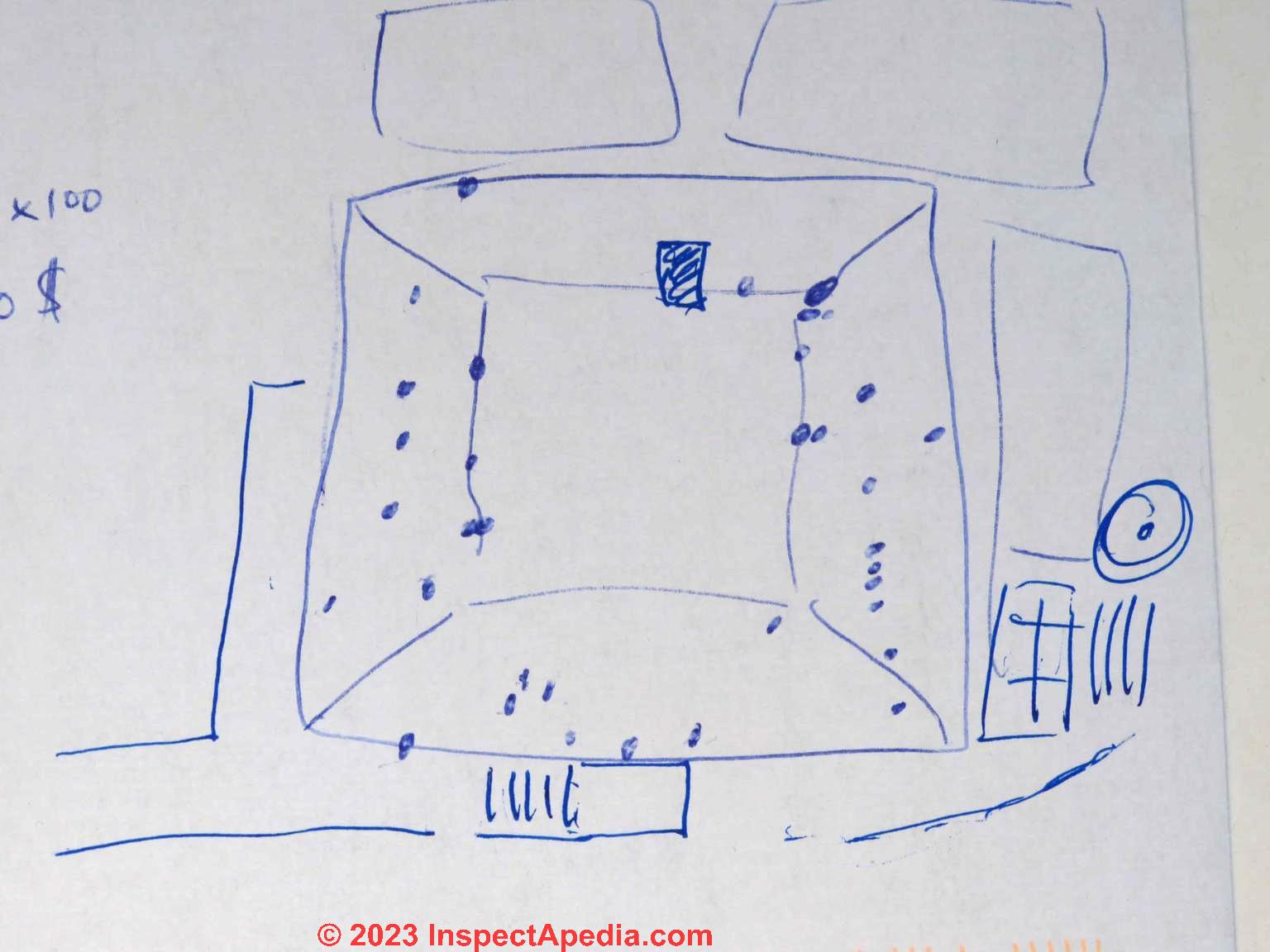
On 2022-11-16 by InspectApedia (Editor)
@Martin,
It would be helpful if you could post a photo of the front and the back of one of these tiles. One photo for comment but as many comments and photos as you need.
On 2022-11-16 by InspectApedia (Editor) - ceramic / clay roof tiles are very long lived
@Martin,
Thank you that's an interesting question. Roofing tiles are very durable material and indeed sometimes people salvage them for reuse, particularly if it's a style that's hard to find.
However it should be easy to look at the tile and tell if it's new or used. A new tile will be uniform in color and clean and its color and appearance in the same on both sides as it has not been exposed to weather or allergy or the normal dirt that collects on roofs over time.
In my opinion even a used tile would be perfectly acceptable if it's not cracked or damaged. The material itself has a very long life.
Unlike other roofing materials such as asphalt, ceramic / clay roof tiles are very long lived.
What limits their life is usually mechanical damage such as being broken by a storm or by branch falling on the roof or by a walker.
On 2022-11-16 by Martin - Pottelberg - made in Belgium imported clay roof tiles
Hi, here is an update of what we found out so far.
On the back of the tiles on our house in Montreals it reads "Pottelberg - made in Belgium". So even back in the 50ies they used imported tiles! Pottelberg still exists in Belgium (now Niederberger), the tile is still produced and is called "Tempete 44".
Our roofer offers a different tile that looks very much the same, its the "Monopole N1" from Imerys, manufactured in the north of France... Europe again!
One thing I'd like to know is if the tiles the roofer installs are really new. There is a code on the tiles, could that be a production date? Something like week number and two-digit-year? I'm unable to get that confirmed.
What puzzles me is the mention of a plywood replacement in the offer. In Europe you have the large vertical beams with the vertical and horizontal battens that hold the tiles. There is no plywood anywhere. Is there a fundamental difference in European tile roofing standards compared to North-America, or just in Canada?
cheers - Martin
On 2022-09-18 by InspectApedia (mod) - restore 1927 flat clay tile roof
@John Sam Hotchkiss,
Take a look at the section above on this page titled:
Clay Roof Tile Roofing Associations, Manufacturers, Sources, History, Manuals
where we list a number of clay tile sources. They may be a good starting point and/or could direct you to other suppliers.
Let us know what you find.
On 2022-09-18 by John Sam Hotchkiss
We’d like to restore this 1927 roof along with the home. These flat clay roof tiles are not easy to find. Any help would be great! They measure 15 1/2” x 7 1/2” (18 x 39 cm). Thanks!
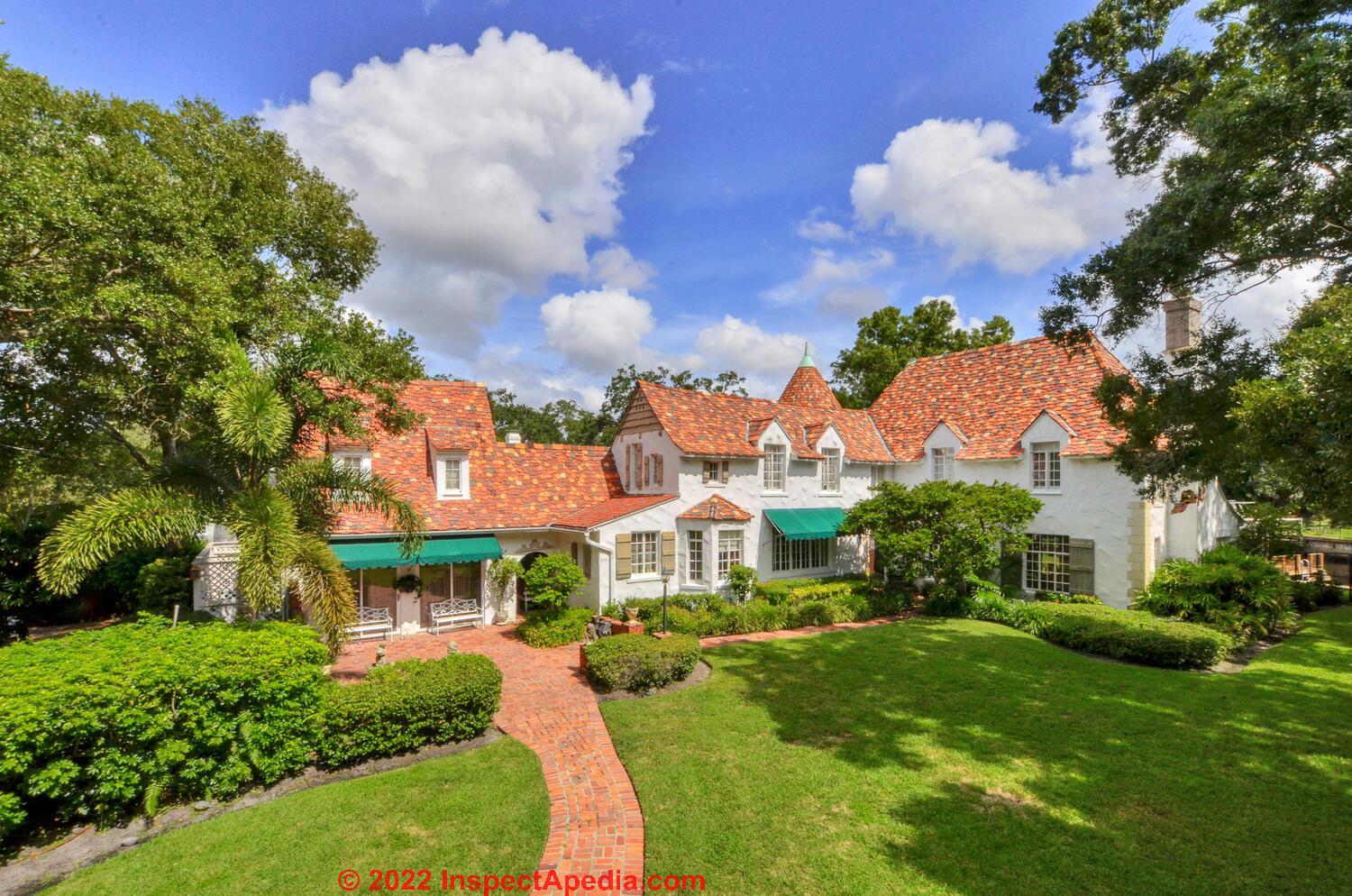
On 2022-09-21 by Martin
@InspectApedia (Editor), No problem! I'll keep you informed when I got more information.
On 2022-09-21 by InspectApedia (Editor)
@Martin,
I hardly believe it either- sorry if I confused you.
My point was simply to give an example of a U.S. company who imports clay roof tiles from European sources because those tiles are no longer available in the U.S.
On 2022-09-21 by Martin
@InspectApedia (Editor), thanks for all the info... here is a pic of the same spot of our roof from below. I can hardly believe a polish company would produce exactly that... Martin

On 2022-09-21 by InspectApedia (Editor) - European clay tile sources
@Martin,
Those are very nice tiles and a very steep slope roof - so a bit more trouble (scaffolding & ladders) to work on.
Apparently the roofer knows where to find an exact match. Indeed some North American tile roofers make a point of offering clay roof tiles made in Europe indicating that it's European clay tile sources who continue to produce exact matches for older clay roof tiles no longer made in the U.S. or Canada.
For example this US Supplier tileroofs dot com says
Current production FCB products are manufactured to custom match old Mound City, Heinz, Ludowici-Celadon, B. Mifflin Hood, Mineral Wells, Cincinnati Terra Cotta, Detroit, National (Lima) and many other obsolete and discontinued clay roof tile product lines.
Furthermore, current production FCB colors will match the colors and surface textures of these old clay tile roofs.
With these FCB custom products, you will incur no limitations, restrictions, and/or outright refusal of service such as you may incur from other tile manufacturers in the United States.
Specs concerning FCB:
European standard PN-EN 538:1999 (*Comparable to US ASTM Grade 1 rating for clay roof tiles)
5.6% Water Absorption rating
Suitable for ANY climate
75 year manufacturer warranty
Custom matching for current and/or obsolete clay tile and trim accessories
I'm guessing that their "FCB" refers to Fabryka Ceramiki Budowlanej, a tile manufacturer in Poland
Fabryka Ceramiki Budowlanej Sp. z o.o.
ul. Powstańców Wlkp. 13
63-500 Ostrzeszów
NIP: 514-02-13-069
Regon: 251470205
KRS: 0000080021
Sąd Rejonowy Poznań Nowe Miasto i Wilda w Poznaniu
IX Wydz. Gospodarczy KRS
Kapitał: 2.640.000,00
Export Manager
Klaudyna Falkowska
tel. +48 665 555 434
tel. +48 62 732 34 44
klaudyna.falkowska@fcbceramika.pl
So do let us know the source of your roof tiles as that will be helpful to other readers.
On 2022-09-21 by Martin
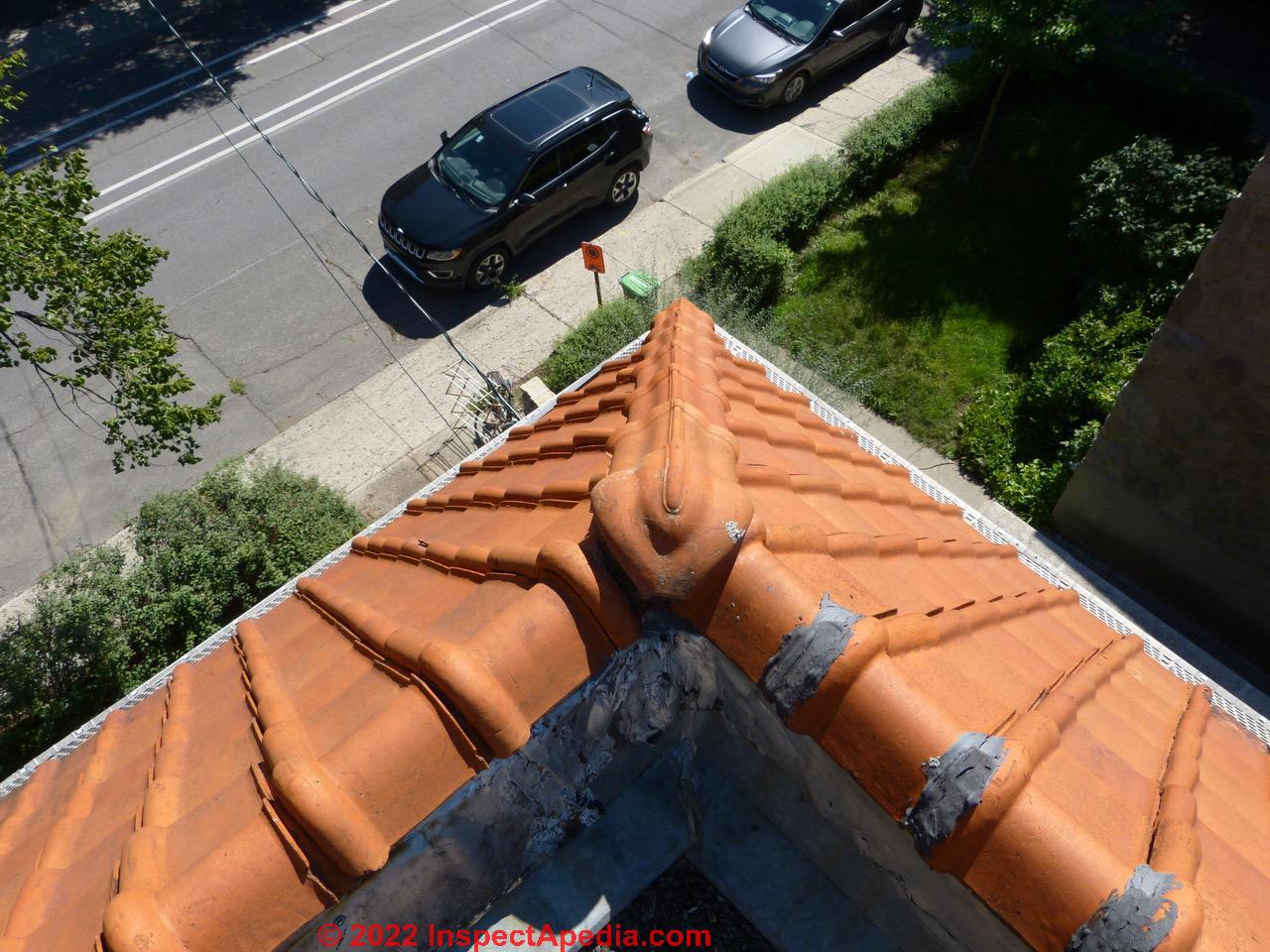
@InspectApedia-911, Hi, my building is located in Cotes-des-Neiges, Montreal. I got a reply from tileroofscanada, saying the tiles will be shipped from Europe... thats what made me wonder. They did not say from where in Europe, though.
Here is a pic of my tiles, taken from the flat top. The corner pieces seem a bit special.
best regards - Martin
On 2022-09-20 by InspectApedia-911 (mod)
@Martin,
Sorry if our article confused you but we certainly do not restrict our roof tile source or product discussions to Europe.
We show roof tiles on the page above from Latin America, Canada, the U.S., Scandinavia, Germany, and other locations around the world, and give and are happy to add to roof tile sources.
Not sure where your building is located but we had no trouble finding Flammand roof tiles in Belgium.
Take care when looking at quotes for roofing tiles. The costs of the roof are the labor, including difficulty of access and fragility of the current roof, as well as the particular roof tile selected.
Last month I replace several broken clay tiles on a small roof in Mexico where the individual clay tiles cost less than $1. USD. each. It was the labor, as well as the discovery of need to repair the supporting roof that added to the cost of the job.
An example of one of these inexpensive roofs is shown below.
On 2022-09-20 by Martin
@InspectApedia-911,
thanks a lot for the additional links. Meanwhile I got 1 (one!) offer for around 100§ per square feet... (40.000$ for 40 square metres which is 400 square feet). Repair is around 100$ per tile, an individual tile 60$... prices for one tile here in Europe are around 1/10th of that!
When looking at your links it seems all these tiles are imported from... Europe! Why is that so? Don't you have any clay in North America? Our tiles are close to the "44" or "Flamand" type, except the special corner and top tiles seem to be more elaborate. Best regards, Martin
On 2022-09-16 by InspectApedia-911 (mod) - 1953 Montreal home needs special clay tile to renew roof
@Martin,
I agree that you want a roofer who has experience with clay tile roofs - lest the contractor cause more harm than good.
Consider that at least in the 1950s, there were clay tile roofers in Montreal. I'd simply search for the same, perhaps within the whole province.
A quick search for "Clay tile roofer - Quebec" finds
https://www.northernrooftiles.com/aboutus
https://www.cverdun.com/en/tile-roof-in-montreal/
Also some slate roofers can probably handle tile
https://tileroofscanada.com/
On 2022-09-15 by Martin
Hi, this is an incredible wealth of information! I purchased a house in Montreal, built in 1953, with a flat roof and a clay tile "corona" around it. I have a very hard time finding any contractor at all that is able to repair and/or renew that roof.
Practically all buildings in the neighborhood have asphalt shingles at that place.
Do you know of any information source in Canada / Quebec / Montreal that could help me with my search? Until now all I got is a quote for the metal type of tiles, for about 30$ CAD per square feet. But I would very much prefer the original tiling!
Best regards, Martin
On 2021-08-26 by inspectapedia.com.moderator - cost of a clay tile roof varies enormously by country and city
@SHIVANAND,
The cost of a clay tile roof varies enormously by country and city where the building is located, both because of differences in labor and material costs and because in some climates such as high-wind or hurricane or storm zones, different, storm-resistant designs are required.
For example, in central Mexico, clay tiles are simply laid in place on low slope roofs, held atop asphalt roofing felt or other coatings by gravity, while in Florida, tiles are bound to the roof sheathing, usually over a heavy waterproof membrane.
A TYPICAL range for clay tile roof costs in the U.S. and Canada is between $10. and $20 per square foot, so your roof, if it's in one of those countries, would cost between $10,000 and $20,000.
On 2021-08-26 by SHIVANAND
Clay tile roof 1000 sqft house what is the cost
On 2021-08-15 by inspectapedia.com.moderator
@Mitzi Borota, for example here's a search result with map of clay tile roofers near you; give these companies a call.
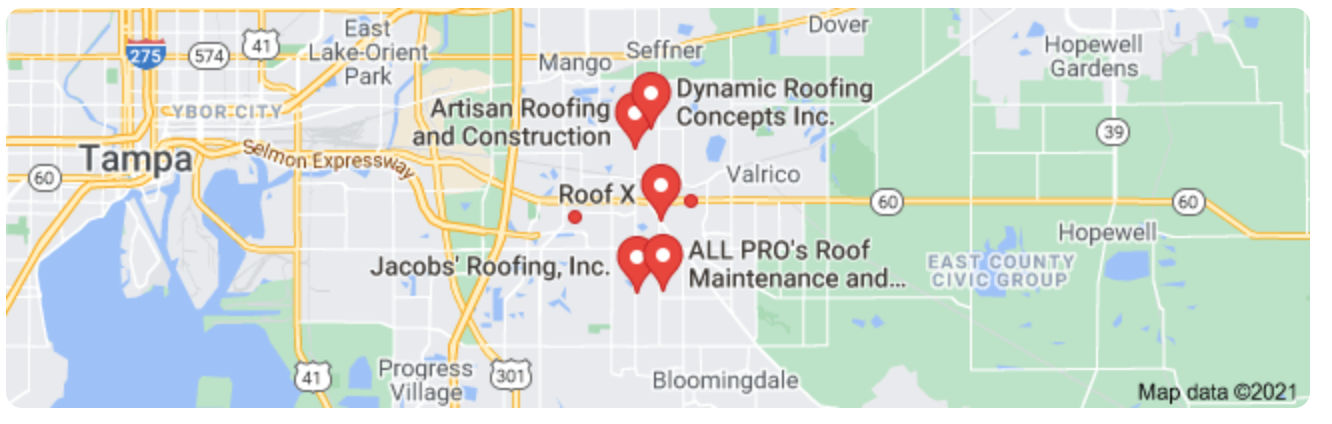
On 2021-08-15 by inspectapedia.com.moderator - black plywood that may be actually leak-damaged
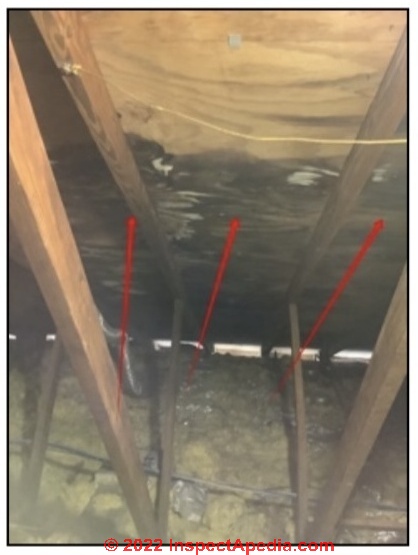
@Mitzi Borota,
We took a look at another of the inspector's photos of your roof and saw a lot of black plywood that may be actually leak-damaged at the lower roof-edge (photo below). So your repair may involve removal of some of the roof tiles and may require some plywood replacement.
There are a lot of clay tile roofs in Florida so there are a lot of clay tile roof installers. A simple web search for "Clay tile roof repairs, Brandon Florida " using any search engine will give you a list of roofers near you.
In order to absolutely assure our readers that we write and report without bias we do not sell any products nor do we have any business or financial relationships that could create such conflicts of interest.
InspectAPedia is an independent publisher of building, environmental, and forensic inspection, diagnosis, and repair information for the public - we have no business nor financial connection with any manufacturer or service provider discussed at our website.
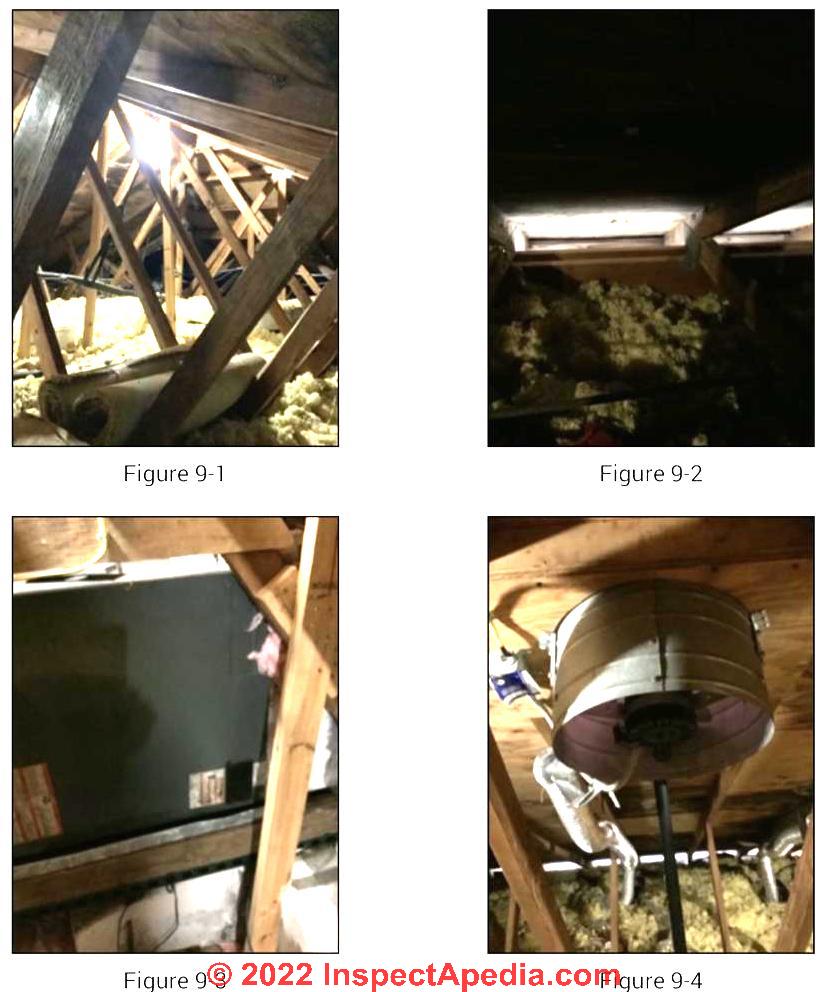
On 2021-08-15 by Mitzi Borota
I am trying to sell my home and the inspection found a leak. I need a fast repair pictures included. I am in Brandon Florida.
Question: How do I Find a Roofer Who Knows how to Work on Clay Tile Roofing?
Nancy said:
We have the original clay tile roof from 1948 when the house was built. Flat clay tiles, not the Mediterranean type.
Pacific Northwest. We've had trouble finding a company that is knowledgeable about this type of roof, and no one seems to know how to repair or clean this roof. Any references for companies that have experience with this type of roof in Washington state? - 2017/08/07
This question was posted originally
Reply:
Thanks for the note, Nancy - nice evidence that well-made clay roof tiles can last well for 60-years and longer.
Like you, I have found that in many cities most roofers working on residential properties specialize in installing asphalt shingles and that the number of roofers who are familiar with clay tile, ceramic tile, slate, and similar materials that require more specialized skills is a smaller, harder to find group.
It can help to recognize that roofers who know to work on tile also often can work on slate, and vice versa.
I have found that a simple google search for CLAY TILE ROOFERS in PACIFIC NORTHWEST or CLAY TILE ROOFERS IN SEATTLE (for example) will certainly come up with companies saying they specialize in those roof materials.
You might ask if there's a roof job they've done and drive by to see if the roof looks like it's in place and is tile. Some roofers also give prior clients as referrals but it may help to hear my experience (I've done roofing work as well as other contracting):
1. I don't much like disturbing my prior clients asking them to accept calls from strangers unless the client has specifically offered to provide recommendations. It can be intrusive, invade privacy, and unannounced it could upset a prior client to be bothered.
2. no roofer with any sense is going to send you to a client who was not happy with their work
So I might ask about how long they've been in business, their specific experience with clay tile roofing, and their warranty terms for their work. I might also never make a final payment before I was sure the job was properly finished.
3. It might be interesting to ask the roofer if they're a member of TRI - and they'll say "what's TRI" - which is itself informative; TRI is a trade association that's been around since 1971, the Tile Roofing Institute located in Seattle - Tile Roofing Institute, 2150 N 107th St. Ste 205, Seattle, WA 98133 Tel: 206-209-5300 Email: info@tileroofing dot org Website: tileroofing.org
That institute also has a "find a tile roof contractor" button on their home page.
I would not insult good tile roofers by asserting that every tile roofer must be a member of TRI, but on the other hand, folks in any field who take the extra time and trouble to find out about the best practices of their trade get an extra plus in my book.
Also take a look at ROOFING CONTRACTOR, FIND & CHOOSE [live link is given just below on this page]
where you'll find other helpful advice about selecting which roofer should work on your home
On 2020-03-17 - by (mod) -
identify this clay roof tile and find where to buy a replacement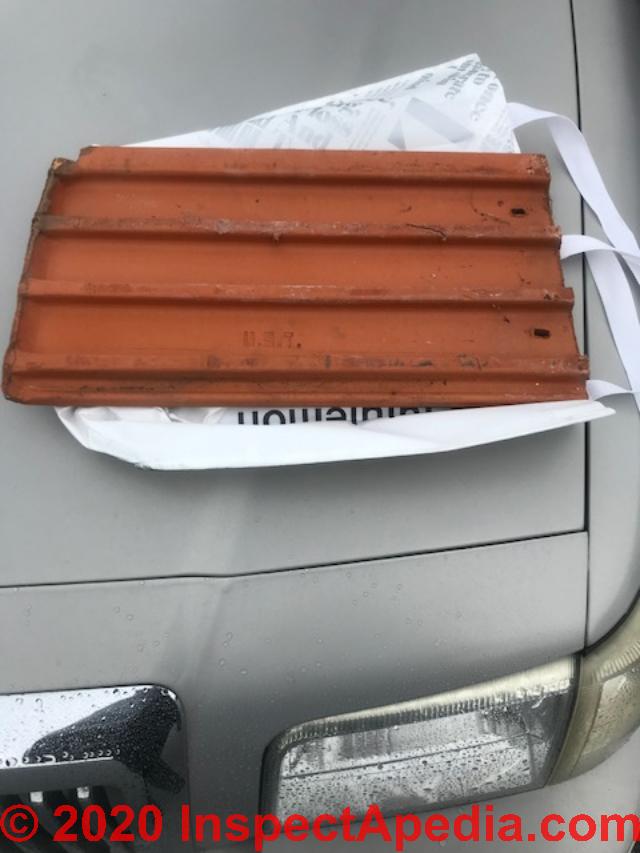 Yessica
That's a flat clay roofing tile.
Of the CONTINUE READING links you'll see a link to an article listing clay roofing tile manufacturers and sources.
On 2020-03-16 by yessica henriquez
Can someone please tell what is the name of this clay tile and where I can buy it.
On 2020-02-09 - by (mod) -
Should not be an issue as long as the type of tile and its fastening method meet local wind and storm codes.
On 2020-02-08 by adelm
Does anyone know if a permit would be issued on a roof repair using a different clay tile not original on the roof? Current roof has ALTUSA "S" clay tile made in Venezuela which is discontinued and obsolete.
On 2019-12-10 - by (mod) -
Clay roofing tile types are indeed listed throughout the article above on this page. You'll also find links to articles offering more detail about each of those.
On 2019-12-10 by Shivani Todkar
Types of clay roofing tiles
On 2018-05-21 - by (mod) -
Here is what a Ludowici greek roof tile looks like
On 2018-05-21 - by (mod) -
Lesley,
No, no concrete or cement is used in the field of the roof.
Greek S-shaped roofing tiles, also described as pan tiles or mission tiles, are not installed using concrete. Below I will include an excerpt from Ludowici's roof tile installation manual [PDF], Ludowici Roof Tile, Inc. 4757 Tile Plant Rd. P.O. Box 69 New Lexington, OH 43764 USA, Tel: 1-800-945-8453 Website: www.Ludowici.com retrieved 2018/05/21, original source: https://www.ludowici.com/products/barrel-tile/mission-tile/greek/
I will also show an excerpt from the company's website that illustrates for other readers the profile of Greek mission roof tiles in a subsequent post. Contact the manufacturer directly for more details.
On 2018-05-21 by Lesley
Is concrete used when laying Greek s shaped roof tiles
Question: What is the minimum slope for a tile roof?
(Feb 18, 2013) what is minimum roof degree requ said:
what is minimum roof degree require for clay roof tile
Reply: waterproof membrane required beneath roofs at slope under 3:12
About minimum slope allowed for clay tile roofs or other tile roofs, if you read through standards such as
ICC-ES-ESR2015 "Concrete and Clay Roof Tile Installation Manual for Moderate Climates" (copy on file) you'll see that there is no prohibition of clay tiles on low slope roofs. Rather for slopes at 3:12 or less the installer is required to install a BUR or similar waterproof membrane on the roof below the tiles.
The document I cite is available from the Roofing Institute - the Western States Roofing Contractors Association (TRI/WSCRA) and other sources.
I give contact information for the Tile Roofing Institute in the article above,
Question: why do I see daylight through the tile roof? Does that mean it leaks?
(Jan 25, 2013) Anonymous said:
I am in process of Purchasing a home with spanish clay tile without underlayment. We checked for water leaks and surprisingly there are none but on a sunny day, we can see the light poking through the holes...How could that be?
Can someone advise if it is safe to purchase it. There are [no] water stains either
5/2/2014 Rob said:
Hi anonymous, hopefully I can catch you. I am curious about what happened in your situation. I just found out that the home I really want to buy has the same problem with no underlayment (concrete tiles,not clay).
Reply:
Rob and Anon,
On some roof designs, particularly if there is sufficiently steep slope, in the attic one might observe daylight filtering in through the roof covering for a slate or clay tile roof that is installed on spaced nailers.
The roof may never leak, given pitch and adequate head lap of the slates or tiles, OR it may leak horribly if there is wind-driven rain blowing water up-slope.
In that circumstance on an older home the observation of leak stains on the nailers or on the floor below would be helpful clues telling us that the roof has or has not leaked.
"Safe to purchase" is too big and vague a question to answer by text with almost no information about a building.
...
Continue reading at CLAY TILE ROOF BATTENS & STACKING or select a topic from the closely-related articles below, or see the complete ARTICLE INDEX.
Or see these
Recommended Articles
- CLAY HOLLOW TILE CONSTRUCTION - Structural clay tile, terra cotta, building tiles
- CLAY TILE / PAVER TILE FLOORING
- CLAY TILE ROOFING - home
- CLAY TILE ROOF BATTENS & STACKING
- CLAY TILE ROOF CONNECTIONS
- CLAY TILE ROOF DAMAGE & WEAR
- CLAY TILE EAVES, HIP & RAKE DETAILS
- CLAY TILE ROOF FLASHING
- CLAY TILE ROOF FLASHING LEAKS
- CLAY TILE ROOF SLOPE, DECK & UNDERLAY
- CLAY TILE ROOF SPECIFICATIONS
- CLAY TILE ROOF SUPPLIERS
- CLAY TILE ROOF STYLES, DESIGNS - descriptions of different clay roof tile styles and characteristics, and
- CLAY TILE ROOFING
- CLAY TILE WIND & SEISMIC CONNECTORS
- CLAY, CONCRETE, FIBER CEMENT ROOF TILE CHOICES
- CONCRETE, MASONRY BLOCKS, & BRICKS, WORKING WITH
- CONCRETE ROOFING
- DURALITA & METAL TILE ROOFS
- EFFLORESCENCE: WHITE DEPOSITS on ROOFS
- ROOFING CONTRACTOR, FIND & CHOOSE
- ROOFING TILE SHAPES & PROFILES - basics of roof tile profiles and what they mean, for both clay or concrete roof tiles
- SLATE ROOF INSPECTION & REPAIR - as with some slate roofs, the fasteners or metal flashings on clay tile roofs are more likely to wear out than the tiles themselves. However both clay & concrete tile roofs as well as slate roofs are often damaged by foot traffic, ice and snow, or by severe storms.
Suggested citation for this web page
CLAY TILE ROOFING at InspectApedia.com - online encyclopedia of building & environmental inspection, testing, diagnosis, repair, & problem prevention advice.
Or see this
INDEX to RELATED ARTICLES: ARTICLE INDEX to BUILDING ROOFING
Or use the SEARCH BOX found below to Ask a Question or Search InspectApedia
Ask a Question or Search InspectApedia
Try the search box just below, or if you prefer, post a question or comment in the Comments box below and we will respond promptly.
Search the InspectApedia website
Note: appearance of your Comment below may be delayed: if your comment contains an image, photograph, web link, or text that looks to the software as if it might be a web link, your posting will appear after it has been approved by a moderator. Apologies for the delay.
Only one image can be added per comment but you can post as many comments, and therefore images, as you like.
You will not receive a notification when a response to your question has been posted.
Please bookmark this page to make it easy for you to check back for our response.
Our Comment Box is provided by Countable Web Productions countable.ca
Citations & References
In addition to any citations in the article above, a full list is available on request.
- Best Practices Guide to Residential Construction, by Steven Bliss. John Wiley & Sons, 2006. ISBN-10: 0471648361, ISBN-13: 978-0471648369, Hardcover: 320 pages, available from Amazon.com and also Wiley.com. See our book review of this publication.
- Mark Cramer Inspection Services Mark Cramer, Tampa Florida, Mr. Cramer is a past president of ASHI, the American Society of Home Inspectors and is a Florida home inspector and home inspection educator. Mr. Cramer serves on the ASHI Home Inspection Standards. Contact Mark Cramer at: 727-595-4211 mark@BestTampaInspector.com
- John Cranor [Website: /www.house-whisperer.com ] is an ASHI member and a home inspector (The House Whisperer) is located in Glen Allen, VA 23060. He is also a contributor to InspectApedia.com in several technical areas such as plumbing and appliances (dryer vents). Contact Mr. Cranor at 804-873-8534 or by Email: johncranor@verizon.net
- Duralita: produces cement & cardboard corrugated and clay tile-like roofing products: Duralita is a combination of cement and cardboard - see www.duralita.com/ Si tiene alguna pregunta, por favor escribanos a: sales@duralita.com - El Salvador: +503 22.25.57.44 ext.31 USA +1 305.677.3597
- Terry Rubin, proprietor of the Posada del Bosque Encantado can be contacted at gringamaya@yahoo.com or call (502) 5208-5334 or (502) 4146-1050 use 011 (502) from the US.
- "Tile Roofs in Snow Country: The Natural Choice For Aesthetics and Durability Proper planning and installation ensure a tile roof with elegance, durability, and low maintenance for premier resort in Vail, Colorado", Mark Wennstedt, Source Products Group, 303 280-9595 - Web Search 07/12/2010 - Original Source http://pdfone.com/download/12_keyword-roof-shingles/tile-roofs-in-snow-country.pdf
- Roof Tiling & Slating, a Practical Guide, Kevin Taylor, Crowood Press (2008), ISBN 978-1847970237,
If you have never fixed a roof tile or slate before but have wondered how to go about repairing or replacing them, then this is the book for you. Many of the technical books about roof tiling and slating are rather vague and conveniently ignore some of the trickier problems and how they can be resolved. In Roof Tiling and Slating, the author rejects this cautious approach. Kevin Taylor uses both his extensive knowledge of the trade and his ability to explain the subject in easily understandable terms, to demonstrate how to carry out the work safely to a high standard, using tried and tested methods.
This clay roof tile guide considers the various types of tiles, slates, and roofing materials on the market as well as their uses, how to estimate the required quantities, and where to buy them. It also discusses how to check and assess a roof and how to identify and rectify problems; describes how to efficiently "set out" roofs from small, simple jobs to larger and more complicated projects, thus making the work quicker, simpler, and neater; examines the correct and the incorrect ways of installing background materials such as underlay, battens, and valley liners; explains how to install interlocking tiles, plain tiles, and artificial and natural slates; covers both modern and traditional methods and skills, including cutting materials by hand without the assistance of power tools; and provides invaluable guidance on repairs and maintenance issues, and highlights common mistakes and how they can be avoided. The author, Kevin Taylor, works for the National Federation of Roofing Contractors as a technical manager presenting technical advice and providing education and training for young roofers. - Building Pathology, Deterioration, Diagnostics, and Intervention, Samuel Y. Harris, P.E., AIA, Esq., ISBN 0-471-33172-4, John Wiley & Sons, 2001 [General building science-DF] ISBN-10: 0471331724 ISBN-13: 978-0471331728
- Concrete Roofing Tile, History of the, Batsford, 1959, AISN B000HLLOUC (availble used)
- Handbook of Building Crafts in Conservation, Jack Bower, Ed., Van Nostrand Reinhold Company, NY 1981 ISBN 0-442-2135-3 Library of Congress Catalog Card Nr. 81-50643.
- Tile Roofs of Alfred: A Clay Tradition in Alfred NY
- History of the Concrete Roofing Tile, Batsford, 1959, AISN B000HLLOUC (availble used)
- Our recommended books about building & mechanical systems design, inspection, problem diagnosis, and repair, and about indoor environment and IAQ testing, diagnosis, and cleanup are at the InspectAPedia Bookstore. Also see our Book Reviews - InspectAPedia.
- Best Practices Guide to Residential Construction, by Steven Bliss. John Wiley & Sons, 2006. ISBN-10: 0471648361, ISBN-13: 978-0471648369, Hardcover: 320 pages, available from Amazon.com and also Wiley.com. See our book review of this publication.
- Building Pathology: Principles and Practice, David Watt, Wiley-Blackwell; 2 edition (March 7, 2008) ISBN-10: 1405161035 ISBN-13: 978-1405161039
- Handbook of Building Crafts in Conservation, Jack Bower, Ed., Van Nostrand Reinhold Company, NY 1981 ISBN 0-442-2135-3 Library of Congress Catalog Card Nr. 81-50643.
- Historic Preservation Technology: A Primer, Robert A. Young, Wiley (March 21, 2008) ISBN-10: 0471788368 ISBN-13: 978-0471788362
- Historic Slate Roofs : With How-to Info and Specifications, Tina Skinner (Ed), Schiffer Publishing, 2008, ISBN-10: 0764330012 , ISBN-13: 978-0764330018
- Problems in Roofing Design, B. Harrison McCampbell, Butterworth Heineman, 1991 ISBN 0-7506-9162-X (available used)
- Roofing The Right Way, Steven Bolt, McGraw-Hill Professional; 3rd Ed (1996), ISBN-10: 0070066507, ISBN-13: 978-0070066502
- Slate Roofs, National Slate Association, 1926, reprinted 1977 by Vermont Structural Slate Co., Inc., Fair Haven, VT 05743, 802-265-4933/34. (We recommend this book if you can find it. It has gone in and out of print on occasion.)
- The Slate Roof Bible, Joseph Jenkins, www.jenkinsslate.com, 143 Forest Lane, PO Box 607, Grove City, PA 16127 - 866-641-7141 (We recommend this book).
- Smart Guide: Roofing: Step-by-Step Projects, Creative Homeowner (Ed), 2004, ISBN-10: 1580111491, ISBN-13: 978-1580111492
- Solar heating, radiative cooling and thermal movement: Their effects on built-up roofing (United States. National Bureau of Standards. Technical note), William C Cullen, Superintendent of Documents, U.S. Govt. Print. Off (1963), ASIN: B0007FTV2Q
- In addition to citations & references found in this article, see the research citations given at the end of the related articles found at our suggested
CONTINUE READING or RECOMMENDED ARTICLES.
- Carson, Dunlop & Associates Ltd., 120 Carlton Street Suite 407, Toronto ON M5A 4K2. Tel: (416) 964-9415 1-800-268-7070 Email: info@carsondunlop.com. Alan Carson is a past president of ASHI, the American Society of Home Inspectors.
Thanks to Alan Carson and Bob Dunlop, for permission for InspectAPedia to use text excerpts from The HOME REFERENCE BOOK - the Encyclopedia of Homes and to use illustrations from The ILLUSTRATED HOME .
Carson Dunlop Associates provides extensive home inspection education and report writing material. In gratitude we provide links to tsome Carson Dunlop Associates products and services.
 | HOME | ABOUT | ASK a QUESTION | CONTACT | CONTENT USE POLICY | DESCRIPTION | POLICIES | PRIVACY | |
| © 2024 - 1985 Publisher InspectApedia.com - Daniel Friedman | |||||||||